Estimated Reading Time: 7 minutes
TL;DR: OSHA 1910.212(b) requires any machine designed for a fixed location to be securely anchored so it can’t walk or move during operation. The rule is one sentence long, but the real-world question is which machines count. Bench grinders, drill presses, table saws, and pedestal equipment almost always need anchoring. Machines with nonskid feet that pass a walk-and-tip test are the exception. Ignore this rule and you’re sitting on one of OSHA’s top 10 most-cited standards.
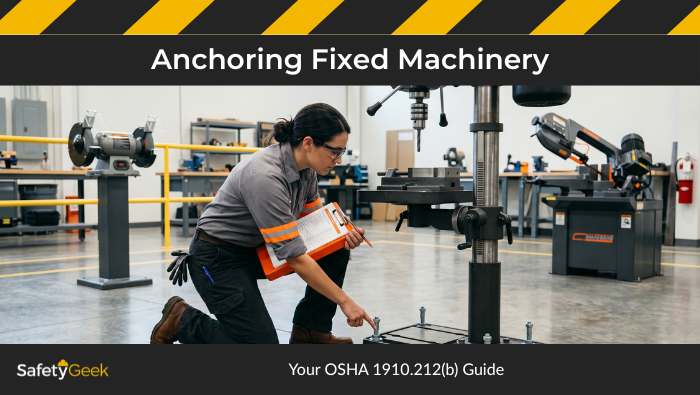
OSHA 1910.212(b) requires machines designed for a fixed location to be securely anchored to prevent walking or moving. That’s the entire rule. One sentence. Two clauses. And it trips up more safety teams than you’d expect.
Here’s the thing… one-sentence rules always get misread on the shop floor. You’ve probably walked past a drill press that slides a quarter inch every time an operator leans into it. Or a pedestal grinder bolted to a plywood base that flexes when the wheel speeds up. The question keeps coming up, and nobody wants to give a straight answer… does THIS machine need anchoring?
Key Takeaways
- 1910.212(b) applies to any machine designed for a fixed location, not just the ones bolted down at the factory
- Machines that walk, tip, or vibrate across the floor are out of compliance, full stop
- Nonskid feet can replace anchoring ONLY if the machine stays put under normal use AND won’t tip
- Bench grinders, drill presses, and pedestal equipment are the most common anchoring violations
- Machine guarding (1910.212) was the #10 most-cited OSHA standard in FY 2024 with 1,541 citations
- A 30-minute walk-through with a checklist catches 80% of your anchoring issues
What OSHA 1910.212(b) Actually Says About Anchoring Fixed Machinery
The regulation text is short and direct. According to OSHA’s general machine guarding standard: “Machines designed for a fixed location shall be securely anchored to prevent walking or moving.”
That’s it. No list of machine types. No anchoring method specified. No exemption for small equipment or old equipment. The rule applies across general industry, and the responsibility to interpret it falls on you.
The reason this matters is that 1910.212 sits under the general machine guarding umbrella, which landed as the #10 most-cited OSHA standard in FY 2024. Anchoring violations get written up inside that category, even though most people think of 1910.212 as point-of-operation guarding.
An OSHA compliance officer doesn’t need to see an injury to cite you. A machine that visibly creeps, vibrates across the floor, or rocks under load is enough evidence on its own. One quick push during a walkthrough can confirm it.
What counts as “designed for a fixed location”? The manufacturer’s manual is your best source. If the installation instructions call for mounting hardware, leveling pads, or floor anchors, the machine is fixed-location by design. If it shipped with wheels and a handle, it isn’t.
When a Machine Must Be Anchored (and When It Doesn’t)
This is where most teams get tripped up. OSHA clarified the rule in a 1981 Letter of Interpretation on machine anchoring. Rubber feet, nonskid pads, or vibration dampening materials CAN be used instead of floor anchors… but only under specific conditions.
The machine must not walk, move, or present a tipping or falling-over hazard under normal operating conditions. If it fails any of those three tests, it has to be anchored. Period.
Here’s a clean comparison for the most common equipment you’ll see in general industry:
| Equipment | Anchoring Required? | Why |
|---|---|---|
| Pedestal grinder | Yes | High RPM creates torque that walks the base; tip hazard if wheel catches |
| Drill press (floor model) | Yes | Drilling force pushes the column; tall frame tips easily |
| Bench grinder on a bench | Yes (bench anchored too) | Both the grinder and the bench must be secured |
| Table saw (contractor) | Usually yes | Kickback forces and vibration move the base |
| Bandsaw (floor) | Yes | Top-heavy; tip hazard is significant |
| Portable tool with rubber feet on the ground | No (if it passes walk/tip test) | Not designed for fixed location; nonskid pads acceptable |
| Mobile mechanic’s grinder on cart | No | Designed to be moved; not covered by 1910.212(b) |
The 2012 OSHA interpretation on guarding machines on moveable benches and pedestals confirmed the walk-and-tip test applies the same way. If it passes, pads work. If it fails, you anchor.
The easiest way to decide? Turn the machine on and run it through its full cycle. Then try to slide it with steady hand pressure. If either test produces movement beyond normal vibration, you have an anchoring problem.
THE ALL-ACCESS PASS RESOURCE PAGE
Get all the FREE templates, safety management resources, PDFs, spreadsheets, and more...
Common Anchoring Violations I See in General Industry
After walking hundreds of shops, the same five anchoring issues show up over and over. And none of them require fancy equipment to find.
- The drill press that’s walked three feet from its original spot. You can see the marks on the floor. Operators just work around it and nobody reports it.
- The bench grinder bolted to a rolling cart. Technically mobile, so they think it’s fine. But the cart wasn’t designed to absorb the grinder’s forces, and it rocks during use.
- Pedestal equipment on wood blocks. The blocks were a shim that became permanent. The bolts were never run into concrete underneath.
- Machines anchored to a raised floor. The anchors are real, but the subfloor flexes. The machine moves with the floor.
- Top-heavy cabinets that tip when drawers open. Not technically “machinery,” but tool chests and storage cabinets on wheels near operating equipment are a 1910.212-adjacent hazard.
One pattern I notice with safety teams… the drill press in the maintenance bay always gets missed. Production floors get audited. Maintenance shops don’t. That’s where most of the anchoring problems live.
Another common one is the grinder at the warehouse end of the shop that was installed by whoever had a drill that day. No torque spec. No concrete anchor. Just two lag bolts into whatever was underneath. When I ask who installed it, nobody remembers.
How to Audit Your Facility for Machine Anchoring Compliance
You don’t need an engineering degree or a torque wrench to run this audit. You need a checklist, a mallet, and 30 minutes. This isn’t a replacement for a full hazard assessment of your facility, but it’ll close the biggest gap in your machine guarding program fast.
Walk the floor with this 5-step process:
- List every piece of stationary equipment. Pedestal grinders, drill presses, bandsaws, table saws, punch presses, lathes, mills, and any fixed tool under power. If it has a motor and a specific spot on the floor, it goes on the list.
- Check the base. Look underneath. Are there floor anchors? Lag bolts into concrete? Leveling pads with anti-skid material? Or is it just sitting on the floor?
- Run the walk test. With the machine OFF, push with steady hand pressure. It shouldn’t move. Now turn it on, run a normal cycle, and watch the base. Any creep means it fails.
- Run the tip test. Push sideways at the operator’s working height. Does the machine rock? If yes, it needs anchoring regardless of whether it walks.
- Document the findings. Take a photo of each machine’s base and note pass or fail. Route fails to maintenance with a target date, and track them through your hazard reporting and corrective action process.
What gets measured gets managed. Run this audit quarterly, log the results in the same system you use for your routine safety inspections, and anchoring stops being a surprise citation risk. It becomes a data point you already own.
Anchoring Methods That Actually Hold
Anchoring isn’t glamorous, but the method matters. The wrong hardware fails slowly, and a machine that slips a 16th of an inch every shift will walk a foot in six months. Here are the options that work in a real shop environment.
Wedge anchors into concrete. This is the gold standard for permanent equipment. Drill a hole, drop the anchor, tighten the nut. The wedge expands and grips the concrete. Fast, strong, and rated by the manufacturer for specific loads.
Epoxy anchors. Used when the hole needs to be slightly oversized, the concrete is cracked, or vibration is severe. More expensive than wedge anchors, but they hold in conditions where mechanical anchors loosen.
Through-bolts with a steel plate. If you have access to both sides of the floor, this is the most secure option. A common approach for mezzanines and raised platforms where wedge anchors can’t reach undisturbed concrete.
Heavy equipment pads with nonskid material. Valid ONLY when the machine is light enough that the pads meet the walk-and-tip test under full load. Document the rationale if you’re relying on this method.
What doesn’t work: Lag bolts into wood floors or subfloors. Tapcon screws into cracked concrete. Double-sided tape or adhesive strips. Sandbags. A piece of plywood under the base. I’ve seen all of these, and all of them fail.
This kind of physical control is part of a bigger picture. When anchoring becomes a repeatable step in your installation and inspection workflow, it’s one more piece of a safety management system built on repeatable processes, not heroic effort.
Frequently Asked Questions About Anchoring Fixed Machinery
Does every bench grinder need to be bolted down?
If the grinder is mounted to a bench and the bench is stationary, both the grinder and the bench need to be secured. If the grinder is on a rolling cart designed to be moved, it’s not covered by 1910.212(b), but the cart still has to pass the walk-and-tip test during operation.
Can I use rubber feet instead of anchoring my drill press?
Only if the drill press passes OSHA’s walk-and-tip test under full load. For most floor-model drill presses, rubber feet are not enough. The drilling force and top-heavy frame cause movement and tipping risk, which means anchoring is required.
Does OSHA specify the type of anchor I have to use?
No. The standard only requires that the machine be “securely anchored.” The method is up to you, as long as it prevents walking, moving, or tipping. Follow the manufacturer’s installation instructions and concrete anchor specifications for the load you’re securing.
What’s the citation risk if I skip anchoring?
Anchoring violations fall under 1910.212, which was the #10 most-cited OSHA standard in FY 2024 with 1,541 citations. A visibly walking or tipping machine can be cited during a routine inspection, and repeat violations carry significantly higher penalties.
Do anchoring requirements apply to older equipment?
Yes. OSHA doesn’t grandfather old machinery out of 1910.212. If a machine is designed for a fixed location, it must be anchored, whether it was installed last month or 40 years ago. “We’ve always had it set up this way” is not a compliance defense.
Now It’s Your Turn
Anchoring fixed machinery is one of the quickest compliance wins you can get. The rule is one sentence. The audit takes 30 minutes. And it closes a gap that sits under one of OSHA’s top 10 most-cited standards.
Here’s your action plan for this week:
- Walk your facility and list every piece of fixed-location equipment under power.
- Run the walk-and-tip test on each one. Photograph the base.
- Flag every fail and route it to maintenance with a target date.
- Add the anchoring check to your quarterly inspection routine so it never slips again.
- Document your decision process on any equipment you’re keeping on nonskid pads.
If you want a shortcut, grab the All-Access Resource Library. You’ll find inspection checklists, audit templates, and done-for-you tools that plug right into the workflow above. No more building from scratch when the template already exists.
You got this, Safety Friend.
Hi, I'm Brye (rhymes with sky)! I am a self-proclaimed safety geek with two decades of general industry safety experience. Specializing in bringing safety programs to a world-class level and building a safety culture, I have trained and coached many safety managers, just like you, on how to effectively manage workplace safety in the real world. I would love to help you too.