Estimated Reading Time: 7 minutes
TL;DR: Peer-to-peer safety accountability among manufacturing workers means your team watches out for each other without waiting on you to enforce it. It starts with psychological safety, grows through shared values and clear expectations, and gets reinforced with tools like near-miss peer reporting, huddle self-checks, and cross-shift observations. Build it right and you stop being the safety cop. Build it wrong and you get a floor full of tattletales.
Building peer-to-peer safety accountability among manufacturing workers starts with one shift: making it safe to speak up. When a worker trusts that a heads-up is help and not a write-up, they start watching out for each other on their own. That’s the whole game.
You already know the other version of this. You’re the safety cop – the only person on the floor who says anything when a machine guard is off or a spotter is missing. And being the one everyone waits on? It wears on you.
Key Takeaways
- Peer accountability means workers correct and support each other without management standing over them.
- Psychological safety is the foundation. People won’t speak up if speaking up gets them mocked or punished.
- It grows through shared values and clear expectations, not through rules and consequences alone.
- The best tools are peer near-miss reporting, huddle self-assessments, and cross-shift observations framed as coaching, not catching.
- The tattletale trap is real. If accountability feels like snitching, workers go quiet and the whole thing dies.
What Peer-to-Peer Safety Accountability Actually Means
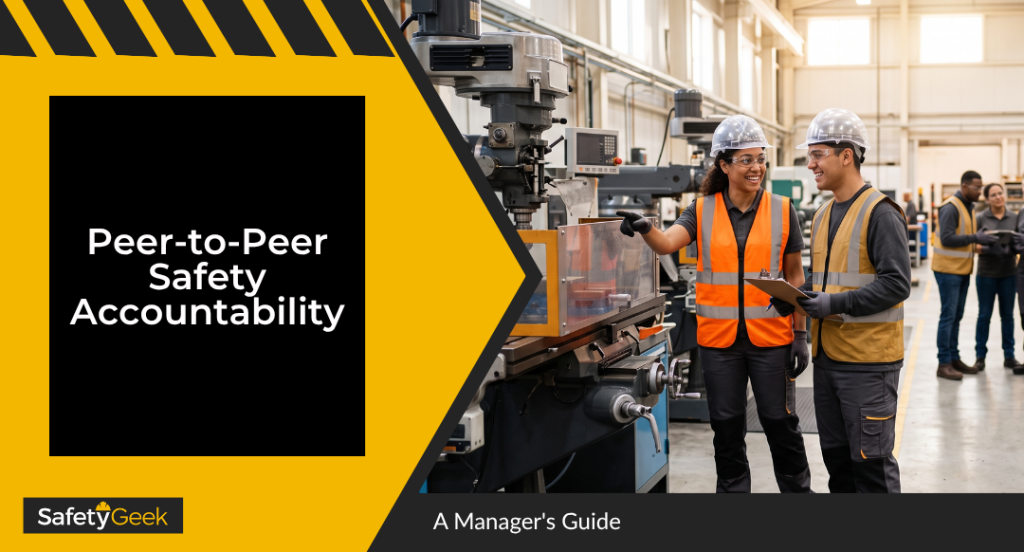
Peer-to-peer safety accountability is the shared habit of coworkers looking out for one another and speaking up about risk, without a manager forcing it. It’s horizontal, not top-down. Nobody has hire-fire power over anybody else, so it runs on trust and shared values instead of authority.
And that distinction matters more than it sounds. Most accountability breaks because we try to bolt formal consequences onto people who have no authority over each other.
Peer accountability works differently. It’s one worker saying “hey, grab your glasses” because they actually care whether their buddy goes home with both eyes.
Here’s the part people skip over. This isn’t workers policing each other – it’s workers protecting each other. That line is the whole ballgame.
| Safety Cop Model | Peer Accountability Model |
|---|---|
| Safety manager catches problems | Coworkers catch problems together |
| Correction feels like punishment | Correction feels like a favor |
| People go quiet when you walk up | People speak up when you’re not there |
| Runs on authority you don’t have | Runs on trust the team already has |
| You’re the bottleneck | The team owns it |
It’s a culture layer, not a program
You don’t launch peer accountability like a new form or a poster campaign. It’s a byproduct of a healthy safety culture where people feel seen and safe. That’s why you can’t mandate it – you can only create the conditions and let it grow.
Why Peer Accountability Starts With Psychological Safety
Peer accountability only works when workers believe they can speak up without getting ridiculed or retaliated against. That belief has a name: psychological safety. And it’s the single biggest predictor of whether your team will ever call out a hazard on their own.
The research backs this up hard. The American Psychological Association’s 2024 psychological safety report found that workers who feel psychologically safe are far more comfortable voicing concerns, ideas, and mistakes. That’s exactly the muscle peer accountability needs.
NIOSH echoes it too, reporting that workers with supportive managers feel safer speaking up and asking for help.
So what actually builds it? Amy Edmondson’s work on psychological safety points to a few moves you can steal:
- Treat near-misses and mistakes as learning, never as ammunition.
- Ask for input with real humility and actually act on it.
- Make sure every person feels seen and respected on the floor.
- Bond the team through the daily work, not just safety talks.
When you do this consistently, something shifts. People stop hiding problems and start surfacing them. That’s the same principle behind collaboration changing beliefs – the experience of speaking up and being thanked for it slowly rewires what people believe about safety.
THE ALL-ACCESS PASS RESOURCE PAGE
Get all the FREE templates, safety management resources, PDFs, spreadsheets, and more...
How to Build Peer-to-Peer Accountability Among Manufacturing Workers
You build peer-to-peer accountability by giving workers small, low-stakes ways to look out for each other and by rewarding the behavior every single time you see it. Start with the mechanics below and layer them into work people already do.
Peer near-miss reporting. Make it dead easy for a worker to flag a close call they saw, with zero blame attached. The point isn’t naming who slipped up. It’s catching the hazard before it catches someone.
That kind of reporting is one of the strongest leading indicators you can build, and it lives inside the Analyze stage of the Safety Management Cycle.
Self-assessment in huddles. Open each shift with a 60-second gut check on the riskiest task of the day and who needs a second set of hands. Let workers name it themselves instead of reading it off your slide.
Cross-shift observations. Have workers do quick peer observations on each other’s tasks, focused on catching safe behavior, not writing people up. Employees relax into normal behavior after the first few minutes, so short and frequent beats long and formal.
Peer safety champions. Pick respected workers, not the loudest ones, to model speaking up. When a champion your team already trusts says “we watch out for each other here,” it lands harder than any memo you send.
Every one of these turns a job hazard analysis into something workers own. And the more they participate in real work like this, the deeper employee engagement goes.
Track it. Aim for every worker contributing 15 to 20 minutes a week to safety, and watch what happens to the numbers.
Speaking of numbers, they show why this matters. Bureau of Labor Statistics injury data recorded about 2.5 million nonfatal workplace injuries and illnesses in private industry in 2024, and manufacturing alone accounted for roughly 332,600 of those cases.
The National Safety Council’s Injury Facts shows the overall rate slowly improving, but production work still carries heavy exposure. Peer eyes on the floor catch what you never will from an office.
How to Avoid the Safety Tattletale Trap
The fastest way to kill peer accountability is to let it turn into snitching. The moment workers feel like they’re being asked to report on each other, they clam up. So you have to design the whole thing around support, not surveillance.
Language does a lot of the heavy lifting here. Talk about “watching out for each other,” “coaching,” and “learning teams.” Never “reporting violations” or “catching people.”
A near-miss system should be no-blame and improvement-focused, the way most solid industrial safety programs run them.
There’s a deeper principle underneath this. Most workplace accidents aren’t caused by bad people – they’re caused by good people working in bad systems.
When you frame every problem as a systems problem, not a people problem, you take the sting out of accountability. You’re not asking “who messed up?” You’re asking “what made it hard to do this safely?”
This is also why you stay the guide on the side instead of the enforcer. You create the resources, you train the coaches, and you reinforce the wins.
But the accountability lives between the workers, built on the know, like, and trust they already share. That’s what makes it stick when you’re not standing there.
Reinforce publicly and correct privately. When a worker catches a hazard for a teammate, thank them out loud so everyone sees the norm. That single habit does more for peer accountability than any policy you’ll ever write.
Frequently Asked Questions About Peer-to-Peer Safety Accountability
How is peer accountability different from safety enforcement?
Enforcement is top-down and runs on authority – you correct behavior because you can discipline someone. Peer accountability is horizontal and runs on trust, where coworkers speak up because they genuinely care about each other. That’s why it keeps working when management isn’t watching.
Won’t workers see peer observations as spying?
They will, if you frame it as catching people, so don’t. Design observations around spotting safe behavior and coaching, keep them short and frequent, and never tie them to discipline. When workers see peers thanked instead of written up, the spying fear fades and participation climbs.
How do I start peer accountability with a resistant crew?
Start tiny and start with trust. Pick one respected worker as a peer champion, add a 60-second safety gut-check to the daily huddle, and make near-miss reporting blame-free. Skip the big announcement and let small wins build the habit, reinforced publicly every time.
Does OSHA require peer-to-peer safety programs?
No specific standard mandates peer observation. But OSHA’s safety and health program guidance strongly emphasizes worker participation in hazard identification and problem-solving. Peer accountability is simply how you put that participation to work on the floor every day, which also supports compliance and lowers your exposure.
How do I measure if peer accountability is working?
Track leading indicators, not just injury counts. Watch near-miss reports submitted by peers, participation rate in huddles and observations, and how many hazards get fixed at the floor level before they reach you. Rising peer reports and falling repeat hazards mean the culture is taking hold.
Now It’s Your Turn
Peer-to-peer safety accountability is what finally gets you out of the safety cop role – your team watching out for each other because they want to, not because you’re standing there. It starts with psychological safety and grows one thanked catch at a time.
Here’s what to do this week:
- Add a 60-second safety gut-check to one shift’s daily huddle.
- Pick one peer champion the team already respects and ask them to model speaking up.
- Make near-miss reporting blame-free and thank the next person who uses it, out loud.
- Reframe your next correction as a systems question: “what made this hard to do safely?”
Want the full system behind this – how to build the influence and culture that gets your team owning safety with you? Watch the free training on the Safety Influencer System, where I walk through exactly how to stop being the safety cop and earn a real seat at the table.
You’ve got this, Safety Friend. I got you.
Hi, I'm Brye (rhymes with sky)! I am a self-proclaimed safety geek with two decades of general industry safety experience. Specializing in bringing safety programs to a world-class level and building a safety culture, I have trained and coached many safety managers, just like you, on how to effectively manage workplace safety in the real world. I would love to help you too.