Estimated Reading Time: 8 minutes
The cost comparison surprises people. A bolted steel guard for a small bench machine might run $150 to $400.
A safety-rated interlock door with a coded magnetic switch, controller, and proper wiring can cost $1,500 to $5,000 per door, plus ongoing inspection time. The math only works when access truly is required.
TL;DR: Interlocked guards vs fixed guards both satisfy OSHA 1910.212, but they’re not interchangeable. Fixed guards are bolted-in barriers used when access isn’t needed during operation. Interlocked guards open for setup or clearing jams and stop the machine when opened. Pick fixed guards for permanent danger zones. Pick interlocked guards when operators need routine access and you can manage the bypass risk.Interlocked guards vs fixed guards comes down to one question: how often does someone need to get inside the danger zone during normal operation? Fixed guards are permanent barriers held on with fasteners that require tools to remove. Interlocked guards open for routine access and shut down the machine the moment they do. You’re standing in front of a hydraulic press with the operator looking over your shoulder, and you have 20 minutes before the next run. The plant manager wants a fix today. Pick the wrong guard type and you’ll get either a citation in six months or a workaround taped over with a magnet.
Key Takeaways
- Fixed guards are the default first choice when no one needs access during operation
- Interlocked guards are required by ANSI B11.19 anytime a guard can be removed without tools
- Both must satisfy OSHA 1910.212(a)(1), affixed to the machine and creating no new hazard
- Interlocked guards add cost and maintenance, but they reduce bypass risk when designed well
- The hierarchy of controls favors fixed guards over interlocks when both options solve the hazard
- A formal risk assessment, not personal preference, decides which guard wins for each hazard
What a Fixed Guard Is and When OSHA Requires One
A fixed guard is a permanent barrier attached to the machine with bolts, welds, or fasteners that need tools to remove. It does not move during normal operation. Operators cannot reach the danger zone over, under, around, or through it. OSHA 1910.212(a)(1) requires every machine to have one or more methods of guarding to protect operators from hazards like point of operation, ingoing nip points, rotating parts, and flying chips. Fixed guards satisfy this rule whenever the danger zone never needs to be opened during a normal production cycle. Think bench grinder wheel covers, conveyor belt nip-point shields, fan guards on overhead motors, and the steel cage around a robotic cell. Here’s why fixed guards are the default in safety engineering. They have no moving parts, no wiring, no sensors to fail. The only way through is to grab a wrench, which takes intent and time. That friction is what makes fixed guards the highest-reliability option in the hierarchy of controls. When a machine can be guarded permanently and the operator never needs inside, fixed is almost always the right call. In one of my plants we had a roll-forming line where the operator had been propping open a swing-out access cover with a screwdriver to clear a jam. We replaced the cover with a bolted steel panel, added a clearing port the operator could safely use without opening anything, and the bypass behavior stopped overnight.What an Interlocked Guard Is and How It Differs
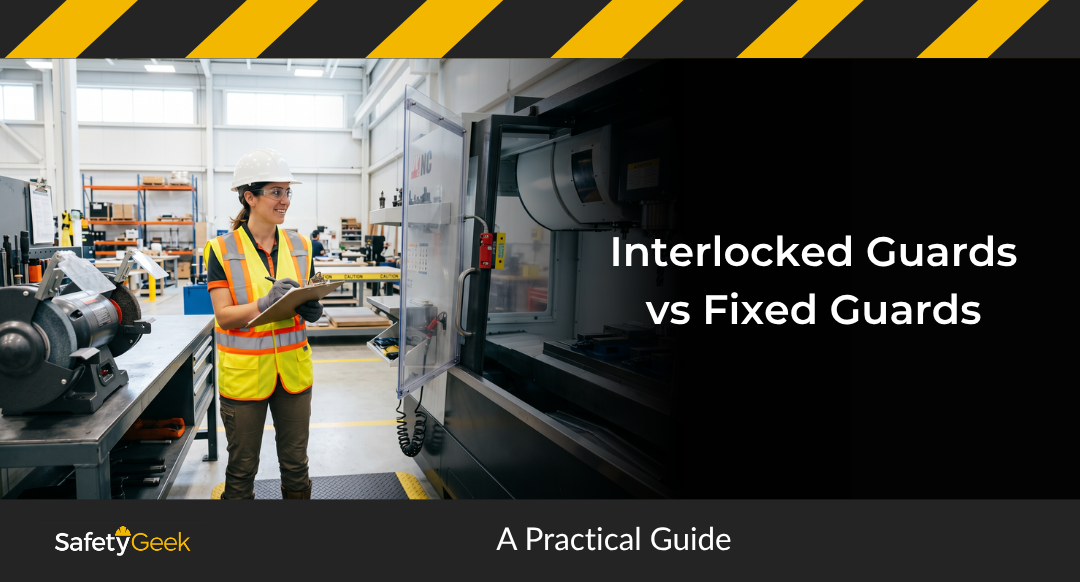
An interlocked guard is a movable barrier connected to a sensor or switch that stops machine motion the moment the guard is opened. The machine cannot restart until the guard is closed and, in most modern designs, until a separate reset is pressed. Interlocked guards exist because some machines genuinely need routine access for setup, clearing jams, blade changes, or material loading. ANSI B11.19-2019 (R2024) sets a specific trigger for interlocks. If a guard can be removed without tools, it must be interlocked. This rule closes the loophole where a worker could lift off a panel by hand mid-cycle and reach a moving part. CNC enclosures, plastic injection molding doors, robotic cell gates, and power press light curtains all rely on interlocks because access is part of the job. Two design rules separate a good interlock from a bad one. First, the device must be specifically built for safety applications, not a general-purpose limit switch. Second, the guard must stay locked closed until the hazard has stopped, or be located so a worker cannot reach the danger zone before motion ceases. Get either wrong and you have a guard that looks compliant but is not.Side-by-Side Comparison
| Factor | Fixed Guards | Interlocked Guards |
|---|---|---|
| Access during operation | None, tools required | Routine, opens by hand |
| Reliability | Highest (no moving parts) | High when designed correctly |
| Upfront cost | Lower (steel, fasteners) | Higher (sensors, wiring, controls) |
| Maintenance burden | Minimal | Sensor checks, wiring, periodic validation |
| Bypass risk | Low (requires intent and tools) | Moderate to high (magnets, jumpers) |
| Best for | Permanent danger zones, fan guards, anchored equipment | Setup, jam clearing, blade changes, robotic cells |
| OSHA basis | 1910.212(a)(1), (a)(2) | 1910.212(a)(1) plus ANSI B11.19 |
| Visibility into process | Often blocks view | Can be transparent (polycarbonate) |
THE ALL-ACCESS PASS RESOURCE PAGE
Get all the FREE templates, safety management resources, PDFs, spreadsheets, and more...
Common Failure Modes and How to Stop Them
Workers who operate and maintain machinery suffer roughly 18,000 amputations, lacerations, and crushing injuries every year, according to OSHA’s Safeguarding Equipment publication. About half occur in manufacturing, per OSHA’s amputation factsheet. Most of those involve a machine that had a guard at some point in its life. Fixed guards fail in three predictable ways. They get removed for maintenance and never reinstalled. They are sized too small and leave a reach-around gap. They are mounted too far from the hazard, allowing a hand to enter through the opening. The fix is documentation in your SOPs requiring guard reinstallation as a sign-off step, plus a physical machine guarding risk assessment that measures actual reach distances against ANSI B11.19 tables. Interlocked guards fail in one dominant way: workers defeat them. Magnets stuck on the sensor body, paperclips jammed into the receptacle, a piece of tape over the optical eye. NIOSH has documented this pattern repeatedly with plastic injection molding and power presses, where the interlock bypass saves seconds per cycle and the worker pays the price during the next jam. The fix is two-channel coded interlocks that detect tampering, plus understanding why the bypass is happening in the first place. If operators are defeating a guard, the system is making it hard for them to do their job, not “letting them” cheat.How to Choose Between Them
Run every machine through this sequence and the answer becomes obvious. First, ask whether anyone needs to enter the guarded space during normal operation. If no, fixed guard. Done. Second, if yes, ask whether the access can be eliminated through design changes (chutes, ports, clearing tools that work from outside). If you can engineer the access away, fixed guard. Third, if access is genuinely required, specify a safety-rated interlocked guard with the right components for the hazard severity. Use a category 3 or 4 control architecture for high-energy machines like presses and robots, and category 1 or 2 for lower-risk applications. Fourth, document your decision in a written risk assessment that ties to the OSHA standard and the relevant ANSI section. This becomes your defense if a citation lands. The mistake I see most is safety leads picking guard types based on what’s already in the catalog instead of what the risk assessment demands. Don’t do that. Let the hazard drive the choice, then source the hardware that meets it. The Safety Management Cycle handles this naturally: identify the hazard, develop the control, implement and train, coach and observe, then analyze whether it’s working. That’s the same playbook covered in our machine guarding best practices guide.Frequently Asked Questions About Interlocked vs Fixed Guards
Does OSHA require interlocked guards specifically?
OSHA 1910.212 does not name interlocked guards by name. It requires guarding sufficient to protect the operator and others from hazards. ANSI B11.19, which OSHA references in its compliance directives, specifies that any guard removable without tools must be interlocked. So in practice, yes, interlocks are required when access is part of normal operation.Are fixed guards safer than interlocked guards?
Fixed guards are more reliable because they have no failure modes beyond removal or damage. Interlocked guards add electronic components that can fail, be defeated, or be improperly designed. That said, interlocked guards are safer than no guard, an inadequate fixed guard, or a fixed guard that operators routinely bypass. Use the right tool for the access pattern.Can I retrofit an old machine with an interlocked guard?
Yes, and OSHA expects you to. The 1910.212 standard is retroactive, with no grandfather clause for older equipment. If your risk assessment shows the existing fixed guard is inadequate or routinely bypassed, you must upgrade. Many integrators offer retrofit interlock kits for legacy machines, including drill presses, mills, and band saws.What happens if an operator bypasses an interlocked guard?
You have a serious safety issue and a likely OSHA citation under the General Duty Clause. But the deeper problem is system design. If multiple operators bypass the same guard, the system is making it hard for them to do their job. Investigate the access pattern, redesign the guard or the work flow, and rebuild trust before disciplining anyone.How often should interlocked guards be inspected?
ANSI B11.19 recommends functional testing of safety interlocks at least every six months, and after any maintenance that affects the guard or its wiring. Daily pre-shift checks should verify that the guard stops the machine when opened. Document every test in your maintenance system. This is one of the first records OSHA asks for during a machine guarding inspection.Now It’s Your Turn
Interlocked guards vs fixed guards comes down to one question: who needs inside the danger zone during normal operation. Fixed guards win when access is not required. Interlocked guards win when it is. Both must satisfy OSHA 1910.212 and both must come out of a documented risk assessment. This week, do these three things on your highest-risk machine:- Walk the equipment with the operator and identify every reach-in point during normal operation
- Pull your existing guard documentation and check whether each guard matches the access pattern
- Where there is a mismatch (fixed guard being bypassed, or interlock missing where access happens), schedule an upgrade and document the gap
Hi, I'm Brye (rhymes with sky)! I am a self-proclaimed safety geek with two decades of general industry safety experience. Specializing in bringing safety programs to a world-class level and building a safety culture, I have trained and coached many safety managers, just like you, on how to effectively manage workplace safety in the real world. I would love to help you too.