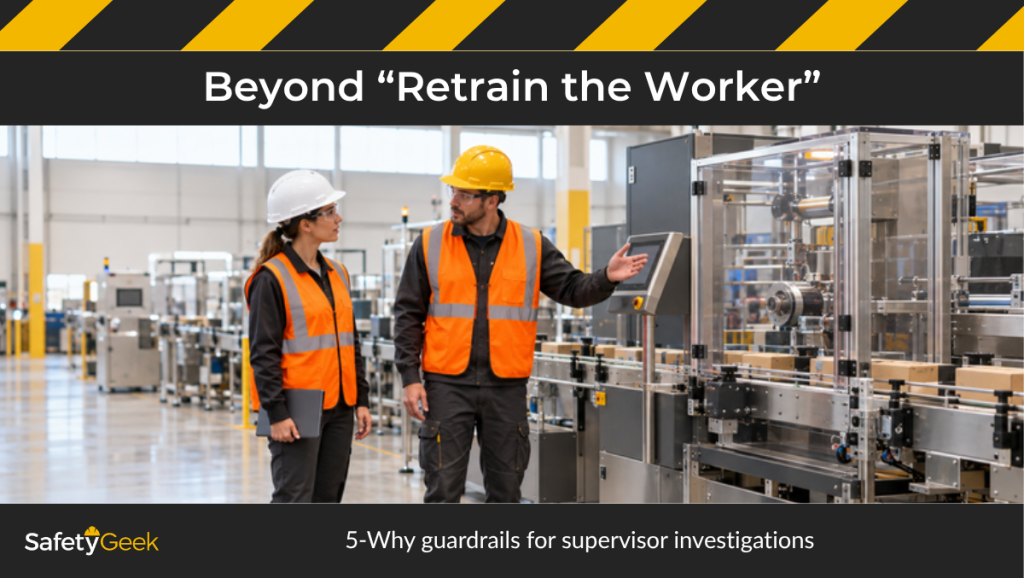
Ask any safety manager what makes their blood pressure spike on a Monday morning, and nine times out of ten, it’s opening a preliminary incident or near-miss report from a shift supervisor that reads like this:
- Root Cause: Worker wasn’t paying attention / Human error.
- Corrective Action: Retrained employee on standard procedure.
If you are trying to scale yourself out of a 16-hour workday, you know you cannot be the sole investigator for every scratched bumper, blown hydraulic hose, or near-miss on the floor.
Frontline supervisors have to own the preliminary investigation. They are closest to the work, they know the crew, and they are there when the dust settles.
But when you hand off preliminary investigations and get back “Operator rushed / Retrained worker,” you haven’t actually delegated anything. You just inherited a homework assignment where you have to walk out to the floor and redo the entire investigation yourself.
Key Takeaways:
- “Human error” isn’t a root cause—it’s the starting line. When a report stops at “worker was in a hurry,” the investigation ended right where it should have begun.
- Standalone “retraining” has a 6-week shelf life. If you don’t fix the SOP clarity, shift tempo, or physical tooling (
Paper → People → Places), the exact same failure will happen again.- Coaching supervisors with active 5-Why guardrails and native-language witness links eliminates blank-page blame-shifting and surfaces real engineering controls on the first pass.
Why do well-meaning supervisors default to blaming the worker and prescribing a classroom quiz? And more importantly, how do you build a system that coaches them into uncovering real, operational root causes on the first pass?
Why Supervisors Default to “Human Error” (Hint: It’s the Blank Text Box)
Most frontline supervisors aren’t trying to be lazy when they write “worker wasn’t paying attention.” They are reacting to two broken pieces of traditional incident reporting:
- The “Blank Form” Interrogation Trap: Traditional incident forms hand a busy shift supervisor five empty text boxes labeled Why #1, Why #2, Why #3, Why #4, Why #5 and expect them to suddenly think like a certified forensic engineer while a production line is down. Faced with a blank page and a ticking clock, the fastest way to close the form and get the line moving is to blame the human standing nearest to the machine.
- The Fear of Saying “I Don’t Know Yet”: Standard incident software forces supervisors to pick a definitive root cause before it lets them hit submit. If the supervisor doesn’t immediately know whether a valve failed from metal fatigue or improper torque, they guess—and guessing almost always lands on operator error.
If you want supervisors to hand you real root causes instead of blame-shifting, you have to replace blank text boxes with structured guardrails.
Fix #1: Ban “Human Error” Using the Paper → People → Places Sequence
“I was in a hurry” is never the root cause of an incident. Hurry always has a source.
To get supervisors past the person and into the process, train—and structure—your preliminary investigations around a strict three-part sequence before anyone is allowed to propose a corrective action:
1. Paper First (Work as Imagined)
Before asking what the worker did wrong, look at the standard.
- Was there a written SOP or pre-shift check for this task?
- Was the procedure actually readable at the point of work, or buried in a three-ring binder in the safety office?
- Had the standard drifted from how the job is actually run on night shift?
2. People Second (Operational Reality & Tempo)
Instead of asking “Why did you rush?”, investigate the operational pressure surrounding the crew.
- Was the line running short-staffed or behind quota?
- How many hours into the shift did the anomaly happen?
- If a witness or operator’s first language is Spanish or French, did we capture their statement in their native language—or force them to write a two-word English summary to avoid an essay?
3. Places Third (The Physical Environment & Tooling)
Look at the physical layout where the failure occurred.
- Were the right tools staged at the machine, or did the operator have to walk 200 yards to a tool crib?
- Was lighting, congestion, noise, or a missing physical guard setting a trap for the next person on shift?
When supervisors walk through Paper → People → Places in order, “worker wasn’t paying attention” naturally turns into “staging lane was blocked, lighting over Bay 3 was out, and the torque spec wasn’t listed on the kiosk.”
Fix #2: Put Up Guardrails That Reject “Retrain the Worker”
In workplace safety, standalone retraining is a comforting lie we tell auditors.
You can sit a crew down for a 45-minute classroom refresher, hand out a 10-question multiple-choice quiz, and file away a stack of 100% test scores. Two weeks later, when the shift falls behind schedule and the physical environment hasn’t changed, the crew will take the exact same shortcut.
To break the retraining habit, apply three simple rules to your supervisor investigations:
- Rule 1: Block Vague Blame at the Door: If a supervisor types “human error,” “worker was careless,” or “not paying attention,” bounce it back immediately and ask: “What physical condition, tool, or shift pressure made that mistake easy to make?”
- Rule 2: Allow Explicit “Unknowns” (Discovery Tasks): Never force a supervisor to guess a root cause just to submit a form. If they don’t know whether a sensor failed electrically or mechanically, let them mark that branch “Unknown”—which should automatically spawn a tracked discovery task for maintenance to inspect the part.
- Rule 3: Require an Engineering or Process Control: A supervisor should never be allowed to close an investigation with “retrain operator” as the sole fix. Pair every coaching note with a tangible change to the work environment, tooling, or pre-shift verification check.
Fix #3: Capture Witness Truth at the Point of Work (Without Login Friction)
Half of a great preliminary investigation is simply getting the unfiltered truth from the operators who saw what happened while their memory is still fresh.
If capturing a witness statement requires pulling three operators into an office, logging them into a desktop computer, or forcing a Spanish-speaking technician to type a paragraph in English, you will only get a fraction of the story.
Instead, make witness capture frictionless:
- Text a Zero-Login Witness Link: Let the supervisor text a secure link straight to the operator’s or witness’s phone—no user account, password, or app download required.
- Let Them Speak in Their Native Language: Let the witness hold down the microphone button and explain the exact mechanical nuance of what happened in English, Spanish, or French, sealed with a quick 2-second Selfie Signature.
When witnesses can speak naturally in their own language for 20 seconds right on the floor, you uncover the real operational culprit in minutes instead of days.
Coach the Process, Not Just the Person
You don’t need to redo every supervisor’s investigation yourself—you just need a workflow that refuses to accept lazy answers.
When you replace blank 5-Why forms with Paper → People → Places coaching, let witnesses speak in their native language without login barriers, and block standalone “retrain the worker” Band-Aids, your supervisors stop handing you blame and start handing you real engineering solutions.
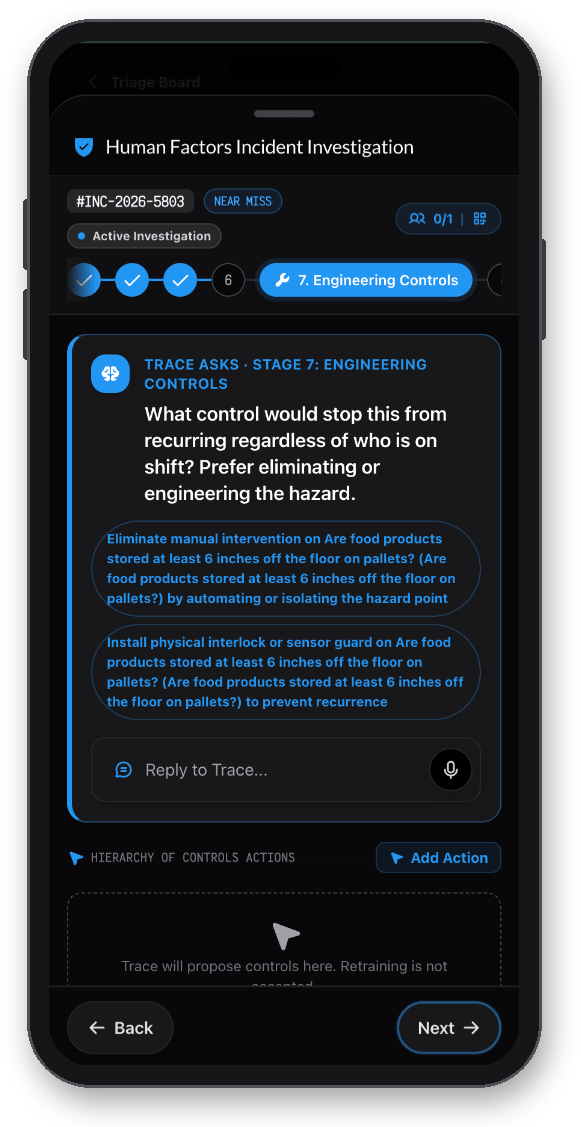
Want to See What an AI-Coached 5-Why Investigation Looks Like When Someone Tries to Type “Human Error”?
We built TraceTrack with an embedded Socratic investigation coach (Trace) that guides supervisors through structured Human Factors & 5-Why investigations by voice—actively pushing back on “human error” and “retrain the worker” excuses while capturing zero-login witness statements in English, Spanish, and French.
Because you’re reading The Safety Geek, clicking over to TraceTrack from this page automatically unlocks an exclusive 7-Day Full AI Pass (upgraded from our standard 3-day trial, with zero credit card required).
About the Author

Ben Midget spent over a decade architecting enterprise compliance systems before founding TraceTrack around a single rule: let workers work, and let managers manage. He builds zero-login voice inspection tools and AI human-factors investigation guardrails that help safety leaders get out of paperwork policing and back to leading on the floor. When he isn’t writing code, Ben can usually be found hiking Utah’s mountain trails or around a table playing modern board and card games.