Estimated Reading Time: 7 minutes
TL;DR: Applying marketing principles to safety management in manufacturing means treating your employees like an audience you have to win over, not a crew you get to command. You build know, like, and trust before you need anything. You use social proof so the safe way looks like the normal way. And you run safety programs as campaigns with one clear message, repetition, and an easy first step.
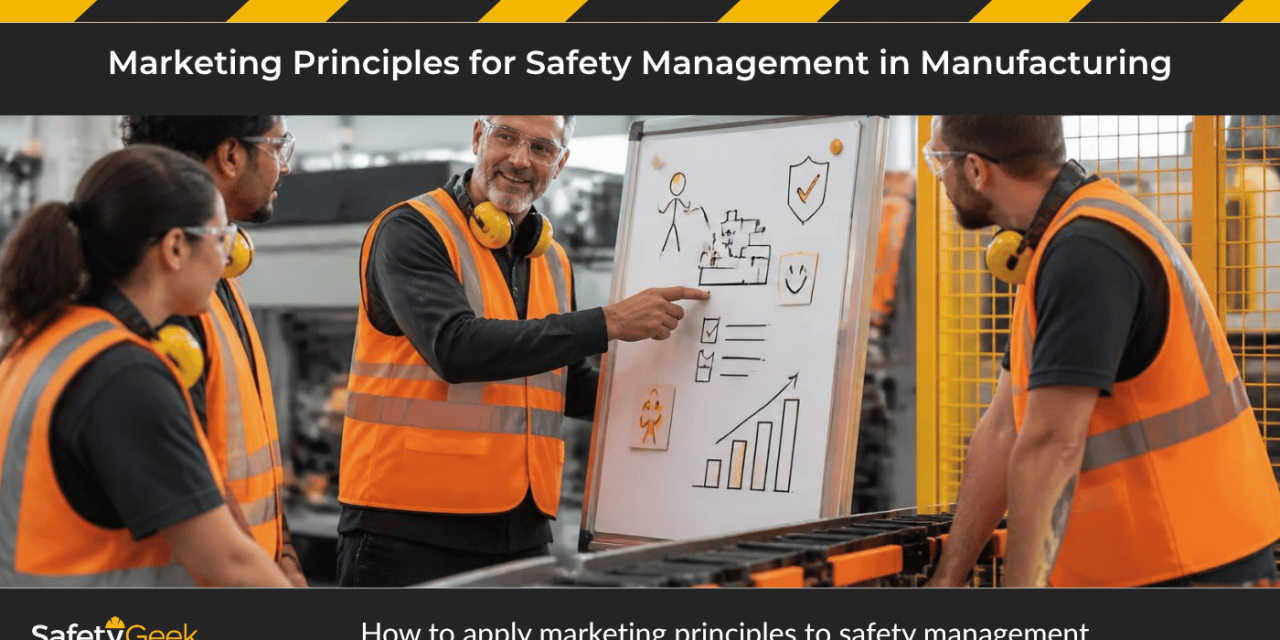
If you want to know how to apply marketing principles to safety management in manufacturing, start with this: sell the behavior before you require it. Marketers spend months learning their audience, testing the message, and making the desired action almost effortless. Most safety leads get one all-hands meeting and a signature sheet.
You already know how that ends. You roll out a solid program, the eyes roll, and three weeks later everybody is back to the old way. That’s a selling problem, and selling has rules you can learn.
Key Takeaways
- Marketing principles for safety professionals start with the audience, not the regulation. You have to know what your operators actually care about before you can write a message they’ll act on.
- Know, like, and trust is the currency of influence. Every positive interaction is a deposit you can draw from later when you need someone to change how they work.
- Social proof moves people faster than policy. When employees see peers doing the safe thing and getting recognized for it, the behavior spreads on its own.
- Campaigns beat mandates. One message repeated across formats for 90 days sticks. A single kickoff meeting does not.
- Manufacturing still carries a higher recordable rate than private industry overall, which tells you the compliance-only approach has a ceiling.
- Selling safety internally is what earns you the seat at the table, because leadership funds what employees actually adopt.
Why Safety Management in Manufacturing Is a Selling Problem
Marketing, applied to safety, is the practice of understanding your audience, shaping a message they care about, and repeating it until the desired behavior feels normal. That’s the whole discipline. It’s the same skill set a brand uses to get you to switch toothpaste, pointed at lockout instead.
The regulations are already written. Your procedures probably exist somewhere. What’s missing is adoption, and adoption gets won with psychology and marketing.
According to BLS injury and illness data by industry, manufacturing recorded 332,600 nonfatal injury and illness cases in 2024, at a rate of 2.7 per 100 full-time workers. The Bureau of Labor Statistics industry rate tables put all private industry at 2.3 for that same year, with manufacturing’s days-away, restriction, or transfer rate sitting at 1.7. Manufacturing carries the higher recordable rate even though the standards are identical everywhere.
The 2024 BLS summary of employer-reported injuries and illnesses shows 2.5 million private industry cases, down 3.1 percent from the year before and the lowest recordable rate since 2003. So progress is real. But the gap between what’s written in the binder and what happens on second shift is still where people get hurt.
Enforcement Approach vs. Marketing Approach
| Enforcement Approach | Marketing Approach | |
|---|---|---|
| Goal | Get compliance today | Get the behavior when nobody is watching |
| How employees are viewed | A group required to follow rules | An audience with their own motivations |
| Main tool | Policy, training, discipline | Message, messenger, repetition |
| Who delivers it | The safety department | Supervisors and respected peers |
| What success looks like | Signed rosters and closed findings | Adoption you can measure and trend |
| What happens when you leave the floor | The old habit returns | The new habit holds |
Here’s what I see over and over in plants. The program is technically sound, the binder is current, and the safety lead has quietly become the person everybody avoids in the aisle.
That’s the cost of leading with authority you were never actually given. If you’ve landed in the safety expert versus safety police trap, the repair work starts with the message. And when it feels like you’re dealing with employees who don’t care about safety compliance, what you’re usually watching is a message that never got sold in the first place.
Build Know, Like, and Trust Before You Need the Buy-In
Know, like, and trust is the foundation of influence, and it works exactly like a bank account. Every positive interaction is a deposit. When you need somebody to change how they work, you’re making a withdrawal.
Most safety leads make their first withdrawal before they’ve ever made a deposit. They walk onto the floor for the first time carrying a corrective action, and then wonder why it lands flat.
Know means people know a little bit about you, and the fastest route there is asking about them. Their kids, their weekend, the project they’re proud of. Nobody cares about you more than they care about themselves, and the psychology of reciprocity does the rest.
Like is mostly subtraction. People don’t like liars, they don’t like anybody who only talks about themselves, and they really don’t like being talked down to. Skip those three things, and you’re most of the way there.
Trust gets built by follow-through. Answer the question correctly, do the thing you said you’d do, and when you can’t deliver, go back and say why. What breaks trust is silence after a promise.
Marketers call this brand equity. On a plant floor, it looks like a maintenance tech flagging a missing guard to you before it becomes a recordable, because he knows you’ll handle it without turning it into a write-up.
THE ALL-ACCESS PASS RESOURCE PAGE
Get all the FREE templates, safety management resources, PDFs, spreadsheets, and more...
Use Social Proof So the Safe Way Looks Like the Normal Way
Social proof is our tendency to copy the behavior we see around us, especially from people we consider peers. It’s the most underused tool in safety, and it costs nothing.
Employees don’t decide whether to wear cut gloves by reading the policy. They decide by looking at what the guy next to them is doing.
So your job is to make the safe behavior visible and the safe employee a little bit famous. Name names in the shift huddle. Put a photo of the line that redesigned its own pinch point on the break room screen.
Peer messengers outperform the safety department almost every time. A hazard communication training study in a large manufacturing firm found that a joint labor-management program raised employee knowledge and improved work practices, that more interactive delivery outperformed less interactive methods, and that the effects held for two years. Interaction and credible messengers are the active ingredients.
One of my students, Gabriel, put this into practice in manufacturing by giving his safety committee members real ownership. In his words: “It raised team member morale because they felt more involved and respected… Once they realized we were on the same team, we were able to make a lot of process improvements.”
That’s social proof compounding. His committee members became the messengers, and the message stopped sounding like it came from the safety office.
Run Your Safety Program Like a Campaign
A mandate is an announcement. A campaign is one message, aimed at a specific audience, delivered by a trusted messenger, repeated across formats over time.
Marketing teams plan 90 days out. Most safety teams plan one meeting.
- Pick one behavior. Not the whole program. One behavior your plant keeps missing, stated in plain language a new hire would understand.
- Segment your audience. For any change, you’ll have three groups: the people already for it, the people against it, and the undecided. Spend your energy on the undecided, because that’s where the movement is.
- Choose the messenger. The supervisor delivers it, not you. Employees respond to the person inside their line of power, and safety sits outside of it.
- Repeat across formats: huddles, toolbox talks, signage, coaching conversations, a text on the plant board. Repetition is what builds the neural pathway, and one launch meeting builds nothing.
- Make the safe way the easy way. If the safe method takes four extra steps, your message is fighting the design. Fix the friction first, and the campaign does half the work for you.
Before any campaign goes live, prime the audience. Priming employees for a safety program change is the pre-launch work that turns a surprise into an expectation, and it’s the same reason brands tease a product for weeks before it ships.
Then build the participation into the work itself. Real employee engagement in safety means people doing actual work on the program, not sitting through a discussion about it. Track it as a percentage of your workforce, and it becomes a number you can report upward.
And when you need budget for the campaign, skip the moral argument. Executives fund business value, so making a case for safety in dollars is what gets you a yes. That’s the exact muscle we build inside the Safety Leadership Academy.
All of this lives inside the Safety Management Cycle: Identify, Develop, Implement and Train, Coach and Observe, Analyze. Marketing is what you layer on top of Implement and Train, so the work actually sticks.
Frequently Asked Questions About Marketing Principles in Safety Management
What does it mean to apply marketing principles to safety management?
It means treating employees as an audience with their own motivations, not a group required to comply. You learn what they care about, shape a message around it, pick a messenger they trust, and repeat it until the safe behavior feels normal. Compliance is the floor. Adoption is the goal.
Does this work in a union manufacturing plant?
Yes, and it often works better. Union environments already have credible peer leaders and formal channels for employee input. Bring stewards and committee members into building the message instead of presenting it finished, and you get messengers who carry real standing with the crew.
How long should a safety campaign run?
Plan 90 days on one behavior. Week one launches the message. Weeks two through eight repeat it across huddles, toolbox talks, signage, and coaching conversations. The last few weeks measure adoption, so you have a number to report. One meeting is an announcement, not a campaign.
Who should deliver the safety message to employees?
The front-line supervisor, almost always. Employees respond to the person inside their line of power, and safety sits outside of it. Your role is coaching the coach: write the message, prepare the supervisor, then let it travel through the chain of command instead of around it.
Is marketing safety just manipulation?
No. Manipulation hides the truth to get compliance. Marketing makes a true message easier to hear and easier to act on, using plain language, credible messengers, and repetition. You’re removing the friction between what people already want, which is going home whole, and what they actually do.
Now It’s Your Turn
Applying marketing principles to safety management in manufacturing comes down to one shift: earn the behavior instead of ordering it. The regulations tell you what has to happen. Psychology and marketing are how you get it to happen when nobody is watching.
Take action this week:
- Pick the one behavior your plant keeps missing, and make it the only thing you campaign on for the next 90 days.
- Spend 20 minutes on the floor asking questions with zero agenda. That’s your first deposit in the know, like, and trust bank.
- Find one employee already doing the behavior right and recognize them by name in front of their crew.
- Hand the message to a supervisor and let them deliver it in the next shift huddle.
- Write down the one number you’ll use to prove it worked.
If you want the full system behind this, my free training on the Safety Influencer System walks through how to layer influence into the work you’re already doing, so every hazard you identify and every observation you run builds your credibility instead of just filling a binder.
You got this, Safety Friend.
Hi, I'm Brye (rhymes with sky)! I am a self-proclaimed safety geek with two decades of general industry safety experience. Specializing in bringing safety programs to a world-class level and building a safety culture, I have trained and coached many safety managers, just like you, on how to effectively manage workplace safety in the real world. I would love to help you too.