Estimated Reading Time: 9 minutes
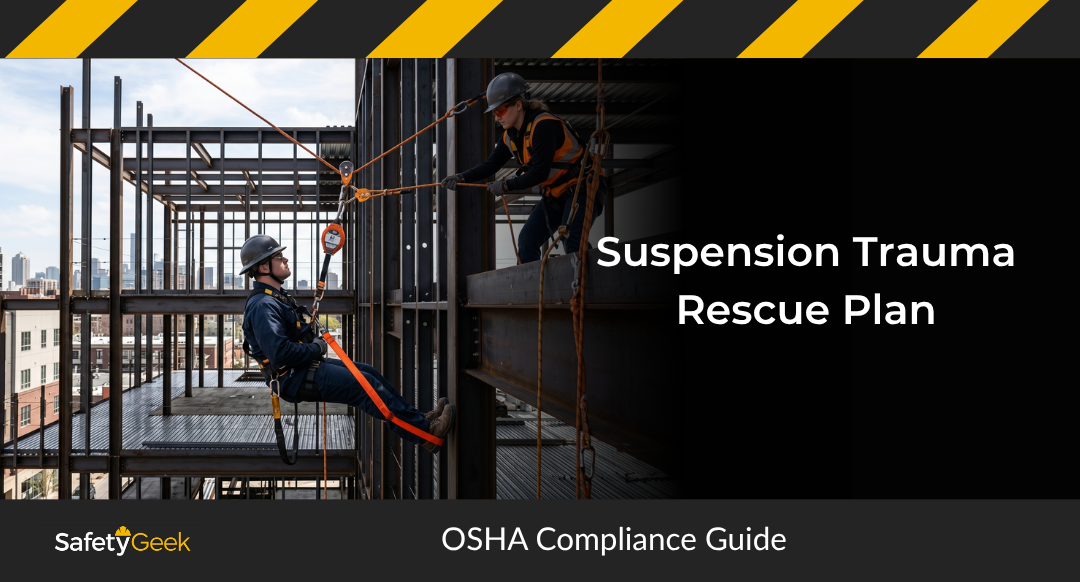
TL;DR: A suspension trauma rescue plan is a written, practiced procedure for getting a worker out of a fall arrest harness fast, before motionless hanging turns deadly. OSHA 1926.502(d)(20) requires prompt rescue or self-rescue for anyone in a personal fall arrest system. Suspension trauma can cause unconsciousness in minutes, so “call 911 and wait” is never a complete plan.
A suspension trauma rescue plan is the written procedure your team follows to retrieve a worker who is hanging in a fall arrest harness after a fall. OSHA 1926.502(d)(20) requires it: you must provide for prompt rescue or make sure workers can rescue themselves. A successful catch is not the end of the emergency… it’s the start of a new one.
If you run safety for a crew that works at height, you already know the harness math cold. But ask yourself the one question that keeps a lot of safety leads up at night: if someone fell right now and hung there, who is getting them down, with what gear, and how fast?
For most teams, the honest answer is fuzzy. And fuzzy is what gets people killed on the day it finally happens.
Key Takeaways
- OSHA 1926.502(d)(20) requires prompt rescue or self-rescue for every worker in a personal fall arrest system.
- “Prompt” has no defined time, but suspension trauma can cause unconsciousness in as little as a few minutes.
- “Call 911 and wait” is not a compliant rescue plan. You need on-site equipment, trained rescuers, and a written procedure.
- A complete plan covers self-rescue, assisted rescue, and the handoff to EMS, with the gear and people named for each.
- Trauma relief straps and foot loops buy time by letting a conscious worker take pressure off their legs.
- Post-rescue care matters as much as retrieval. How you position the worker afterward can change the outcome.
What OSHA 1926.502(d)(20) Requires for Prompt Rescue
The rule is one sentence: the employer shall provide for prompt rescue of employees in the event of a fall, or shall assure that employees are able to rescue themselves. That’s the whole requirement, straight out of OSHA’s fall protection systems criteria.
Notice what it doesn’t say. It doesn’t define “prompt.” It doesn’t list approved methods or tell you what equipment to stage.
This is a performance-based standard, which means OSHA hands you the goal and leaves the how to you. The catch is that you have to prove your plan will actually get a worker down fast enough to prevent harm.
That’s why a vague answer fails an inspection. According to OSHA’s Technical Manual fall protection chapter, prompt or self-rescue is “imperative to preventing injury or a fatality.” An inspector who asks about your rescue plan is not looking for “we’ll call the fire department.” They want a written, site-specific procedure with named roles and staged equipment.
Why “Call 911” Falls Short
Emergency services are part of your plan, never the whole plan. Response times vary wildly, and a fire department on the far side of the county can’t reach a suspended worker inside the window that matters.
Even a fast response assumes EMS arrives with the right high-angle rescue gear and training. Many crews don’t.
Your team has to be able to start the rescue before anyone external shows up. That means the gear is already on site and someone on the crew knows how to use it.
Why Minutes Matter: Suspension Trauma Explained
Suspension trauma, also called orthostatic intolerance, is the rapid loss of consciousness, and potentially death, that comes from hanging motionless in a vertical position. When a worker dangles still in a harness, blood pools in their legs. Venous return to the heart drops, the brain is starved of oxygen, and the body can’t compensate.
This is why a worker hanging perfectly still after a successful arrest is still in serious danger. The harness saved them from the fall. Now the stillness in that harness is the threat.
OSHA’s Safety and Health Information Bulletin on suspension trauma lays out how fast this moves.
| Time hanging motionless | What can happen |
|---|---|
| First few minutes | Light-headedness, nausea, and pre-fainting symptoms begin |
| 5 to 30 minutes | Risk of fainting and shock climbs sharply |
| Under 1 minute (vulnerable workers) | Unconsciousness possible with dehydration, heat, or a heart condition |
The Reflow Risk After Rescue
Getting the worker down is not the finish line. After prolonged suspension, sitting them straight up can send a rush of pooled, oxygen-poor blood back to the heart at once, a reaction called reflow or reperfusion.
Current guidance is to lay the rescued worker flat, keep their airway open, and get EMS managing them quickly. Older training that said to keep a rescued worker sitting upright has been walked back.
Tell your responders to treat it like a fainting case unless there’s other trauma, and to tell arriving EMS it was a suspension event. That single detail changes how the worker gets treated.
THE ALL-ACCESS PASS RESOURCE PAGE
Get all the FREE templates, safety management resources, PDFs, spreadsheets, and more...
What Goes Into a Compliant Suspension Trauma Rescue Plan
A compliant suspension trauma rescue plan answers four questions for every place your crew works at height: who calls it, who performs it, what gear is staged, and how long it takes. If any of those is blank, the plan isn’t done.
Build it around three layers of rescue, in order of speed.
| Rescue method | How it works | Best when |
|---|---|---|
| Self-rescue | Worker descends or steps to safety with their own gear (descent SRL, ladder, controlled descent device) | Worker is conscious and gear is rigged for it |
| Assisted rescue | Trained co-workers lower or raise the worker with a pre-staged rescue kit | Worker can’t self-rescue but the crew is trained and equipped |
| EMS / technical rescue | Fire department or rope rescue team retrieves the worker | Backup only, never the primary plan |
Self-rescue is fastest because it removes the wait. A worker with a descent-capable self-retracting lifeline can lower themselves to the ground in seconds.
Assisted rescue is your workhorse for anyone who is hurt, unconscious, or panicked. It depends entirely on having a rescue kit staged near the work and at least one trained rescuer on the crew.
EMS is the safety net under your safety net. You plan for it and you call early, but you never build the whole plan around their arrival time.
Make It Site-Specific
A plan written for a “typical” jobsite protects no one. The rescue for a worker on a 40-foot tower is nothing like the rescue for someone over a leading edge or inside a tank.
Tie the plan to your job hazard analysis for each task at height. The same walkthrough that identifies the fall hazard should identify the rescue path, the anchor for the rescue system, and where the kit lives.
ANSI Z359.2, the consensus standard for managed fall protection programs, goes a step past OSHA and calls for written rescue procedures plus verbal contact with a fallen worker within about six minutes. That’s a useful target even though OSHA doesn’t name a number.
The Equipment That Buys a Hanging Worker Time
The cheapest piece of rescue gear on this list might be the one that saves a life before anyone reaches the worker: the trauma relief strap.
A trauma relief strap (sometimes called a suspension relief or trauma step) is a small pouch attached to the harness. After a fall, the worker deploys it into a loop they can stand in, which takes the pressure off their thighs and lets the leg muscles pump blood back toward the heart.
Gear Worth Staging
- Trauma relief straps on every harness. They cost little and deploy in seconds.
- Foot loops or stirrups so a conscious worker can stand and keep blood moving.
- A descent-capable SRL or controlled descent device where self-rescue is realistic.
- A pre-rigged rescue kit (haul or descent system) staged near the work, not locked in a truck across the lot.
- A rescue pole or rigid hook for reaching a worker who has swung out of reach.
None of this works if it’s buried in a gang box across the site. Stage rescue gear where the work is happening, inspect it on the same schedule as the rest of your personal fall arrest system equipment, and make sure the crew knows exactly where it lives.
This is the “D” in the ABCDs of fall arrest: Anchorage, Body support, Connectors, and Descent or rescue. A lot of teams nail the first three and treat the D as paperwork. The D is where a successful catch becomes a survivable one.
Training and Drills That Make the Rescue Plan Real
A rescue plan in a binder is not a rescue plan. It’s a document. The plan only exists in the hands and muscle memory of the people who’d have to run it under pressure.
That’s the gap between writing the plan and living it. And it’s the same gap I see between safety programs that pass audits and programs that actually bring everyone home.
Drill It Like a Fire Drill
You’d never run a facility without a fire drill. A fall rescue deserves the same seriousness, because the clock on suspension trauma is far less forgiving than most evacuation scenarios.
Run a mock rescue with the actual gear, on the actual structures, with the actual crew. Time it. If your assisted rescue takes eleven minutes, you’ve found that problem on a Tuesday instead of during a real emergency.
Where the Safety Management Cycle Comes In
Training alone doesn’t make a behavior stick. You train, you coach, you observe, and you reinforce. That’s how a rescue procedure becomes second nature instead of a one-time class everyone forgot by spring.
This is the Coach and Observe stage of the Safety Management Cycle (Identify, Develop, Implement and Train, Coach and Observe, Analyze). Your competent person watches a drill, spots the worker who fumbled the haul system, and coaches it on the spot. Then the next drill gets analyzed and the plan gets better.
That loop is what turns a compliance requirement into a capability your crew actually has.
Frequently Asked Questions About Suspension Trauma Rescue Plans
What does OSHA say about suspension trauma rescue?
OSHA 1926.502(d)(20) requires employers to provide for prompt rescue of any worker who falls into a personal fall arrest system, or to ensure they can self-rescue. The standard is performance-based and doesn’t define “prompt,” but suspension trauma can turn deadly within minutes, so plans must enable a fast, on-site response.
How long can a worker safely hang in a harness?
There’s no safe duration. OSHA’s suspension trauma bulletin notes symptoms can begin within the first few minutes, and fainting or shock can develop in 5 to 30 minutes. In vulnerable workers, unconsciousness can happen in under a minute. Treat every suspended worker as a time-critical emergency.
Is “call 911” an acceptable rescue plan?
No. Emergency services are a backup, not a complete plan. Response times vary, and many crews don’t arrive with high-angle rescue gear or training. A compliant suspension trauma rescue plan stages rescue equipment on site and trains the crew to begin the rescue before outside help arrives.
What is a trauma relief strap?
A trauma relief strap is a small pouch on a fall arrest harness that deploys into a foot loop after a fall. The suspended worker stands in it to take pressure off their legs, letting the leg muscles pump blood back toward the heart and delaying suspension trauma until rescue arrives.
What should you do after rescuing a suspended worker?
Lay the worker flat, keep their airway open, monitor for shock, and get EMS managing them right away. Tell responders it was a suspension event so they watch for reflow, the rush of pooled blood back to the heart. Don’t sit a rescued worker upright as a default.
Does a rescue plan have to be written?
OSHA 1926.502(d)(20) doesn’t use the word “written,” but inspectors routinely ask for documentation, and the consensus standard ANSI Z359.2 calls for written rescue procedures. A site-specific written plan with named roles, staged gear, and trained rescuers is the practical standard for proving compliance.
Now It’s Your Turn
A suspension trauma rescue plan comes down to one promise: if a worker falls and hangs, your crew can get them down fast, with gear that’s already there and people who’ve practiced. The harness stops the fall. Your plan keeps the catch from turning into a fatality.
Here’s what to do this week:
- Walk every spot your crew works at height and ask the four questions: who calls the rescue, who performs it, what gear is staged, and how long it takes.
- Add trauma relief straps to every harness that doesn’t have one. It’s the highest-impact, lowest-cost fix on this list.
- Stage a rescue kit where the work happens, and confirm at least one person per crew is trained to use it.
- Pull your fall protection plans and add a site-specific rescue procedure to each one, tied to your hazard assessment.
- Schedule a timed mock rescue this month. Find your gaps on a drill day, not on the worst day.
Building this kind of system, the kind that protects people instead of just passing inspections, is exactly what we work on inside the Safety Leadership Academy. When you book your free Safety Leadership Roadmap Session, you’ll walk away with a clear path to a program that’s ready for the bad day before it comes.
You got this.
Hi, I'm Brye (rhymes with sky)! I am a self-proclaimed safety geek with two decades of general industry safety experience. Specializing in bringing safety programs to a world-class level and building a safety culture, I have trained and coached many safety managers, just like you, on how to effectively manage workplace safety in the real world. I would love to help you too.