Estimated Reading Time: 8 minutes
TL;DR: OSHA ladder safety training for supervisors has to go beyond memorizing regulations. Under 29 CFR 1926.1060, a competent person must train workers to recognize fall hazards, inspect ladders, and use them correctly. But supervisors need more than the rulebook… they need the coaching skills to correct unsafe ladder use in real time, without turning into the safety police.
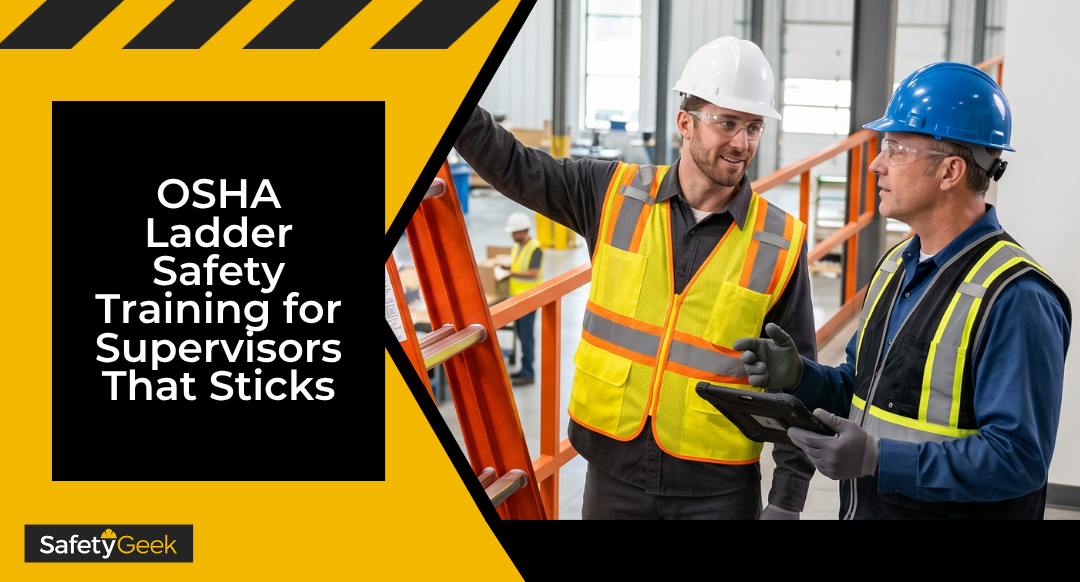
OSHA ladder safety training for supervisors works best when it teaches them to coach, not just to quote the standard. The regulations tell you what to cover. They don’t tell you how to make it stick on the floor.
Here’s the part most training programs skip. You can run every supervisor through a slideshow on 29 CFR 1926.1053, hand out a quiz, and still watch someone lean a too-short ladder against a roof an hour later. Knowing the rule and changing the behavior are two completely different things.
Key Takeaways
- The training rule: OSHA’s ladder training requirement lives in 29 CFR 1926.1060, and it has to be delivered by a competent person.
- The authority piece: A competent person can spot ladder hazards AND has the authority to fix them on the spot (1926.32(f)).
- What supervisors do: Recognize hazards, run pre-shift inspections, tag out defective ladders, and verify safe setup.
- Why rote training fails: It creates supervisors who can recite the rule but freeze when they see an unsafe ladder.
- The skill that works: Coaching… asking the right question instead of reaching for the write-up.
- Why it pays off: Ladder violations land on OSHA’s Top 10 most-cited list nearly every year.
What OSHA Requires for Ladder Safety Training
Ladder safety training is the formal instruction OSHA requires before an employee uses a ladder on the job. For construction, the requirement sits in 29 CFR 1926.1060. It says the employer must provide a training program that lets every employee recognize ladder and stairway fall hazards and follow the right procedures to reduce them.
That training has to be delivered or overseen by a competent person. And it has to be repeated… OSHA requires retraining whenever the worksite changes, new equipment shows up, or someone’s actions show they didn’t get it the first time.
What the Training Has to Cover
OSHA’s ladder and stairway training requirements spell out the minimum content. Your program has to address each of these where they apply to the work your team does.
- The nature of fall hazards in the work area
- Correct procedures for setting up, using, and taking down ladders
- Proper construction, placement, and care of the ladders your team uses
- The maximum intended load and load-carrying capacity of each ladder
In general industry, the parallel standard is 29 CFR 1910.23. It requires ladders to be used only on stable, level surfaces and inspected before the first use of each shift by a competent person.
Who Counts as a Competent Person
A competent person is someone who can identify existing and predictable hazards AND has the authority to take prompt action to correct them. That definition comes straight from 29 CFR 1926.32(f). The second half matters more than people think.
Plenty of supervisors can point at a bad ladder setup. Far fewer have been told, in writing, that they can stop the work and fix it. If your ladder training names supervisors as competent persons, back it up with real authority to act.
What Supervisors Actually Need to Learn About Ladder Safety
Frontline supervisors are the people who see ladders go up every day. They are the closest thing safety has to eyes on every setup. So their training can’t stop at “don’t stand on the top rung.”
Recognize the Hazards on Their Own Site
Generic ladder photos in a slide deck don’t transfer to the loading dock or the mezzanine your team actually climbs. Train supervisors using their own work areas. Walk the floor, point at the real roof-access ladder, and ask what could make it unsafe today.
The hazards they need to catch are specific. Unstable footing, the wrong angle, a metal ladder near energized lines, slippery rungs, and the worker who takes one extra reach instead of moving the ladder.
Inspect and Tag Out Defective Ladders
OSHA requires a competent person to inspect ladders for visible defects, and 1910.23 calls for that check before the first use of each shift. Supervisors need to know what a defect looks like… cracked rails, bent or missing rungs, loose hardware, damaged feet, missing labels.
When they find one, the ladder gets tagged “Dangerous – Do Not Use” and pulled from service until it’s repaired or replaced. Build the tag-out step into the routine so it’s automatic, not a judgment call.
Verify Safe Setup Every Time
Setup is where most ladder citations come from. Supervisors should be able to confirm the basics on sight: the 4-to-1 angle, the extension ladder 3-foot rule at the landing, and the ladder secured so it can’t slide.
A good visual cue is three rungs showing above the landing. Less than that, and the setup gets corrected before anyone climbs.
THE ALL-ACCESS PASS RESOURCE PAGE
Get all the FREE templates, safety management resources, PDFs, spreadsheets, and more...
Why Rote Regulation Training Fails Supervisors
Here’s what I’ve seen over and over in two decades of safety management. A supervisor sits through ladder training, passes the quiz, and still walks past an unsafe setup because nobody taught them what to do in that moment.
Reciting 1926.1053 and correcting a live hazard are two different skills. The first is knowledge. The second is influence… and influence is the part that keeps people safe.
Supervisors Own Compliance, Safety Coaches the Supervisors
Daily rule-following belongs to the people who control the work. That’s why frontline supervisors own daily safety compliance, while you act as the guide on the side.
Your job isn’t to catch every bad ladder yourself. It’s to train supervisors so well that they catch them for you, every shift, whether you’re standing there or not.
Teach Them to Coach, Not to Cite
When a supervisor spots an unsafe ladder, the write-up shouldn’t be the first move. The conversation is. Real safety coaching pairs a specific observation with an open-ended question.
“What made you reach instead of moving the ladder?” opens a door. “You’re getting written up” slams it. One builds compliance that lasts after you walk away. The other lasts until you turn the corner.
How to Build OSHA Ladder Safety Training for Supervisors That Sticks
The training that changes behavior looks less like a classroom and more like a coaching system. This is the Coach & Observe phase of the Safety Management Cycle in action… you train, you watch, you correct, you reinforce.
Make It Hands-On and Site-Specific
Cal/OSHA’s ladder training guidance recommends active methods over lecture: demonstrations, open-ended questions, and small-group discussion of past incidents.
Put it to work. Have supervisors run a live inspection, classify the defects, and tag out a mock-damaged ladder. Use photos from your own site so they spot the violation in a setting they recognize.
Tie It Into the Work You Already Do
Ladder safety shouldn’t be a once-a-year class. Fold it into a job hazard analysis for every task that uses a ladder, and into the pre-task plan supervisors already run.
When ladder checks live inside daily work, supervisors stop seeing safety as a separate thing you bolt on. It becomes how the job gets done.
Reinforce It With Mini Coaching
The fastest way to keep ladder safety top of mind is short, repeated coaching. Mini coaching sessions woven into daily task talks beat a long annual training every time.
Repetition is what builds the habit. One slideshow fades by Friday. A 90-second ladder conversation every few days rewires how your crew sets up.
Compliance-Only vs. Coaching-Based Training
Here’s the difference between the two approaches side by side.
| Element | Compliance-Only Training | Coaching-Based Training |
|---|---|---|
| Goal | Pass the quiz | Change the behavior |
| Method | Lecture and slideshow | Demonstration and live practice |
| When a hazard appears | Write it up | Ask, correct, reinforce |
| Frequency | Once a year | Built into daily work |
| Result | Rules recited, hazards repeated | Hazards caught every shift |
Frequently Asked Questions About Ladder Safety Training for Supervisors
Does OSHA require ladder safety training for supervisors specifically?
OSHA requires ladder training for every employee who uses a ladder, under 29 CFR 1926.1060. Supervisors often serve as the competent person who delivers or oversees that training, so they need deeper instruction in hazard recognition, inspection, and correction, not just basic user-level content.
How often is ladder safety retraining required?
OSHA doesn’t set a fixed calendar. Retraining is required whenever the worksite changes, new ladders or fall protection are introduced, or a worker’s actions show they didn’t retain the original training. Many employers retrain annually as a best practice to stay ahead of those triggers.
What is a competent person for ladders?
A competent person can identify existing and predictable ladder hazards and has the authority to correct them on the spot, per 29 CFR 1926.32(f). For ladders, that means inspecting before each shift, tagging out defects, and overseeing safe setup and training.
What should ladder safety training for supervisors include?
It should cover fall hazard recognition on their own site, pre-shift inspection and tag-out of defective ladders, correct setup (the 4-to-1 angle, the 3-foot extension rule, securing), load limits, and the coaching skills to correct unsafe use without defaulting to discipline.
Can supervisors train their own crews on ladder safety?
Yes, if they qualify as a competent person and have been trained to do it well. Supervisor-led training usually sticks better because it’s grounded in the team’s real work. Give them a simple framework, real site examples, and the authority to act.
Now It’s Your Turn
OSHA ladder safety training for supervisors only works when it builds the skill to coach, not just the knowledge to recite. Teach the standard, then teach them what to do the moment they see a ladder set up wrong.
Here’s where to start this week.
- Pull your current ladder training and check it against the content required in 1926.1060.
- Name your supervisors as competent persons in writing, and back it with real authority to stop unsafe work.
- Run one live inspection drill… have a supervisor find the defects and tag out a ladder.
- Add a 90-second ladder check to your supervisors’ daily walk.
Turning rules on paper into habits in the field is a culture skill, and it’s exactly what we build inside the Safety Leadership Academy. When you book a Safety Leadership Roadmap Session, we’ll map out how to get your supervisors owning safety so you stop chasing the same ladder violations year after year.
Want a head start? My free guide on the Safety Management Influencer System walks through how to layer influence into the safety work you’re already doing.
Hi, I'm Brye (rhymes with sky)! I am a self-proclaimed safety geek with two decades of general industry safety experience. Specializing in bringing safety programs to a world-class level and building a safety culture, I have trained and coached many safety managers, just like you, on how to effectively manage workplace safety in the real world. I would love to help you too.