Estimated Reading Time: 9 minutes
TL;DR: To find a mentor and build a professional network as a safety manager, start with the safety communities that already run structured matching (ASSP practice specialties), then add two or three peers you talk to monthly. Ask for a specific problem-solving conversation, not a lifetime commitment. Peer community is what keeps you from guessing alone in a building where nobody else does your job.
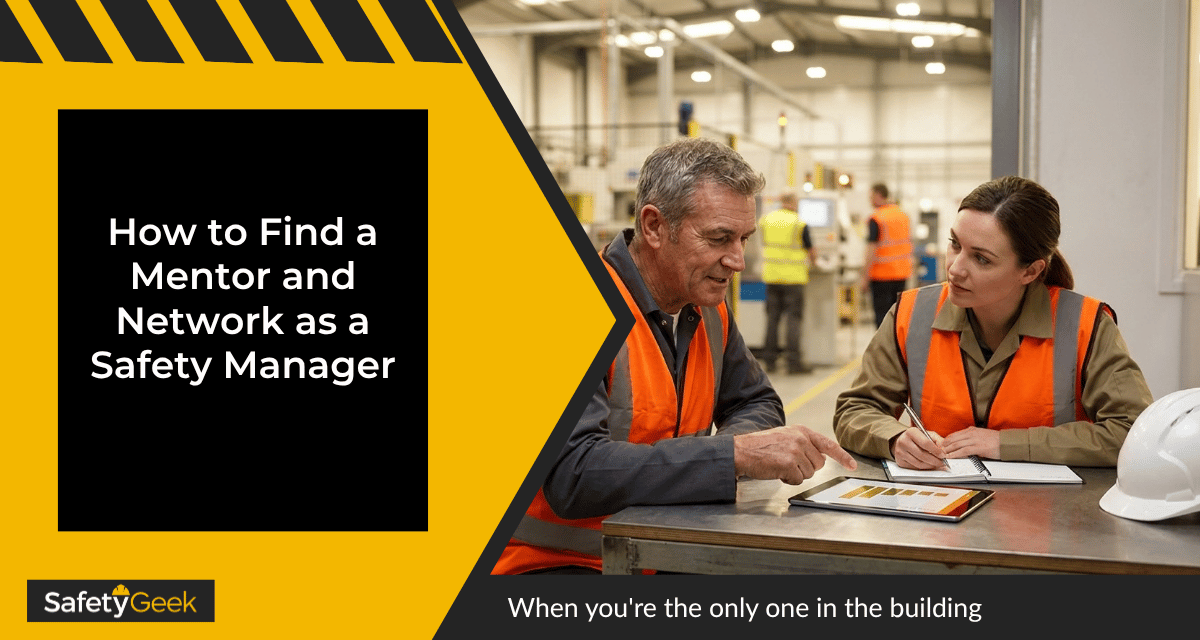
Learning how to find a mentor and build a professional network as a safety manager comes down to three moves: join a group that already does formal matching, make a small and specific ask, and keep two or three peers in steady rotation. You do not need a famous name or a paid program to start. You need one person who has already solved the thing you are staring at right now.
And here is why this matters more in safety than almost anywhere else. You are often the only person in the building who does what you do… which means you answer every question, guess at every answer, and live with every outcome.
That is not a knowledge problem. That is an isolation problem, and it has a fix.
Key Takeaways
- Safety is structurally isolating. Most safety leads are a department of one, so professional community is a working requirement, not a nice-to-have.
- ASSP runs formal mentor matching through its member communities and practice specialties, with defined match periods and time commitments.
- Research backs the career payoff. Mentored professionals see more promotions and higher career satisfaction than people going it alone.
- Informal mentoring outperforms formal programs. Structured matching is a great starting door, but the relationships that stick usually grow organically.
- The ask should be small and specific. “Can I get 20 minutes on how you rolled out supervisor-led inspections?” beats “Will you be my mentor?” every time.
- You need peers, not just a mentor. A mentor pulls you forward. Peers keep you sane, and they answer faster.
Why Safety Managers End Up Professionally Alone
Safety is one of the last departments a company adds, and it is usually added as one person. That structure creates isolation by design, not by accident. You report to operations or HR, sit outside the chain of command, and have no one down the hall who has done your job before you.
The profession’s scale makes it worse. Bureau of Labor Statistics data on occupational health and safety specialists and technicians puts total employment around 163,700 in 2024, spread across manufacturing, construction, healthcare, and government. Those people are scattered one or two per site, which is why you can work in a 400-person facility and still have nobody to bounce ideas off.
The cost of guessing alone
Without anyone to check your thinking, every decision carries extra weight. You second-guess whether your JHA format is right. You wonder whether you handled that near miss the way a seasoned safety director would have.
That constant self-checking is exhausting, and it is a big driver of imposter syndrome in safety management. The knowledge gap is usually smaller than it feels. The validation gap is what is actually killing your confidence.
The isolation is baked into how safety departments get formed
The most common thing I hear from safety leads is some version of “I don’t know what I don’t know.” That is not a character flaw. That is what happens when a company hands someone a role with no predecessor, no documented program, and no peer to compare notes with.
If you are also carrying the whole program by yourself, the structural fix and the professional fix run together. Building support for a one-person safety department starts with getting input from outside your building.
Where to Actually Find a Safety Mentor
A safety mentor is an experienced safety professional who gives you regular, direct guidance on your specific situation, not general advice to a room. You will find them in four places, each with different speed and cost.
| Source | How you find them | Typical cost | Best for |
|---|---|---|---|
| Professional associations | Formal matching applications | Membership dues | A structured first mentor |
| LinkedIn and online groups | Direct outreach after real engagement | Free | Specific technical questions |
| Inside your own company | Operations, HR, or plant leadership | Free | Business acumen and politics |
| Paid programs and communities | Enrollment | Program tuition | Speed, and a full peer group at once |
Professional associations with real matching programs
The American Society of Safety Professionals runs mentoring programs through its member communities, including Emerging Professionals in OSH, Women in Safety Excellence, Construction, Consultants, and Management. Applications are accepted year-round, with matches made in spring and fall.
The commitment is lighter than people expect. The ASSP Management Practice Specialty mentoring program asks for at least one hour a month, runs six-month matches with an optional six-month extension, and requires confidentiality on both sides. Mentors are explicitly not there to hand out jobs, which is the right expectation to set going in.
LinkedIn, if you use it like a professional and not a lurker
Most safety leads treat LinkedIn as a place to scroll. The people who get mentors out of it comment thoughtfully on the same handful of practitioners for a month before ever sending a message. By the time they reach out, they are a familiar name instead of a cold DM.
That slow build is Know, Like, and Trust applied to your own career. Every useful comment is a deposit you can draw on later. If your profile is doing none of that work for you, fix your LinkedIn profile as a safety professional before you start reaching out.
The mentor already inside your building
Here is what most safety leads miss. Your best mentor may not be a safety person.
The plant manager who has moved product through three recessions can teach you business acumen faster than any safety conference. The HR director knows exactly how decisions really get made in your company. Neither of them will teach you fall protection, and that is fine, because the skills blocking most safety careers are business and influence skills, not technical ones.
Conferences and speaking
Conferences work because they compress a year of relationship-building into three days. Go with a list of five people you want to meet and one specific question for each. Sitting in sessions and going back to your hotel room is how people leave with a tote bag and no contacts.
Getting on stage accelerates it further, because people come to you afterward. Speaking at a safety conference is one of the fastest ways to build a network from a standing start, and you do not need a director title to submit a session proposal.
THE ALL-ACCESS PASS RESOURCE PAGE
Get all the FREE templates, safety management resources, PDFs, spreadsheets, and more...
What Mentorship Actually Does for Your Career
The career data here is stronger than most people realize. The landmark meta-analysis by Allen and colleagues in the Journal of Applied Psychology compared mentored and non-mentored professionals and found mentored people reported more promotions, higher compensation, greater career satisfaction, and a stronger belief that they would keep advancing.
There is a wrinkle worth knowing. Underhill’s review in the Journal of Vocational Behavior found that informal mentoring produced a larger effect on career outcomes than formal, assigned programs did. So use the formal programs as your entry door, then let the relationships that actually click turn into something ongoing.
It compresses the learning curve.
A mentor’s real value is not information. Information is free and everywhere. What a mentor gives you is judgment… which of the fifteen things on your list actually matters this quarter, and which one is a trap.
That is the difference between having a bag of Legos and having the instructions. One of our Academy students in New Zealand, the sole safety lead for a non-profit running about 400 early childhood centers, described it exactly that way. University-trained, plenty of pieces, no picture on the box.
It changes what you believe you’re allowed to do
The mindset shift usually happens before the promotion does. When someone two steps ahead of you treats a COO meeting as a normal Tuesday, you stop treating it as terrifying. That single reframe is often what separates a safety manager from someone moving along the path from safety manager to safety director.
How to Ask Someone to Mentor You
Most people never get a mentor because they make the biggest possible ask first. “Will you be my mentor?” is an open-ended ask with no defined end. Almost everyone says no, or says yes and then ghosts.
Make the first ask small and specific
Ask for one conversation about one problem.
Something like this: “I saw your post about getting supervisors to run their own inspections. I’m trying to do that, and my supervisors are pencil-whipping the forms. Could I get 20 minutes to ask you two questions about how you handled it?”
That is easy to say yes to. It respects their time, it flatters their expertise honestly, and it gives them a clear finish line.
Run the first meeting like a professional
Come with three written questions and a two-sentence summary of your situation. Take notes where they can see you taking them. End five minutes early, on purpose.
Then do the part almost nobody does. Implement one thing they said, then email them two weeks later to tell them what happened. That single follow-up is what converts a one-time call into a mentor, because it proves their time produced something.
Set a light structure if it turns ongoing.
Monthly, 30 minutes, you bring the agenda. After six months, you both decide whether to keep going. Say that out loud early so nobody is stuck in a vague open-ended arrangement.
How to Build a Peer Network That Answers Fast
Mentors pull you forward. Peers keep you steady, and honestly, peers answer faster. When you need to know whether your lockout audit form is normal or insane, you need someone at your level who will look at it today.
Build a small board instead of chasing a crowd.
You do not need 500 connections. You need four or five safety leads at similar levels in different industries, in a group chat, who you actually talk to. Different industries matter, because someone in healthcare will solve your manufacturing problem in a way nobody in manufacturing would have tried.
Give before you ask
Send someone a template you built. Answer a question in a group where you actually know the answer. Share the outcome of something you tried, including the parts that flopped.
Peer networks run on reciprocity, and the person who only shows up when they need something gets quietly deprioritized. Contributing is also how you find out you know more than you thought.
Consider a paid community when time is the constraint
Associations and group chats are free but slow to assemble. A structured program compresses it, because you get the mentor and the peer group on day one instead of building both over two years. That is the whole reason mentorship and community are built into the Safety Leadership Academy rather than sold as an add-on.
Frequently Asked Questions About Finding a Safety Mentor
Do I need to be certified before I look for a mentor?
No. Certification has nothing to do with whether someone will help you. Mentors respond to people who ask specific questions and follow through, at any career stage, and waiting until you feel qualified is the most common reason safety leads spend years without one.
Should my mentor work in my industry?
It helps for technical questions, but it is not required. The skills that stall safety careers are business acumen, influence, and communication, and those transfer across every industry. A mentor from a different sector often spots your blind spots faster than someone inside your world.
What if I work somewhere too small to have a network?
Company size does not limit your network, because your network lives outside your company. Association chapters, online safety communities, and LinkedIn all work regardless of headcount. Being the only safety person at a small employer makes outside community more important, not less.
How much time does mentorship actually take?
Formal association programs generally ask for about one hour a month for a six-month match. Peer conversations take even less, often a 15-minute call or a few messages. The time cost is small compared to the hours you lose guessing at problems someone else already solved.
Can I have more than one mentor?
Yes, and most people should. One person for technical safety depth, one for business and executive skills, and one peer group covers far more ground than a single relationship can. Think of it as a personal board rather than one all-purpose advisor.
How do I know if a mentor relationship isn’t working?
If you leave conversations with encouragement but no decisions, it is not working. A good mentor changes what you do next week, not just how you feel about your job. Thank them, keep the relationship warm, and go find someone whose experience matches what you are actually stuck on.
Now It’s Your Turn
Finding a mentor and building a professional network as a safety manager is not about luck or charisma. It is about making a small, specific ask to someone one step ahead of you, then following through so the relationship earns its next conversation. The isolation you are feeling is built into how safety departments get formed, and the fix lives outside your building.
Take action this week:
- Apply to one ASSP community or practice specialty mentoring program.
- Pick three safety professionals whose work you respect and comment on their content, thoughtfully, five times over the next two weeks.
- Identify one leader inside your own company, outside of safety, and ask them for 20 minutes about how business decisions get made.
- Message two safety leads at your level and start a group chat. That is your peer board.
- Write down the one problem you are most stuck on right now. That is your ask.
If you would rather not assemble all of that piece by piece, that is exactly what a Safety Leadership Roadmap Session is for. It is a free call where we look at where you are, what is actually keeping you stuck, and what your next step should be.
You are not behind. You have just been doing a job that was never meant to be done alone. You got this.
Hi, I'm Brye (rhymes with sky)! I am a self-proclaimed safety geek with two decades of general industry safety experience. Specializing in bringing safety programs to a world-class level and building a safety culture, I have trained and coached many safety managers, just like you, on how to effectively manage workplace safety in the real world. I would love to help you too.