Estimated Reading Time: 7 minutes
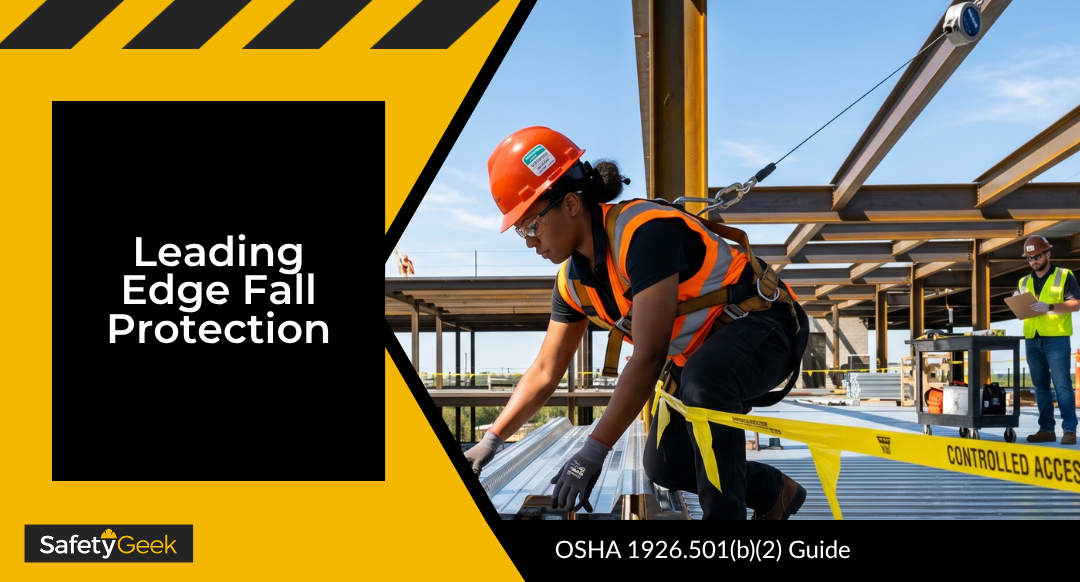
TL;DR: OSHA 1926.501(b)(2) requires guardrail systems, safety nets, or personal fall arrest systems any time a worker is constructing a leading edge 6 feet or more above a lower level. When those options are infeasible or create a greater hazard, you fall back to a written fall protection plan with a controlled access zone. Here’s what compliance looks like in the real world.The hardest part about leading edge fall protection requirements 1926.501(b)(2) isn’t the rule itself. It’s that the edge keeps moving. You install one decking sheet, and now the leading edge is six feet further out… and so is the hazard. That’s the trap. Safety teams write a fall protection program around stationary guardrails, then watch the crew get into trouble on Monday morning because nobody planned for the edge that didn’t exist yet. Let’s break down what the standard actually requires and how to build a plan your crew can follow without slowing down production.
Key Takeaways
- OSHA 1926.501(b)(2) applies whenever a worker is constructing a leading edge 6 feet or more above a lower level.
- Conventional fall protection comes first: guardrails, safety nets, or personal fall arrest systems (PFAS).
- Controlled access zones (CAZs) are a fallback, not a default. Use them only when conventional systems are infeasible or create a greater hazard.
- A written fall protection plan under 1926.502(k) is mandatory when you use the CAZ alternative.
- A competent person must oversee the CAZ, the plan, and the daily inspections.
- Fall protection has been OSHA’s #1 cited standard for 14 years running, and leading edge violations are a regular feature.
What “Leading Edge” Actually Means Under 1926.501(b)(2)
A leading edge is the unprotected side or edge of a floor, roof, or formwork that changes location as additional sections are installed. Steel decking. Concrete formwork. Precast erection. The edge isn’t a fixed line on a finished floor. It advances as the structure goes up. That’s why the regulation treats it differently from 1926.501(b)(1), which covers static unprotected sides and edges. Same six-foot trigger, very different control strategy. The OSHA standard applies to two groups: the workers actually placing the new structural members AND any other employees on that walking-working surface near the leading edge. A lot of citations come from forgetting that second group. The welder, the deck inspector, the laborer carrying material.Three Conventional Options (in priority order)
- Guardrail systems built to 1926.502(b) specs.
- Safety nets under 1926.502(c).
- Personal fall arrest systems (PFAS) under 1926.502(d).
When Conventional Fall Protection Isn’t Feasible
Sometimes it really isn’t. A guardrail can’t span an edge that moves every fifteen minutes. A safety net needs structural attachment points that don’t exist yet. And PFAS without leading-edge-rated equipment can cut the lanyard at the deck edge during a fall. That’s when 1926.501(b)(2) lets you switch to a written fall protection plan with a controlled access zone. But the burden is on you to prove infeasibility or greater hazard, and “we didn’t want to slow down” is not on that list. OSHA’s standard interpretation from 2010 makes that crystal clear. Document the specific work activity, the specific reason conventional systems don’t work, and the specific alternative measures you’ll use. Vague language like “not practical for our operation” gets shredded during an inspection.What “Greater Hazard” Looks Like
Real examples that have held up:- Workers risk being struck by structural members during guardrail installation.
- Net installation requires more time at the edge than the work itself.
- Anchorage isn’t yet structurally sound to support PFAS forces (5,000 lbs per worker per 1926.502(d)(15)).
THE ALL-ACCESS PASS RESOURCE PAGE
Get all the FREE templates, safety management resources, PDFs, spreadsheets, and more...
Controlled Access Zones, Done Right
A controlled access zone is the alternative when conventional protection won’t work. It’s also one of the most misused tools in construction safety. Most CAZs I’ve inspected fail on the same three points: poorly marked boundaries, untrained workers inside the zone, and no safety monitor or competent person actually monitoring. Per 1926.502(g), a proper CAZ requires the following.| CAZ Element | Requirement |
|---|---|
| Control line distance | 6 to 25 feet from the leading edge (up to 60 ft for precast) |
| Control line height | 39 to 45 inches above the surface |
| Tensile strength | Withstand 200 lbs of horizontal force |
| Marking | Flagged at intervals of no more than 6 feet, high-visibility |
| Access | Only authorized workers performing leading edge work |
| Oversight | Competent person designated and on site |
Safety Monitor System: When It’s Allowed
A safety monitor on its own is not an acceptable substitute for fall protection at a leading edge. The monitor system is a low-slope roofing tool under 1926.501(b)(10). For leading edge work, monitors can be part of a written plan inside a CAZ. But they don’t replace the CAZ itself. If you’ve inherited a fall protection program where a monitor walks the deck and that’s the whole plan, you’ve got a serious gap to close before the next OSHA visit.What Goes in Your Written Fall Protection Plan
The plan required under 1926.502(k) isn’t a generic safety binder. It’s site-specific, written by a qualified person, and signed off before work starts. At minimum it documents:- The specific location where conventional systems are infeasible or pose a greater hazard.
- Why they’re infeasible, in evidence-based language.
- The alternative measures (CAZ, safety monitor, restraint systems, designated work areas).
- The competent person responsible for implementation.
- Training records for every worker entering the zone.
- How you’ll investigate any near-miss, fall, or change in conditions.
Building a Compliance Culture Around the Leading Edge
Here’s where I’ll get on my soapbox. The strongest safety programs I’ve seen don’t win at leading edge compliance because they have the best harnesses. They win because they’ve trained their supervisors to coach the work, not just police it. A foreman who can spot a slack lanyard, who understands why the CAZ control line has to be 39 to 45 inches high, who can explain the rule to a new hire in their own words… that’s the person who keeps your crew alive. Equipment is the floor. Leadership is the ceiling. This is the same shift in mindset I cover in our guide to safety management best practices. You can buy the compliance. You have to build the culture. And the culture is what stops the fall before the harness has to. That same principle drives executive safety leadership across every program element, not just fall protection.Frequently Asked Questions
What does 1926.501(b)(2) say about leading edge fall protection?
OSHA 1926.501(b)(2) requires that every employee constructing a leading edge 6 feet or more above a lower level be protected by a guardrail system, safety net system, or personal fall arrest system. If those are infeasible or create a greater hazard, the employer must develop a written fall protection plan under 1926.502(k) and use a controlled access zone.Is a safety monitor enough on its own for leading edge work?
No. A safety monitor is permitted as the sole means of protection only in low-slope roofing under 1926.501(b)(10). For leading edge work, a safety monitor can be part of a written fall protection plan inside a controlled access zone, but it cannot replace conventional fall protection or the CAZ structure itself.How far should the control line be from the leading edge?
Per 1926.502(g)(1), the control line must be set between 6 and 25 feet from the unprotected leading edge. For precast concrete erection, the maximum extends to 60 feet. The line must be 39 to 45 inches high and able to withstand 200 lbs of horizontal force.Who can enter a controlled access zone?
Only employees who are authorized to perform the leading edge work and who have been trained on the fall hazards and the plan. Supervisors, inspectors, and other trades stay outside. A competent person must be designated to oversee the zone, conduct inspections, and stop work if conditions change.What’s the penalty for a leading edge violation?
Fall protection citations under 1926.501 are the most-cited OSHA standard, with over 5,000 violations recorded in fiscal year 2025. A serious violation runs $16,550 in 2026, and willful or repeat citations climb past $165,000. That’s before workers’ comp, lost time, and reputational damage.Where can I find authoritative best practices for leading edge work?
Start with OSHA’s standard text and interpretations at osha.gov. The CPWR Leading Edge Tipsheet and NIOSH falls in construction resources are excellent industry-vetted references with practical guidance you can adapt to your site.Now It’s Your Turn
You can’t out-equipment a poorly designed leading edge plan. You can’t out-train a culture that treats fall protection as someone else’s job. What you can do is build the systems and the leadership behaviors that keep your crew protected before the harness has to do its work. That’s exactly what we teach inside the Safety Leadership Academy. The systems, the influence skills, and the Safety Management Cycle that turn safety professionals into the leaders their organizations need. If you’re ready to stop fighting the same fall protection fires every quarter, that’s where to start.Hi, I'm Brye (rhymes with sky)! I am a self-proclaimed safety geek with two decades of general industry safety experience. Specializing in bringing safety programs to a world-class level and building a safety culture, I have trained and coached many safety managers, just like you, on how to effectively manage workplace safety in the real world. I would love to help you too.