Estimated Reading Time: 8 minutes
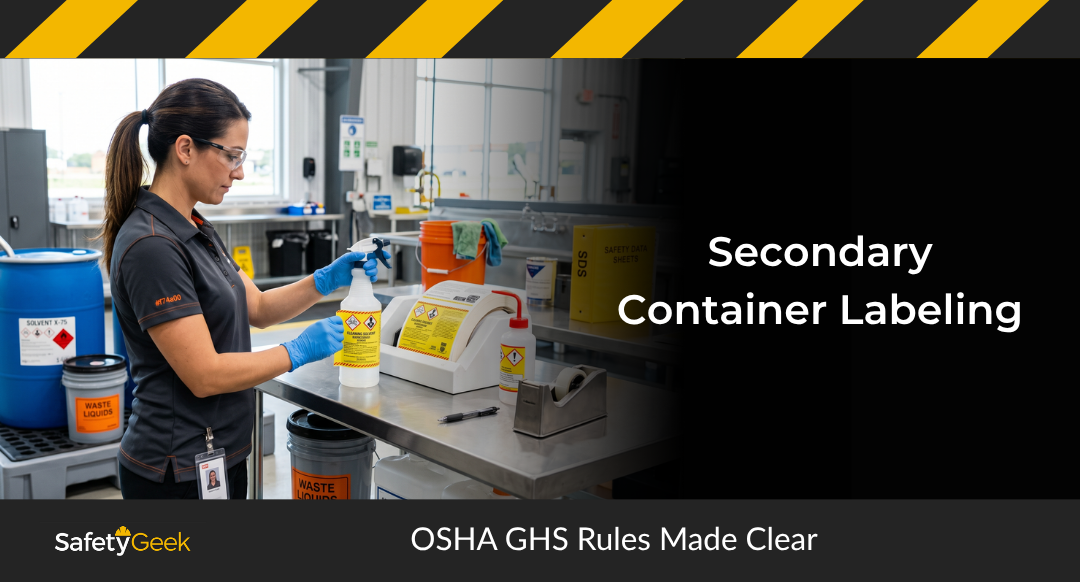
Secondary container labeling is how you mark every workplace container that holds a hazardous chemical after it leaves the manufacturer’s packaging. OSHA’s GHS-aligned rules give you two compliant options: reproduce the full shipped label, or use a simpler workplace label with the product identifier plus the hazards shown in words or symbols. The “immediate use” exemption is narrow, and the 2024 update adds flexibility for containers 100 mL or smaller.
Secondary container labeling is how you mark every workplace container that holds a hazardous chemical after it’s been moved out of the manufacturer’s packaging. Under OSHA’s GHS-aligned rules, you have two compliant ways to do it. You can reproduce the full shipped label, or use a simpler workplace label that names the chemical and shows its hazards.
Here’s where it falls apart for most teams. That spray bottle of degreaser someone mixed at the sink, the bucket labeled “cleaner” in Sharpie, the mystery container nobody can identify by Friday… those are the easy pickins an inspector walks straight to. Labeling is one of the most cited pieces of the entire Hazard Communication Standard, and almost all of it is preventable.
Key Takeaways
- A secondary container is any container you fill yourself – spray bottles, jugs, buckets, transfer tanks.
- OSHA gives you two label options: the full GHS label, or a workplace label with the product identifier plus hazard info in words or symbols.
- The “immediate use” exemption is narrow – same worker, same shift, container never leaves their hands.
- Hazard Communication is consistently OSHA’s #2 most-cited standard, and labeling is a big part of why.
- NFPA and HMIS systems are allowed, but only if you train your team on them and the SDS fills in the details.
- The 2024 HazCom update lets you use reduced labels on containers 100 mL or smaller.
What Goes on a Secondary Container Label
A secondary container is any container you fill in your own facility from a larger shipped container. Think spray bottles, squeeze bottles, jugs, buckets, and transfer tanks. OSHA’s Hazard Communication Standard (1910.1200) treats these differently from the original shipped containers, and it gives you two ways to label them.
Your two labeling options under 1910.1200(f)
Option one is the full GHS label. You reproduce everything the manufacturer’s label carries: product identifier, signal word, hazard statements, pictograms, precautionary statements, and supplier information. It’s the safest bet because it matches what’s already on your shelf.
Option two is the simpler workplace label. Under 1910.1200(f)(6)(ii), you only need the product identifier plus general information about the hazards, shown in words, pictures, symbols, or some combination. OSHA’s 2017 interpretation letter on workplace labels confirms you can leave off the manufacturer’s address, hazard statements, and precautionary statements.
There’s a catch with option two. The missing details have to be immediately available through your safety data sheets, and your team has to be trained to find them. If you’re still building the foundation under all of this, start with what the OSHA HazCom standard actually covers before you fine-tune your labels.
Match the name to the SDS
Whichever option you pick, the product identifier on the label has to match the name on the SDS exactly. This is the link an inspector checks first. When the label says “Purple Cleaner” and the SDS says “Sodium Hydroxide Solution,” you’ve got a gap that’s easy to find and easy to fix.
The “Immediate Use” Exemption and the Mystery Container Trap
OSHA gives you one narrow way to skip the label, and it trips up more safety teams than almost anything else in the standard. It’s called the immediate use exemption. The word that matters most is “immediate.”
When a container truly doesn’t need a label
A portable container can go unlabeled only when all three of these are true at the same time:
- The chemical is used up within the same work shift by the person who filled it.
- That same person keeps the container in their possession the entire time.
- The container never leaves their work area and nobody else uses it.
Set that bottle down at lunch, hand it to a coworker, or leave it on the shelf overnight, and the exemption is gone. Now it needs a label. OSHA’s Quick Facts on labeling and chemical transfer spells this out plainly.
Why mystery containers get cited
Here’s the conversation nobody’s having about mystery containers. When you find a dozen unlabeled bottles on a line, the instinct is to write up the operators and move on. That feels like accountability, but it rarely changes anything.
Here’s what I see over and over… a labeling station with no labels in it, or labels locked in an office three departments away. When the right label is hard to grab, good people improvise with a Sharpie. Recurring labeling gaps are almost always a systems problem, not a people problem.
So ask a better question. Instead of “why won’t they label these,” ask “what makes it hard for my team to label this correctly?” That one shift will fix more bottles than any write-up ever will, and it’s the same pattern behind the most common HazCom violations inspectors find.
THE ALL-ACCESS PASS RESOURCE PAGE
Get all the FREE templates, safety management resources, PDFs, spreadsheets, and more...
GHS vs. NFPA vs. HMIS Labeling Systems
OSHA lets you use an alternative in-plant system like NFPA 704 or HMIS instead of full GHS labels, as long as it carries equivalent hazard information and your team is trained on it. The trouble starts when a facility mixes all three without explaining any of them. A worker stares at a number, a color bar, and a pictogram and has no idea which one tells them how to handle the chemical today.
Which system should you use?
| System | What it shows | Best for | Watch out for |
|---|---|---|---|
| GHS workplace label | Product identifier plus pictograms, signal word, and hazards in words or symbols | The default for most secondary containers; matches the shipped label | Product name must match the SDS exactly |
| NFPA 704 diamond | 0-4 ratings for health, flammability, and reactivity, plus special hazards | Stationary tanks, room placards, and emergency response | Rates emergency severity, not daily handling; needs training |
| HMIS color bars | 0-4 ratings for health, flammability, and physical hazard, plus a PPE code | In-plant systems where you want a built-in PPE prompt | Looks like NFPA but isn’t; easy to confuse without training |
For portable secondary containers that move around your facility, GHS workplace labels are the cleanest choice. Save NFPA and HMIS for fixed tanks and room signage where emergency responders need a quick read. Whatever you choose, write it into your HazCom plan and teach it… a rating nobody understands is just decoration.
What Changed in the 2024 HazCom Update
In May 2024, OSHA updated the Hazard Communication Standard to line up with the newest version of GHS. Most of the changes land on manufacturers and importers. But one piece matters for anyone labeling small containers.
Small containers and packaging too small to label
For containers 100 mL or smaller, OSHA now lets you use a reduced label – product identifier, pictogram, and signal word – with the full information on the outer packaging or a fold-out tag. For packaging that’s physically too small to label at all, the hazard details can live on the outer packaging instead. Your team still has to be able to reach the full label elements and the SDS.
Labs and specialty shops have handled tiny vials this way for years. The 2024 rule simply writes that practice into the standard, so you’re no longer stuck trying to fit a full GHS label on a container the size of your thumb.
The compliance timeline
Here’s the part most summaries skip over. The deadlines roll out in stages: manufacturers of substances comply first, mixtures follow, and employers update workplace labels and training as new SDSs arrive. Expect new-format OSHA Hazard Communication labels to show up between 2026 and 2028. Review your workplace labels each time a product’s SDS changes.
How to Build a Secondary Container Labeling System That Sticks
Compliance isn’t a one-time label blitz before an audit. It’s a system you run on repeat. This is the Coach and Observe part of the Safety Management Cycle, and it’s where labeling either becomes a habit or quietly falls apart.
Make the right label the easy label
People take the path of least resistance, every single time. So put a labeling station at every transfer point – the sink, the dispensing drum, the mixing area – stocked with pre-printed labels for your most-used chemicals. When grabbing the right label takes two seconds, the Sharpie stays in the drawer.
This is also where a strong written program earns its keep. Your written HazCom plan should name your labeling system, where the stations live, and who restocks them. A plan that sits in a binder doesn’t change behavior on the floor.
Coach it, don’t cop it
You’re the guide on the side here, not the label police. Build a quick label check into your regular walk-throughs, and ask your team one question: “Can you find the SDS for this?” That single question tells you whether your training stuck and whether your SDS access actually works.
When you treat labeling as a coaching habit instead of a gotcha, your team starts catching gaps for you. Pair the walk-throughs with solid HazCom training so people understand the “why,” not just the rule. And if you ever need to make the business case upstairs, the numbers behind what HazCom penalties actually cost will get leadership’s attention fast.
Frequently Asked Questions About Secondary Container Labeling
Do I need to label a spray bottle if I fill it myself?
Usually, yes. A spray bottle only skips the label under the immediate use exemption, which means you fill it, use up the contents on your own shift, and never let it leave your hands. The moment you set it down or share it, it needs a workplace label.
What’s the difference between a primary and secondary container label?
A primary container is the original packaging from the manufacturer, and it carries the full GHS label. A secondary container is one you fill yourself in the facility. Secondary containers can use a simpler workplace label as long as it names the chemical and shows its hazards.
Can I use NFPA diamonds instead of GHS labels?
You can. OSHA allows alternative systems like NFPA 704 and HMIS for in-plant containers, as long as they convey the same hazard information and your team is trained to read them. NFPA works best on fixed tanks and room placards, not portable bottles that move around the floor.
Does the immediate use exemption cover a container I use all shift?
Only if you personally keep control of it the whole time and use up the chemical before your shift ends. If the container sits out overnight, gets handed off, or another worker grabs it, the exemption no longer applies. At that point, label it.
How small can a container be before the labeling rules change?
Under the 2024 HazCom update, containers 100 mL or smaller can use a reduced label with the product identifier, pictogram, and signal word. The full information goes on the outer packaging or a tag. Packaging too small to label at all can carry the details on its outer packaging.
Who is responsible for secondary container labels?
The employer owns the labeling program, but the worker who fills the container is the one who applies the label in the moment. That’s why a good system makes labeling effortless. When labels are stocked at the transfer point, your team can do the right thing without slowing down.
Now It’s Your Turn
Secondary container labeling comes down to two things: pick a clear system, and make the right label the easy one to grab. Do that, and one of OSHA’s most cited problems stops being your problem.
Here’s where to start this week:
- Walk your floor and photograph every secondary container. Look for Sharpie names, faded labels, and anything you can’t identify on sight.
- Pick one system per use case. GHS workplace labels for portable containers, NFPA or HMIS for fixed tanks, and write it into your HazCom plan.
- Set up a labeling station at every transfer point. Stock it with pre-printed labels for your top chemicals so the right label is always within reach.
- Add the SDS question to your next walk-through. Ask a worker, “Can you find the SDS for this?” and see what you learn.
If you want a head start, I’ve got done-for-you templates and chemical safety resources waiting in my free resource library. Grab the secondary container label template, print a stack, and drop them at every transfer station in your building.
You’ve got this, Safety Friend. One clean labeling system, and you’ve turned a common citation into a quiet win.
Hi, I'm Brye (rhymes with sky)! I am a self-proclaimed safety geek with two decades of general industry safety experience. Specializing in bringing safety programs to a world-class level and building a safety culture, I have trained and coached many safety managers, just like you, on how to effectively manage workplace safety in the real world. I would love to help you too.