Estimated Reading Time: 7 minutes
One person can wear both hats if they meet both definitions. In most general industry and mid-size construction teams, they don’t.
Treat them as separate roles unless you have someone with both the engineering depth and the field authority.
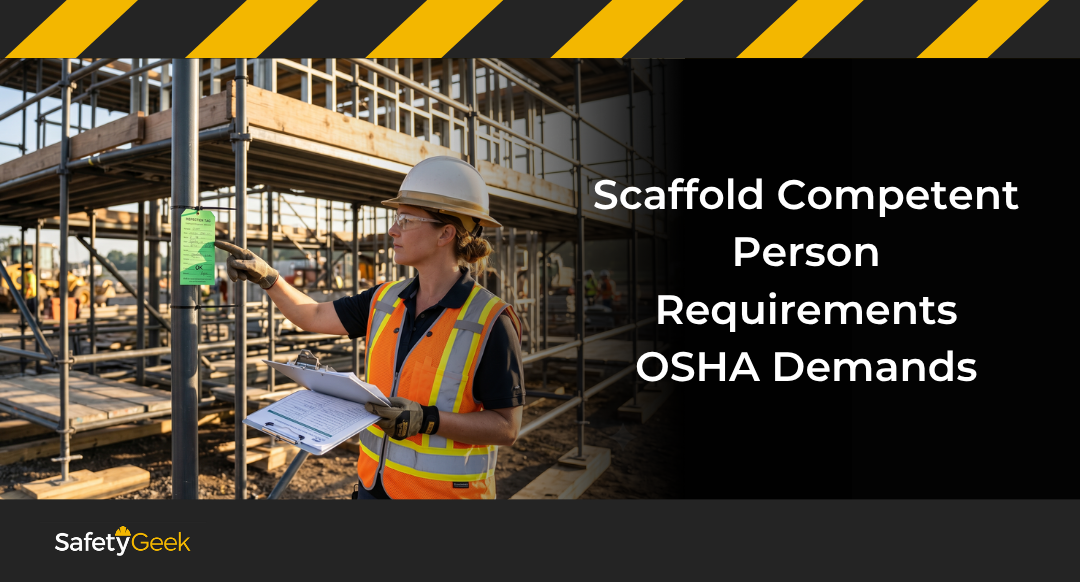
TL;DR: A scaffold competent person is the on-site safety professional OSHA requires to inspect scaffolds before every shift, supervise erection and dismantling, and decide when work can or cannot continue. Under 29 CFR 1926.451 and 29 CFR 1926.454, that person identifies scaffold hazards and holds written authority to stop work and fix them. OSHA doesn’t mandate a specific class… your employer judges the knowledge and grants the authority in writing.When OSHA shows up at a scaffold project, the first question is almost always… “Who’s your competent person, and where is the inspection record?” That single question decides whether the citation is a paperwork warning or a serious violation worth thousands of dollars per item. I’ve watched too many safety professionals get blindsided by that question. They have a great scaffold contractor, solid training, even color-coded tags… but no written designation and no daily inspection records. Scaffold competent person requirements live in the field, not in a binder. If you can’t prove yours daily, OSHA assumes you don’t have one.
Key Takeaways
- OSHA defines a competent person as someone who can identify scaffold hazards AND has authority to correct them on the spot.
- Scaffold inspections happen before every shift and after any event affecting integrity, per 29 CFR 1926.451(f)(3).
- Erection, alteration, and dismantling are supervised by a competent person under 29 CFR 1926.451(f)(7).
- OSHA does not require a specific class. The employer designates competency in writing and grants authority to stop work.
- Scaffold standard 1926.451 is cited roughly 1,900 times each year, often tied to missing competent person inspections.
What OSHA Actually Means by “Competent Person”
Here’s the part most safety professionals miss. OSHA’s definition isn’t about training hours or a wallet card. It’s about two things… capability and authority. Per 29 CFR 1926.32(f), a competent person is “one who is capable of identifying existing and predictable hazards… and who has authorization to take prompt corrective measures to eliminate them.” Both pieces matter. If your designated person can spot a problem but can’t shut the scaffold down, they’re not competent in OSHA’s eyes. OSHA reinforced this in a 2005 standard interpretation. Completing a scaffold course alone does not make someone competent. Only the employer can grant the authority piece.Knowledge the role actually requires
The standard doesn’t list course hours, but OSHA’s 1999 interpretation letter makes the expectations clear. A scaffold competent person carries working knowledge of structural integrity, scaffold maintenance, load limits, manufacturer instructions, and all of Subpart L. Most teams hit this by combining a scaffold-specific training course with hands-on field experience. Neither alone is enough… and OSHA has been very direct about that.The Six Duties Your Scaffold Competent Person Must Own
Scaffold competent person requirements aren’t theoretical. They’re built into specific subsections of 29 CFR 1926.451. Here’s where the duties actually live. 1. Pre-shift inspections. Under 1926.451(f)(3), scaffolds are inspected by a competent person before each work shift. The inspection also kicks in after any event that could affect structural integrity… a vehicle bump, a storm, a dropped load. 2. Supervision of erection and dismantling. Per 1926.451(f)(7), only employees the competent person selects can build, move, or take down a scaffold. The competent person directs the operation start to finish. 3. Mixed components and dissimilar metals. Sections (b)(10) and (b)(11) of 1926.451 require the competent person to evaluate whether mixed manufacturer parts or dissimilar metals are structurally sound and corrosion-safe. 4. Suspension scaffold ropes and stability. Under 1926.451(d)(10) and (d)(18), the competent person inspects suspension ropes pre-shift and decides when suspended scaffolds get secured against sway. 5. Storm and high-wind decisions. Per 1926.451(f)(12), work in storms or high winds is prohibited unless the competent person determines it’s safe and provides extra fall protection or windscreens. 6. Fall protection feasibility for erectors. Section 1926.451(g)(2) requires the competent person to determine whether fall protection is feasible during erection and dismantling… a judgment call that has to be defensible if challenged. That’s six job-defining decisions every shift. If your designated person isn’t making them, no one is.Competent Person vs. Qualified Person: Know the Difference
Safety professionals mix these up constantly, and OSHA inspectors notice. Here’s the side-by-side.| Element | Competent Person | Qualified Person |
|---|---|---|
| Primary role | On-site authority, daily decisions | Technical expertise, design, training |
| Standard reference | 29 CFR 1926.32(f) | 29 CFR 1926.32(m) |
| Authority to stop work | Yes… required | Not part of definition |
| Credentials | None required by OSHA | Degree, certificate, or recognized standing |
| Typical scaffold duty | Pre-shift inspections, supervision | Designing complex systems, training users |
| Training reference | 1926.454(b) trains erectors | 1926.454(a) trains users |
THE ALL-ACCESS PASS RESOURCE PAGE
Get all the FREE templates, safety management resources, PDFs, spreadsheets, and more...
How to Designate and Document Your Competent Person
OSHA won’t tell you exactly how to designate competency. They will absolutely cite you if it isn’t clear who holds the role. Here’s the system I’ve coached safety teams to put in place. Write the role definition. Build a one-page competent person policy listing the scope of authority, required knowledge, and required experience. Reference Subpart L and your specific scaffold types directly. Select based on demonstrated ability. Look at supervisors and senior craft workers who’ve already been making scaffold judgment calls. Confirm they understand the standard, not just the equipment. Train and refresh annually. Use scaffold-specific training that maps to the duties in 1926.451, not generic OSHA 10. Document the date, content, instructor, and proof of completion. Issue a written designation letter. State the person’s name, scope, effective date, and explicit authority to stop work, red-tag scaffolds, and order corrections. Make sure crews know who holds the role. Use a documented inspection system. Daily scaffold tags or digital checklists that name the competent person and the items inspected. Keep them for at least one year. This single habit eliminates most of OSHA’s scaffold citations. It’s the same system we drill into our Safety Leadership Academy students. When maximizing transparency at a construction site is the goal, the competent person record is one of the loudest signals you can send.The Daily Inspection That Keeps You Out of Trouble
If you do nothing else from this post, fix the daily inspection. Scaffold standard 1926.451 lands in OSHA’s top-cited construction standards every year, with roughly 1,900 citations annually. A large share of those come back to one missed step… no documented pre-shift inspection. The daily inspection isn’t a 90-minute audit. It’s a 5 to 10 minute walk that hits the right checkpoints… footings, plumb and level, planking, guardrails, access, ties, and signs of overload or damage. Pair the inspection with a tag system. Green tag means safe to use, yellow means restricted access with conditions noted, red means do not enter. The tag includes the date, time, scope, restrictions, and the competent person’s signature. Tie this back to your broader inspection process. The 4-Step Safety Inspection System gives you the structure to run scaffold checks the same way you’d run a walking-working surfaces inspection… consistent, documented, and coachable. This is also where the Safety Management Cycle comes in. Identifying scaffold hazards is one stage… developing controls, implementing them through training, coaching the competent person, and analyzing inspection data round out the system. Compliance follows when the whole cycle is running. It doesn’t when only one stage gets attention.Frequently Asked Questions
Does OSHA require a scaffold competent person certificate?
No. OSHA does not require a specific certificate, course, or wallet card. The standard requires knowledge and authority, both granted by the employer. Most safety teams use a scaffold-specific training course as evidence of knowledge, then document the authority in a written designation letter.Can the same person be both competent and qualified?
Yes, if they meet both definitions. The qualified person definition requires a degree, certificate, or recognized professional standing in scaffold design. The competent person definition requires on-site authority. One person can hold both roles, but most field teams split them between a designer or engineer and a supervisor.How often do scaffold inspections happen?
Before every work shift and after any event that could affect structural integrity. That includes vehicle impacts, severe weather, dropped loads, or modifications. The competent person performs the inspection and documents the result on a scaffold tag or daily log.What happens if my designated competent person leaves the company?
You designate a new one before scaffold work continues. OSHA expects coverage at all times during scaffold operations. Build a backup into your designation system so you’re not scrambling when a supervisor takes vacation or leaves.Can a competent person delegate scaffold inspections?
Only to another designated competent person. The role itself can’t be handed off to a worker without the same knowledge and authority. If you want broader coverage, train and designate multiple competent persons by shift, site, or scaffold type.Now It’s Your Turn
Scaffold competent person requirements look straightforward on paper. Capability plus authority, documented daily. The hard part is making the role real on a busy site… and that’s where most safety teams quietly lose ground. If you want a step-by-step system for building competent person programs your team actually follows, that’s what we teach inside the Safety Leadership Academy. You’ll learn how to designate, document, train, and coach competent persons across scaffold work, fall protection, and every other field role that demands on-site authority. Start with one move this week… write a designation letter for your scaffold competent person and put a daily inspection tag on every scaffold. That single change closes the most common OSHA finding on the job.Hi, I'm Brye (rhymes with sky)! I am a self-proclaimed safety geek with two decades of general industry safety experience. Specializing in bringing safety programs to a world-class level and building a safety culture, I have trained and coached many safety managers, just like you, on how to effectively manage workplace safety in the real world. I would love to help you too.