Estimated Reading Time: 9 minutes
TL;DR: To address safety violations without creating adversarial relationships in manufacturing, stop treating every violation the same. Honest mistakes need a system fix and a coaching conversation, while willful violations need consistent consequences delivered by someone inside the employee’s line of power. Punishment pushes reporting underground, and coaching plus consistency builds a floor that corrects itself.
Here’s the short answer on how to address safety violations without creating adversarial relationships in manufacturing. Stop treating every violation the same. An honest mistake needs a system fix and a coaching conversation, while a willful violation needs consistent consequences from someone inside that employee’s line of power.
And you already feel the tension. Come down too hard and you become the person nobody tells anything to. Let it slide and nothing changes, the same shortcut shows up next week, and you’re holding the bag when it finally goes wrong.
Key Takeaways
- Not every violation is the same violation. Honest mistakes, at-risk habits, and willful violations each require a different response.
- Punishment suppresses reporting. NIOSH-published research found injury non-reporting more than twice as likely where workers faced discipline for reporting.
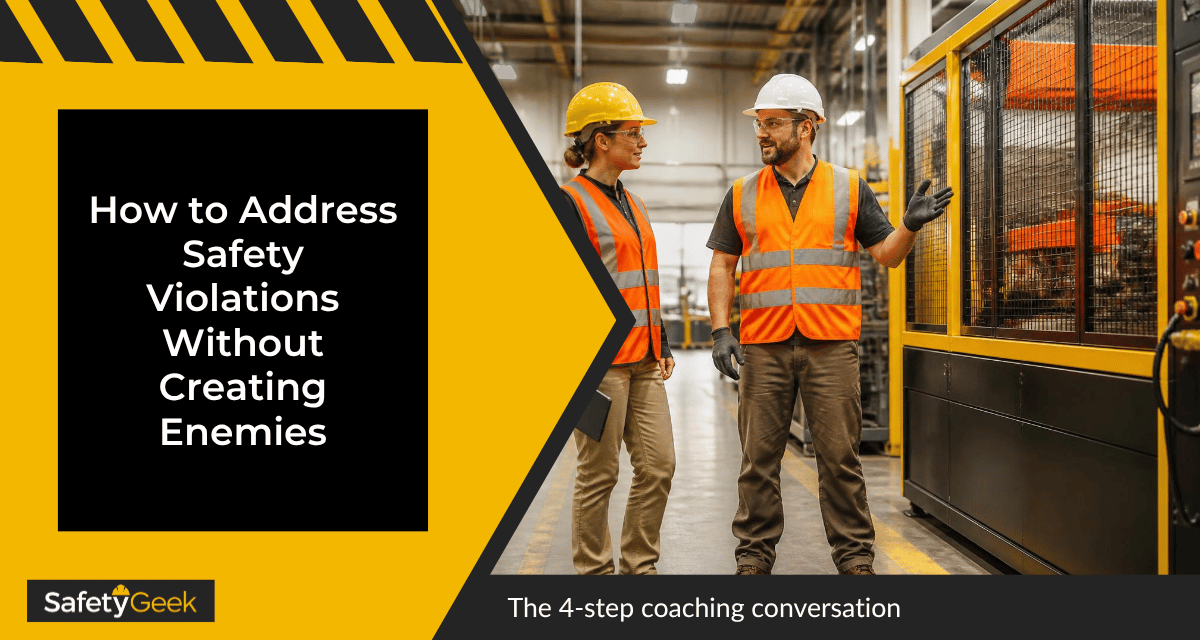
- Coaching is a four-step conversation: describe, impact, ask, agree. It takes about ninety seconds and it does not need documentation.
- You are not in the line of power. Consequences have to come from the employee’s supervisor, or they carry no weight.
- Consistency matters more than severity. Responding only when the outcome is expensive is what teaches people the rule is optional.
- The goal is self-correction, not compliance while you’re watching.
Why Safety Violations Turn Into Conflict on a Manufacturing Floor
An adversarial safety relationship is what happens when correction stops being about the task and starts being about the person. The employee hears “you did something wrong” instead of “this step has a hazard in it.” Once that shift happens, every future conversation starts with defenses up.
Most of the time it starts with a bias called attribution error. When someone else takes a shortcut, we assume it’s about who they are: careless, lazy, in a hurry. When we take the same shortcut, we blame the circumstances.
So the correction comes out as a judgment. And the person on the receiving end knows it.
The floor reads that pattern fast. Workers stop reporting the small stuff because small stuff turns into write-ups.
NIOSH-published research on injury non-reporting and jobsite safety climate surveyed 1,155 workers and found non-reporting was more than twice as prevalent where workers faced discipline for reporting injuries. Fear of reprisal ran four times higher on sites with policies or threats of discipline tied to getting hurt.
That is the real cost of being the enforcer. You don’t just lose the relationship. You lose your data.
Here’s what I see over and over in manufacturing plants: the safety lead who gets the most honest information is almost never the one with the strictest reputation. They’re the one people trust enough to say, “Hey, that guard has been loose for a week.” Being the safety expert instead of the safety police is what keeps that channel open.
Willful Violations vs. Honest Mistakes: Know Which One You’re Looking At
A willful violation is when a trained employee knowingly chooses not to follow a procedure they understand and have the tools to follow. An honest mistake is when a trained employee intended to follow the procedure and something got in the way: a missing tool, an unclear step, fatigue, or a process that quietly made the safe way the hard way.
Between those two sits the one you’ll see most: the at-risk habit. Nobody decided anything. The shortcut just became normal, everybody does it, and nobody has been corrected in two years.
Treating all three the same is what builds the adversarial dynamic. Discipline an honest mistake, and you punish someone for a system failure. Coach a willful violation, and you tell the floor the rule doesn’t matter.
| Honest Mistake | At-Risk Habit | Willful Violation | |
|---|---|---|---|
| What it looks like | One person, one time, surprised by their own error | Multiple people doing the same thing the same way | Trained employee, knowingly skipping a step they can follow |
| Root cause | Process, tools, training gap, or conditions | Normalized deviance and no correction history | Choice |
| Right response | Fix the system, then coach | Reset the standard for the whole group, then observe | Consistent, progressive consequences |
| Who delivers it | Supervisor coaching in the moment | Supervisor with safety supporting the reset | Supervisor or manager in the line of power |
| Documentation | None needed | Observation form | Follow your written program |
There’s a practical test. If you pulled five other employees and put them in that exact spot, would most of them have done the same thing? If yes, you’re looking at a system problem wearing a person’s name.
OSHA’s guidance on protection from retaliation draws a related line. Employers can absolutely discipline safety rule violations. What they cannot do is apply that discipline in a way that’s actually triggered by someone reporting an injury or a hazard, and the test OSHA applies is whether similarly situated employees were treated the same way.
The Coaching Conversation Framework: Describe, Impact, Ask, Agree
Coaching is a question-based discussion where you either recognize what someone did right or give corrective feedback to change a behavior. It’s built into normal everyday conversation. It doesn’t need to be documented, and documenting every one is exactly how organizations end up doing almost none.
The whole thing runs about ninety seconds in four steps.
- Describe what you saw, with zero adjectives. “I noticed the machine was running with the guard swung open.”
- Impact in terms that matter to them, not to your audit. “That’s a pinch point about six inches from your hand.”
- Ask an open question and then stop talking. “What’s making it easier to run it that way?”
- Agree on one specific thing that happens next. “So you’ll pull it down before the next cycle, and I’ll get maintenance to look at that latch today.”
Step three is the whole framework. That’s the step where you find out the guard sticks, the latch is broken, or the changeover takes four minutes longer with it closed. It’s also the step most people skip, because we walk up already knowing what we’re going to say.
None of this is about going soft. You still name the behavior, and you still land on a commitment. What changes is that the person leaves the conversation having solved something with you instead of having been caught by you.
This is the same principle underneath behavior-based safety, which works because it catches people doing things right far more often than it catches them doing things wrong. If you want the research on why recognition outperforms correction, the breakdown of positive versus negative reinforcement covers what actually changes habits.
THE ALL-ACCESS PASS RESOURCE PAGE
Get all the FREE templates, safety management resources, PDFs, spreadsheets, and more...
How to Address Safety Violations Without Creating Adversarial Relationships When You Have No Authority
Here’s the part they skip over in the job description. You don’t have authority over the person you just watched skip a step. Unless you can hire and fire them, you’re outside their chain of command, and every correction you deliver directly asks them to choose between you and the person who signs their timecard.
So the friction you’re feeling is structural. It comes from where safety sits on the org chart, and it’s why so many safety leads feel like they’re fighting the floor every day.
Accountability only works when five things are in place: commitment from the top, real training, defined consequences, authority, and consistency. Pull authority out and the other four collapse. So the correction has to come from inside the employee’s line of power.
That doesn’t mean you go silent. It means your coaching target changes.
You coach the supervisor, and the supervisor coaches the crew. You’re the coach of the coaches, which is exactly why supervisors need to own safety compliance rather than routing every correction through you.
In practice, that looks like three moves:
- Hand supervisors the topics. Pull the safe work practices out of your job hazard analyses and give each supervisor two or three coaching points a week. They don’t have to invent anything.
- Coach them on delivery. Walk them through describe, impact, ask, agree until it’s automatic. Most supervisors default to either ignoring it or writing someone up because nobody ever showed them the middle option.
- Escalate through the org chart, not around it. When a real willful violation shows up, you bring it to the manager with the observation data. They decide and they deliver. Leadership accountability is their job, not yours.
One of our Academy students, Keith, runs safety for a 400-plus employee operation with a two-person team. The shift that moved his program was handing safety ownership back to supervisors through structured toolbox talks instead of trying to cover the floor himself. Same headcount, completely different reach.
Building a Culture of Self-Correction Instead of Fear
A self-correcting culture is one where employees fix and flag things without a supervisor present, because the standard is clear and speaking up has never cost anyone anything. Consequences still exist in that culture. Everyone just knows exactly what triggers them.
Consistency is what makes that work, and it’s where most manufacturing programs break. Say someone lifts wrong and nothing happens, then a month later someone lifts wrong, herniates a disc, and gets written up. What you enforced there was the outcome, and the floor learns that violations are fine right up until they get expensive.
So respond to the behavior every time, at the same level, regardless of whether anyone got hurt. Progressive consequences give you room to do that without going nuclear on step one.
Then protect the reporting channel like it’s the asset it is. OSHA’s Recommended Practices for Anti-Retaliation Programs lays out five elements worth stealing: leadership accountability, a system for hearing and resolving concerns, a channel for reporting retaliation, anti-retaliation training, and program oversight.
The payoff is measurable. A near-miss reporting system at a mid-size electrical manufacturing plant logged 1,690 events over seven years, and the expected rate of OSHA recordable injuries dropped by 0.84 per year across that span. People only report near misses when reporting is safe.
And when they go quiet, it’s usually specific. NIOSH research on safety silence identified four reasons employees don’t speak up: they’re protecting a relationship, they’ve read the climate, they’ve decided the issue isn’t big enough, or the job itself makes speaking up costly. Every one of those is fixable, and none of them are fixed by more discipline.
Frequently Asked Questions About Addressing Safety Violations
Should I ever discipline an employee for a safety violation?
Yes, when it’s a willful violation by a trained employee who had the tools and understanding to comply. The discipline should come from their supervisor or manager, follow your written progressive program, and be applied the same way every time regardless of whether anyone got hurt.
How do I correct a violation without making the employee defensive?
Describe the behavior with no adjectives, state the physical impact, ask an open question about what made the unsafe way easier, and agree on one specific next step. Skipping the question is what triggers defensiveness, because it turns a conversation into a verdict.
What if the supervisor won’t hold their team accountable?
That’s a commitment problem above the supervisor, not a personality problem. Bring observation data to their manager showing the pattern, and ask leadership to set the expectation. Corrections only stick when they come from inside the employee’s chain of command.
Do I need to document every coaching conversation?
No. Coaching is meant to be frequent and conversational, and documenting each one guarantees supervisors will do fewer of them. Document formal observations and assessments instead, and feed that data into your leading indicators so you can trend behavior over time.
How do I handle a violation I witnessed directly as the safety manager?
Address the immediate hazard on the spot, then coach rather than correct. If it rises to a willful violation, hand it to the supervisor with what you saw. Stepping into their authority undermines them and puts the employee in the middle.
Will a non-punitive approach make employees think rules are optional?
Only if you drop the consequences piece. Non-punitive means honest mistakes get system fixes instead of write-ups. Willful violations still carry consistent consequences, and applying them the same way every single time is what proves the rule is real.
Now It’s Your Turn
The tension between being liked and being effective is a false choice. You address safety violations without creating adversarial relationships by sorting the mistake from the choice, coaching through the supervisor instead of around them, and staying consistent whether or not the outcome was expensive.
Here’s what to do this week:
- Pull your last ten corrective actions and sort them into honest mistake, at-risk habit, or willful violation. Look at how many got the wrong response.
- Pick one supervisor and walk them through describe, impact, ask, agree. Have them run it three times before Friday.
- Pull two coaching topics out of your job hazard analyses and hand them to every supervisor on the floor.
- Check your written program for one thing: does the consequence depend on the outcome, or on the behavior? Fix it if it’s the outcome.
If the real problem is that you’re doing all of this alone, without the authority or the backing to make it stick, that’s the exact gap we work on inside the Safety Leadership Academy. You can watch the free training on the Safety Influencer System and see the whole framework first.
You got this, Safety Friend.
Hi, I'm Brye (rhymes with sky)! I am a self-proclaimed safety geek with two decades of general industry safety experience. Specializing in bringing safety programs to a world-class level and building a safety culture, I have trained and coached many safety managers, just like you, on how to effectively manage workplace safety in the real world. I would love to help you too.