Estimated Reading Time: 10 minutes
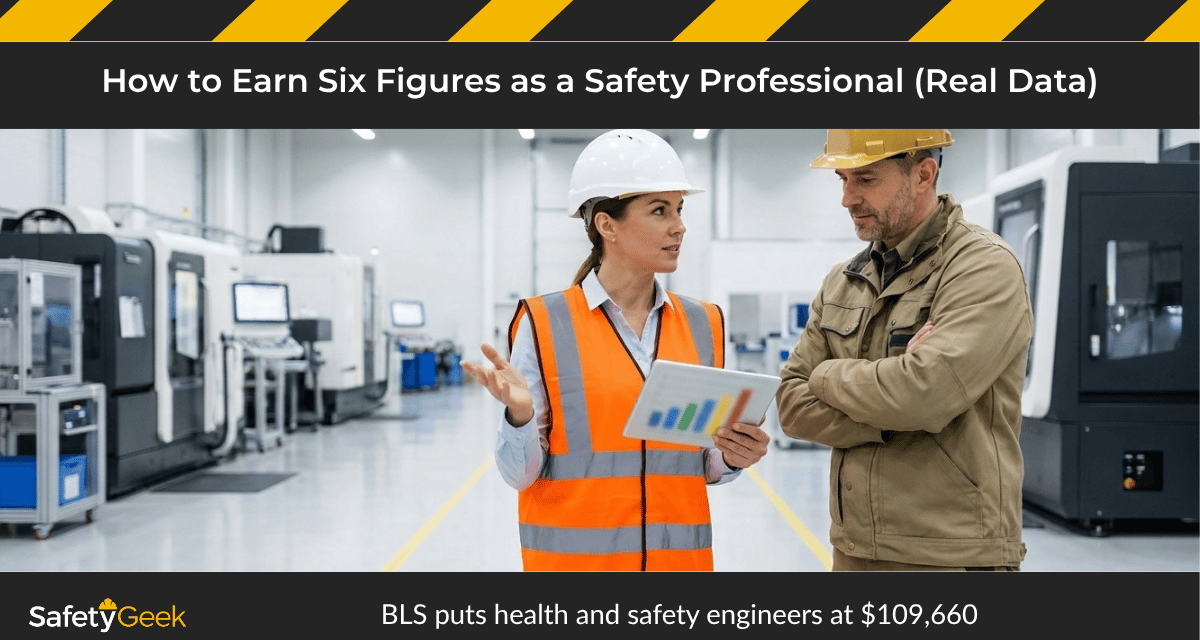
TL;DR: Six figures in manufacturing safety is real. Bureau of Labor Statistics data puts the median for safety technicians at $58,440 and health and safety engineers at $109,660, a gap of more than $51,000 inside one profession. The people who land on the high side of it get there by taking on scope, not by waiting their turn.
Yes, you can earn six figures as a safety professional in manufacturing. Bureau of Labor Statistics data confirms it, and the profession is growing fast enough that the market has room to pay you.
But what most safety leads are living instead is $60K, a department of one covering three people’s work, and an executive team that couldn’t name one thing the safety program did for the business last quarter.
Sound familiar? Then here’s the number that should bother you.
Between the BLS median for a safety technician and the median for a health and safety engineer sits $51,220 a year… one profession, one industry, sometimes one building. Three things decide which end you land on, and none of them is what you were told to chase.
Most of us are living the thing our own people say out loud all the time: “I don’t know what I don’t know.” So let’s fix that part first.
Key Takeaways
- Median pay for safety specialists is $83,910 (BLS, May 2024). Technicians sit at $58,440. That gap is about skill and scope. Years logged have almost nothing to do with it.
- Health and safety engineers median $109,660, which makes a six-figure safety salary a documented market rate.
- Salary follows SCOPE. One site, one plant, one set of numbers pays less than multi-site responsibility and budget ownership.
- Business skills move you faster than technical safety knowledge once you’re past the compliance basics.
- Changing companies is often the fastest way to get a raise. Internal pay bands cap internal raises. Market rates aren’t.
- You need documented dollars. If you can’t put a number on what your program protected, you’re negotiating on feelings.
What Safety Professionals Actually Earn in Manufacturing
Want the honest picture? Guessing at this is what keeps good people underpaid for years.
The national numbers
Want to know why two people with the same title and the same years can be $40,000 apart? Occupational safety pay splits into three tiers, and the tier you sit in has more to do with the work you own than the years you’ve logged.
According to Bureau of Labor Statistics wage data for occupational health and safety specialists and technicians, the median annual wage for specialists was $83,910 in May 2024, while technicians earned $58,440. That’s a $25,470 spread inside the same profession.
The third tier is where six figures become normal. Health and safety engineers had a median annual wage of $109,660 in May 2024. Same industry, same plants, very different scope of work.
And the field is growing. BLS projects 12 percent growth for safety specialists and technicians from 2024 to 2034, much faster than the average for all occupations. More demand means more room to negotiate.
Why the manufacturing number moves so much
Manufacturing pay is scattered because manufacturing safety jobs got created in two completely different ways. Some were built as a real department with a budget. Most were bolted onto whoever was standing closest when the insurance carrier started asking questions.
A single-site coordinator at a 90-person shop and a regional EHS manager over eight plants are both “manufacturing safety.” They are not the same job, and the pay tells you which origin story your role came from.
What actually moves your number:
- How many sites you cover
- Whether you own a budget
- Whether you carry environmental compliance on top of safety
- Whether the executive team gives you a seat at the table or treats you as a paperwork stop
The six career stages and what each one pays
Every safety career I’ve watched, including my own, moves through the six stages of a safety career. Here’s roughly what each one pays, and what actually gets you to the next one.
| Career Stage | Typical Range | What Moves You Up |
|---|---|---|
| 1. The Confused Safety Grunt | Entry-level, varies widely | Learning the regulations and the operation |
| 2. Overlooked Safety Employee | $40,000 – $55,000 | Building your first real systems instead of putting out fires |
| 3. Underappreciated Safety Manager | $57,000 – $70,000 | Influencing the line of power instead of enforcing at it |
| 4. Overwhelmed Subject Matter Expert | $70,000 – $90,000 | Owning a budget and reporting business results |
| 5. In Control Safety Professional | Knocking on six figures | Delegating the doing, keeping the coaching |
| 6. Respected Safety Executive | $110,000 – $150,000+ | Multi-site scope and a documented financial case |
See what’s missing from that right-hand column? NOT more OSHA courses. NOT more years.
Every move on that list is about scope and influence.
Honestly, I’m not sure which one you’re standing in. The Safety Career Journey Quiz takes about two minutes and emails you a roadmap built for that stage.
What staying put actually costs you.
Nobody puts a price tag on standing still, so let me put one on mine.
I sat on the sideline of my own development for about ten years. I estimate that cost me nearly $700,000 in earnings I’ll never get back.
“Eight years and I’ve tried everything I can” is the most common sentence I hear from safety leads… and it’s a scope problem nobody ever named out loud. It shows up as being invisible when things go right and blamed when they go wrong.
The Three Skills That Separate Six-Figure Safety Leaders
I’ve hired more than ten safety managers, specialists, and administrators. The resumes that commanded the top of the band shared the same three things, and regulatory knowledge wasn’t one of them.
Business acumen
Safety is a profit center, not a cost center. Every dollar you keep from walking out the door in workers’ comp, insurance premiums, overtime backfill, rework, and turnover is a dollar the company earned.
But most of us were never taught to talk that way. We were taught citations and standards, so we walk into budget meetings armed with the wrong language.
The fix is smaller than it sounds. Learn how your plant makes money, learn what metric your plant manager gets graded on, and attach safety to that metric. OSHA’s $afety Pays estimator translates an injury into the sales volume your company has to generate just to cover it, which is a number a general manager feels in their gut.
Then say it out loud. Kill “we need to fix the guarding on line four.” Try this: “That guard is $4,200. An amputation runs six figures once you count the claim, the backfill, and the downtime, and at our margin we’d have to sell millions just to earn that back.”
Matt Michalak, one of our students in commercial roofing, got that framing in front of his CFO: “I’m not here about spending money; I’m here to protect the money we bring in.” He watched the light bulb come on.
Influence without authority
You don’t have authority in safety. Unless you can hire and fire, corrections have to travel through somebody in the employee’s line of power.
That’s not a limitation to complain about… that IS the game.
The safety leads who get paid the most stopped trying to enforce and started building systems that put the message in the supervisor’s mouth. That’s the difference between managing safety and influencing it (and it’s the single hardest habit to break).
Some of this is deeply unglamorous. For years I got to the plant an hour before shift, did a PPE walk with a clipboard before touching my computer, then sat in the break room with my coffee while people came in. (My crew knew my coffee mug better than they knew my office.)
That hour bought me more influence than any policy I ever wrote, because by the time I needed something from a supervisor, we’d already had forty conversations that had nothing to do with safety. Half of them were about his fantasy football team, and I still could not tell you the rules.
Documented results you can put in a sentence.
And here’s the part I really want you to understand about safety pay. Being conscientious doesn’t show up on an offer letter. A sentence with a number in it does.
Eric Bryant, a Safety Director in our program, can say his workers’ comp claims dropped 34 percent in eight months. That sentence travels. It survives a hiring panel, a budget meeting, and a salary review.
If you can’t finish a sentence like that today… that’s your project for the next quarter. Track a baseline, run one initiative, measure the delta, and write it down while it’s fresh.
THE ALL-ACCESS PASS RESOURCE PAGE
Get all the FREE templates, safety management resources, PDFs, spreadsheets, and more...
How to Actually Move Up a Stage
Knowing the numbers doesn’t move you. These moves do.
Build the system before you have the title.
The biggest jump in pay comes when you stop being the person who does safety and become the person who runs the system that does safety. That’s the whole point of the Safety Management Cycle: Identify, Develop, Implement and Train, Coach and Observe, Analyze.
When your program runs on a repeatable cycle, you stop drowning, and your work finally becomes visible as a system. That visibility is what gets you considered for the bigger role.
Building a safety management system that grows your career is the closest thing to a reliable ladder in this profession.
Change companies on purpose
This one’s uncomfortable, but it’s true. Internal raises are capped by internal pay bands. The biggest salary jumps I see come from people who changed jobs once they had the skills to back it up.
Rhett Keiser spent nine years at one company before he left, and he now oversees EHS at a packaging manufacturer. In his own words, he makes “35k a year more” and finally works with a management team that values safety.
Wesley Sanchez gave one company 25 years. Twelve of those were in safety, and he built their entire program from nothing.
Then he earned his certification on his own and asked for a raise. HR said no.
He left. He gained $50,000 in pay and got promoted to senior inside his first year at the new place.
Get the credential that unblocks the conversation
I’ll be honest about this one, because I got it wrong.
When I started in safety 20-plus years ago, a certification was something consultants had. Most of us at the field level didn’t even have a safety degree, and the programs I found cost enough that going after one meant real strain on my family.
So I put it off… every year. (Always after the next project, and there is always a next project.)
That was a mistake. Better opportunities kept coming to me, and my lack of a certification stalled the conversations before they got to money.
The Certified Safety Professional (CSP) shows up most often in senior manufacturing postings. Before you commit, though, work out which safety certification actually fits your path, because the wrong one is expensive in both money and time.
Take the scope, even when it’s messy
Multi-site responsibility is the clearest dividing line between a $75K job and a $115K job. So when your company acquires a facility, volunteer. When a second plant loses its coordinator, raise your hand.
Nobody hands you the clean version. The path from safety manager to safety director is almost always paved with the mess somebody else refused to touch.
Frequently Asked Questions About Six-Figure Safety Salaries
How long does it take to reach six figures in safety?
It depends on scope changes and job moves far more than on time served. Safety leads who add sites, take a budget, or move companies can get there in a handful of years. Stay at one site with one title and the ceiling stays where it is, no matter how long you wait.
Do I need a safety degree to earn six figures?
No. Plenty of six-figure safety leaders came in without one, and I’m one of them. I was promoted into a safety administrator role with no experience, and worked my way up to Director of Safety reporting to a board of directors, and later to a regional role covering 39 US locations plus 18 in the UK and Ireland.
Is the CSP worth it for the salary bump?
The CSP won’t hand you a raise by itself, but it removes a filter. Many senior manufacturing and corporate postings screen for it, so without the credential you never reach the salary conversation at all. It won’t make you better at the job either, and it will get you in the room where the job is offered.
Which manufacturing sectors pay safety professionals the most?
Higher-hazard, higher-margin sectors pay the most. Petroleum and coal products, chemicals, and pharmaceuticals generally sit above general manufacturing. The bigger the potential boom, the more a company will pay to prevent it.
How do I ask for more money without getting shut down?
Bring numbers, not needs. Skip “I’ve been here four years and I’m underpaid.” Try: “Last year we cut workers’ comp spend by $84,000 and dropped recordables by a third. I’d like to talk about what it takes to move into the next pay band.”
Can I earn six figures without moving into management?
You can. Health and safety engineers, process safety specialists, and technical safety roles in high-hazard manufacturing all reach six figures on the technical track, which runs parallel to the management track. The trade-off: you go deep, not wide.
Now It’s Your Turn
Six figures in safety comes down to scope, and to being able to put a dollar figure on what you protect.
And before you tell me your company would never pay that… you might be completely right.
That’s information, though, and not a verdict. Rhett and Wesley both got their number by taking their skills somewhere that already wanted them.
Three things to do this week:
- Pull your last twelve months of injury and workers’ comp data and calculate one real savings number.
- Book fifteen minutes with your plant manager and ask what metric they’re graded on this year.
- Pick one process you currently do yourself, and write the system that lets a supervisor run it instead.
And if you’re not sure which stage you’re standing in, take the Safety Career Journey Quiz. Two minutes, and you’ll get a roadmap built for where you actually are.
The money in this profession is real. You just have to go get the scope that comes with it.
You got this, my safety friend.
Hi, I'm Brye (rhymes with sky)! I am a self-proclaimed safety geek with two decades of general industry safety experience. Specializing in bringing safety programs to a world-class level and building a safety culture, I have trained and coached many safety managers, just like you, on how to effectively manage workplace safety in the real world. I would love to help you too.