Estimated Reading Time: 9 minutes
TL;DR: To prevent burnout as a safety manager in manufacturing, you have to change the workload, not just your mindset. Safety burnout comes from three things: reactive firefighting, professional isolation, and responsibility without authority. The fix is handing ownership to supervisors, building systems that run without you, and protecting recovery time on purpose. Self-care helps. Structure is what actually holds.
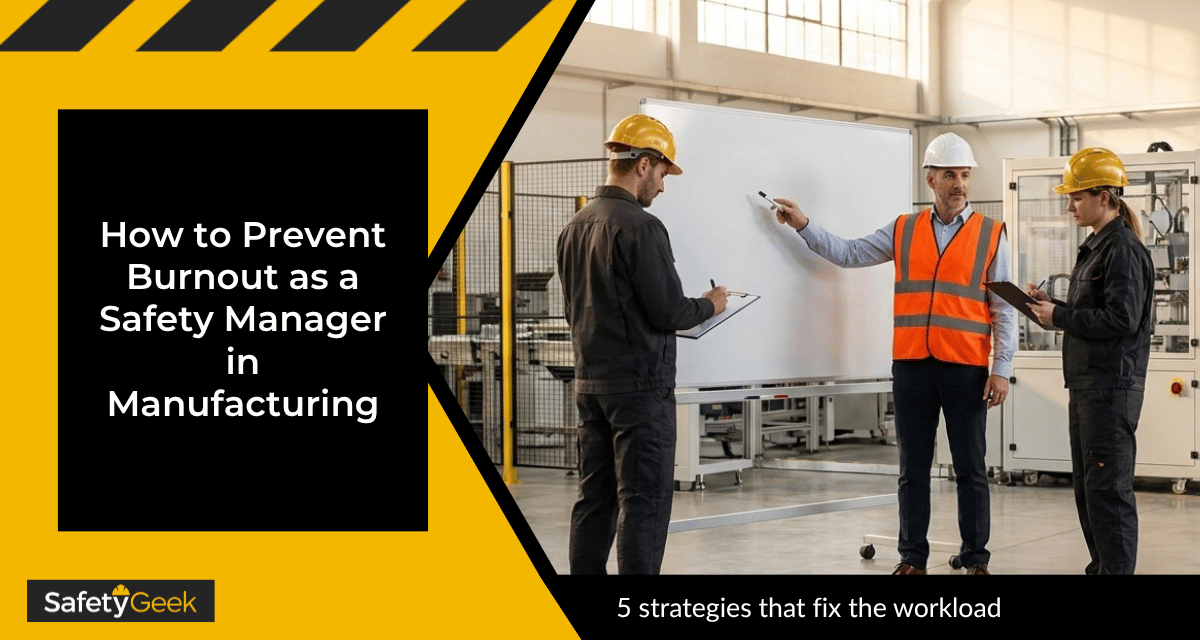
Learning how to prevent burnout as a safety manager in manufacturing starts with an uncomfortable admission. You cannot rest your way out of a workload problem. Burnout in this role is a work design issue, and the strategies that work change what you own and how the work flows.
You carry the weight of everyone else’s wellbeing, and nobody is carrying yours. You’re the department of one, spinning too many plates, running around like a headless chicken while the numbers still climb. And when something goes wrong, all fingers point at you.
Key Takeaways
- Burnout is a workplace condition, not a character flaw. The World Health Organization classifies it as chronic workplace stress that hasn’t been successfully managed.
- Three root causes drive safety burnout: reactive firefighting, professional isolation, and responsibility without authority.
- The warning signs show up in your work before they show up in your body. Cynicism toward employees is usually the first crack.
- Self-care advice fails because it treats a workload problem with a personal habit.
- Redistribution is the strongest prevention strategy. When supervisors own their piece, safety stops living on one desk.
- Recovery has to be scheduled, not earned after the backlog clears. That day never comes.
What Burnout Actually Looks Like in a Safety Role
Burnout is chronic workplace stress that hasn’t been successfully managed. The World Health Organization’s classification of burnout describes three dimensions: exhaustion, mental distance or cynicism toward the job, and reduced professional effectiveness.
That second dimension is what makes safety burnout so hard to catch from the inside. You don’t wake up feeling burned out. You wake up feeling annoyed.
Annoyed that the same line lead is still cutting the same corner. Annoyed that you’re writing the same corrective action for the third time this quarter.
And here’s what I see over and over with safety leads in manufacturing. They interpret that cynicism as a character problem. They decide they’ve become bitter, or that they’ve stopped caring, or that they were never cut out for this.
None of that is what’s happening. Cynicism is a documented symptom of a workload that has outrun your control over it. It’s data, and it’s telling you the system needs to change.
The Early Warning Signs Most Safety Leads Miss
The physical signs get all the attention, but the job-related signs come first. Watch for these:
- Dread before floor time. You used to like being out there. Now you find reasons to stay at your desk.
- Documentation you no longer believe in. You’re filling out the form to have the form, which is the CYA documentation trap.
- Shrinking scope. You’ve quietly stopped bringing up the bigger issues because you’re tired of hearing no.
- Weekend rumination. The incident you didn’t catch replays on Sunday night.
- Resentment toward the people you serve. Supervisors become “them.” That one is the loudest alarm.
If three or more of those sound familiar, you’re not failing. You’re carrying a load that was never designed to sit on one person.
The 3 Root Causes of Safety Manager Burnout
Safety is uniquely exposed to burnout, and it’s not because safety leads are fragile. It’s because the role is built with three structural pressures stacked on top of each other.
1. Reactive Firefighting That Never Ends
Manufacturing runs on go, go, go. Something breaks, you stop, you fix it, you go again.
When your day is dictated by whatever went wrong in the last hour, you never get to the work that prevents the next hour from going wrong. You stay in the whirlwind, and it’s exhausting because it has no finish line.
Kelly Dunn, now Director of Safety at a 130-office consulting firm, described this exactly. Safety positions get draining because you never see a finished product.
2. Professional Isolation
Most manufacturing safety leads are a team of one. There’s nobody down the hall who does what you do, nobody to sanity-check a judgment call, nobody who understands why a near-miss report ruined your afternoon.
OSHA’s workplace stress guidance for employers names this directly, listing loneliness, isolation, uncertainty, and grief as real workplace stressors employers should address rather than ignore.
Isolation does something specific to burnout. It removes the calibration that tells you what’s normal, so every problem starts to feel like your personal failure.
It also leaves you alone with the hard parts of the job, which is how vicarious trauma in safety management roles quietly accumulates.
3. Responsibility Without Authority
This is the big one, and it’s the one nobody warns you about when you take the job.
You’re handed a title and the expectation that you’re in charge of safety. But you don’t have hire-and-fire authority over a single person on that floor. That gap between what you’re accountable for and what you actually control is the artificial authority trap, and it is a burnout engine.
The research backs this up. Lack of control over your own work is one of the most consistently identified drivers of occupational burnout, and it’s a core theme in the WHO’s guidance on mental health at work.
So you push harder. You chase another certification, work another Saturday, memorize another standard. And none of it closes the gap, because the gap was never about your knowledge.
THE ALL-ACCESS PASS RESOURCE PAGE
Get all the FREE templates, safety management resources, PDFs, spreadsheets, and more...
How to Prevent Burnout as a Safety Manager in Manufacturing: 5 Strategies
These five work because they change the job’s structure. Start with one. Trying all five at once is just a new way to overload yourself.
1. Hand Ownership to Supervisors
Your job is not to do safety. It’s to be the subject matter expert, the guide on the side, and the coach of the coaches.
Start small and specific. Give supervisors the toolbox talk, the daily walkthrough, or the first-level correction, then coach them on delivery instead of doing it yourself.
Kelly’s turning point came when she rolled out an office safety coordinator plan across her organization. She shifted from directing people to partnering with them, and the load stopped landing entirely on her.
2. Build Systems That Run Without You
The real test of a safety program isn’t whether it works when you’re there. It’s whether it works when you’re out for a week.
Pick the one process that falls apart in your absence and document it well enough that someone else can run it. Then do the next one. Running each process through the Safety Management Cycle gives you a repeatable structure: Identify, Develop, Implement and Train, Coach and Observe, Analyze.
This is also how you stop being the bottleneck. Bottlenecks don’t look indispensable to leadership. They look slow.
3. Triage by Risk, Not by Volume
When everything is urgent, you default to whoever asked last. That’s how the highest-risk items end up waiting behind the loudest ones.
Rank your open items by actual risk severity and exposure, then work the top of that list first – our guide to prioritizing the most important work when everything feels important walks through the ranking method.
The relief here is real and it’s fast. You stop feeling behind on everything because you’ve defined what “caught up” means.
4. Break the Isolation on Purpose
Isolation doesn’t fix itself, and waiting for your company to hire you a partner is a long wait.
Build the outside connection deliberately. That can be a peer group, a mentorship program, an industry community, or one other safety lead you text when something goes sideways.
If you’re running solo, our post on managing a safety team of one covers the practical side of this. And if the isolation is tipping into something heavier, our roundup of mental health resources for overwhelmed safety managers lists where to go.
5. Schedule Recovery Like a Compliance Deadline
You will never earn recovery by finishing the backlog. The backlog is not going to end.
Block it instead. A real lunch away from the desk, a hard stop time two nights a week, PTO that gets requested in January rather than surrendered in December.
OSHA’s guidance on addressing workplace stress and mental health points to exactly this kind of structural support, including transparent communication, access to mental health resources, and training supervisors to recognize and talk about stress.
Why Self-Care Advice Doesn’t Fix Safety Burnout
Meditation apps and gratitude journals get recommended constantly, and there’s nothing wrong with them. But they treat your response to the workload instead of the workload itself.
NIOSH’s burnout prevention guidance is direct about this. Improving workplace policies and practices is the most effective way to address burnout, and self-care alone is not enough.
Here’s how the two approaches compare in a safety role:
| Individual Fix | System Fix | |
|---|---|---|
| Example | Breathing exercises before a tough meeting | Supervisors own first-level corrections |
| What it changes | How you feel about the load | How much load reaches you |
| Time to effect | Immediate but temporary | Slower but permanent |
| Works when you’re out sick | No | Yes |
| Effect on the program | None | Program scales past one person |
| Effect on leadership’s view | None | Safety looks responsive, not backed up |
Use both. Just don’t mistake the first column for a strategy.
Frequently Asked Questions About Safety Manager Burnout
Is burnout the same as being stressed at work?
No. Stress is temporary pressure that eases when the demand passes.
Burnout is what happens when that pressure never lets up and you lose control over it. The World Health Organization defines it by three markers: exhaustion, cynicism toward the job, and a drop in your professional effectiveness.
How long does it take to recover from safety manager burnout?
There’s no fixed timeline, and it depends far more on what changes than on how long you rest. Time off without a workload change usually leads right back to the same place within weeks. Most safety leads feel meaningful relief within one to three months of actually redistributing ownership.
Should I tell my manager I’m burned out?
Yes, and frame it as a program risk rather than a personal one. Show what’s backing up, what the delay costs, and what redistributing ownership would fix. Leadership responds to a capacity problem with numbers attached far better than to a general statement about being overwhelmed.
Is quitting the answer if my company won’t change?
Sometimes, but change jobs from a position of strength, not exhaustion. Build the systems and the delegation model where you are first, because those skills travel with you. Many safety leads find the role becomes livable once ownership shifts, and the ones who do leave negotiate better with proof of what they built.
Can I prevent burnout if I’m the only safety person on site?
Yes, and it matters more for you than for anyone. Being a team of one makes redistribution essential rather than optional, because the alternative is a program that only functions when you do. Start by handing supervisors one recurring task, then add outside peer support to break the isolation.
Does burnout mean I’m not cut out for safety?
No. Burnout tracks with workload and lack of control, not with aptitude or commitment.
The safety leads who burn out are usually the ones who care the most and absorb the most. That instinct is an asset once it’s paired with systems that spread the work.
Now It’s Your Turn
Preventing burnout as a safety manager in manufacturing comes down to one shift: stop absorbing the work and start distributing it. The exhaustion isn’t a sign you’re doing it wrong. It’s a sign you’re doing all of it.
Take Action
Pick one item from this list and do it this week.
- Name the three tasks that only you can currently do, and choose one to hand to a supervisor.
- Rank your open corrective actions by risk instead of by age, and work the top three.
- Document one process well enough that someone could run it while you’re out.
- Reach out to one safety lead outside your company and start a standing check-in.
- Put one hard stop on your calendar this week and keep it.
You don’t need a bigger budget or a new title to start any of those. You need permission to stop being the only person holding it up, and you have that.
If you want the full system behind this, the free training on the Safety Influencer System walks through how to build influence into the work you’re already doing, so the program stops depending on your personal capacity. It’s the same framework we teach inside the Safety Leadership Academy.
You got this, Safety Friend.
Hi, I'm Brye (rhymes with sky)! I am a self-proclaimed safety geek with two decades of general industry safety experience. Specializing in bringing safety programs to a world-class level and building a safety culture, I have trained and coached many safety managers, just like you, on how to effectively manage workplace safety in the real world. I would love to help you too.