Estimated Reading Time: 8 minutes
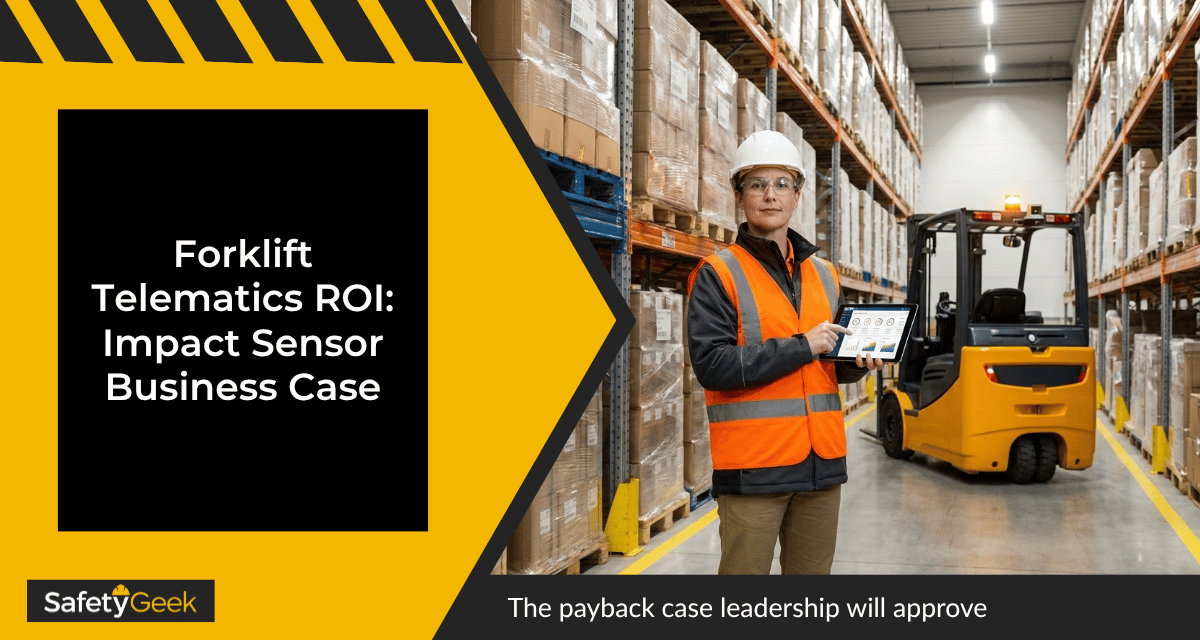
TL;DR: Forklift telematics and impact sensors pay for themselves when you count more than injuries. Fleet software commonly runs $25 to $50 per truck per month. The return shows up in racking and product you stop repairing, trucks you stop rebuilding, citation exposure you stop carrying under OSHA 1910.178, and downtime you stop absorbing. Build the case on those four buckets, put a dollar figure next to each one, and the payback math writes itself.
The ROI of forklift telematics and impact sensors comes from four cost buckets, not just injury reduction. Racking and product damage, truck damage, citation exposure under the powered industrial truck standard, and unplanned downtime.
Injuries matter most. They are also the slowest number to move and the hardest one to defend in a budget meeting.
Most safety leads I talk to already believe the sensors would help. They get stuck the second finance asks for a payback number, and the honest answer sounds like a guess.
That’s where the request dies. A good idea with no dollars attached reads like a wish list item.
Key Takeaways
- Telematics answers who, when, and how. Impact sensors answer what got hit and how hard.
- Fleet software commonly runs $25 to $50 per truck per month, making the annual cost easy to compare against a single rack repair invoice.
- Racking and product damage is usually the fastest-moving number, and operations already tracks it for you.
- OSHA 1910.178 lands in the top 10 most-cited standards year after year, which puts real dollars in the compliance bucket.
- Fork truck incidents kill about 100 workers and seriously injure about 20,000 every year, according to OSHA’s own emphasis program data.
- Payback gets calculated, not estimated. Pull 12 months of damage, repair, and downtime records before you request a single sensor.
- These systems die when the data becomes a discipline list, because operators will work around anything that gets them written up.
What Forklift Telematics and Impact Sensors Actually Do
Forklift telematics is a hardware and software system that records how a powered industrial truck gets used: who operated it, when, for how long, at what speed, and whether the pre-shift inspection actually happened.
An impact sensor is an accelerometer mounted to the truck that detects a collision above a set force threshold, then logs it with a timestamp and the operator ID from the login.
Most systems bundle the two. The telematics box handles access control and inspection prompts, the sensor handles collisions, and both feed the same dashboard.
Here is what that changes on the floor. Right now, a damaged rack beam gets reported when somebody notices it, which might be Thursday for a hit that happened Monday.
Nobody knows which truck did it, so nobody owns it. The repair disappears into a maintenance line item that never gets traced back to a cause.
With sensors, that same impact shows up as a timestamped event tied to a truck, an operator, and a shift. You stop guessing where your damage comes from, and you start seeing that most of it happens in two aisles on second shift.
| Capability | Telematics only | Impact sensors only | Both together |
|---|---|---|---|
| Operator access control | Yes | No | Yes |
| Electronic pre-shift inspection | Yes | No | Yes |
| Certification expiration alerts | Yes | No | Yes |
| Collision detection and severity | No | Yes | Yes |
| Automatic slow-down or lockout after a hit | No | Sometimes | Yes |
| Damage traced to a location and a shift | No | Limited | Yes |
This is the piece vendors skip in demos. Access control and inspection logging are the compliance half of the system, and impact detection is the damage half.
You need both halves for the business case to hold up. The compliance half rarely produces a big enough number on its own.
The Real Numbers Behind the Business Case
Fleet software pricing commonly lands between $25 and $50 per truck per month, with hardware either bundled into the subscription or charged once per unit. Treat that as a planning range for your own quotes, not an industry average.
For a 20-truck fleet at $40 per truck per month, you are looking at roughly $9,600 a year in software plus whatever the hardware quote comes to. That is the entire left side of the equation.
The right side is where safety leads leave money on the table. Most only count injuries, and injuries are the one number executives quietly discount because they do not believe it will happen to them.
| Cost bucket | What you pay for it today | What the data changes |
|---|---|---|
| Racking and product damage | Replacement beams, engineering inspections, damaged inventory write-offs | Every hit ties to a truck, an operator, and an aisle, so you fix the layout instead of guessing |
| Truck damage | Masts, forks, hydraulics, overhead guards, rebuilds, rental trucks | Rough handling surfaces months before it turns into a rebuild quote |
| Citation exposure | OSHA penalties, abatement work, legal hours, corporate attention | Training, evaluation, and inspection records are date-stamped instead of pencil-whipped |
| Downtime | Stopped lines, blocked aisles, cleanup crews, re-picks | Impact alerts reach a supervisor in minutes instead of at the end of the shift |
Say your plant replaced 14 rack beams last year at $600 installed, absorbed $38,000 in forklift repairs above normal wear, and lost 22 hours of line time to cleanup and blocked aisles. That is roughly $46,400 before you touch a single injury number.
Cut the damage side by 40 percent, and the system pays for itself inside the first year. The injury reduction sits on top as a bonus you never had to promise.
That reframe is the whole job. Safety is a profit center when you show the money you protect, and this is one of the few purchases where the receipts already live in somebody else’s spreadsheet.
THE ALL-ACCESS PASS RESOURCE PAGE
Get all the FREE templates, safety management resources, PDFs, spreadsheets, and more...
What Doing Nothing Actually Costs
Fork truck incidents kill about 100 workers and seriously injure about 20,000 every year, according to OSHA’s powered industrial truck emphasis program directive. Overturns alone drive roughly 25 percent of forklift-related deaths, per OSHA’s guidance on forklift loading and unloading.
Those numbers are why the standard exists. They rarely win a budget meeting.
The compliance cost is more concrete. OSHA’s powered industrial truck standard covers operator training, evaluation at least every three years, certification records, and a daily inspection before each shift.
OSHA’s frequently cited listing for powered industrial trucks shows the same handful of subsections coming up over and over. Training, refresher evaluation, certification documentation, and failing to remove an unsafe truck from service.
Every one of those is a documentation problem. And documentation is exactly what a telematics system produces without anyone remembering to produce it.
Penalties are only the opening bid. The abatement work, the legal hours, the corporate attention, and the inspection that expands into three other standards cost more than the check ever does.
If you want the human side of that math, the forklift accident statistics behind these citations tell the story better than any penalty table.
How to Build the Payback Calculation
The number you walk in with matters more than the technology you picked. Executives are not evaluating sensors. They are evaluating whether your math can be trusted.
- Pull 12 months of damage records. Maintenance work orders, rack repair invoices, damaged product write-offs, rental truck charges. Operations already has all of it.
- Separate wear from abuse. Tires and forks wear out on their own. Bent masts, cracked overhead guards, and sheared uprights do not.
- Price your downtime per hour. Ask finance for the number they already use in their models. Do not invent one.
- Add your citation exposure. Count your open OSHA 1910.178 requirements that you cannot currently document, then price them at current penalty levels.
- Get three quotes and model a 40 percent reduction. Conservative beats optimistic when you have to defend the number 12 months from now.
That last step is the one I push hardest. A pattern I see over and over is a safety lead walking in with the vendor’s best-case number, getting the approval, missing it by half, then losing credibility for the next three requests.
Promise 40 percent and deliver 55. You will get the next thing you ask for without a fight.
This is the Analyze stage of the Safety Management Cycle doing its job. You identify the hazard, develop the control, implement and train, coach and observe, then analyze what the data actually says and start the loop again.
The same structure works for any safety capital request. If you want the longer version, the forklift safety investment ROI framework walks through the full build.
Why These Systems Stop Working Around Month Three
The fastest way to kill a telematics rollout is to hand the first impact report to a supervisor as a discipline list.
Operators are smart. They will run somebody else’s login, coast the last ten feet, and stop reporting the small hits that used to get fixed quietly.
Now your data is worse than the paper system you replaced. And the $30,000 you spent becomes proof that technology does not work here.
Ask a different question when the report lands. What makes it hard to move through that aisle cleanly at the pace we are asking for?
That question puts the friction on system design, which is where recurring impacts almost always live. Narrow aisles, bad lighting, a staging pattern that forces a blind reverse, a production target that quietly rewards speed.
Positive reinforcement moves this faster than write-ups ever will. Post the impact count by area instead of by name, and let each crew compete against last month rather than against each other.
Pair that with real powered industrial truck operator training, and you have a system that keeps producing numbers a year from now. Skip it, and you have an expensive scoreboard nobody looks at.
The teams that make this stick treat the dashboard as a coaching tool. That is the same principle behind every lasting forklift safety culture I have seen hold up past the first year.
Frequently Asked Questions About Forklift Telematics ROI
How much do forklift telematics and impact sensors cost?
Fleet software commonly runs $25 to $50 per truck per month, with hardware either bundled or billed once per unit. A 20-truck fleet at $40 per month comes to about $9,600 a year in software. Get three quotes, because bundling and multi-year terms move the number significantly.
What is a realistic payback period?
Most plants with a real damage problem see payback inside 12 to 18 months on the damage and downtime buckets alone. Facilities with low existing damage take longer, and that is worth knowing before you ask. Run your own 12-month damage history first.
Does OSHA require forklift telematics or impact sensors?
No. OSHA 1910.178 requires operator training, evaluation at least every three years, certification records, and a daily inspection before each shift. Telematics can document those requirements automatically, but the standard does not name any technology.
Which savings bucket moves first?
Racking and product damage, almost always. It responds within a quarter because operators change behavior the moment hits become visible and traceable. Truck repair savings follow over the next two to three quarters, and citation exposure drops as soon as your records get clean.
How do I keep operators from fighting the system?
Tell them what it measures and what it will not be used for before install day, then hold that line. Report impacts by area rather than by name for the first 90 days. The moment the data becomes a write-up tool, the reporting quality drops and the ROI goes with it.
Can telematics replace the daily forklift inspection?
It can replace the paper, not the walk-around. Electronic checklists prompt the operator, timestamp the inspection, and lock out the truck if it’s skipped. The operator still has to physically check the forks, tires, chains, horn, and hydraulics.
Now It’s Your Turn
The ROI of forklift telematics and impact sensors lives in damage, downtime, and citation exposure. Count those three honestly, and the payback stops being a guess you have to defend.
Here is what to do this week.
- Ask maintenance for 12 months of forklift-related work orders and rack repair invoices.
- Ask finance for the downtime cost per hour they already use.
- Separate the abuse damage from the normal wear, and total it.
- Request three quotes, then model a conservative 40 percent reduction against your real numbers.
- Write the request as a business case with a payback date, not a safety appeal.
That last one is the shift. When you bring dollars instead of a moral argument, the conversation changes from whether safety deserves money to when the investment pays back.
This is exactly the kind of business case we build inside the Safety Leadership Academy, because getting the seat at the table has more to do with how you present numbers than how much you know about the standard.
If you want the system behind it, the free training on the Safety Influencer System walks through how to turn the work you are already doing into influence with the people who sign the checks.
You got this.
Hi, I'm Brye (rhymes with sky)! I am a self-proclaimed safety geek with two decades of general industry safety experience. Specializing in bringing safety programs to a world-class level and building a safety culture, I have trained and coached many safety managers, just like you, on how to effectively manage workplace safety in the real world. I would love to help you too.