Estimated Reading Time: 8 minutes
TL;DR: OSHA’s welding shade chart sets a minimum filter lens shade for every arc welding process and current range. Shielded metal arc welding runs from shade 7 under 60 amps up to shade 11 above 250 amps. Gas metal arc and flux cored work jumps to shade 10 once you pass 60 amps.
Start with the darkest shade that still lets you see the weld puddle, then step lighter one number at a time.
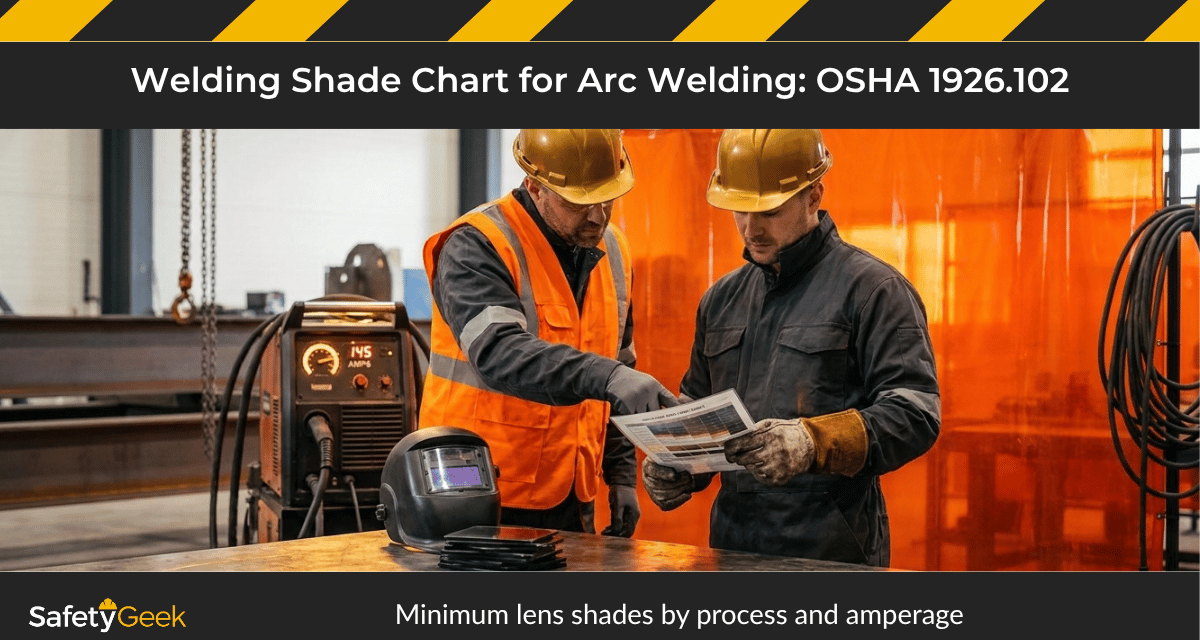
The welding shade chart for arc welding under 29 CFR 1926.102 gives you a minimum filter lens shade for every process and current range running on your site. For shielded metal arc welding, that’s shade 7 below 60 amps and shade 11 above 250 amps. Darker is always allowed… lighter is a violation and an arc flash burn waiting to happen.
And here’s where it gets confusing. The shade table printed inside the construction standard is organized by electrode diameter, while the table OSHA publishes for welding eye protection is organized by arc current. Two tables, one standard, different numbers, and no clear signal about which one a compliance officer is going to hold you to.
You’re not missing something obvious. This is one of those spots where the regulation genuinely didn’t age well, and nobody handed you the decoder ring. So let’s fix that.
Key Takeaways
- Shade numbers are minimums, not targets. OSHA lets you go darker any time the welder needs it.
- The amperage-based table is the practical one. It covers stick, MIG, TIG, plasma, and air carbon arc by actual arc current.
- The electrode-diameter table still lives in the construction rule, and its numbers run higher for common stick work.
- Auto-darkening helmets are fine, as long as the selected shade covers the process and amperage in use.
- Helpers, fire watches, and anyone inside the arc flash zone need protection too, not just the person holding the stinger.
- A welding helmet is not impact protection. Safety glasses still go on underneath.
What 29 CFR 1926.102 Actually Requires
29 CFR 1926.102 is OSHA’s eye and face protection rule for construction. It requires employers to make sure every affected employee uses appropriate eye or face protection when exposed to flying particles, molten metal, liquid chemicals, acids, caustics, chemical gases or vapors, or injurious light radiation. Welding hits three of those at once.
The standard doesn’t invent its own product specs. It points to three consensus standards, and equipment built to any of them complies: ANSI/ISEA Z87.1-2010, ANSI Z87.1-2003, and ANSI Z87.1-1989 (R-1998).
The rule also carries its own filter lens shade table for protection against radiant energy. That table is where the electrode-diameter numbers come from. Arc welding operations are covered separately under 29 CFR 1926.351, and general industry follows the same eye-protection logic under OSHA’s general industry eye and face protection standard, 1910.133.
Why the Shade Number Matters More Than the Helmet
A welding arc throws ultraviolet, visible, and infrared radiation. The filter lens is the only thing between that energy and the retina, and the shade number measures how much it blocks. Get the number wrong by two steps, and the helmet is basically a face shield with a window.
NIOSH’s eye and face protection guidance puts roughly 2,000 job-related eye injuries a day in front of medical treatment across US workplaces. Arc flash burns to the cornea, the ones welders call flash burn or arc eye, are one of the most preventable entries on that list. The correction costs nothing but picking the right number off a chart.
The OSHA Welding Shade Chart by Process and Amperage
This is the table that answers the question people actually ask. It comes from OSHA’s fact sheet on eye protection during welding and cutting, and it matches the filter lens table used in general industry.
Every value below is a minimum protective shade. You can always go darker.
| Operation | Arc current | Minimum shade |
|---|---|---|
| Shielded metal arc welding (stick) | Less than 60 A | 7 |
| Shielded metal arc welding | 60 to 160 A | 8 |
| Shielded metal arc welding | 160 to 250 A | 10 |
| Shielded metal arc welding | 250 to 550 A | 11 |
| Gas metal arc and flux-cored (MIG) | Less than 60 A | 7 |
| Gas metal arc and flux-cored | 60 to 160 A | 10 |
| Gas metal arc and flux cored | 160 to 250 A | 10 |
| Gas metal arc and flux cored | 250 to 500 A | 10 |
| Gas tungsten arc welding (TIG) | Less than 50 A | 8 |
| Gas tungsten arc welding | 50 to 150 A | 8 |
| Gas tungsten arc welding | 150 to 500 A | 10 |
| Air carbon arc cutting (light) | Less than 500 A | 10 |
| Air carbon arc cutting (heavy) | 500 to 1000 A | 11 |
| Plasma arc welding | Less than 20 A | 6 |
| Plasma arc welding | 20 to 100 A | 8 |
| Plasma arc welding | 100 to 400 A | 10 |
| Plasma arc welding | 400 to 800 A | 11 |
| Plasma arc cutting (light) | Less than 300 A | 8 |
| Plasma arc cutting (medium) | 300 to 400 A | 9 |
| Plasma arc cutting (heavy) | 400 to 800 A | 10 |
| Torch brazing | Not applicable | 3 |
| Torch soldering | Not applicable | 2 |
| Carbon arc welding | Not applicable | 14 |
The Electrode-Diameter Table Inside the Construction Rule
The filter lens table printed in the construction standard predates the amperage version and sorts stick welding by electrode size instead. Its numbers run higher, which is why a compliance officer working straight off the CFR text can land on a different answer than your welder did.
- Shielded metal arc, 1/16 to 5/32 inch electrodes: shade 10
- Shielded metal arc, 3/16 to 1/4 inch electrodes: shade 12
- Shielded metal arc, 5/16 to 3/8 inch electrodes: shade 14
- Gas-shielded arc, nonferrous: shade 11
- Gas-shielded arc, ferrous: shade 12
- Carbon arc welding: shade 14
- Torch brazing: shade 3 to 4
- Soldering: shade 2
When the two tables disagree, use the higher number. That’s the defensible position in an inspection and the safer one for the welder’s eyes, and it costs you nothing but a lens swap.
THE ALL-ACCESS PASS RESOURCE PAGE
Get all the FREE templates, safety management resources, PDFs, spreadsheets, and more...
How to Pick the Right Shade Without Guessing
Shade selection is a two-variable problem: what process is running, and how much current is going through it. Everything else is noise. Here’s the order I walk a crew through when we’re setting this up for real.
- Name the process. Stick, MIG, flux-cored, TIG, plasma, and air carbon arc all pull different numbers. Guessing between MIG and flux-cored is fine because they share a row, but guessing between stick and TIG is not.
- Get the actual amperage. Not the machine’s rating… the setting the welder runs on that joint. Write it down for each recurring task.
- Pull the minimum shade off the chart. That’s your floor for that task, permanently.
- Start darker than the floor. OSHA’s own guidance says begin with a shade too dark to see the weld zone, then step lighter one number at a time until you can see the puddle clearly.
- Stop at the floor. If the welder needs to go below the minimum to see the work, the problem is the lighting on that task, not the lens.
That last step is the one people skip. When somebody says they can’t see with a shade 10, the honest answer is usually a dark corner, a dirty lens, or a cover plate that should have been replaced two weeks ago. Fixing the light beats thinning the protection every single time.
Write the Shade Into the Task, Not Into a Policy Binder
A shade chart taped to the welding shop door does almost nothing. The number needs to live where the work lives, which means it belongs in the task documentation for every welding job you’ve already broken down. If you’ve done a hazard assessment for those tasks, the shade number goes in it as a specific value, not as “appropriate filter lens.”
Same goes for the flying particle hazard assessment that 1926.102 also requires. Welding, grinding, and chipping usually happen within ten feet of each other, so one assessment can cover radiant energy and impact hazards together. One document, one conversation with the crew, two hazards handled.
Where Welding Eye Protection Programs Break Down
The shade chart is the easy part. What I see over and over is a program that gets the number right on paper and then loses it in the four places nobody audits.
The Helper Nobody Assigned a Shade To
Fire watches, fitters, and helpers stand inside the arc flash zone all day and frequently get handed nothing but clear safety glasses. Their exposure is real, even at an angle, even at fifteen feet. Assign them protection appropriate to their actual exposure, and set up screens or curtains so the arc doesn’t reach people who never signed up for it.
The Auto-Darkening Helmet Set to One Number Forever
Auto-darkening lenses are a genuine improvement, and they’re allowed. But a variable-shade helmet parked on shade 9 because that’s where the dial was when it left the truck isn’t compliant. The selected shade has to cover the process and amperage in use, and that means somebody actually checks the dial during observations.
Safety Glasses Under the Hood
The helmet handles radiant energy. It does not handle the slag chip that comes off during cleanup with the hood flipped up, and it never has. Impact-rated safety glasses go on underneath, every time, because PPE is the last line of defense and stacking two layers on the same body part is not overkill when one of them is a lens.
Training That Ends at the Handout
Handing a welder a laminated shade card is not training, and a quiz about it verifies nothing. Real workplace safety training on this looks like walking the shop, asking a welder what amperage they’re running, and having them tell you the shade without looking it up. That’s the Coach and Observe stage of the Safety Management Cycle doing exactly what it exists to do.
And if the answer keeps coming back wrong across three different welders, that’s a system problem, not a people problem. Recurring non-compliance means the shade information is hard to get to, not that your crew is careless. Making the right lens the easiest lens to grab fixes more behavior than a write-up ever will.
Frequently Asked Questions About Welding Shade Numbers
What shade lens do I need for stick welding?
It depends on your amperage. Below 60 amps, the minimum is shade 7; from 60 to 160 amps, it’s shade 8; from 160 to 250 amps, it’s shade 10; and from 250 to 550 amps, it’s shade 11. The construction rule’s electrode-diameter table calls for shade 10 to 14 on common electrode sizes.
Does 29 CFR 1926.102 allow auto-darkening welding helmets?
Yes. Auto-darkening helmets comply as long as the helmet meets the applicable ANSI Z87.1 version and the selected shade covers the process and arc current in use. The catch is verification, because a variable-shade lens set too light is still a violation.
What shade do welding helpers and nearby workers need?
Anyone exposed to the arc needs eye protection appropriate to that exposure, not just the welder. Helpers working close to the arc generally need a filter lens, while workers farther out may be protected by screens, curtains, or shaded spectacles. Assess the exposure by distance and angle, then assign protection to match.
Do welders need safety glasses under the welding helmet?
Yes, whenever there’s a flying particle hazard. The helmet protects against radiant energy but does nothing when it’s flipped up for chipping, grinding, or slag removal. Impact-rated safety glasses with side shields go on underneath and stay on through the whole task, including cleanup.
Why do OSHA’s two welding shade tables show different numbers?
They were built at different times using different variables. The table in the construction standard sorts stick welding by electrode diameter, while the table OSHA publishes for welding eye protection sorts by arc current. When the two disagree for the same job, use the higher shade number.
Can I use a shade darker than the OSHA minimum?
Yes, and you often should. Every number on the chart is a minimum protective shade, not a maximum. OSHA’s guidance actually recommends starting with a shade too dark to see the weld zone and stepping lighter until the puddle is clearly visible, which means you land on the darkest workable lens.
Now It’s Your Turn
The welding shade chart isn’t complicated once you separate the two tables and treat every number as a floor. Name the process, get the real amperage, pull the minimum, then start darker and work down until the puddle is visible.
TAKE ACTION this week:
- Walk the shop and write down the actual amperage on every welding machine currently in use.
- Match each one to the chart above and record the minimum shade in that task’s documentation.
- Check every auto-darkening helmet’s dial setting against the number you just recorded.
- Ask three welders what shade they should be running and why. Their answer tells you whether your training landed.
- Look at who’s standing near the arc without a filter lens, and fix that before you fix anything else.
This is also a good reminder that eliminating the exposure always beats managing it. If you’re looking at where welding fits into a bigger control strategy, the hierarchy of controls gives you the order of operations.
And if you’re tired of being the person who knows all the right numbers and still can’t get the support to make them stick, that’s a different problem than compliance. I put together a free training on the Safety Influencer System that walks through how to build the influence to get your program taken seriously.
You got this, Safety Friend.
Hi, I'm Brye (rhymes with sky)! I am a self-proclaimed safety geek with two decades of general industry safety experience. Specializing in bringing safety programs to a world-class level and building a safety culture, I have trained and coached many safety managers, just like you, on how to effectively manage workplace safety in the real world. I would love to help you too.