Estimated Reading Time: 10 minutes
TL;DR: The 2024 HazCom final rule updated 29 CFR 1910.1200 to match GHS Revision 7. It added new hazard classes for desensitized explosives and chemicals under pressure, opened the aerosol class to non-flammable products, resplit the flammable gas categories, and changed label rules for small containers. Chemical manufacturers had to reclassify substances by May 19, 2026. Employers have until November 20, 2026 to update workplace labels, written programs, and training.
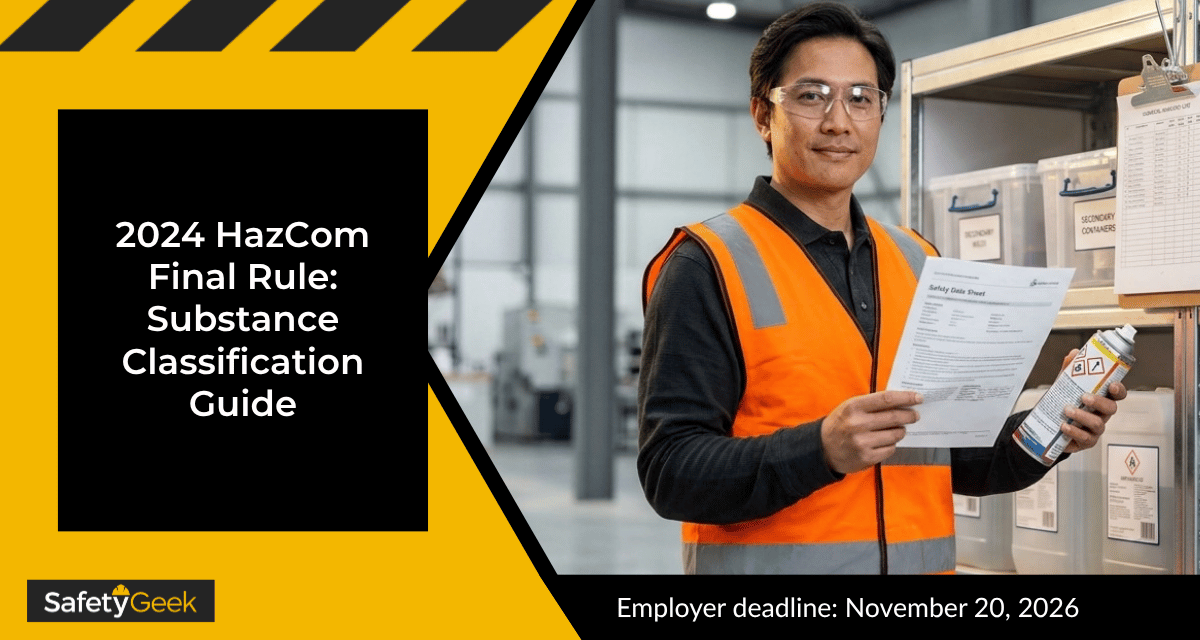
The 2024 HazCom final rule substance classification updates changed how OSHA classifies, labels, and documents chemicals under its Hazard Communication Standard. The rule aligned 29 CFR 1910.1200 with GHS Revision 7, added two new physical hazard classes, and rewrote the aerosol and flammable gas categories.
Your suppliers already hit their reclassification deadline on May 19, 2026. Yours lands November 20, 2026.
And if your reaction to that is “nobody told me,” you’re in good company. Almost every safety lead I talk to found out about this rule the same way… a supplier’s revised safety data sheet showed up in the inbox with a pictogram that wasn’t there last year.
So let’s walk through what actually changed, which dates apply to you, and what to fix before November.
Key Takeaways
- The 2024 HazCom final rule aligns 1910.1200 with GHS Revision 7, plus a few pieces borrowed from Revision 8.
- Two new physical hazard classes exist now: desensitized explosives and chemicals under pressure.
- Aerosols are no longer a flammability-only class. Non-flammable aerosols got their own category.
- OSHA pushed every deadline back four months in January 2026. The employer deadline for substances is November 20, 2026.
- Your obligation is workplace-facing: secondary container labels, the written program, and retraining on newly identified hazards.
- Nothing about the core standard changed. You still need a written program, an inventory, accessible SDSs, and trained employees.
What Changed in the 2024 HazCom Final Rule
The 2024 Hazard Communication final rule was published on May 20, 2024, and took effect July 19, 2024. It’s the first major update to the standard since 2012, when OSHA first adopted GHS.
The rule doesn’t replace OSHA’s Hazard Communication Standard. It updates the classification rules underneath it.
The GHS Revision 7 Alignment
GHS is the United Nations system that standardizes how chemical hazards get sorted, labeled, and described. It is revised every two years, and OSHA has been using Revision 3 since 2012. The 2024 rule jumps the standard forward to Revision 7, with a handful of provisions pulled from Revision 8.
That jump is why the classification changes feel so big all at once. Twelve years of GHS updates landed in a single rulemaking.
The practical effect for you is simple. Chemicals you’ve had on the shelf for a decade can come back reclassified, with a new pictogram, a new signal word, or a hazard statement that didn’t exist before.
Nothing about the chemical changed. The criteria used to judge it did.
What Stayed the Same
Every core requirement survived intact. You still need a written hazard communication program, a chemical inventory, safety data sheets employees can access without asking permission, labels on every container, and training.
The 16-section SDS format didn’t change. The nine pictograms didn’t change. The obligation to train before exposure didn’t change.
So if your program is solid, this is an update, not a rebuild. If your written HazCom program has dust collected on it, this deadline is the forcing function you’ve been waiting for.
The Compliance Deadlines and Why They Moved
Here’s the part that trips people up. There isn’t one deadline. There are four, split by who you are and whether the chemical is a substance or a mixture.
A substance is a single chemical, like acetone. A mixture is two or more substances blended, like a solvent-based adhesive. Substances got the earlier deadlines because they’re simpler to reclassify.
The Four Dates That Matter
| Who | What They Must Do | Substances | Mixtures |
|---|---|---|---|
| Manufacturers, importers, distributors | Reclassify, relabel, reissue SDSs | May 19, 2026 (passed) | November 19, 2027 |
| Employers (that’s you) | Update workplace labels, written program, and training | November 20, 2026 | May 19, 2028 |
The dates above come straight from OSHA’s Hazard Communication Standard at 29 CFR 1910.1200. Your suppliers are already past their substance deadline. That means the revised SDSs and shipped labels are landing in your facility right now, whether or not anyone flagged them.
Your November 20, 2026 date only covers newly identified hazards on substances, and mixtures give you until May 2028. In practice, most safety leads I work with are handling both in one pass. Splitting a chemical inventory into two projects two years apart creates more work than it saves.
Why OSHA Pushed Everything Back Four Months
The original schedule had manufacturers finishing substances by January 19, 2026, and employers finishing by July 20, 2026. On January 15, 2026, OSHA published a compliance date extension notice moving every date back four months.
The reason was straightforward. OSHA hadn’t finished the guidance documents employers needed to interpret the new classification criteria, and the manufacturer deadline was days away. The agency used the good cause exception to skip notice and comment and get the extension out in time.
If you built a project plan around July 2026, you got four extra months. Take them.
THE ALL-ACCESS PASS RESOURCE PAGE
Get all the FREE templates, safety management resources, PDFs, spreadsheets, and more...
New Hazard Classes in the Substance Classification Updates
Four classification changes drive almost all of the new pictograms and hazard statements you’ll see. Two are brand-new classes. Two rewrite existing classes.
Aerosols Now Includes Non-Flammable Products
The old class was called Flammable Aerosols, and it had two categories. If your aerosol didn’t burn, it didn’t get classified as an aerosol at all.
The 2024 rule renamed the class to Aerosols and added a third category for products that don’t meet the flammability criteria. That change is most likely to show up in a general industry facility.
Think about what’s actually on your shelves: compressed air dusters, non-flammable cleaners, lubricant sprays, spray-on inspection dyes.
A lot of those products carried no aerosol hazard classification before and now carry a Category 3 aerosol classification with a warning label. The can didn’t change. The rulebook did.
Desensitized Explosives
This is a genuinely new physical hazard class, added at Appendix B.17. A desensitized explosive is an explosive substance that’s been wetted, diluted, dissolved, or suspended in something else to suppress its explosive properties.
Most general industry facilities won’t have these. If you work anywhere near demolition, mining, pyrotechnics, certain lab reagents, or specialty chemical manufacturing, you will.
The class has four categories based on how much the desensitizing agent actually suppresses the burn rate. If a chemical in your inventory falls here, expect a new pictogram and storage and handling requirements you didn’t have to manage before.
Chemicals Under Pressure
The second new class, at Appendix B.19, covers liquids or solids pressurized with a gas at 200 kPa or more at 20 degrees Celsius, in a container that isn’t an aerosol dispenser.
The gap this fills is real. Products in refillable pressurized cylinders that weren’t aerosols and weren’t compressed gases were falling through the cracks. Now they get classified on their own terms.
Check your gas cylinders, your pressurized cleaning systems, and any product that arrives in a non-aerosol pressurized container. Those are the ones most likely to come back with a new classification.
Flammable Gases Got Split Apart
The flammable gas class was reorganized, not replaced. Category 1 was divided into Category 1A and Category 1B, and provisions for pyrophoric gases and chemically unstable gases were folded in as part of the structure.
The distinction matters because a Category 1B gas is flammable but doesn’t ignite as readily as a Category 1A gas. Under the old system, both carried identical labeling. Under the new one, they don’t.
For most safety leads, this shows up as a hydrogen, acetylene, or specialty gas SDS that reads differently than the copy in your binder. That’s not a supplier error. The new categories are doing their job.
| Class | Before the 2024 Rule | After the 2024 Rule |
|---|---|---|
| Aerosols | Flammable Aerosols, 2 categories | Aerosols, 3 categories including non-flammable |
| Desensitized explosives | Not a class | New class, 4 categories, Appendix B.17 |
| Chemicals under pressure | Not a class | New class, Appendix B.19 |
| Flammable gases | Category 1 and Category 2 | Category 1A, 1B, plus pyrophoric and chemically unstable gas provisions |
Label and Safety Data Sheet Changes You Will See
The classification changes drive most of the work, but a few labeling provisions changed too. Your employees will notice these most.
Small Container Labeling
OSHA finally acknowledged that you can’t fit a full GHS label on a 30 mL vial. The rule creates two thresholds.
For containers of 100 mL or less, manufacturers can use a reduced label with the product identifier, pictogram, signal word, and a reference pointing to the full information on the outer packaging. For containers of 3 mL or less where a label would be obscured during normal use, even the reduced label can be scaled down further using a pull-out label, fold-back label, or tag.
If you run a lab or a QC bench, this is the change you’ll see most. It also means your employees need to know that the outer package is where the full hazard information lives, which is a training point, not a labeling point.
Released for Shipment
A new provision at 1910.1200(f)(11) handles chemicals that are packaged, labeled, and sitting in a warehouse waiting to ship when new hazard information comes out.
Manufacturers don’t have to break down and relabel packaged inventory. They do have to include the updated information on labels for shipments that go out after that point.
For you, the practical takeaway is that two containers of the same product can legitimately carry different labels for a while. That’s not a violation. That’s the transition working as designed, and it’s worth saying out loud in training so nobody reports it as an error.
Concentration Ranges and Trade Secrets
The rule revised how concentration ranges work on safety data sheets when the exact concentration is claimed as a trade secret. Manufacturers can disclose a prescribed range rather than a precise percentage.
This one rarely changes anything at the workplace level. It matters if you do exposure assessments or industrial hygiene calculations and need a real number to work from.
When you do, request it. The standard still requires disclosure to health professionals in an emergency.
How to Update Your HazCom Program Before November 20
You don’t need a special project for this. You need the work sequenced so it doesn’t eat your fall.
Start With Your Chemical Inventory
Pull your list and sort it by supplier, not alphabetically. Then request current SDSs from each supplier in one batch instead of chasing them one chemical at a time.
Flag anything that comes back with a new pictogram, a new signal word, or a hazard class that wasn’t on the old sheet. That flagged list is your entire scope of work. Everything else stays as is.
For most facilities I’ve walked through, the flagged list is far shorter than expected. Aerosols and gases account for the bulk of it, which is why those two categories are worth checking first.
Rebuild the Training Around What Changed
Your existing HazCom training doesn’t get thrown out. It gets a module added.
Employees need to know what a new pictogram means on a product they’ve used for years, why the label on the small bottle points somewhere else, and why two identical cans might carry different labels through the transition. That’s a fifteen-minute conversation, not a retraining event.
And do it as a coaching conversation at the point of use, not a slide deck in a break room. Training alone doesn’t change behavior.
Train, coach, observe, reinforce… that’s what makes it stick.
Make It a Cycle, Not a Project
This rule caught so many people flat-footed because chemical inventories get treated as a one-time setup instead of a running process.
Run it through the Safety Management Cycle instead. Identify what’s in the building, develop the updated labels and program language, implement and train, coach and observe at the workbench, then analyze what employees actually understood. When the next GHS revision lands, and it will, you already have the machine to handle it.
This is exactly the kind of thing we build inside a chemical safety program so it runs without you having to remember it. And if you want to know where programs usually break down first, the most common HazCom violations are a fast diagnostic.
Frequently Asked Questions About the 2024 HazCom Final Rule
Do I have to retrain every employee on the new rule?
No. You have to train on newly identified hazards for the chemicals in your workplace. If a product’s classification changed, the employees who use it need that update by November 20, 2026.
If a chemical’s hazards haven’t changed, no retraining is required.
What if my supplier hasn’t sent an updated SDS?
Request it in writing and keep the record. Suppliers of substances must comply by May 19, 2026. Mixture suppliers have until November 19, 2027, so a mixture SDS that hasn’t changed yet is normal and not a compliance gap on your end.
Does this rule change my written HazCom program?
Only where classification language, labeling procedures, or training content is written into it. Most written programs need a short revision covering the new hazard classes and the small container labeling reference. The structure, the responsibilities, and the inventory format all stay the same.
Are the pictograms different under GHS Revision 7?
No. The nine GHS pictograms are unchanged. What changed is which chemicals get assigned which pictogram, because the classification criteria underneath them moved.
A product can gain a pictogram it never carried, or lose one it always had, without the product itself changing.
What happens if I miss the November 20, 2026 deadline?
You’d be cited under 1910.1200, one of OSHA’s most frequently cited standards for years. OSHA’s hazard communication rulemaking page tracks the current requirements.
Citations usually land on the written program, missing or outdated labels, and inadequate training, all three of which are exactly what this deadline covers.
Now It’s Your Turn
The 2024 HazCom final rule substance classification updates aren’t a rewrite of how you manage chemical safety. They’re a re-sort of which chemicals carry which hazards, and your job is to catch the ones that moved and tell your people why.
Here’s what to do this week:
- Pull your chemical inventory and sort it by supplier.
- Send one batch request for current Safety Data Sheets to each supplier.
- Flag every chemical that comes back with a new pictogram, signal word, or hazard class.
- Check your aerosols and compressed gases first. That’s where most of the changes land.
- Add the new hazard information to your written program and put a fifteen-minute training update on the calendar before November 20, 2026.
That’s it: five steps, one deadline, and a shorter list than you’re bracing for.
And if the real problem isn’t the rule but the fact that you’re carrying all of this alone with no system underneath it, that’s a different fix. I put together a free training on the Safety Influencer System that walks through how to build safety systems that keep running without you holding every piece together.
You got this, Safety Friend.
Hi, I'm Brye (rhymes with sky)! I am a self-proclaimed safety geek with two decades of general industry safety experience. Specializing in bringing safety programs to a world-class level and building a safety culture, I have trained and coached many safety managers, just like you, on how to effectively manage workplace safety in the real world. I would love to help you too.