Estimated Reading Time: 12 minutes
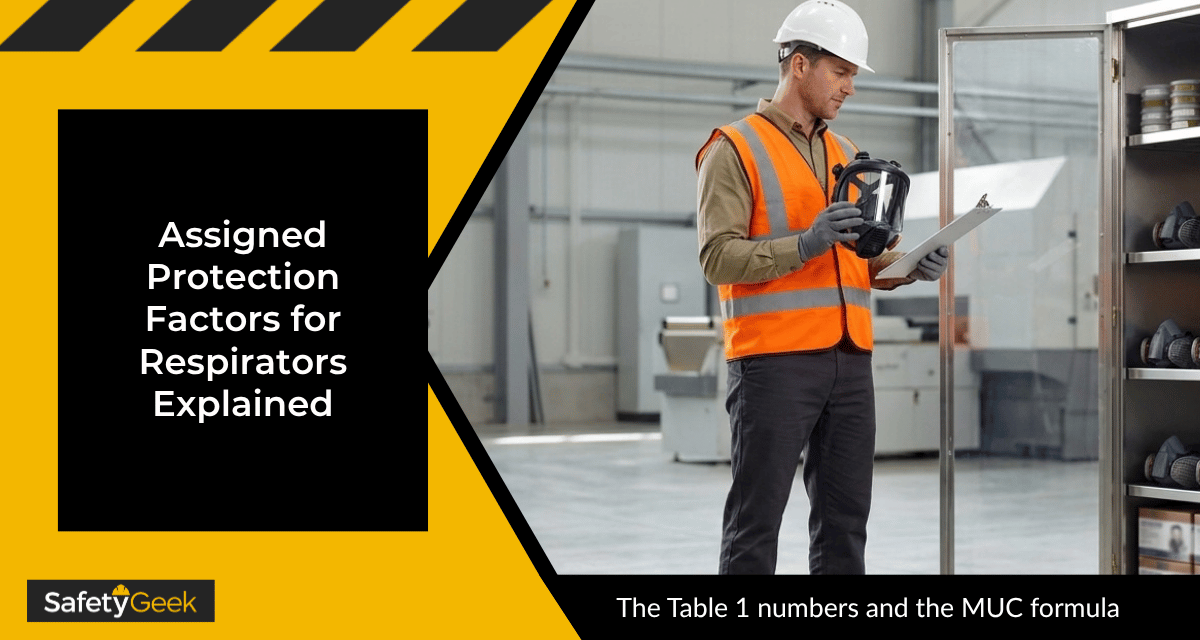
TL;DR: Assigned protection factors for respirators are the numbers OSHA gives each class of respirator to show how much cleaner the air inside the facepiece should be than the air outside it. A half mask air-purifying respirator carries an APF of 10. Multiply that APF by the applicable exposure limit and you get the maximum use concentration, which is the highest air concentration that respirator can be worn in.
Assigned protection factors for respirators are OSHA’s ranking of how much protection each class of respirator is expected to give. The number tells you how many times cleaner the air is inside the facepiece than the air in the room. An APF of 10 means the wearer breathes one-tenth of what everyone else is breathing.
Fair warning up front: these numbers are a C grade, and we’ll come back to that.
Do you know who picked the respirators in your cabinet? Most safety leads don’t… You inherited the program, the masks were already on the shelf, and nobody remembers who chose them. You got a bag of Legos with no instructions.
And the first time an auditor asks why THAT respirator, the whole program starts feeling like a guess you have to defend. If you’re the department of one who got handed that cabinet, you are not the person who got it wrong. You’re just the one holding it.
Key Takeaways
- An assigned protection factor is a ratio. It describes how much the air gets cleaned relative to the room, and it only holds if your full program is running.
- OSHA’s Table 1 in 1910.134 is the only APF list you get to use for respirator selection under the standard. You can’t substitute a manufacturer’s number.
- Maximum use concentration is the APF multiplied by the applicable exposure limit. Treat that number as a ceiling you stay well under.
- Cartridge limits and NIOSH approvals can drop your MUC below the math, and IDLH atmospheres take MUC off the table entirely.
- Fit testing doesn’t raise an APF. A fantastic fit factor still leaves a half mask at 10.
- Respiratory protection was the fifth most frequently cited OSHA standard in fiscal year 2025, which shows how often these gaps are found.
What Assigned Protection Factors for Respirators Actually Measure
An assigned protection factor is the workplace level of respiratory protection that a respirator, or class of respirators, is expected to provide to employees when the employer runs a continuing, effective respiratory protection program. That definition comes straight out of OSHA’s respiratory protection standard.
Read it again… It says the mask is expected to provide it when the employer runs the program.
Expected. When. Neither of those is a small word.
How the ratio works at the facepiece
Think of the APF as a division problem happening right at the seal of the facepiece. Room concentration divided by APF equals what the person is actually breathing.
At an APF of 10, a room at 50 parts per million puts 5 parts per million inside the mask. At an APF of 1,000, that same room drops to 0.05.
And that’s why APFs get assigned to whole classes instead of to specific models. OSHA is describing what a category of respirator does when it’s worn correctly by a trained, fit-tested employee.
Why the APF belongs to your program
So why does the number belong to your program instead of to the mask? Because the footnotes under Table 1 say so. They state that the assigned protection factors are only effective when the employer implements a continuing, effective respirator program, including training, fit testing, maintenance, and use requirements.
So the 50 on a full-face air-purifying respirator is not a property of the rubber. It’s a promise, and the promise holds up only if:
- The medical evaluations are current.
- The fit tests are done.
- The cartridges get changed on schedule.
- People actually wear the thing on their face.
I’ve seen respirator cabinets that were exactly right sitting on top of programs that weren’t:
- Nobody was medically cleared.
- Nobody had been fit-tested in three years.
- Cartridges got changed whenever somebody remembered.
I asked to see the fit-test records twice and got the same shrug both times.
Those employees weren’t getting an APF of 50 (the binder said they were, which is the part that still bothers me). They were getting whatever the leak around a stubbly chin allowed, and no number in a table fixes that.
The OSHA APF Table, Row by Row
OSHA Table 1 assigns protection factors across four respirator families, split by operating mode into seven rows, against five facepiece styles. A blank cell means OSHA hasn’t assigned a factor to that combination, so that pairing isn’t an option for selection under the standard.
| Type of respirator | Quarter mask | Half mask | Full facepiece | Helmet/hood | Loose-fitting facepiece |
|---|---|---|---|---|---|
| Air-Purifying Respirator | 5 | 10 | 50 | ||
| Powered Air-Purifying Respirator (PAPR) | 50 | 1,000 | 25/1,000 | 25 | |
| Supplied-Air or Airline Respirator, demand mode | 10 | 50 | |||
| Supplied-Air or Airline Respirator, continuous flow mode | 50 | 1,000 | 25/1,000 | 25 | |
| Supplied-Air or Airline Respirator, pressure-demand or other positive-pressure mode | 50 | 1,000 | |||
| Self-Contained Breathing Apparatus (SCBA), demand mode | 10 | 50 | 50 | ||
| SCBA, pressure-demand or other positive-pressure mode | 10,000 | 10,000 |
Source: 29 CFR 1910.134(d)(3)(i)(A), Table 1.
Air-purifying respirators
The air-purifying row is where most general industry programs live, and it’s the row people get wrong most often. A quarter mask is 5, a half mask is 10, and a full facepiece is 50.
OSHA’s footnote on the half mask category matters here. That APF of 10 covers filtering facepieces and half masks with elastomeric facepieces alike, which means the disposable N95 in the dispenser and the rubber half mask in the locker carry the same assigned protection factor.
People assume the elastomeric earns a better number because it feels more substantial. It’s a heavier lock on the same door.
OSHA still says 10. If you need more than a factor of 10, you have to move up a class, and no amount of budget spent on nicer half masks will get you there.
Powered and supplied-air respirators
Powered air-purifying respirators and supplied-air respirators climb fast the moment you add a blower or an air line.
Half mask PAPR, 50. Full facepiece, 1,000. Loose-fitting facepiece, 25.
Helmet or hood is either 25 or 1,000, and which one you get depends on a document.
Supplied-air respirators split by operating mode, and the mode changes the number. Demand mode gives you 10 on a half mask and 50 on a full facepiece, while continuous flow and pressure-demand modes give you 50 and 1,000. With a combination respirator, the APF has to match the mode it’s actually operated in.
At the top of the table, pressure-demand SCBA in a full facepiece or helmet/hood carries an APF of 10,000. That’s emergency and IDLH gear, not what you’re picking a mask for on a Tuesday.
The footnotes that change the numbers
Two footnotes do real work in this table, and skipping them is how programs end up over-protected on paper and under-protected in practice.
The helmet/hood entry reads 25/1,000 for a reason. To claim the 1,000, OSHA wants proof from the manufacturer that the hood was tested at a level of protection of 1,000 or greater. No proof, and every other PAPR or supplied-air hood gets treated as a loose-fitting facepiece at an APF of 25.
That is a 40-fold difference resting on whether you have a document in a file…
…and it isn’t a paperwork problem. It’s a person breathing forty times more than the file says they are, every shift, until somebody finally asks for the study.
So ask for it. Send your supplier this exact line: “Can you send me the test data showing this hood performs at an APF of 1,000 or greater?” If what comes back is a glossy spec sheet instead of test data, you’re running at 25.
The other footnote is simpler and easier to miss: these APFs don’t apply to respirators used solely for escape.
THE ALL-ACCESS PASS RESOURCE PAGE
Get all the FREE templates, safety management resources, PDFs, spreadsheets, and more...
How to Calculate Maximum Use Concentration
Maximum use concentration is the maximum atmospheric concentration of a hazardous substance an employee can be expected to be protected from while wearing a respirator. In plain terms, it’s the dirtiest air that a mask is allowed to be worn in.
OSHA requires you to keep exposure, measured outside the respirator, at or below the MUC.
The MUC formula
The math is one line:
MUC = APF x the applicable exposure limit
The exposure limit is normally the OSHA permissible exposure limit, and you can look yours up on OSHA’s annotated permissible exposure limits tables. Where a short-term, ceiling, or peak limit applies to the task, you run the calculation against that limit instead. OSHA’s Assigned Protection Factors guidance booklet works through the same math.
A worked example
Say your monitoring comes back at 8 parts per million and the PEL for that substance is 0.2 parts per million. Divide the measured concentration by the limit to get a hazard ratio of 40.
That ratio is your shopping list. It rules out every class at 10 or 25, including the half-mask air-purifying respirator, and leaves you choosing among the classes at 50 or above. A full-face air-purifying respirator is usually the lightest of those, though a half-mask PAPR also sits at 50.
Now check the ceiling. An APF of 50 times a PEL of 0.2 parts per million gives an MUC of 10 parts per million, and your measured 8 parts per million sits under it. The selection is legal, unless a cartridge limit or an IDLH level caps it lower.
But look at how little room is left. Eight against a ceiling of ten means one bad day, one hotter process, one broken fan, and you’re over.
A selection that only clears is a selection that needs a control above it. That’s not a mask problem anymore.
That math is also your answer when the auditor asks why THAT respirator. You don’t defend the mask; you read the file back:
“Our monitoring came back at 8 parts per million against a PEL of 0.2. That’s a hazard ratio of 40, and Table 1 puts a full facepiece air-purifying respirator at 50. Here’s the sampling report.”
What overrides the math
The calculated MUC is a starting point. OSHA is explicit that when the calculated MUC exceeds the IDLH level for a substance, or exceeds the performance limits of the cartridge or canister, the employer must set the maximum MUC at that lower limit.
So the equipment in your hand gets a veto. Whatever the NIOSH approval and the cartridge rating allow is the real ceiling, and your arithmetic doesn’t get to argue with it.
IDLH atmospheres are a harder stop. You can’t apply MUCs to them at all… those require the respirators OSHA lists for IDLH conditions, which means pressure-demand SCBA or a pressure-demand supplied-air respirator with an auxiliary escape bottle.
Where Respirator Selection Goes Sideways
Selection failures rarely look dramatic. They look like a reasonable person making a reasonable choice in the wrong order, and that choice hardening into “how we’ve always done it.”
Choosing the respirator before measuring the exposure
The most common pattern I see is a respirator picked from a catalog, with the exposure assessment done later or never. Once the masks are in the building, nobody wants to find out they were the wrong ones.
Run it the other direction:
- Identify the hazard.
- Measure the concentration.
- Find the applicable exposure limit.
- Calculate the hazard ratio.
- Let that ratio choose the APF.
That’s the Identify stage of the Safety Management Cycle, and it’s the stage most respirator programs skip entirely.
I’ll admit this is a place I needed help. A few years back I sat through an industrial hygiene sampling webinar that was way outside my expertise (I signed up mostly so I could stop nodding along whenever an IH started talking), and it changed how I run this step.
If exposure assessment is the shaky part of your program, a structured risk assessment on the tasks involved will surface what you need to sample. Chemical hazards especially like to hide in handling and storage practices rather than in the obvious process step.
Treating a great fit test as a bigger APF
A quantitative fit test that comes back at 2,500 on a half mask feels like proof the wearer is getting way more than a factor of 10. OSHA won’t let you use it that way, and here’s why.
Fit factors measure one person on one day in a test booth. Assigned protection factors describe what a class delivers across a working population over a full shift of real movement, talking, sweating, and bending.
The fit test qualifies the person, and the table still sets the number.
Skipping straight past the hierarchy of controls
Respirators are personal protective equipment, which puts them at the very bottom of the hierarchy of controls. Sometimes a respirator really is the only option left, and often it’s just the fastest one to buy.
Ventilation, substitution, and enclosure change the concentration itself. That changes the hazard ratio, which can move you down a class or out of respiratory protection entirely. Facilities that get serious about industrial indoor air quality often find their APF requirements drop on their own.
And this is the mistake we make. We treat the APF table as the answer to the hazard, when it only answers the leftover hazard after everything else is done.
That’s the C grade I promised you at the top. Table 1 and the exposure limits you multiply it against were built to keep people out of the hospital, and plenty of those limits are decades behind the science.
Hitting the number means you passed. It doesn’t mean the exposure is gone.
Which means the permanent fix for a respirator program is a funding decision. That conversation happens with the people who sign the checks, and safety stays a priority right up until it costs money.
It is winnable, though. One of my students runs safety for a commercial roofing company that nearly lost a $15 million job over weak safety numbers, and what turned it around was his compliance lead walking the CFO through what those numbers actually meant to the business.
Same math, different audience. That’s the skill I teach in my free training on the Safety Influencer System.
Frequently Asked Questions About Assigned Protection Factors
What is the assigned protection factor of an N95?
An N95 filtering facepiece is a half-mask air-purifying respirator, so it carries an assigned protection factor of 10 under OSHA Table 1. That means the wearer should be breathing one-tenth of the airborne concentration in the room, provided the respirator is fit-tested and worn correctly.
Is the APF the same as the fit factor?
No. A fit factor measures one wearer’s seal during a quantitative fit test on a specific day. An assigned protection factor is the value OSHA assigns to an entire class of respirators for selection purposes, and a high fit factor never raises the APF you’re allowed to claim.
How do you calculate maximum use concentration?
Multiply the respirator’s assigned protection factor by the applicable exposure limit for the substance. A full facepiece air-purifying respirator with an APF of 50, used against a PEL of 0.2 parts per million, yields an MUC of 10 parts per million. Cartridge limits and IDLH levels can lower that ceiling.
Why do helmet and hood respirators show 25/1,000?
OSHA assigns 1,000 only when the manufacturer provides testing evidence demonstrating performance at that level or greater. Without that documentation, treat the respirator as a loose-fitting facepiece and assign an APF of 25. Ask your supplier for the study before you claim the higher number.
Do assigned protection factors apply to escape respirators?
No. OSHA’s Table 1 footnote states these APFs don’t apply to respirators used solely for escape. Escape respirators for substances covered by subpart Z follow the substance-specific standards, and escape respirators for other IDLH atmospheres are addressed separately in the standard.
Now It’s Your Turn
Assigned protection factors for respirators are a division problem. Pick the class whose APF covers your hazard ratio, confirm the maximum use concentration isn’t capped by a cartridge limit or an IDLH level, and then keep the program running that makes the number real.
Here’s what I’d do this week.
Your five-step check this week.
- Pull your current respirator list and write the OSHA Table 1 APF next to each one. Use the number in Table 1, not the one on the box the masks came in.
- Find the exposure data behind each selection. If there isn’t any, you’ve been winging it on somebody else’s decision, and that respirator goes on your assessment list.
- Calculate the MUC for your top three exposures and compare it against the measured concentration. Anything sitting close to the ceiling needs a better control above the mask.
- Check your helmet and hood respirators for the manufacturer testing that justifies an APF of 1,000. No document means you’re running at 25.
- Look one level up the hierarchy on your worst exposure and ask what it would take to change the concentration instead of the mask.
That last step changes your job description. And OSHA’s list of the most frequently cited standards shows how many programs aren’t clearing even the C grade… respiratory protection sat at number five in fiscal year 2025.
That guess you were afraid of defending? Once the exposure data sits behind the number, there’s nothing left to defend. You’re just reading the file.
Getting the number right protects people. Getting your leadership to fund the controls that lower the number is a different skill, and it’s the one that moves your career. Skip it, and you’ll still be defending a mask five years from now instead of changing the concentration.
That skill is what my free training on the Safety Influencer System walks through, step by step.
You got this, my safety friend!
Hi, I'm Brye (rhymes with sky)! I am a self-proclaimed safety geek with two decades of general industry safety experience. Specializing in bringing safety programs to a world-class level and building a safety culture, I have trained and coached many safety managers, just like you, on how to effectively manage workplace safety in the real world. I would love to help you too.