Estimated Reading Time: 18 minutes
TL;DR: A safety program roadmap puts everything on 1 page: what you want (more money, more status, job security), what’s in the way (overwhelm, being ignored, no confidence), and the system that fixes it. You build it in order through the Safety Management Cycle. Run each system yourself first, then bring people in, then shift the work to the line of power (the supervisors and managers your employees report to).
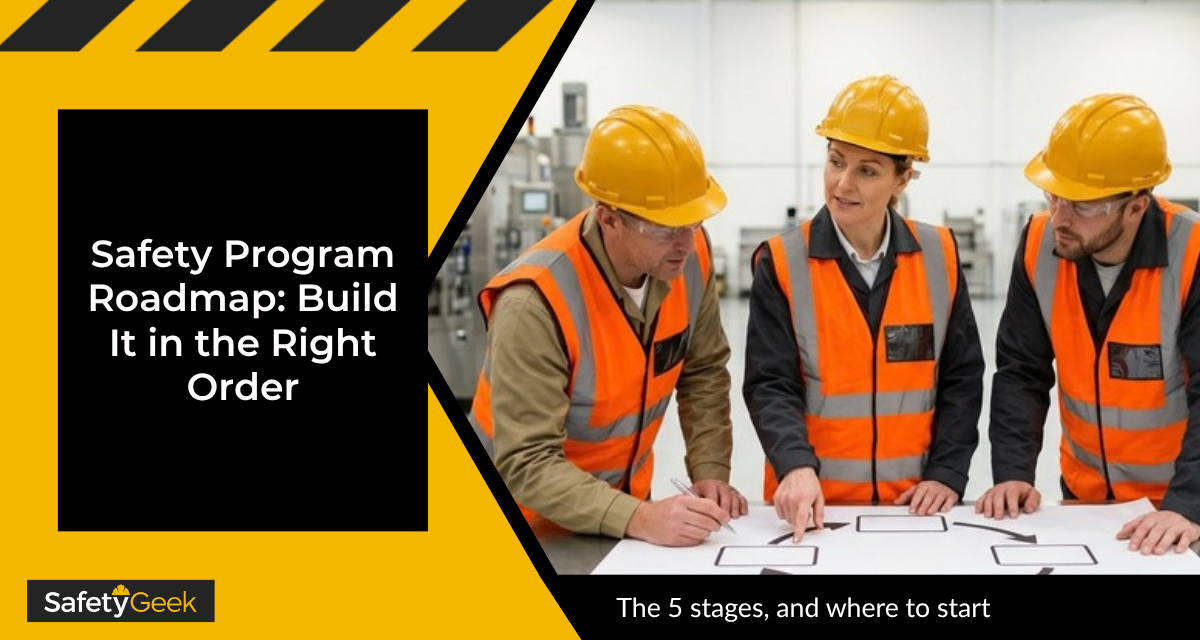
A safety program roadmap shows you how every piece of your program connects and the order to build it in.
If you’re the person responsible for safety in your organization, you probably already know what isn’t working. You’re buried in work that was never really yours, leadership nods along and nothing changes, and your to-do list is a mile long. But knowing what’s wrong and having a program that fixes it are 2 different things… and that gap is exactly where it’s easy to get stuck.
I’m a Certified Safety Professional, I build safety programs from the ground up, and I’ve helped over 20 locations get their VPP application status within 18 months. This is the last part of a 7-part series on what’s standing between you and a seat at the executive table. Today I’m pulling it all together so you can build it for yourself.
There are 3 things I want to walk through with you: the whole roadmap on 1 page, the order to build it in, and why building it alone is actually keeping you stuck (plus why adding people to your safety team is not the answer).
Everything in this series comes straight out of the Safety Leadership Academy, the full system laid out step by step with the tools to build it. It’s there whenever you’re ready.
Key Takeaways
- Safety leads want 3 things: more money, more status, and job security. The skills that make you exceptional at this job are the same skills that get you all 3.
- 3 things stand in the way: overwhelm, being ignored, and no confidence.
- The Safety Management Cycle runs your program, and the Safety Influencer System sits on top of it, so every system you build changes how people see safety.
- The order you build in matters as much as what you build. If you build it out of order, things are not going to work.
- Asking for more safety staff quietly backfires. It takes apart the influence you’re trying to build.
- Plan on 12 months, in 90-day stretches… though some students have changed their entire program in less than 4 months.
Your Safety Program Roadmap on 1 Page
Before we talk about anything else, let’s put the whole roadmap on 1 page. When you can see how every piece connects, you stop treating it like a pile of separate problems. You start building it into 1 system…like an engine that can just run itself.
| The roadmap | What’s on it |
|---|---|
| What you want | More money, more status, job security |
| What’s in the way | Overwhelm, being ignored, no confidence |
| What runs underneath | The Safety Management Cycle, with the Safety Influencer System on top |
| The order you build in | Identify, Develop, Implement and Train, Coach and Observe, Analyze |
| How each system gets built | Do it yourself first, then include collaboration, then shift the responsibility to operations |
What You’re Really After: Money, Status, and Job Security
When I think about safety leads and what they actually and truly want out of their career, it comes down to 3 things.
More money. I don’t necessarily mean a bigger salary. You might be really happy where you are, but you want to feel like you’re paid your worth.
You don’t ever want to feel like you’re being overworked and underpaid, right?
More status. Have you ever walked into a managers’ meeting and felt like you should be treated just like the director or the VP? But you’ve been given the title of safety coordinator, and you look at your workload next to theirs and you’re like, “This just isn’t matching up.”
Quite frankly, job titles are just made up. I’ve seen a lot of people doing the work of a director or a VP with the title of coordinator or specialist.
So don’t get stuck on your job title… unless it comes with more money. (I worked for an organization where your bonus level was based on your title, so there the title mattered a lot.)
Job security. We all want to know we can support our families and our way of living, now and into the future. But don’t just think of it as, “I want to keep the job I currently have.”
When you have the skills and a track record of results, you stop waiting for somebody to give you a job. You know you can pick whatever job you want.
And that gives you more confidence in the role you’re in right now, because you’re not acting out of fear. If they fire you, you’ll just go pick up a job somewhere else.
In the research I’ve done with thousands of safety leads, everything comes down to those 3 things when they look toward their future.
And I truly believe safety management is a unicorn profession. We have to build skills to be exceptional at our job, and those skills make us more valuable in the job market. That’s what gets you the job security, the status, and the money.
The 3 Things Standing in Your Way
Overwhelm. There’s so much to do in safety management. They might have promoted you into this role just to take over the training, the accident investigations, and the claims handling.
But as you try to get the injury rate down and save money on insurance, you realize how much goes into a safety management system… and you’re expected to do all of it.
I once laid out every single task I was responsible for and timed it out. It was 1 location with 300 employees.
Doing my job would have taken me 16 hours a day.
Some of that was the expectation the company had on me. But some of it I put on myself, because of the way I was running my program.
Being ignored. You’re not included in the managers’ meetings, or you’re given a 5-minute window to recap what’s going on in safety. Decisions get made without your input.
You find out about things from employees and not even your own boss, or you walk out onto the floor and all of a sudden there’s new equipment or a new process nobody included you in.
No confidence. A lot of safety leads don’t even see the experience level they have, or that they’re ready to take that step up.
I was recently chatting with somebody who had her degree, was working toward her master’s, and had certifications… and she was making $55,000 a year as a safety administrator.
I was like, “Why? Why aren’t you going for something more?”
“Well, I need a couple more years of experience.”
Why do you need that experience? You have it. That all comes down to a lack of confidence in yourself.
The System Underneath All of It
Underneath all of that is how you run your program. In the Academy, we implement the Safety Management Cycle, which is basically how you run your safety management system. But we don’t just run the cycle.
We overlay it with the Safety Influencer System, so every system you build uses psychology and marketing hacks to change the perception and beliefs about safety. (It’s the same idea as learning to sell safety like a marketer.) That’s what gives you a bigger, braggable track record of results…and it’s how you start being seen as that executive.
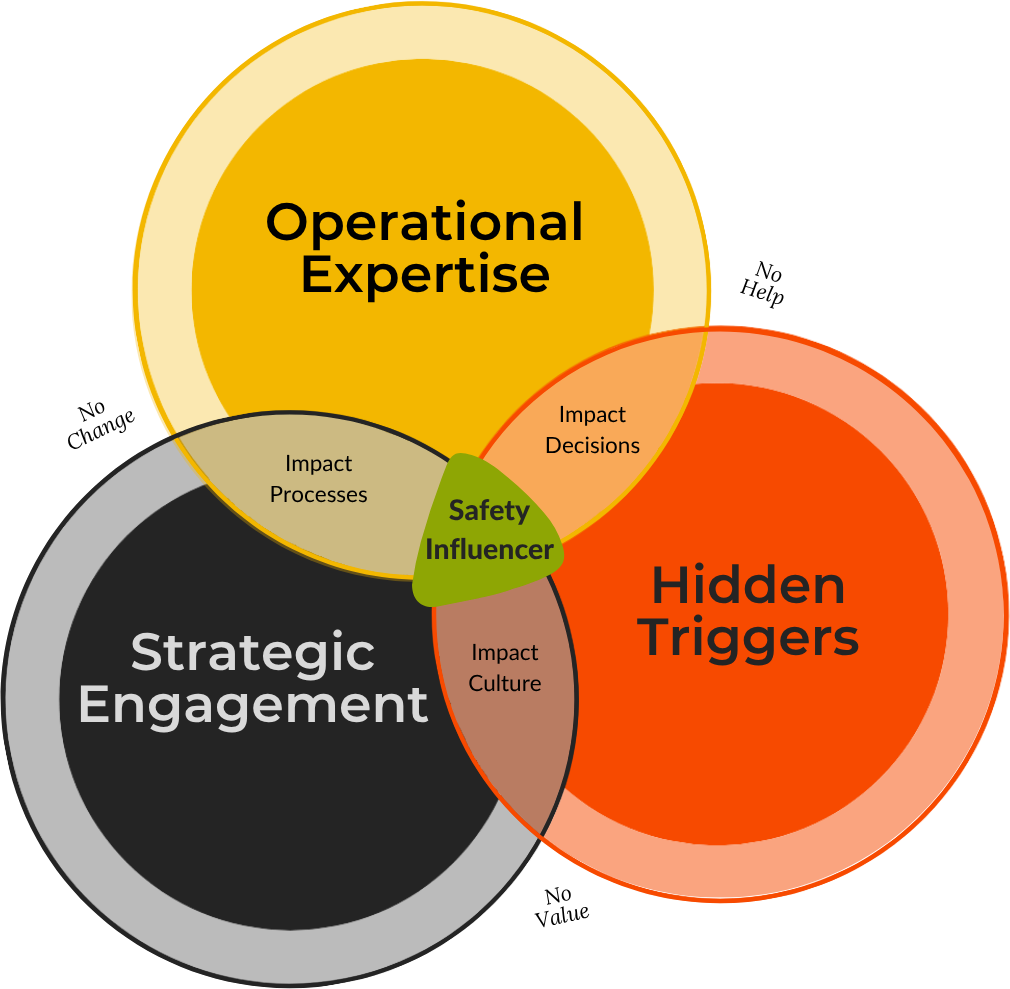
Let me give you an example. Say you have a facility that needs to be inspected on a regular basis. You’re likely doing it yourself right now, and maybe you even go in early and inspect the entire facility.
The way we have you do your inspections is different:
- Break the inspection up into small, bite-sized chunks.
- Collaborate with supervisors and employees on each one.
- Document, share, and follow up on every finding, so it’s not just going into some black hole work order.
- Put the findings into a data system, so you’re tracking and trending the hazards and the behaviors they’re related to.
- When something improves, show your management team how it’s impacting the business.
Do you see the difference there? You can do exactly what you’re doing right now. But if you tweak your systems a little bit, you build collaborative systems that organically change management support and employee engagement.
How the Roadmap Clears Each Block
The Safety Management Cycle and the Safety Influencer System work on all 3 of the things standing in your way. And each fix feeds the next one.
| What’s in your way | What fixes it | What you get |
|---|---|---|
| Overwhelm | Collaborative systems, with decisions made inside the line of power | Supervisors and managers with skin in the game |
| Being ignored | Operational expertise, a data-driven program, and a strategic communication cadence | A business case your decision-makers can act on |
| No confidence | A braggable track record, getting outside your bubble, and a career plan | Proof of how good you are that you can physically see |
Overwhelm: Give People Skin in the Game
Because you’re involving employees, supervisors, and management along the way, safety becomes everyone’s responsibility and they now have skin in the game. That makes them more apt to support safety.
You also take a step back from decision-making, and the people within the line of power make those decisions. And you shift your focus to influencing and supporting the line of power, so you’re not spending all of your energy at the bottom of the org chart.
Being Ignored: Connect Safety to the Business
When it comes to feeling ignored, the way we solve that is to connect the work of safety to the business impact. To do that, you have to have business acumen… you need to understand how the business works. We call this operational expertise.
Then you create a data-driven safety program. That way you’re not just complaining about hazards or behaviors, you’re demonstrating how they’re impacting the business’s bottom line. On top of that sits a strategic communication cadence for how information comes in and how it flows out to employees, supervisors, and managers.
Go back to that inspection. Say you had a pretty big finding, one that needs approval before anybody takes action on it. We don’t want to be the decision-makers, so you take your data, build a business case for safety, communicate it to the decision-makers… and let them decide.
No Confidence: Build a Braggable Track Record
After every initiative, you want to do an after action review. What worked well, what didn’t work well, and what were the results? With our system, you also throw in how it impacted the business, so you can show the actual return on investment.
So when you go into your performance review, or even an interview, what do you think would sound better?
“I reduced injury rates from a 5 to a 3.”
Or, “I added X number of dollars to the business’s bottom line while at the same time reducing injury rates.”
When you have that stack of braggable results, your safety achievement portfolio, you can flip through it like a book. It gives you the confidence to step up, because now you can physically see how good you are at your job.
There are 2 more steps to building that confidence:
- Get outside of your bubble. Network with and learn from people outside your industry and your workplace, volunteer at safety events, or join communities where you can connect with other people.
- Create a career plan. Set someday goals, 10-year goals, 5-year goals, 3-year goals, and 1-year goals, so you’re always working toward them.
As your wins pile up, opportunities just open up to you. Maybe you finally see how amazing you are at your job and that you should be reaching for more. Or maybe that network connection you made just to get outside your bubble has a better opportunity for you.
So that’s the whole map. What you did to get over the overwhelm fed into building that business case, and that business case fed into giving you more confidence. Every piece of it is built out step by step inside the Safety Leadership Academy, and you can see everything it covers there.
The Order to Build Your Safety Program In
What the map doesn’t tell you is where to take the first step. And if you build this in the wrong order, you’re definitely going to get pushback. You’re definitely going to feel frustrated.
If you walked into your workplace tomorrow and said, “Hey, this is how we’re doing things now. I watched a YouTube video on this over the weekend,” nothing would change. In fact, you’d get even more pushback.
The order you build this in matters as much as what you’re building.
The 5 Stages of the Safety Management Cycle
The Safety Management Cycle is the 5 stages you run a safety program through: Identify, Develop, Implement and Train, Coach and Observe, and Analyze. Honestly, those 5 stages are how most well-run safety programs work. They just might not realize it.
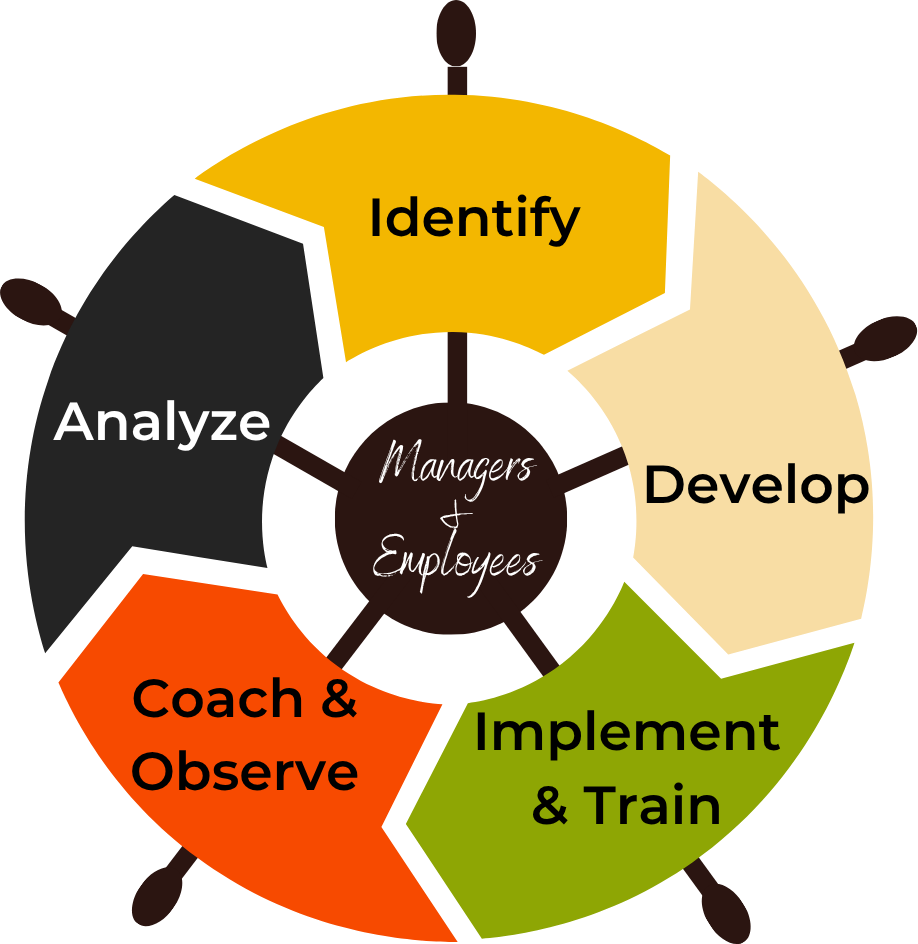
What a lot of them are missing is that influence layer on top. So in the Academy, you build it in order.
You don’t go skipping around and using it like a little Netflix game, going, “Oh, I’m implementing a safety initiative right now, so let me do those lessons first.” If you build it out of order, things are not going to work.
Identify: Start by Running Everything Yourself
In the beginning, you are the one running EVERYTHING. So yeah, you’re probably going to be overwhelmed in this stage, because it has to start with you.
Then you take 1 system at a time, and you slowly put in those psychology and marketing hacks to shift how that 1 system is done. You do that for all of them in the Identify stage… your inspections, your JHAs, your employee reports of hazards, your self-audits, and your hazard tracking.
Develop: The Right Corrective Action Is the One Everybody Supports
At first, yes, you’re probably going to develop your own corrective actions. They might be the right ones for safety. But the right corrective action is the one that everybody supports.
So you build out how you determine a corrective action, how you action plan to complete it, and how you write the policies and procedures. Then, system by system, you start including collaboration and changing who makes the decision.
That works because of what you did in Identify. You already started collaborating with supervisors, so now they care that the hazard is corrected in the right way. And when you bring their feedback into Develop, it changes how your continuous improvement program goes.
Implement and Train: Training That Actually Sticks
Most action plans are going to require training. So you train in the right way (training that actually sticks, training that people will follow), and you implement in a manner where you’re not the one doing everything.
That comes from Develop, because your action plan included everybody on the team. In Implement, everybody on that team is held accountable, and the training happens within the line of power.
Coach and Observe: The Biggest and Hardest Shift
This is where you check that everything you just implemented is actually working. In the beginning, you’re likely doing all the coaching and observing yourself. But because you’re not in the line of power, you’re not necessarily the best person to be doing that.
So you slowly shift it over to the people who are.
This is the biggest and the hardest thing to do, and it generally takes students 3 to 4 months before they can get there. It gets a little bit easier because you already started shifting beliefs in Identify, Develop, and Implement.
If you just walked in and said, “Brye said supervisors have to do all the training, coaching, observations, and accident investigations,” everybody would freak out on you…and you’d likely get fired. So you pilot it:
- In a meeting, say to a supervisor, “Hey, I’ve been coaching the employees. They’re not listening to me as well. Do you mind trying it out and seeing how it goes?”
- Take that example of how well it worked and let it move like a virus through your organization: “Hey, it worked for this supervisor. I want to try it with this supervisor.”
- Go to your decision-makers and say, “We piloted this with 2 supervisors. I really think employee coaching needs to be on their plate and not mine. It just works better, and I’ll be the coach of the coaches.“
You see that shift, right?
Analyze: Layer Your Data Onto the Business
Analyze means analyzing all the data you’ve collected along the way: your hazard reports, your coaching, your training records, your action planning. You layer it onto the business (this is where that business acumen comes in), and then you start reporting it.
And you don’t just generate 1 report about hazards and share that same report with everybody. Everybody has a different why, a different motivation, and a different awareness. So you craft your reports to match the audience you’re sharing them with.
As you’re analyzing that data, you’re likely going to identify some new gaps… and that leads you right back to Identify.
The Build Order in 3 Moves
Every system you build goes through the same 3 moves:
- Do it yourself first. Perfect the system, the forms, and the processes.
- Slowly start to include collaboration.
- Slowly shift the responsibilities out of your office and into the operations office.
So yes, it starts with you doing everything, and then you shift it over. The Academy walks you through all of this, stage by stage.
THE ALL-ACCESS PASS RESOURCE PAGE
Get all the FREE templates, safety management resources, PDFs, spreadsheets, and more...
Why Asking for More Safety Staff Quietly Backfires
When you see how much there is to build, your first instinct is to go and get help. You go to your boss and say, “Hey, I’m a department of one, and I need a coordinator, an admin, a trainer.”
It feels right, because there is so much to do. But that’s the wrong move. It quietly takes apart all the influence you’re trying to build.
I Asked for an Assistant Too
I’m going to be honest with you. When I laid out every task and my job came to 16 hours a day, I 100% went to my boss and asked them to hire me an assistant.
And they said NO.
So I said, “Well, then there has to be another way, because I can’t work 16 hours.” That’s how the Safety Management Cycle and the Safety Influencer System actually came to be.
What a Safety Staff Does to Your Influence
What I’ve learned from being a regional over tens of locations, and seeing how other organizations run their safety programs, is that when you have a staff in safety, it backfires on your influence.
When a supervisor is doing the training, the coaching, or the observing, it shifts the beliefs about safety in that supervisor’s mind. They really internalize the company’s policies and procedures, and they get involved in the SOPs and how their people work. That’s the whole reason to get your production supervisors to own safety.
If you all of a sudden say, “Okay, I’m going to hire a trainer, and they’ll do all the training,” you’re eliminating all that influence you’re trying to build. The same thing happens when you have coordinators doing the inspections.
And the worst part? When you have a team, the management team will help you less.
They’ll just go, “Well, you have a team. Why do you need us to help you?”
How can they justify paying 2 or 3 or 4 people to manage safety, and then turn around and tell their supervisors to do the coaching, observations, training, and accident investigations? This is especially true at a small organization.
Now, if you have a really large organization, then yes, you might need a safety administrator to help you keep track of the paperwork, or somebody to help with claims. That’s fine. Just don’t take things off of the management team’s plate and put them onto the safety plate.
Anything Employee-Facing Belongs With the Line of Power
The line of power is about who has power over somebody else. An employee reports to a frontline supervisor, and from there it goes manager, director, VP, GM, president. Nowhere in that line is safety, and you don’t have hire-fire authority.
So the supervisor is telling them 1 way to do it and watching them do it that way. Then you come along and tell them to do it a different way, and now you’re creating a conflict. That employee has to go, “Do I listen to safety, who’s trying to look out for me, or do I listen to my boss, who owns my job security?”
They’re ALWAYS going to pick their boss. So anything that’s employee-facing has to come from the line of power and not from the safety department.
Become the Guide on the Side
I know you can see that shift. But it’s really hard for the management team to understand it.
So you start off with 1 tiny piece, and you really vocalize and demonstrate how it’s more effective when it comes from them than when it comes from you. Then you slowly shift the conversation.
“I’m your guide on the side. I’m like your CFO. I don’t spend the money, but I guide you on how to spend the money.”
Same thing with safety. “I don’t do the coaching, but I coach you on how to do your job better and more effectively.” That shifts the role of safety to auditing, assessing, and coaching the line of power… and that’s also how you get over the overwhelm.
How Long It Takes to Build
I bet you’re curious how long building all of this actually takes.
12 Months, in 90-Day Stretches
In the Academy, we encourage students to work in 90-day stretches:
- The first 90 days: get through the first cycle and build the basic systems. You run each system yourself first. And then, once it’s in place, you start building collaboration into it…typically within those 90 days, or right around the 90-day mark.
- The next 90 days: slowly shift stage by stage over to the right people. You ask supervisors to do some coaching, and you take tiny little steps.
- The next 90 days: start really demonstrating the value of safety and shifting the executives’ mindset.
- The last 90 days: by 12 months in, you’ve got this down pat.
Now, I say 12 months, and that’s what to plan on. But I’ve had students change their entire program, and the salaries they’ve earned, in less than 4 months.
You’ll start to see the shift right away. And I’ve literally done this at tens of different locations.
You Can DIY It…I Did
You might be thinking, “I already know this stuff. I just need to change a couple of things.”
And if you want to try to DIY it, you go right ahead. I DIY’d it…it took me 15 years.
But if you want to change how you’re doing safety this year and really accelerate the trajectory of your career, then you’ve got to check out the Safety Leadership Academy. It’s the full system from this series, laid out step by step and system by system, with all the templates, tools, and resources.
And if you’d rather talk about it first, book a free Safety Leadership Roadmap Session with me. We’ll talk about where you are, the results you’re getting, and where you want to go, and I’ll point you in the right direction. And if that right direction is the Academy, then we’ll talk about that too.
Frequently Asked Questions About Building a Safety Program Roadmap
What is a safety program roadmap?
A safety program roadmap is a 1-page picture of how your whole program connects. It shows what you want out of your career, the 3 things standing in the way, and the system that fixes them. It also gives you the order to build in, so everything you build fits into 1 system.
What order should I build my safety program in?
Follow the 5 stages of the Safety Management Cycle in order: Identify, Develop, Implement and Train, Coach and Observe, and Analyze. Inside each stage, take 1 system at a time. Run it yourself first, then slowly include collaboration, then slowly shift the responsibility out of your office and into operations.
Should I ask my boss for more safety staff?
At a really large organization, you might need an administrator for the paperwork or somebody to help with claims. But asking for a trainer or a coordinator takes work off the management team’s plate and puts it on safety’s plate. Anything employee-facing belongs with the line of power, so keep it there.
How long does it take to build a safety program this way?
Plan on about 12 months, in 90-day stretches. You build the basic systems and run them yourself. Then you shift each stage to the right people and demonstrate the value of safety to your executives, though some students have changed their entire program in less than 4 months.
Where do I start if I’m already overwhelmed?
If you’re overwhelmed and don’t know where to start, start in the Identify stage with 1 system, like your inspections. You’ll still be running it yourself at first, so the overwhelm doesn’t go away right away. But break it into bite-sized chunks and bring supervisors and employees into it, and they start to get skin in the game.
Now It’s Your Turn
The biggest point I want you to take from your safety program roadmap is this: you have to stop building your safety program by yourself. You run each system yourself first, and then you include employees, supervisors, and the management team. And stop focusing all of your time on the employees… focus most of it on the supervisors and the managers.
- Put your own roadmap on 1 page: what you want, and which of the 3 things is standing in your way.
- Pick 1 system in the Identify stage and run it yourself the new way, in small bite-sized chunks.
- Bring 1 supervisor into that system with you.
- After your next initiative, do an after action review and add the business impact.
- When you get to Coach and Observe, ask 1 supervisor to try the coaching, then share how well it worked with the next one.
If you’re catching this one first, I strongly encourage you to go back through the entire series, because a lot of this you need to hear more than once. It starts with the path from safety manager to safety executive and the safety cop trap. And if you know a safety lead who’s trying to build all of this on their own, send this one to them.
You can DIY this. Or you can go see what’s inside the Safety Leadership Academy and knock it out this year. You got this, my safety friend.
How to Build Your Safety Program in the Right Order
===
Safety Brye: [00:00:00] If you're the person responsible for safety in your organization, you probably already know what isn't working. You're buried in work that was never really yours. Leadership nods along and nothing changes, and you're not sure you're ready to actually step up or where you'd even step up to. But knowing what's wrong and having a program that fixes it are two different things, and that gap is exactly where it's easy to get stuck when you have a to-do list that's a mile long and no idea where to start. So today, I am putting the whole roadmap in one place.
Safety Brye: [00:00:32] I'll show you the order to build it in and the fastest way to get it running in your building. Let's get to it. Hey there, my name is Brye, that rhymes with sky, and that is Lola back there. I am a certified safety professional, and I build safety programs from the ground up, and I've helped over 20 locations get their VPP application status within 18 months. Now, I teach safety leads the systems behind my methods. This is part seven and the last part of a series.
Safety Brye: [00:00:59] Now, over the last six episodes, we have covered what's standing between you and a seat in that executive table and how to fix each piece of it. Today, I'm gonna pull it all together so you can build it for yourself. There are three things I want to walk through with you. Number one, the whole roadmap on one page. Number two, the order to build it in. And number three, why building it alone is actually keeping you stuck and what you need to do instead.
Safety Brye: [00:01:25] But real quick, before we get into it, everything in this series comes straight out of the Safety Leadership Academy. The full system laid out step by step with the tools to build it. You want to see what's inside the academy? There is a link below for whenever you're ready. Now, before we talk about anything, let's put the whole roadmap on one page, because when you can see how every piece connects, you stop treating it like a pile of separate problems, and you start building it into one system, like an engine that can just run itself.
Safety Brye: [00:01:57] Now, when I think about safety leads and where they're going to go in their career and what they actually and truly want, I think it comes down to three things. One is more money. Obviously, we want to be paid our worth. Two is more status, and three is job security. So what do I mean by these three things? When I say more money, I don't necessarily mean the salary.
Safety Brye: [00:02:18] Of course, we all want more money, but in addition, we might be really happy where we are, but we still might be paid less. But as long as you feel like you're paid, you're worth, then that is likely what you're after. You don't ever want to feel like you are being overworked and underpaid, right? As for status, have you ever walked into a manager's meeting and felt like you should be treated just like the director or the VP, right? But you're given a title of safety coordinator, and you look at your workload compared to their workload and you're like, "This just isn't matching up."
Safety Brye: [00:02:49] That is a lot of what comes with status. So status could mean a job title, but quite frankly, job titles are just made up. And I've seen a lot of people doing the work of a director or a VP with a title of a coordinator or specialist. So don't get stuck on whatever your job title is. But if they're keeping you in the meeting and they're including you in that meeting, that makes you feel the status of your position. Now, I would fight for the job title if it comes with, uh, more money, right?
Safety Brye: [00:03:14] If you're not being treated fairly and not being paid your worth, then one hundred percent. I actually work for an organization that your bonus level was based on your title, so title was very important in that situation. And the third one of job security. We all want job security. We want to know that we're going to be able to support our families and our way of living now and into the future. And the thing about job security is that we don't just want to think of it as like, "I want to keep the job I currently have."
Safety Brye: [00:03:41] You want to be able to gain skills and have a track record of results and be able to, like, land any job you want. It kind of shifts in your mind when you have that type of experience and knowledge base and everything that you can share that instead of you waiting for somebody to give you a job, you now know that you can pick whatever job you want. And when you have that freedom to work for anyone, do the job anywhere, it gives you more confidence in your current role because then you're now, you're not acting out of fear. You're not worried if they fire you, because if they do, you'll just go pick up a job somewhere else, right?
Safety Brye: [00:04:16] Now, those are the three things that as I have done research with thousands of safety leads, everything comes down to when they're looking towards their future and their career: more money, more status, and job security. Now, what is standing in the way of you getting that? Because I truly believe that safety management is a unicorn profession. It is the gateway into all three of those things because we have to build skills to be exceptional at our job that then makes us more valuable in the job market, which gives us more job security, status, and money.
Safety Brye: [00:04:47] That's just how it works. So what is standing in your way from being exceptional at the job that you're doing? One is overwhelm. Now, if you think about it, there is so much to do when it comes to safety management. And if you are new, you might not even be realizing this yet. They might have promoted you into this role just to kind of get you to take over the training and the accident investigations, right, and deal with the claims handling.
Safety Brye: [00:05:09] But as you're going on in the role and you're trying to get the injury rate down and save the money on insurance, what you'll realize is there is a lot that goes into a safety management system. And because when the job was handed to you, you're expected to do all of it, it creates a ton of overwhelm. And I know I've told this story before that, like when I literally laid out every task I was responsible to do and timed it out for me to do my job as a safety manager, at that time, it was one location because it was after the recession.
Safety Brye: [00:05:40] One location with three hundred employees, it would have taken me sixteen hours because of all the expectation that the company had on me, but also I put on myself because of the way I was running my program So there's a ton of overwhelm to it. Next, you're likely feeling ignored. You are maybe not included in the managers' meetings, or you're given, like, a five-minute time to kind of like recap what's going on in safety. Decisions are being made without your input. You are finding out about things from employees and not even your own boss.
Safety Brye: [00:06:13] Or you walk out onto the floor and there's all of a sudden new equipment or new processes or new products that are being made that you might not have been included in. This gives you that feeling of being ignored and not being listened to. That's going to stand in your way as well, especially for our third one, which is confidence. What I have found that stands in the way of a lot of safety leads is that they just don't have the confidence to step up to take that next step. They don't even see the experience level that they have and that they actually are ready to take that step up.
Safety Brye: [00:06:46] I was recently chatting with somebody who literally had, uh, their degree. They were working towards their master's, they had certifications, and they were making fifty-five thousand dollars a year as a safety administrator. And I was like, "Why? Why aren't you going for something more?" She was like, "Well, I need a couple more years experience." Why do you need that experience?
Safety Brye: [00:07:07] You have it, and that all comes down to lack of confidence, lack of confidence in yourself. So you need to build that up to realize how amazing you are and that you are ready to take that next step. Now, underneath all of this, as you are working towards our rock star safety executive, underneath all of that and how you run your program to get, to get rid of that overwhelm, to gain that confidence, to stop being ignored, the way that we do it in the academy is we implement the safety management cycle, which is basically how you run your safety management system.
Safety Brye: [00:07:42] But we don't just run the cycle. We overlay it with our influencer system so that every system that you build within your safety program uses psychology and marketing hacks to change the perception and belief of safety to give you a bigger braggable track record of results, and that way you are then seen as that executive. So let me give you an example of this. So let's say that you are building an inspection program. You have a facility that needs to be inspected on a regular basis. You are likely doing it yourself right now.
Safety Brye: [00:08:13] You are likely going, "Hey, got to do the monthly inspection." Maybe you even go in early and you inspect the entire facility. The way that we have you do your inspections is we break them up into small bite-sized chunks, and then we collaborate with supervisors and employees on the inspection. We have a process so that when you f- have findings, they're not just going into some black hole work order. We have a whole system where they're documented, shared, followed up on, and then we put that into a data system, so we're tracking and trending all of our hazards that have been found and what it's related to behavior-wise.
Safety Brye: [00:08:49] So that way we can connect all those dots, and that way when we improve something, we can see the improvement and share that with our management team as how it is impacting the business. Do you see the difference there? You can do exactly what you're doing right now, but if you tweak your systems a little bit to put some psychology and marketing hacks in there, you build collaborative systems that organically change, uh, management support and employee engagement. So how does the safety management cycle and the safety influencer system impact those three things that are likely standing in your way? First, with overwhelm, because we are involving employees and supervisors and management along the way in that we are building collaborative systems, they now have skin in the game, which makes them more apt to support safety.
Safety Brye: [00:09:34] In addition, we take a step back from decision-making and make sure that people within the line of power are making that decision, and we shift what we're doing to focus on influencing and supporting the line of power instead of focusing all of our energy at the bottom of the org chart, which is the employees. Now, when it comes to feeling ignored, the way we solve that is to make sure that we connect the work of safety to the business impact. And in order to do that, you have to have business acumen. You need to understand how the business works.
Safety Brye: [00:10:06] We call this operational expertise. And then you create a data-driven safety program, so that way you're not just complaining about hazards or behaviors, you're actually demonstrating how it's impacting the business's bottom line. So then on top of that, we have a strategic communication cadence of how information is coming in and how it is flowing out to both employees, supervisors, and managers. So if you think about it, let's say you did that inspection that we just chatted about. You had a finding, but it was a pretty big finding that would need approval before taking action on it.
Safety Brye: [00:10:37] We don't want to be the decision-makers. That's going back to eliminating the overwhelm. So what we'll do is we'll take our data and we will create a business case for safety on how it's impacting the business, and then we'll communicate that to the decision-makers and let them decide. Now, our third one is about having no confidence, right? So as you're doing the safety management cycle with our influencer system, you're going to be building up really meaningful, braggable track records of results. Let me describe it this way.
Safety Brye: [00:11:05] So after every initiative, you want to do an after action review, you know, like what worked well, what didn't work well, what were the results? But with our system, we also want to throw in how it impacted the business. You're going to have your business case before, so you'll have an ROI. Now we want to throw in how it impacted the business. So what was the actual return on investment to that business? So when you go into your performance review or even to an interview and you have your braggable track record of results, what do you think would sound better?
Safety Brye: [00:11:34] "I reduced injury rates from a five to a three," or, "I added, you know, X number of dollars to the business's bottom line while at the same time reducing injury rates." And you can demonstrate that. And when you have this stack of the braggable track record of results, it gives you confidence, because now you can physically see how good you are at your job. You can see-- You can flip through like it was a book, right? Flip through and see how amazing you actually are. Now, another step in building that confidence is getting outside of your bubble and making sure that you are networking and, uh, meeting and learning from people outside of your industry, outside of your workplace, joining and volunteering in safety events, or joining communities where you can connect with other people.
Safety Brye: [00:12:21] And the last step is creating that career plan for you to grow. So what I always suggest for everybody is that you look at where you want to go, and we create someday goals, ten-year goals, five-year goals, three-year goals, one-year goals, and you're always working towards them. So as you are seeing your wins pile up, as you're working towards those goals, as you're looking at that braggable track record of results, opportunities just open up to you. And you're able to see things that maybe you weren't able to see before.
Safety Brye: [00:12:51] Maybe you're able to see how amazing you are at your job and that you should be reaching for more. Or maybe all of a sudden, that network connection that you made just to kind of get outside your bubble has a better opportunity for you that sounds interesting to you. So that is what we're talking about when we say getting out of your bubble and building up that confidence. And each of these feeds into the next one. If you notice, what you were doing to, uh, get over overwhelm fed into building that business case, and then that business case fed into giving you more confidence.
Safety Brye: [00:13:22] So that is the whole map, and every piece of this roadmap is built out step by step inside of Safety Leadership Academy. And you can see everything it covers when you go to the link below. But what the map doesn't tell you is where to take the first step, right? And that's the thing, like, if you build this in the wrong order, you are definitely going to get pushback. You're definitely going to feel frustrated. Because if you walked into your workplace tomorrow and said, "Hey, this is how we're doing things now.
Safety Brye: [00:13:51] This is what I learned over the weekend," or, "I watched a YouTube video on this, and this is how we're going to do it," nothing would change. In fact, you would get even more pushback, right? So the order that you build this in matters as much as what you are building in your safety program. So back to our safety management cycle. There are five stages in the cycle: identify, develop, implement and train, coach and observe, and analyze. Now, honestly, those five stages are how most well-run safety programs follow.
Safety Brye: [00:14:21] They just might not realize it. What a lot of them are missing is that influence layer on top. So in the academy, what we teach you to do is that you build it in order. You don't go skipping around and using it like a little Netflix game and go, "Oh, well, I'm implementing a safety initiative right now, so let me do that, those lessons first." If you build it out of order, things are not going to work. So first and foremost, you want to make sure that you're building out all of the systems.
Safety Brye: [00:14:49] And in the beginning, you are the one running everything. So going back to our overwhelm in our things that are holding you back, yeah, you're probably going to be overwhelmed in this stage because it has to start with you doing everything. But in the academy, what we teach you is how you take one system at a time, and you slowly put in those psychology and marketing hacks to shift how that one system is done. So we do all of them in the identify stage. We change our inspection systems, our JHA systems, our employee reports of hazards, our self-audit systems, our hazard tracking systems.
Safety Brye: [00:15:23] All of those things get changed in the right manner. Then we move on to develop. And at first, yes, you are probably going to develop your own corrective actions. They might not necessarily be the right ones. They're the right ones for safety, but the right corrective action is the one that everybody supports. But in the beginning, you're going to be developing out how you determine that corrective action and how you action plan to complete it, how you write the policies and procedures, how you create all, all the little bits and pieces to get that corrective action in place.
Safety Brye: [00:15:53] But in the academy, we teach you that each system of it, we slowly shift to start including collaboration, changing decision-making, putting in some of those little psychology hacks, because in the identify stage, you started already building skin in the game. You already started collaborating with supervisors. Now they care that that hazard is corrected in the right way. So when you bring their feedback to your develop stage, it changes how your continuous improvement program goes. And then once you have that action plan, we then move on to our implement and train.
Safety Brye: [00:16:26] So most action plans are going to require training, but you're implementing an action plan which also requires training. So we're going to make sure that we're training in the right way, training that actually sticks, training that people will follow, and then implementing it in a manner that you're not the one doing everything. And that all came from our develop stage, because in develop, we created an action plan that included everybody on the team. But in implement, we're making sure everybody on the team is being held accountable. And then we're training and putting out all the training pieces on there and making sure the training is happening within the line of power. Our next stage is coach and observe.
Safety Brye: [00:16:58] This is where we make sure that everything that we just implemented is actually working. This is also a great data-driven point as well. Now, in the beginning, you were likely doing all the coaching and observing yourself. But what you'll learn along the way is that because you are not in the line of power, you're not necessarily the best person to be doing that. So we slowly shift it over to the people within the line of power. So this is the biggest and the hardest thing to do, and it generally takes students anywhere from three to four months before they can get there.
Safety Brye: [00:17:28] But because in identify, develop, and implement, we already started shifting beliefs, it gets a little bit easier to say, "You know what? I'm not the right person to be correcting employees. That really should come within the line of power. I'm not the right person to be training employees." If somebody within the line of power was training them, they would listen to them more. So we slowly shift everything over there.
Safety Brye: [00:17:47] Because if you just walked in and said, "Hey, Bry said that supervisors have to do all the training, coaching, observations, and accident investigations," everybody would freak out on you, and you would likely get fired. But if you slowly said, went to one of your meetings and was like, "Hey, I've been coaching the employees. They're not listening to me as well. Do you mind trying it out and seeing how it goes?" And then taking that example about how well it worked and then making it Move like a virus through your organization, right? That like, "Hey, it worked for this supervisor.
Safety Brye: [00:18:15] I want to try it with this supervisor." And then you go to your decision-makers and say, "Look, we piloted this with two supervisors. I really think employee coaching needs to be on their plate and not mine. It just works better. And then I'll be the coach of the coaches. I will make sure that they're doing a good job."
Safety Brye: [00:18:28] You see that shift, right? Now, during coach and observe, you're collecting data as well, and that all feeds into our last stage, which is analyze. And analyze means analyzing all the data you've collected along the way, your hazard reports, your coaching, your, um, training records, your action planning, all of that. You analyze it, and you layer it onto the business. This is where we get that business acumen in there. And you layer it onto that, and then you start reporting it.
Safety Brye: [00:18:52] And in your reporting, you do it the right way, meaning that I don't just generate a report about hazards and share that same report with everybody. In psychology, everybody has a different why, right? Everybody has a different motivation and different awareness. So we want to make sure we're crafting our reports to match the audience that we're sharing it with. And as you're analyzing that data, you're likely going to identify some new gaps, right? And that leads us back to our identify stage.
Safety Brye: [00:19:17] So this is how you want to make sure you build it in the right order. You do it yourself first. You perfect the system, the, the forms, the processes. Then you slowly start to include collaboration, and then you slowly start to shift responsibilities outside of your office and into the operations office. Now, the academy walks you through all of this, and there is a link to that below. So that's the order.
Safety Brye: [00:19:41] Now, where this gets tricky, because when you see how much there is to build, your first inc-instinct is to go and get help, right? To go to your boss and say, "Hey, I'm a department of one, and I need help." Once you see everything that goes into a real effective safety program, one that does get to zero incidents, one that does add to the bottom line of the organization, it's a lot. So a lot of safety leads, they go to their boss, and they say, "Hey, I need more staff. I need a coordinator.
Safety Brye: [00:20:12] I need an admin. I need a trainer. I need another safety person." But honestly, that's the wrong move. It quietly takes apart all the influence that we're trying to build. Now, it feels right because there is so much to do, and I am going to be honest with you.
Safety Brye: [00:20:30] At when I had that list where it took sixteen hours, I one hundred percent went to my boss and asked them to hire me assistant. And they said no. And I had to come up with a different way. This is how the safety management cycle and the safety influencer system actually came to be. Because when they said no to me, I said, "Well, then there has to be another way, because I can't work sixteen hours." But what I have learned after being a regional of, you know, tens of locations across the globe and seeing how other organizations run their safety programs, when you have a staff in safety, it quietly backfires on your influence.
Safety Brye: [00:21:09] Because when you have a supervisor doing the training or the coaching or the observing, it is shifting the beliefs about safety in that supervisor's mind. It is having that supervisor really internalize the company's policies and procedures. It is really getting them involved in the SOPs and how their people work. And if you all of a sudden say, "Okay, I'm going to hire a trainer, and they'll do all the training," you're now eliminating all that influence that you're trying to build. The same thing happens when you have coordinators doing inspections and all of that.
Safety Brye: [00:21:41] And then the worst part of it is when you have a team, then the management team of that organization now will help you less because they will just go, "Well, you have a team. Why do you need us to help you?" How can they justify paying two to three to four people to manage safety, but now all of a sudden, my supervisors need to do coaching, observations, training, accident investigations? What do I have a safety team for? Do you see the difference? This is especially prevalent if you try to do it at a small organization.
Safety Brye: [00:22:10] Now, if you have a really large organization, then yes, you might need a safety administrator to help you keep track of the paperwork. You might need to have somebody to help with claims. That's fine. But we want to make sure we're not taking things off of the management team's plate and putting them onto the safety plate. Because anything that is employee-facing should not be done by safety. It should be done by somebody who is in the line of power.
Safety Brye: [00:22:34] So the line of power talks about how somebody has power over somebody else. Let me just give you a quick recap of that, right? So if you think about an employee, they report to probably a frontline supervisor, and their frontline supervisor is telling them one way to do it, and you are not in that employee's line of power because it goes like supervisor, manager, director, VP, GM, president, whatever, right? Nowhere in that line is safety. You don't have hire-fire authority. So the supervisor is telling them one way to do it.
Safety Brye: [00:23:03] The supervisor is watching them do it that one way and either approving it or whatever. And then you come along, and you tell them to do it a different way. You're now creating a conflict. So now that employee has to go, "Do I listen to safety, who's trying to look out for me, or do I listen to my boss who owns my job security?" They're always going to pick their boss. So anything that is employee-facing needs to come from the line of power and not from the safety department.
Safety Brye: [00:23:30] And that is a shift that I know you can understand, that you can see it, but it's really hard for the management team to understand that. So that's why starting off with one tiny piece and then really vocalizing and demonstrating how when it comes from you, it's more effective than when it comes from me. And then slowly shifting the conversation to be like, "I'm your guide on the side. I'm like your CFO. I don't spend the money, but I guide you on how to spend the money." So when it comes to safety, it's like, "No, I'm the guide on the side.
Safety Brye: [00:24:04] I don't do the coaching, but I coach you on how to do your job better and more effectively." So then it shifts the role of safety. Our role is then to audit and assess and coach The line of power, right? That's how we also get over that overwhelm. So if this is resonating with you, this- these are the things that we talk about here on this channel, so make sure that you share this episode with your best safety friend so that way they can get in on all of the safety goodness as well.
Safety Brye: [00:24:35] All righty, so we have been talking today about the whole map and how you build it and building it in the right order. And I know that this is the end of an entire series, so if you're catching this one right now, I strongly encourage you to go back and watch this through the entire series because a lot of this stuff you sometimes na- need to hear more than once, or you need to go deeper into one different area. But the biggest point that I want you to understand is that you have to stop building your safety program by yourself. You have to include employees, supervisors, and the management team.
Safety Brye: [00:25:08] And secondly, you have to stop focusing all of your time on the employees and focus most of your time on the supervisors and the managers. All righty, so let's go over what we covered today. One, I showed you the whole map. I wanted to make sure that you understood that I see what you are currently after. I can tell what your goals are, and I broke them down into three different wants and three different things that are likely blocking you from getting those things. We went through the safety management cycle as well as the influencer system that is built on top of it.
Safety Brye: [00:25:40] I walked you through how to build it in order and why it is so important to start with your identify stage and not jump right into all of the other stages. And we chatted about why adding people to your safety team is not the answer. It's all about not building your program alone, so that way you are changing the perception and the beliefs about safety, and that this is a proven blueprint. I've literally done this at tens of different locations. This is how I get sites to VPP in less than 18 months.
Safety Brye: [00:26:11] And I bet you're curious how long building all of this actually takes. So in the academy, we encourage all of our students to get through the first cycle and building the basic systems within 90 days, and that way they're running everything themselves differently for 90 days. And then they spend the next 90 days slowly shifting stage by stage over to the right people, right? So they start collaborating with people. They start asking supervisors to do some coaching. They take tiny little steps.
Safety Brye: [00:26:40] And then the next 90 days is where we start really demonstrating the value of safety and trying to shift the executive's mindset. And then by the next 90 days, 12 months in, they've literally got this down pat. Now, I say 12 months, but I have to be honest with you, I have had students change their entire program as well as their salaries that they've earned in less than four months. So you will start to see the shift right away. And you might be thinking, "I already know this stuff. I just need to change a couple of things."
Safety Brye: [00:27:11] And if you want to try to DIY it, you go right ahead. I DIY'd it. It took me 15 years. But if you want to knock this out this year, if you want to change how you're doing safety this year and really accelerate the trajectory of your career, then you have got to check out the academy. Go to the link below. It's thesafetygeek.com/academy.
Safety Brye: [00:27:32] It is the full system from this series laid out step by step, system by system, with all the templates, tools, and resources that you need. And if you'd rather talk about it first, then book a call with me. It's a free safety leadership roadmap session where we can talk about where you are, the results you're getting, where you want to go, and I will definitely point you in the right direction. And if that right direction is the academy, then we'll talk about that, too. All righty, my safety friends, this was the last episode in this series.
Safety Brye: [00:28:03] Thank you so much for spending this time with me. But don't go anywhere. Make sure you stay subscribed. Over the next several weeks, we're answering your burning questions, so if something from this series is still on your mind, drop it in the comments and it could end up on an upcoming episode. And if you know a safety lead who's trying to build all of this on their own, then send this one to them, and I will see you in the next one. Bye for now.
Sign up to receive email updates
Enter your name and email address below and I'll send you periodic updates about the podcast.
Hi, I'm Brye (rhymes with sky)! I am a self-proclaimed safety geek with two decades of general industry safety experience. Specializing in bringing safety programs to a world-class level and building a safety culture, I have trained and coached many safety managers, just like you, on how to effectively manage workplace safety in the real world. I would love to help you too.