Estimated Reading Time: 9 minutes
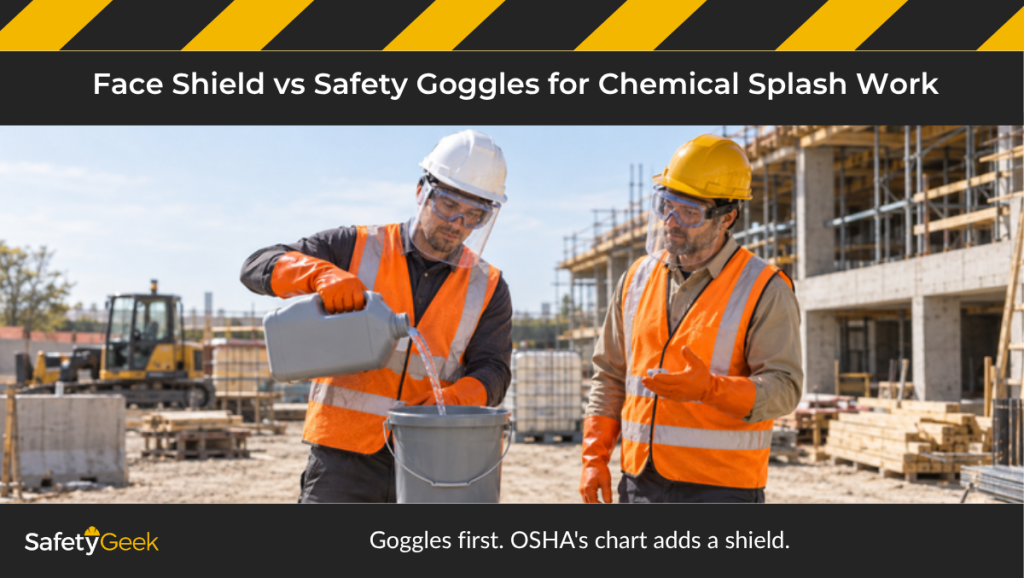
TL;DR: For chemical splash, goggles come first. They seal around your eyes, and a face shield doesn’t. OSHA’s selection chart lists goggles for chemical splash and adds a face shield over them for severe exposure. So the real question is when you need both. The chemical, how the liquid moves, and where your face is compared to it will tell you.
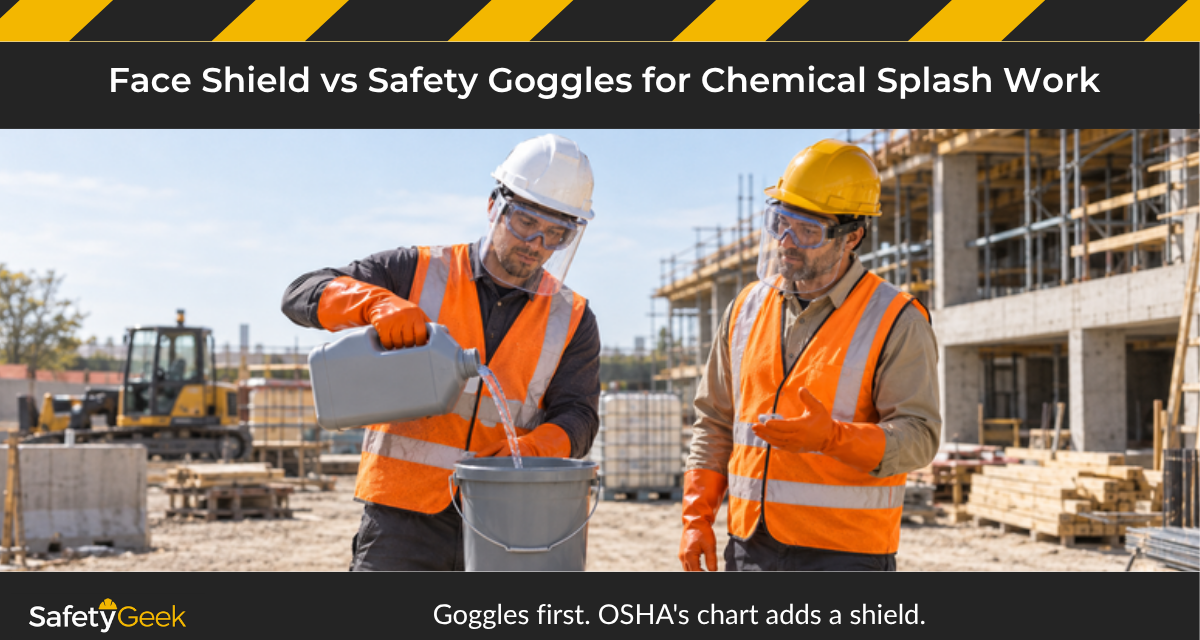
Face shield vs safety goggles for chemical splash? Start with goggles. A face shield protects your skin and adds a second layer, but it leaves gaps at the sides and bottom, so it can NEVER replace a goggle seal.
And if you’ve ever stood in front of a shelf of PPE thinking, “Am I doing the right thing here?”…you’re asking the right question. OSHA’s own chart gives you a starting point, and the rest comes down to 3 questions about the task. And I’ll tell you about the maintenance supervisor who was more than 40 seconds from an eyewash, and what that distance cost him.
Key Takeaways
- Goggles are your primary protection for chemical splash because they seal around the eyes.
- A face shield is secondary protection. OSHA’s chart says to wear it only over primary eye protection, and for chemical splash that means goggles.
- OSHA’s rule says “appropriate” and leaves the choice to you. 1926.102 lists liquid chemicals, acids, and caustics as hazards without naming a device.
- Vents matter. Use indirect-vented or non-vented goggles for splash. Direct vents are for less fog around large particles.
- Add the Shield when a splash could reach your whole face, like a drum transfer or work at face level.
- Eyewash doesn’t replace eye protection. OSHA has said so since 1982.
What OSHA Says About Chemical Splash Eye Protection
29 CFR 1926.102(a)(1) requires appropriate eye or face protection when workers are exposed to liquid chemicals, acids, or caustic liquids. Notice what’s missing… the word “goggles.” The construction rule names the hazard and leaves the device to you, and 1910.133(a)(1) uses the same wording for general industry.
The Chart to Start With
So where do you look? Appendix B to OSHA’s PPE standard is written for general industry, and it’s non-mandatory, but it’s where I’d start on any site. (Yes, I’m the kind of geek who has opinions about PPE appendices.)
Look under chemicals. For acid and chemical handling, degreasing, and plating, the splash line says goggles. Severe exposure? Add a face shield.
Note 3 on that same chart adds the line that matters most: face shields “should only be worn over primary eye protection.” That note covers every hazard on the chart. For chemical splash, the chart names goggles…so go with goggles.
What “Appropriate” Means on a Construction Site
OSHA’s construction eye and face protection standard adds 2 details. Whatever you pick has actually to protect against the hazard, and it has to fit snugly.
So your supervisor should be able to tell a worker why, in plain words: “It’s a pour, and a splash can reach your whole face, so it’s goggles and a shield on this one.” A flying particle hazard assessment follows the same thinking for impact hazards, and chemical work deserves the same care.
Face Shield vs Safety Goggles: How They Compare
Safety goggles are tight-fitting eye protection that cover the eyes, the eye sockets, and the area right around them. A face shield is a clear sheet of plastic that runs from the eyebrows to below the chin. Both descriptions come from OSHA’s Personal Protective Equipment booklet, and that difference in shape is why one can’t replace the other.
| Feature | Splash Goggles | Face Shield | Goggles + Face Shield |
|---|---|---|---|
| Seals around the eyes | Yes | No | Yes |
| Covers face and chin | No | Yes | Yes |
| Impact protection | Yes, if rated | Not adequate alone | Yes, if rated |
| OSHA chart role | Primary | Secondary | Severe exposure |
| Main headache | Fog and heat | Open sides and bottom | Fog, heat, and bulk |
And this isn’t abstract. Workers had 18,510 eye injury and illness cases with days away from work in 2020, according to the Bureau of Labor Statistics. Exposure to harmful substances or environments accounted for 4,830 of them, and construction trades workers had 2,120 of the total.
Why a Shield Alone Falls Short
Think of a face shield like an umbrella in a sideways rainstorm. It covers you from the front…and the rain comes in from the side.
NIOSH’s eye safety guidance warns that the Shield’s curve can direct particles or chemicals from the side into your eyes. So you wear something under it, EVERY time.
Picture someone pouring acid with a shield on over regular safety glasses. They look protected. But safety glasses don’t seal, so that liquid can still reach your eyes.
NIOSH is blunt about chemical and industrial settings: shields go on in addition to goggles, not as a substitute.
Why Goggles Alone Can Fall Short
Goggles protect your eyes and nothing else. Your cheeks, chin, lips, and neck are still exposed when a corrosive splashes.
So goggles alone can work for a quick wipe-down. They aren’t enough when liquid could hit the rest of your face.
Why Vents Matter for Splash
Not all goggles stop liquid. NIOSH points to indirect venting for splash or fine dust, and saves direct venting for less fog around large particles. Direct vents are open holes (great for fog, terrible for acid), and liquid can come right through them.
Look for the D3 marking, which is the ANSI Z87.1 marking for droplet and splash protection. No D3? NEVER assume it’s a splash goggle, no matter what the box picture looks like.
How to Choose for the Task in Front of You
The right choice comes from 3 questions: What’s the chemical? How does the liquid move? And where is your face compared to it? Start with Section 8 of the Safety Data Sheet (SDS), which covers exposure controls and personal protection, and then walk the actual task.
OSHA’s chart doesn’t put a number on “severe exposure”…so that call is yours. Here’s where I’d start. Test every row against your SDS.
| Task | Starting Point |
|---|---|
| Wiping a small amount of cleaner at waist height | Indirect-vented or non-vented goggles |
| Transferring a corrosive from a drum to a pail | Goggles plus face shield |
| Acid-washing masonry with a sprayer | Goggles plus face shield |
| Applying a chemical overhead or at face level | Goggles plus face shield |
| Opening a line or flange that could hold pressure | Goggles plus face shield |
| SDS lists gases or vapors | Review a full-facepiece respirator in your respiratory protection program. |
Write the Call Into the Procedure
Don’t let this live in your head. Add 1 short line to the procedure so the supervisor can coach to it and the next crew gets the same answer. Here’s an example to adapt:
“Drum-to-pail transfer of corrosive cleaner at waist height. Splash can reach the whole face. Goggles plus face shield. SDS Section 8 checked.”
What About Prescription Glasses and Contacts?
Under 1926.102(a)(3), workers with prescription lenses need protection that includes the prescription, or protection that fits over their glasses without disturbing them. Everyday prescription glasses under a shield don’t count.
OSHA’s selection chart also warns that chemical environments can add a hazard for contact lens wearers. Contacts still go under proper eye protection.
THE ALL-ACCESS PASS RESOURCE PAGE
Get all the FREE templates, safety management resources, PDFs, spreadsheets, and more...
Eyewash Is Your Backup, and It Has to Work
Eye protection prevents the injury, and eyewash limits the damage when prevention fails. OSHA drew that line in a 1982 letter, when someone asked whether eyewash could stand in for eye protection. The answer was no.
Where corrosives are in play, 29 CFR 1926.50(g) requires suitable facilities for quick drenching or flushing within the work area for immediate emergency use. Plants fall under the same wording in 1910.151(c).
The rule doesn’t state a flush time. But OSHA often points employers to ANSI Z358.1 for guidance, and 15 minutes is the number to plan around.
What Happens When the Safe Choice Is Far Away
I have a story about a maintenance supervisor who got sprayed with ammonia on a roof. The eyewash was back inside…more than 40 seconds away. He only had a couple of things left to do.
So he finished first.
He ended up with permanent lung damage and complete blindness.
He knew what he was supposed to do.
The walk just felt longer than the risk felt real.
An eyewash bottle in his bag wouldn’t have replaced a full flush. But he’d have started flushing his eyes immediately. The safe choice has to be close enough that nobody has to weigh it.
Test It Before You Need It
I walked into a new acquisition once and found the eyewash station blocked. When I tested it, rusty water came out.
So instead of writing a policy, I ran “chemical splash” simulations where employees had to get to the eyewash fast.
They couldn’t, and supervisors saw it for themselves.
That drill opened their eyes in a way a memo never would have.
We ended up installing eyewash capability in the existing sinks, which were accessible and already had clean water running through them.
How to Make Eye Protection Stick With Your Crew
The best goggles in the world don’t help if they’re hanging around someone’s neck. And when people keep taking it off, the useful question is: what makes this hard to follow?
Make the Safe Way the Easy Way
Fog is the obvious one, and OSHA’s own chart says restricted ventilation can fog lenses. Anti-fog options for humid sites are worth a field trial before you buy in bulk.
Then look at convenience. Are the goggles at the point of use, or in a trailer on the other side of the site? Can a worker put a shield on over a hard hat without hunting for a part?
That’s the Easy Button Approach…make the safe way the easy way, or the moment will talk people out of it.
Run It Through the Safety Management Cycle
The Safety Management Cycle keeps eye protection from turning into a box you order once and forget:
- Identify: List every chemical task using your chemical inventory list and the Safety Data Sheet.
- Develop: Write the eye and face protection for each task right into the procedure.
- Implement & Train: Show people the difference with the actual gear on the actual task.
- Coach & Observe: Supervisors check it during the work, since corrections belong in the line of power (the people each worker actually reports to).
- Analyze: Trend your near misses and observations, then adjust.
Regulations are a C grade. “Appropriate” gets you the C, and a process your supervisors own gets you to the A.
Frequently Asked Questions About Face Shields and Chemical Splash Goggles
Is a face shield enough for chemical splash?
No, OSHA’s selection chart says face shields should only be worn over primary eye protection. For chemical splash, that chart lists goggles, and NIOSH says to use shields in addition to goggles. A shield has open sides and a curve that can direct liquid toward your eyes.
Do I need goggles under a face shield?
For chemical splash, yes, since OSHA’s chart names goggles for splash and adds a face shield for severe exposure. Safety glasses don’t seal around the eyes, so liquid can still get behind them. Wear splash goggles first, then put the Shield over them so a splash can’t reach your whole face.
What type of goggles protect against chemical splash?
Use goggles with indirect venting or no vents, and look for the D3 droplet and splash marking from ANSI Z87.1. NIOSH says direct vents reduce fog around large particles. They’re open holes, so they aren’t the right pick when liquid could hit your face.
Does OSHA require a face shield for chemicals?
OSHA’s rule doesn’t name a device… 1926.102(a)(1) requires appropriate eye or face protection for liquid chemicals, acids, and caustics. OSHA’s non-mandatory chart for general industry recommends a face shield over goggles for severe exposure, so your task review decides. Check Section 8 of the Safety Data Sheet, and write the call into your procedure.
Can an eyewash station replace goggles?
No, OSHA said in a 1982 letter that it doesn’t view eyewash as equivalent protection. Eye protection is meant to prevent the accident, and eyewash limits the injury if that protection fails. When corrosives are present, you need both, and the eyewash must be within the work area for immediate use.
Now It’s Your Turn
For chemical splash, goggles are the foundation and the face shield is the upgrade. The chemical, how the liquid moves, and where your face is compared to it decide when you need both.
Here’s where to start this week:
- Pull your chemical list and mark every task involving a corrosive.
- Check the goggles on your shelf for indirect vents or no vents, plus the D3 marking.
- Walk 1 pouring or transfer task with the supervisor, then write the call into the procedure together.
- Test your eyewash and time the walk from the task. The maintenance supervisor’s was more than 40 seconds.
- Ask 1 crew, “What makes these goggles hard to keep on?”
Getting the gear right is honestly the smaller job. Getting supervisors to own it, without the constant babysitting, is the bigger one. Otherwise, you’re still having the same goggle conversation on every walk…does that sound like your week?
My free training on the Safety Influencer System shows you how to get there. It’s the same thinking we teach inside the Safety Leadership Academy. John Lange, an EHS Supervisor in beverage manufacturing, built a plan there for supervisors to “lead the front line charge.”
You got this, my safety friend.
Hi, I'm Brye (rhymes with sky)! I am a self-proclaimed safety geek with two decades of general industry safety experience. Specializing in bringing safety programs to a world-class level and building a safety culture, I have trained and coached many safety managers, just like you, on how to effectively manage workplace safety in the real world. I would love to help you too.