Estimated Reading Time: 7 minutes
TL;DR: ANSI Z87.1-2025 marking requirements for construction tell you exactly what a piece of eye protection can handle. The base Z87 mark means basic impact protection, Z87+ means high impact, and lens codes like D3 (splash), U (UV), and W (welding) match the gear to the hazard. The 2025 edition added X for anti-fog and O2 for relaxed optics. OSHA’s 1926.102 points to these markings as your selection guide.
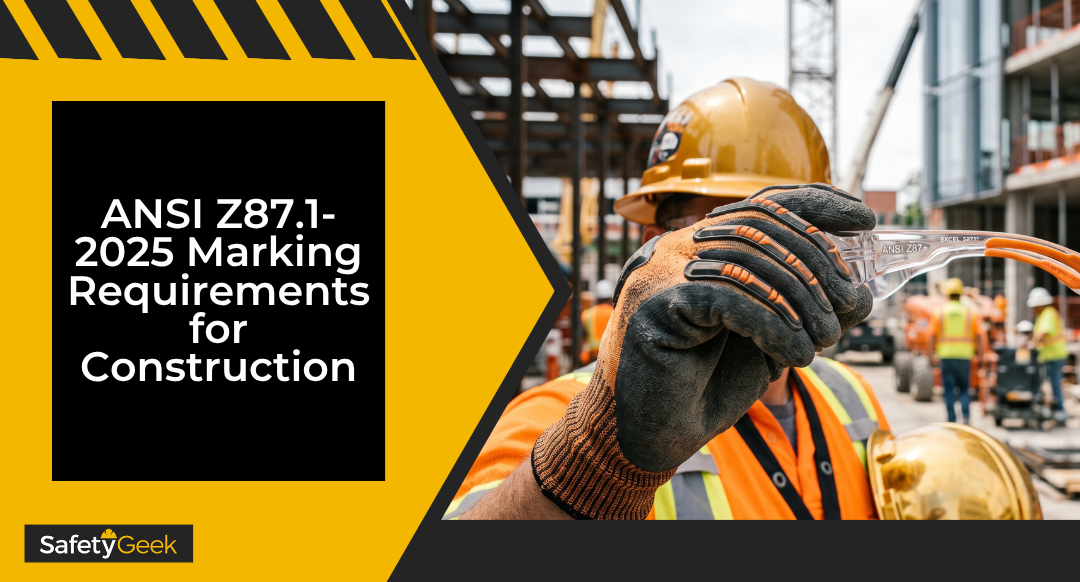
You’re standing in front of a wall of safety glasses, and every box has a different string of letters and numbers stamped on the frame. ANSI Z87.1-2025 marking requirements for construction are what those letters and numbers mean. Learn to read them, and you’ll know in three seconds whether a pair of glasses protects against the hazard in front of you… or whether you just bought obsolete gear.
Here’s the part nobody warns the new safety manager about. You get handed PPE selection, nobody trains you on the markings, and you’re left guessing whether “Z87” is good enough or whether you needed “Z87+” all along.
That guess matters, because NIOSH reports that about 2,000 U.S. workers suffer a job-related eye injury that needs medical treatment every single day. The markings are how you stop being one more line in that statistic.
Key Takeaways
- Z87 is the base impact mark… Z87+ means the gear passed the high-velocity, high-mass impact tests construction usually demands.
- Lens code letters match the hazard: D3 for splash, D4 for dust, D5 for fine dust, U for UV, R for infrared, L for glare, W for welding shades.
- The 2025 edition added two new marks: X for verified anti-fog performance and O2 for a relaxed optical class.
- The manufacturer’s mark must be permanent on every compliant lens and frame, so you can trace the gear back to its maker.
- OSHA 1926.102 doesn’t set the markings itself… it points to ANSI Z87.1 as the benchmark for selecting and verifying eye protection.
- A hazard assessment comes first. The markings only help once you know what you’re protecting against.
What ANSI Z87.1 Markings Actually Tell You
A marking on safety eyewear is a coded promise. It’s the manufacturer telling you, in a standardized shorthand, exactly which tests that lens or frame passed under the ANSI/ISEA Z87.1-2025 standard. Once you know the code, you don’t have to take a salesperson’s word for anything.
Every compliant pair carries at least two things: the manufacturer’s mark and the Z87 designation. The manufacturer’s mark is a permanent logo or symbol identifying who made it.
The Z87 (or Z87+) tells you the impact level it passed. From there, additional letters and numbers stack on to describe filters, fit, and special features.
Think of it like reading a nutrition label. You glance at it, you find the two or three numbers that matter for your situation, and you make a decision.
A worker grinding steel needs a different code than a worker handling acid, and the markings are what separate the two. This is exactly why a real hazard assessment has to come before you ever pick a frame.
So when somebody hands you a box of “OSHA glasses,” flip them over. If you can’t find a manufacturer’s mark and a Z87, they’re not compliant… no matter what the invoice says.
The Impact Rating: Z87 Versus Z87+
The single most important marking for construction is the impact rating. Z87 means the eyewear passed the basic impact test. Z87+ means it passed the high-impact tests, where lenses get hit with a quarter-inch steel ball traveling around 150 feet per second and a pointed drop-ball mass.
For most construction tasks, you want Z87+. Grinding, chipping, nailing, cutting, and demolition all throw debris fast and hard. Basic-impact Z87 gear is fine for low-energy tasks like light assembly or general walking-around protection, but it was never built for flying fragments.
| Marking | Impact Level | Best For |
|---|---|---|
| Z87 | Basic impact | Light tasks, general dust, low-energy hazards |
| Z87+ | High impact | Grinding, chipping, nailing, cutting, demolition |
| Z87-2 | Prescription, basic impact | Rx wearers on low-energy tasks |
| Z87-2+ | Prescription, high impact | Rx wearers on high-energy construction tasks |
The “+” is the difference between a lens that cracks and a lens that holds. On a construction site, that’s the difference between a near miss and an ER visit. When in doubt, spec the plus.
Lens Code Markings for Specific Hazards
After impact, the lens codes tell you what else the eyewear filters or resists. Each letter pairs with the hazard it’s built for, and many lenses carry more than one. This is where matching the marking to the actual job becomes a craft.
Here are the codes you’ll see most on a construction site:
- D3… protection against droplets and splash (think chemicals, coatings)
- D4… protection against dust
- D5… protection against fine dust
- U + number… ultraviolet filter, with the number showing the filter strength
- R + number… infrared filter for hot work and heat
- L + number… visible light filter for glare
- W + shade number… welding filter at a specific darkness shade
A welder cutting with an oxy-fuel torch needs a W shade marking matched to the job. A worker pressure-washing with chemicals needs a D3 splash rating, which usually means goggles, not glasses. A roofer in blinding sun benefits from a U and L combination.
The lens code is also where most “obsolete gear” mistakes happen. Somebody buys a pile of cheap glasses with no D or U marking, then sends them out to a crew handling solvents and working in UV all day.
The glasses technically say Z87, but they don’t carry the codes the hazard demands. PPE is your last line of defense, and the markings are how you make sure that last line actually holds.
THE ALL-ACCESS PASS RESOURCE PAGE
Get all the FREE templates, safety management resources, PDFs, spreadsheets, and more...
What’s New in the 2025 Edition: X and O2
The ANSI/ISEA Z87.1-2025 revision added markings worth knowing, because they change what you can ask for when you spec gear. The two headline additions are X and O2.
The X marking certifies anti-fog performance. Until now, “anti-fog” was a marketing claim with no standard test behind it.
With the X marking, a manufacturer is saying the lens passed a defined anti-fog test, which matters for workers who move between hot and cold areas or sweat under exertion. Foggy lenses get pushed up onto a hard hat, and unprotected eyes are exactly the problem we’re trying to solve.
The O2 marking designates a relaxed optical class. Some specialized lenses, like certain prescription or curved wrap designs, can’t always hit the strictest optical clarity grade without sacrificing protection. O2 gives a defined, acceptable optical class for those cases so the gear stays both compliant and wearable.
You’ll also keep seeing the H marking, which flags eyewear sized for smaller head shapes. Fit is not a side issue. Gear that doesn’t fit gets worn wrong or not at all, which is the same reason properly fitting PPE changes everything on a crew.
Worth a caution: a newer marking on the box doesn’t automatically mean OSHA requires that exact edition. It means the consensus standard moved forward, and your selection options just got better.
How OSHA 1926.102 Uses ANSI Z87.1
OSHA’s eye and face protection standard for construction, 29 CFR 1926.102, requires employers to make sure workers use eye and face protection when exposed to eye or face hazards. The rule itself doesn’t list every marking. Instead, it leans on ANSI Z87.1 as the recognized benchmark for what “appropriate” protection looks like.
Here’s the nuance that trips people up. OSHA incorporates specific editions of ANSI Z87.1 by reference, and those references don’t auto-update the moment ISEA publishes a new edition.
So while Z87.1-2025 is the current consensus standard, OSHA’s construction rule may still formally cite earlier editions. The good news is that the core marking system, Z87, Z87+, and the D, U, and W codes, has stayed consistent across editions.
For a working safety manager, the practical move is simple. Run a hazard assessment, match the markings to the hazards you found, document your selection, and you’re meeting both the spirit and the letter of the rule.
This is the Identify stage of the Safety Management Cycle in action… you can’t pick the right protection until you’ve named the hazard. PPE is also the bottom of the hierarchy of controls, so always ask whether you can engineer or guard the hazard out before you rely on a lens.
When you treat the markings as a selection tool instead of a compliance afterthought, eye protection stops being a box you check and becomes a decision you can defend.
Frequently Asked Questions About ANSI Z87.1 Markings
What does Z87+ mean on safety glasses?
Z87+ means the eyewear passed ANSI Z87.1 high-impact testing, including a high-velocity steel ball and a high-mass drop test. Plain Z87 only passed basic-impact testing. For grinding, chipping, cutting, and most construction tasks, Z87+ is the rating you want on the lens and frame.
Does OSHA require ANSI Z87.1-2025 specifically?
Not exactly. OSHA 1926.102 requires hazard-appropriate eye and face protection and points to ANSI Z87.1 as the benchmark, but it incorporates specific editions by reference. Those citations don’t update automatically when ISEA publishes a new edition, so confirm which edition your jurisdiction enforces.
What does the X marking mean on Z87.1-2025 eyewear?
The X marking is new in the 2025 edition and certifies anti-fog performance against a defined test. Before this, “anti-fog” was an unverified marketing claim. An X-marked lens has actually passed an anti-fog standard, which matters for workers moving between temperature extremes or sweating under heavy exertion.
What do D3, D4, and D5 markings protect against?
These lens codes signal droplet and dust protection. D3 covers splash and droplets, like chemicals or coatings. D4 covers dust, and D5 covers fine dust. A D3 rating usually requires goggles rather than spectacles, because a sealed fit is what actually keeps liquid splash out of the eyes.
Why is the manufacturer’s mark required on safety eyewear?
The manufacturer’s mark is a permanent identifier showing who made the eyewear and certifying it meets ANSI Z87.1. If a lens carries no manufacturer’s mark, you can’t verify the standard it claims to meet, and it shouldn’t be treated as compliant gear no matter what the packaging says.
Now It’s Your Turn
The markings on a pair of safety glasses are a decision tool, not decoration. Once you can read Z87+, the D and U and W codes, and the new X and O2 marks, you can match protection to hazard in seconds and defend every choice you make.
Here’s what to do this week:
- Pull a sample of the eye protection your crews actually wear and read the markings on each one.
- Compare those markings against the hazards in your most recent hazard assessment.
- Flag any gear that’s missing the codes the task demands… that’s your obsolete pile.
- Build a simple selection chart that pairs each task with the required markings.
- Train your supervisors to spot a missing Z87+ or manufacturer’s mark on the spot.
Getting PPE selection right is one piece of a bigger system, and that system is exactly what we build with safety professionals inside the Safety Leadership Academy. When you treat compliance as a craft instead of a checkbox, you stop being the safety cop and start being the expert people actually listen to. You got this.
Hi, I'm Brye (rhymes with sky)! I am a self-proclaimed safety geek with two decades of general industry safety experience. Specializing in bringing safety programs to a world-class level and building a safety culture, I have trained and coached many safety managers, just like you, on how to effectively manage workplace safety in the real world. I would love to help you too.