Estimated Reading Time: 7 minutes
TL;DR: Normalized deviance is what happens when a rule gets broken, nothing bad follows, and the broken version slowly becomes the new standard. It looks like a taped interlock, a skipped lockout step, or a guard left off “just for this run.” You stop it by naming the drift, finding out why the rule is hard to follow, fixing that friction, and checking the work on the floor.
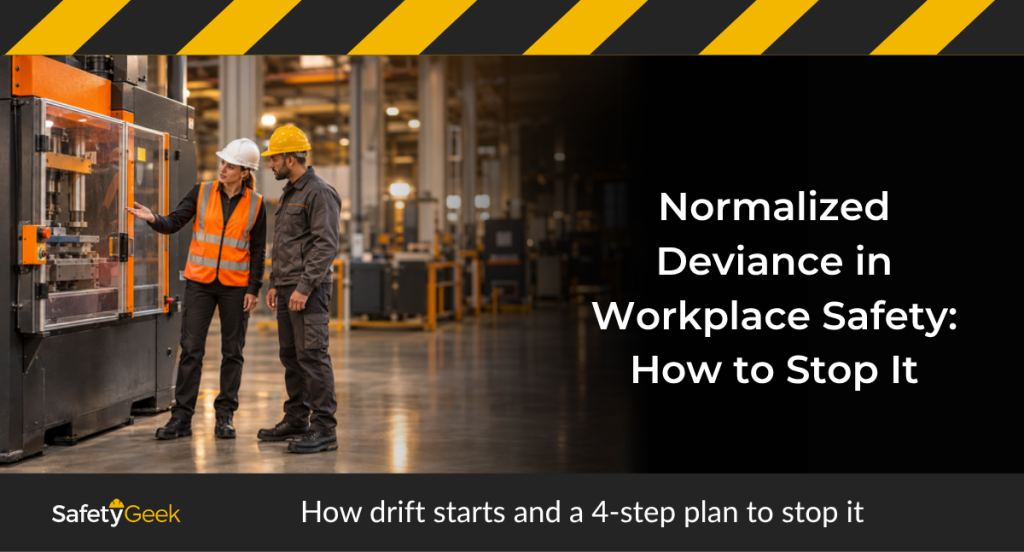
Have you ever walked past a taped interlock, known exactly what it meant, and also known you can’t approve the fix? That’s normalized deviance in workplace safety: a shortcut that goes unpunished long enough to become the way the job gets done.
That’s what makes it dangerous. NASA’s own history office describes how personnel before the Columbia accident knew about earlier foam strikes and assumed they were tolerable. None of those strikes had caused a catastrophe. When something finally goes wrong, the question that follows is “who knew?” and it lands on the safety program…whether or not you ever had the authority to fix it.
Key Takeaways
- Normalized deviance is drift. People copy what they see work, and when nothing bad happens, it feels like proof.
- The first workaround is a choice. By the 100th, it’s just the job.
- Repeated success hides rising risk, because the shortcut that hasn’t hurt anyone yet looks like evidence it’s safe.
- Recurring non-compliance points at the system. Find out what makes the rule hard to follow before you ask who broke it.
- A 4-step intervention works: name it, find the friction, fix the system, verify on the floor.
What Is Normalized Deviance in Workplace Safety?
Normalized deviance is the gradual process where a departure from a safety standard becomes accepted because it didn’t cause visible harm. Sociologist Diane Vaughan coined the term while studying the Challenger accident. As NASA’s history office summarizes it, her point is that an unsafe practice becomes “normalized” because its continued presence doesn’t lead to failure.
A peer-reviewed commentary in the Journal of Patient Safety says people become so insensitive to a deviant practice that it no longer feels wrong. That happens slowly, sometimes over years, because disaster only shows up when other critical factors line up.
How It Differs From Ordinary Rule-Breaking
Here’s the sequence. At first, the workaround is a choice, and everyone involved knows it. Months later, the choice has hardened into a habit, and the wrongness has worn off.
| Ordinary violation | Normalized deviance | |
|---|---|---|
| Who does it | A single person, once | Whole crews, repeatedly |
| How it feels | Everyone knows it’s wrong | It feels like “how we do it here” |
| Who speaks up | A supervisor or coworker | Often nobody |
| What fixes it | Coaching and correction | Changing the system that rewards it |
| Risk over time | Stays contained | Grows quietly until the wrong factors line up |
How Normalized Deviance Develops in a Manufacturing Plant
The pattern is predictable so that you can interrupt it. It runs through the same 4 stages almost every time.
The 4 Stages of Drift
- A workaround appears. Something is slow or keeps faulting, so someone finds a faster way.
- Nothing happens. The shortcut works, the line runs, and no one gets hurt.
- Others copy it. New hires learn it from whoever trains them, and it becomes the real procedure.
- The written rule stops mattering. The SOP says one thing, the floor does another, and everybody has quietly agreed not to mention it.
Say you run a stamping line, and the light curtain keeps tripping on a part that sits slightly proud. An operator learns to bypass it to keep the count up. A week later it’s second shift’s habit…and a month later nobody thinks of it as a bypass anymore, because it’s just how the line runs.
Then the next new hire learns it as the procedure. And the SOP you wrote describes a job nobody does.
Why Production Pressure Speeds It Up
Production, production, production. When a supervisor is judged on units shipped, a taped interlock looks like a solved problem.
The National Safety Council’s breakdown of OSHA’s fiscal year 2025 list shows 2,177 lockout/tagout citations and 1,239 machine guarding citations. Those numbers can’t prove normalized deviance on their own. They do point at the exact places where shortcuts are tempting.
The Warning Signs You Can Spot on a Walk-Through
Normalized deviance hides in plain sight, so you have to look for it.
Physical Signs
- Guards removed, propped open, or missing hardware
- Interlocks taped, jumpered, or held shut with a zip tie
- Lockout devices hanging unused while someone “just clears a jam”
- Handwritten notes taped to equipment that contradict the SOP
Behavioral Signs
- “That’s just how we do it here” in response to a question
- New hires told to ignore part of their training
- Near-misses written off because nobody got hurt
- Supervisors who see the shortcut and keep walking
- Paperwork signed without the check being done (pencil whipping, or tick-a-box safety)
If your people are skipping rules and you can’t figure out why, the psychology behind why employees ignore safety rules explains what’s driving the choice.
THE ALL-ACCESS PASS RESOURCE PAGE
Get all the FREE templates, safety management resources, PDFs, spreadsheets, and more...
How to Stop Normalized Deviance: A 4-Step Intervention
You can’t discipline your way out of drift, because the whole crew is in it. You have to change the conditions that made the shortcut make sense.
Step 1: Name the Deviation Without Blame
Start with a conversation. Walk to the machine with the operator and their supervisor, and say, “Show me how you actually run this.” Start with 15 minutes at one machine.
Skip “Why is the guard off?” because they’ll hear a write-up coming and the real answer disappears. Then say out loud what you see, calmly. Once you name it, the quiet agreement breaks.
Step 2: Find the Friction
So what’s behind the bypass? Ask what makes it hard for people to follow this. NEVER ask what allows them not to, because that still puts the problem on the person.
Most bypasses have a real cause. The guard blocks access for a changeover…not because anyone stopped caring. Or the lockout point is across the room, or the sensor faults on normal parts.
Bad people don’t cause most workplace accidents. Good people work in bad systems, and that is where you find the bad system.
Step 3: Fix the System
Repair the thing that made the shortcut tempting. Redesign the guard so changeovers are fast, or add a lockout point where the work happens. If the sensor is the culprit, recalibrate it.
OSHA’s machine guarding standard requires guarding that protects the operator. The lockout/tagout standard requires energy control procedures. The safe way has to be workable.
Then update the SOP to match reality. Keep it short, bulleted, and no slower than the shortcut, and people will follow it.
What If You Can’t Approve the Fix Yourself?
Chances are you can’t. Most of us can’t. You have influence, not authority.
Bring the problem and 2 or 3 options to the supervisor and their boss. Put the cost of the bypass next to the cost of the fix, and let leadership choose. Try a line like: “Here’s what this bypass could cost us, and here’s what each fix costs.”
Write down that you raised it and when. And while the fix is in the queue, ask for a temporary control so the workaround isn’t the only option.
Step 4: Verify on the Floor
A fix only lasts if somebody keeps looking. That’s where the Safety Management Cycle comes in handy: Coach & Observe puts you on the floor watching real work, and Analyze tells you whether the drift is creeping back. The Safety Management Cycle is also the foundation of the free training.
Track bypass findings by machine and shift. If one line keeps coming up, THAT is the fix that isn’t finished.
Why Leaders Decide What Becomes Normal
Culture flows from the top, and that includes bad habits. Whatever a supervisor or manager walks past becomes the standard, whether they meant it or not.
That’s why consistent accountability beats harsh accountability. When leaders respond the same way every time, people learn the real rule. When the response depends on mood or outcome, people learn to gamble, and lip service wins.
Change also lands better when people are ready for it, and priming employees before a safety program change gives a new standard a fair start. A proactive machine safety culture keeps the guarding conversation going after the fix.
Frequently Asked Questions About Normalization of Deviance
What is an example of normalized deviance in the workplace?
An operator tapes over an interlock to keep a line running. It works, nothing happens, and soon the whole shift does it. Eventually the written procedure describes a job nobody actually does, and new hires learn the taped version first.
What causes normalized deviance?
Production pressure, hard-to-follow procedures, and no consequences when a shortcut works. Each uneventful day makes the shortcut feel safer than it is. Leaders who walk past it without comment confirm that it’s acceptable.
How is normalized deviance different from a safety violation?
A violation is a single act that people recognize as wrong. Normalized deviance is a shared habit that no longer registers as wrong. Violations call for correction, while drift calls for changing the system behind it.
Can you reverse it once it has set in?
Yes, but it takes longer than catching it early. Expect resistance, because the shortcut has become part of how people get through the day. Fix the friction first so people stop needing the workaround, then keep following up so the old habit doesn’t creep back.
Does normalized deviance only happen in manufacturing?
No, it shows up in aerospace, healthcare, construction…anywhere repeated success hides risk. The Columbia accident happened inside a space program with some of the most rigorous engineering on earth, which shows good engineers can drift too.
Now It’s Your Turn
Your job is to make the safe way the easy way, then keep checking.
TAKE ACTION: This week, do these 4 things:
- Walk your highest-risk machine and ask the operator to show you how they really run it.
- Write down every workaround you see, without judging it.
- For each one, ask what makes the written procedure hard to follow.
- Pick the worst one, bring options to the supervisor, and put a re-check on your calendar for 30 days out.
And if you want the full system for leading this kind of change without playing the safety police, watch the free training. It shows you how to get people following the standard when you’re not standing there.
Which workaround on your floor has been there the longest? Tell me in the comments…and remember, you got this, Safety Friend.
Hi, I'm Brye (rhymes with sky)! I am a self-proclaimed safety geek with two decades of general industry safety experience. Specializing in bringing safety programs to a world-class level and building a safety culture, I have trained and coached many safety managers, just like you, on how to effectively manage workplace safety in the real world. I would love to help you too.