Estimated Reading Time: 7 minutes
TL;DR: Ladder duty ratings explained in a sentence: a ladder’s duty rating is the most weight it should carry, and that weight includes the worker, their clothes, their tools, and their materials. Ratings run from Type III (200 lbs) to Type IAA (375 lbs). OSHA says never load a ladder beyond its maximum intended load or the manufacturer’s rated capacity.
A ladder’s duty rating is the maximum weight it should carry, including you. A 240 lb worker is already within 10 lbs of a Type I ladder’s 250 lb rating…before picking up a single tool.
If you’re the safety lead buying ladders for a site, do you know what your crew carries up on a normal day? And if you’re the only safety person at your site, you don’t have time to do load math for every climb.
Why bother? Ladders are the #3 most cited standard on OSHA’s FY 2025 Top 10 list, and Safety+Health Magazine’s report on the list counts 2,842 violations.
The fix starts with 1 number on a label.
Key Takeaways
- A duty rating is the maximum working load a ladder is built to carry, and the 5 types run from 200 to 375 lbs.
- Everything on the ladder counts: worker, clothing, tools, and materials.
- Don’t load ladders beyond the maximum intended load or the manufacturer’s rated capacity.
- Portable ladders must support 4 times the maximum intended load (3.3 times for Type IA).
- Type IAA comes from non-mandatory ANSI guidance, not from OSHA’s Appendix A.
- Set a minimum rating for your site so workers never have to guess.
What Do Ladder Duty Ratings Mean?
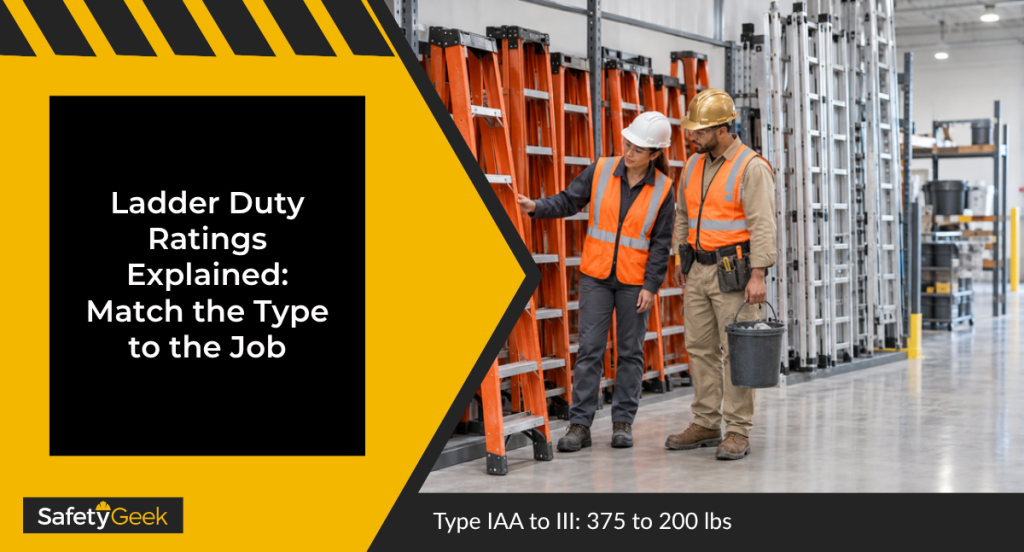
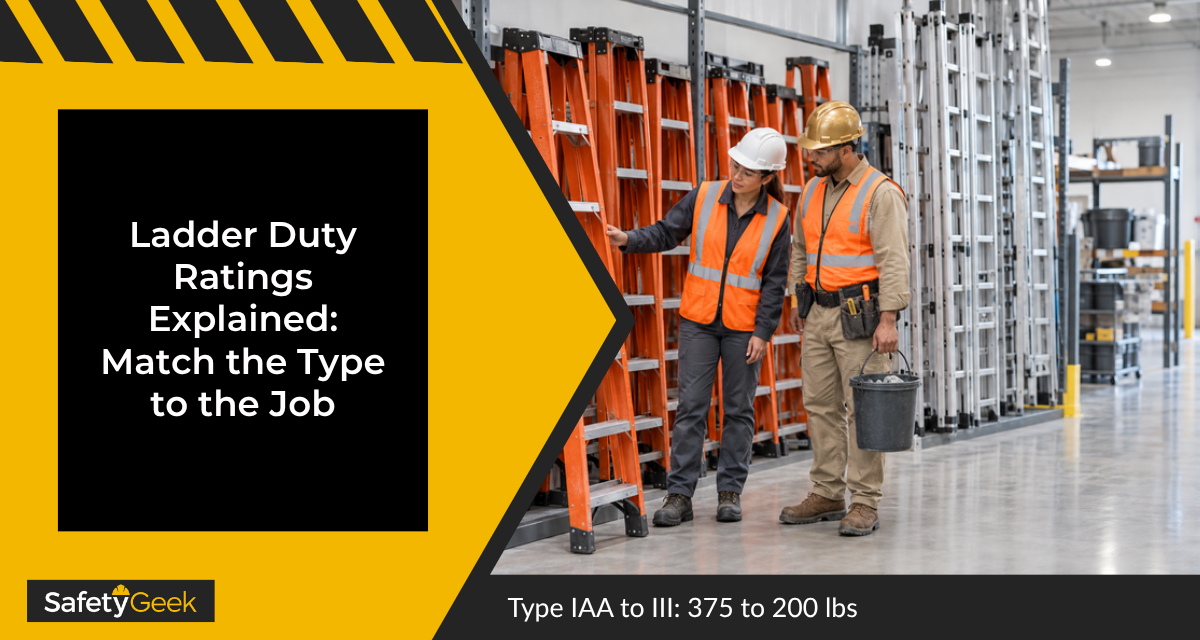
A ladder duty rating classifies how much weight a portable ladder is built to carry in normal use. It’s shown as a type (IAA, IA, I, II, or III), and each type has a maximum working load in pounds.
Think of the label like the payload limit on a pickup bed. The limit counts the toolbox, the generator, and everything else you throw in, not just the lumber.
OSHA’s fact sheets call IAA “Special Duty,” IA “Extra Heavy Duty,” I “Heavy Duty,” II “Medium Duty,” and III “Light Duty.”
The 5 Duty Ratings at a Glance
| Type | Duty Rating | Typical Use | Maximum Working Load |
|---|---|---|---|
| IAA | Special Duty | Rugged | 375 lbs |
| IA | Extra Heavy Duty | Industrial | 300 lbs |
| I | Heavy Duty | Industrial | 250 lbs |
| II | Medium Duty | Commercial | 225 lbs |
| III | Light Duty | Household | 200 lbs |
That table comes straight from OSHA’s fact sheets on extension ladders and stepladders. A Type III ladder is labeled for household use…and a job site isn’t a household.
Where the Ratings Come From
Types IA, I, II, and III come from the American National Standards Institute (ANSI) ladder standards that OSHA’s Appendix A to Subpart X points to. Type IAA comes from the 2009 version of those ANSI standards, which OSHA’s fact sheets describe as non-mandatory guidelines.
Translation: IAA is a guideline. It’s a good choice for heavy work, but OSHA’s own text sets its load rules by “maximum intended load.”
How Much Weight Counts Toward a Ladder’s Load Rating?
Everything on the ladder counts toward its load rating. OSHA’s fact sheets tell workers to consider their weight plus the weight of their load, including all tools, materials, and equipment.
So what does your crew actually carry up? More than anyone guesses. (Nobody weighs their tool belt. Go ahead and ask your crew to guess theirs.)
Add Up the Whole Load
Say a worker weighs 220 lbs in their work clothes. Here’s what goes up the ladder with them:
- 220 lbs for the worker
- 30 lbs for a tool belt and tools
- 40 lbs for whatever’s in the bucket, because there’s always a bucket
- 290 lbs total
A Type I ladder (250 lbs) is too light. Not even close.
A Type IA ladder (300 lbs) clears it by only 10 lbs, and a Type IAA ladder (375 lbs) leaves real room. Be honest…how many of your crew would have guessed 290?
Now picture a whole crew, each with a different weight and a different load. Nobody can run that math on every climb.
What the Safety Factor Does and Doesn’t Mean
OSHA’s rule says each portable ladder must support at least 4 times the maximum intended load, except Type IA metal or plastic ladders, which must support at least 3.3 times. That factor is built into how ladders are made and tested.
You never get to spend it. The rating is the number you load to…and you stay at or under it.
THE ALL-ACCESS PASS RESOURCE PAGE
Get all the FREE templates, safety management resources, PDFs, spreadsheets, and more...
What Does OSHA Require About Ladder Capacity?
OSHA’s construction ladder standard, 29 CFR 1926.1053, sets 3 capacity rules. Ladders must support set multiples of the maximum intended load; they can’t be loaded beyond that load or the manufacturer’s rated capacity, and they can only be used for the purpose they were designed for.
The Rule Workers Break by Accident
Paragraph (b)(3) says ladders shall not be loaded beyond the maximum intended load for which they were built, nor beyond their manufacturer’s rated capacity. A worker can overload a ladder without ever seeing the number, because the system never put it in front of them.
Nobody catches it. The ladder gets used outside what it was built and tested for, on a standard that’s already #3 on the Top 10.
Afterward, the question lands on the safety lead: why was a Type III ladder in the supply room?
Fixed Ladders Have Their Own Load Rule
Fixed ladders follow a different load rule. The standard requires them to support at least 2 loads of 250 lbs each, concentrated between any 2 consecutive attachments, and each step or rung to carry a single 250 lb concentrated load.
So portable-ladder duty ratings (Type IAA through Type III) don’t apply to a fixed ladder.
How Do You Pick and Standardize Ladders on Your Site?
If workers pick their own ladders, you’re counting on every worker to do the math. A site rule for minimum ratings takes the math out of the moment.
Set a Minimum Rating
Pick the lowest type allowed on your site, based on the heaviest realistic load. For a site where workers carry tools and materials, that often means Type IA or IAA.
Pick the minimum from your heaviest realistic climb so the margin does the math for you. Then write it into your ladder policy and buy to it.
Here’s the thing…a rating nobody checks is just a sticker.
Check Ratings During Inspections
Ladder inspections are the place to confirm the rating is still readable and still matches the work. The ladder inspection checklist for competent persons covers what to look for, and the rating label belongs on that list.
If the label is gone, treat the rating as unknown and take the ladder out of service until you can confirm it. The check has to be something a supervisor can do in seconds.
Make the Right Ladder the Easy Ladder
I call it the Easy Button approach: make safety the easiest part of a supervisor’s job, and they’ll do it.
Stock the right ratings where workers pick up ladders, and let supervisors read the label on a pre-shift walk instead of asking anyone to calculate loads. Honestly, the label on the rail is the easiest ladder control to check without anybody doing math, so I’d put the training effort on supervisors instead of on every worker.
Same thinking as ladder safety training for supervisors. A label check takes seconds, and those are the checks that actually happen.
Frequently Asked Questions About Ladder Duty Ratings
What does ladder duty rating mean?
A ladder’s duty rating is its maximum working load, shown as a type from IAA to III. It includes the worker, clothing, tools, and materials. OSHA says ladders can’t be loaded beyond their maximum intended load or the manufacturer’s rated capacity.
What is the difference between Type IA and Type IAA?
Type IA is rated for 300 lbs and Type IAA for 375 lbs. Type IA comes from the ANSI standards in OSHA’s Appendix A. Type IAA comes from the 2009 ANSI update, which OSHA’s fact sheets describe as non-mandatory guidelines.
Does my body weight count toward the ladder’s capacity?
Yes. OSHA’s fact sheets say to consider your weight plus the weight of your load, including all tools, materials, and equipment. Add them all together, then compare the total to the duty rating on the ladder’s label before you climb.
Can I use a Type III ladder at work?
Type III is rated for 200 lbs and labeled for household use. OSHA doesn’t prohibit it by name, but loads are easy to underestimate. A worker’s weight plus tools and materials can quickly exceed 200 lbs, so a higher site minimum keeps people out of that trap.
How much weight should a ladder hold?
OSHA requires portable ladders to support at least 4 times the maximum intended load, or 3.3 times for Type IA metal or plastic ladders. That’s a test margin. Keep your working load at or below the duty rating on the label.
Now It’s Your Turn
Check the label before the climb, every climb.
Here’s where to start this week:
- Walk through your ladder inventory and write down the type and rating on each one.
- Pull out any ladder with a missing or unreadable label until you can confirm its rating.
- Set a minimum rating for your site and add it to your ladder policy.
Ever find a Type III ladder in the supply room, where anybody can grab it? That’s the ladder you’d be explaining after something goes wrong.
My free training on the Safety Influencer System shows safety leads how to get supervisors to take ownership of checks like this one, so you’re not the only person checking.
You got this, my safety friend.
Hi, I'm Brye (rhymes with sky)! I am a self-proclaimed safety geek with two decades of general industry safety experience. Specializing in bringing safety programs to a world-class level and building a safety culture, I have trained and coached many safety managers, just like you, on how to effectively manage workplace safety in the real world. I would love to help you too.