Estimated Reading Time: 8 minutes
TL;DR: A ladder inspection competent person checklist is the set of visible-defect criteria OSHA requires a qualified inspector to check before a ladder goes into service. Under 29 CFR 1926.1053(b)(15), a competent person inspects ladders on a periodic basis and after any event that could affect safe use. This guide gives you the exact defects to look for on portable and fixed ladders, plus what to do the moment you find one.
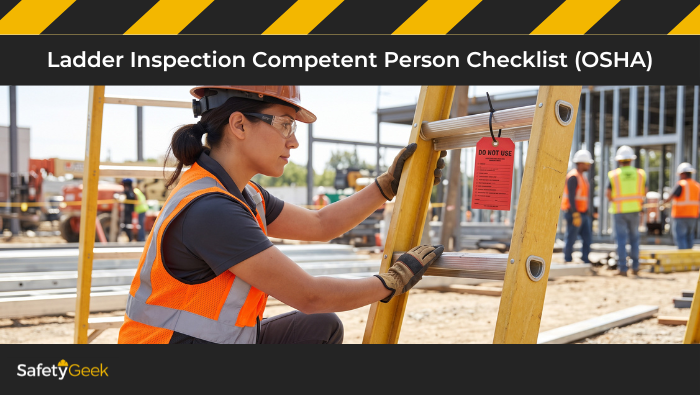
A ladder inspection competent person checklist gives your qualified inspector a repeatable way to catch visible defects before anyone climbs. OSHA 1926.1053(b)(15) requires a competent person to inspect ladders for visible defects on a periodic basis and after any occurrence that could affect their safe use. The checklist is how you turn that vague requirement into something your team does the same way every time.
Here’s where most teams get stuck. You know ladders need inspecting, but nobody wrote down what a defect actually looks like, so one inspector red-tags a ladder another one would have passed. When the criteria live in someone’s head instead of on a page, your inspections are only as good as whoever happened to be holding the clipboard that day.
Key Takeaways
- The rule: OSHA 1926.1053(b)(15) requires a competent person to inspect ladders for visible defects periodically and after any event affecting safe use.
- Who inspects: A competent person can identify ladder hazards AND has the authority to pull a bad ladder from service under 1926.32(f).
- Portable ladder defects: Check side rails, rungs and steps, feet, spreaders and locks, rope and pulley, and legible labels.
- Fixed ladder defects: Check rails and rungs, fastening hardware, corrosion, cages and wells, and the ladder safety system.
- When you find a defect: Tag it “Do Not Use,” withdraw it from service, and repair it to original specs or destroy it. No makeshift fixes.
- Why it matters: OSHA cited the ladder standard 2,405 times in FY 2025, the #3 most-cited standard on the list.
What OSHA 1926.1053 Requires for Ladder Inspections
OSHA’s ladder inspection requirement is short and specific. Under 29 CFR 1926.1053(b)(15), ladders have to be inspected by a competent person for visible defects on a periodic basis and after any occurrence that could affect their safe use. That one sentence carries three duties: a qualified inspector, a regular schedule, and a re-inspection trigger after any impact, tip-over, or exposure to heat or chemicals.
Two more provisions finish the picture. 1926.1053(b)(16) says a defective ladder has to be withdrawn from service and tagged “Do Not Use” until it is repaired or destroyed. 1926.1053(b)(17) adds that fixed ladders with structural defects, like broken or missing rungs, split rails, or corroded components, come out of service until they are repaired or replaced.
OSHA cited the ladder standard 2,405 times in FY 2025, making it the #3 most-cited standard on the list. Most of those citations start with an inspection that never happened.
Who Counts as a Competent Person
A competent person is someone who can identify existing and predictable hazards and who has the authority to take prompt action to correct them. That definition comes from 29 CFR 1926.32(f), and the second half is the part people skip.
Plenty of workers can point at a cracked side rail. Far fewer have been told, in writing, that they can pull that ladder from service on the spot. If you name someone your competent person, back it with the authority to red-tag a ladder without asking permission first.
How Often Ladders Get Inspected
OSHA calls for periodic competent-person inspections plus a re-check after any event that could affect safe use. Most safety programs layer a quick pre-use visual check on top of that, done by whoever is about to climb.
A workable rhythm looks like this. A user glance before every use, a documented competent-person inspection on a set schedule, and an immediate inspection any time a ladder gets dropped, struck, or exposed to fire or corrosive chemicals. The same catch-it-before-someone-steps-on-it logic that drives good walking-working surface inspections applies here.
The Competent Person Ladder Inspection Checklist for Portable Ladders
Portable ladders take the most abuse and account for most of your daily inspections. A competent person works top to bottom, checking each component against a clear defect standard. If any single item fails, the ladder comes out of service.
Here’s what a competent person checks on a portable ladder:
- Side rails: no cracks, bends, splits, dents, corrosion, or fiberglass “blooming,” and no sharp edges.
- Rungs, steps, and cleats: all present, tight to the rails, level, uniformly spaced, and free of grease or heavy wear.
- Rung-to-rail connections: rivets, bolts, and welds intact, with no movement when you flex the ladder.
- Feet and slip-resistant pads: present, pliable, and not worn smooth or missing.
- Spreaders and locks (stepladders): open fully and lock, with no bent or missing braces.
- Rung locks and rope (extension ladders): locks engage on both rails, rope is not frayed, and the pulley runs clean.
- Labels: manufacturer ID, duty rating, and warnings still legible.
One quiet rule trips people up. A missing duty-rating label is a reason to pull the ladder, because you can no longer confirm its load capacity. Sight down the rails for twist or bow, and retire any ladder that has seen fire, high heat, or chemical exposure.
This inspection is the Identify phase of the Safety Management Cycle in miniature. You can’t develop a fix for a hazard you never spotted, so the checklist is where every other correction starts.
THE ALL-ACCESS PASS RESOURCE PAGE
Get all the FREE templates, safety management resources, PDFs, spreadsheets, and more...
Fixed Ladder Inspection Criteria
Fixed ladders are the permanently mounted kind bolted to a tank, silo, or roof access point. They get climbed less often, so they get inspected less often, which is exactly why a corroded rung can sit unnoticed for months.
A competent person checks these on a fixed ladder:
- Rails and rungs: free of rust, cracks, deformation, and deterioration, with rungs uniformly spaced and firmly attached.
- Fastening hardware: brackets, bolts, and anchors tight to the supporting structure, with nothing loose or missing.
- Corrosion: no rust deep enough to weaken the rails, rungs, or the connections to the structure.
- Cages, wells, and supports: not deformed, with every connection secure.
- Ladder safety system or fall arrest components: carrier, sleeve, bolts, and welds in place and working before anyone climbs.
- Climbing surface: rungs and rails clear of mud, grease, or ice.
Fixed ladders deserve a documented inspection on a set schedule, at least annually, and always after storm damage or a vehicle strike. If a fixed ladder over 24 feet still relies on a cage for fall protection, flag it now, because those cages are being phased out as compliant fall protection.
What a Competent Person Does When a Ladder Fails
Finding the defect is only half the job. What you do in the next 60 seconds is what keeps a broken ladder from ending up back in someone’s hands.
The moment a ladder fails inspection, three things happen in order. Tag it “Do Not Use” with a bright, obvious tag. Withdraw it from service so it physically leaves the work area, then decide: repair it to the original manufacturer specs, or destroy it.
There is no fourth option called “good enough.” A rung wrapped in tape, a rail “straightened” in a vise, or a shop weld the manufacturer never authorized does not restore a ladder to service. If it can’t be repaired to original design criteria, cut it up so nobody climbs it again.
Document what you tagged and why. Not to cover yourself, but because a pattern of the same defect, like cracked feet on every ladder from one supplier, is data you can act on. That’s the Analyze step of the Safety Management Cycle doing real work.
Turn the Checklist Into a Habit, Not a Once-a-Year Event
A checklist in a binder changes nothing. The competent person inspection sticks when it’s built into how your team already works, not bolted on as a separate chore.
Fold the pre-use check into the same pre-task routine your crew already runs. A ladder inspection fits naturally inside a job hazard analysis for any task that uses one. A pre-use check also confirms safe setup, like the extension ladder 3 foot rule at the landing.
Here’s how the two inspection layers compare:
| Pre-Use Check | Periodic Competent-Person Inspection | |
|---|---|---|
| Who does it | Any trained user, before climbing | The designated competent person |
| How often | Every use, every shift | On a set schedule, plus after any event |
| Documented | Usually informal | Always, with pass/fail records |
| Authority to remove | Reports it up the chain | Pulls the ladder on the spot |
| Depth | Quick visual scan | Full component-by-component check |
The last piece is coaching. When a supervisor catches a worker on a defective ladder, the first move is a conversation, not a write-up. That’s the Coach & Observe phase of the Safety Management Cycle, and it’s the same skill we teach inside ladder safety training for supervisors.
Rules on paper don’t remove a single bad ladder. People who know what to look for do. NIOSH’s ladder safety research ties ladders to 161 workplace deaths and more than 22,000 injuries in a single year, and nearly all of it traces back to a ladder that should never have been in use.
Frequently Asked Questions About Ladder Inspections
What does a competent person check on a ladder?
A competent person checks side rails, rungs and steps, feet, spreaders and locks, rope and pulley, and labels on portable ladders. On fixed ladders they check rails, rungs, fastening hardware, corrosion, cages, and the ladder safety system. Any visible defect that affects safe use pulls the ladder from service.
How often does OSHA require ladder inspections?
OSHA 1926.1053(b)(15) requires a competent person to inspect ladders on a periodic basis and after any occurrence that could affect their safe use. Most programs add a quick pre-use visual check before every climb. Fixed ladders are typically inspected on a documented schedule, at least annually.
Who qualifies as a competent person for ladder inspection?
A competent person can identify existing and predictable ladder hazards and has the authority to correct them on the spot, per 29 CFR 1926.32(f). For ladders, that means inspecting for defects, tagging out damaged ladders, and removing them from service without asking permission first.
What do you do with a defective ladder?
Tag it “Do Not Use” and withdraw it from service immediately, as OSHA 1926.1053(b)(16) requires. Then repair it to the original manufacturer specifications or destroy it. Makeshift fixes like taped rungs or unauthorized welds do not return a ladder to service, so if it can’t be properly repaired, cut it up.
Does a ladder inspection have to be documented?
OSHA doesn’t require a specific form for portable ladder pre-use checks, but documented periodic competent-person inspections are a best practice and often expected during an audit. Records also reveal patterns, like a recurring defect on ladders from one supplier, so you fix the source instead of the symptom.
Now It’s Your Turn
A ladder inspection competent person checklist only works when the criteria live on a page instead of in one inspector’s head. Write down exactly what a defect looks like, name who inspects, and decide what happens the moment a ladder fails.
Here’s where to start this week.
- Build a one-page checklist covering side rails, rungs, feet, spreaders, locks, rope, labels, and corrosion.
- Name your competent person in writing and give them the authority to red-tag a ladder on the spot.
- Fold the pre-use check into your existing pre-task routine so it happens every time.
The templates and checklists I use to build inspections like this into a program that sticks live on the All-Access Pass Resource Page, so you’re not starting from a blank page.
And if you want to turn compliance work like this into the kind of safety program that earns you a real seat at the table, that’s exactly what we build inside the Safety Leadership Academy. You got this, Safety Friend.
Hi, I'm Brye (rhymes with sky)! I am a self-proclaimed safety geek with two decades of general industry safety experience. Specializing in bringing safety programs to a world-class level and building a safety culture, I have trained and coached many safety managers, just like you, on how to effectively manage workplace safety in the real world. I would love to help you too.