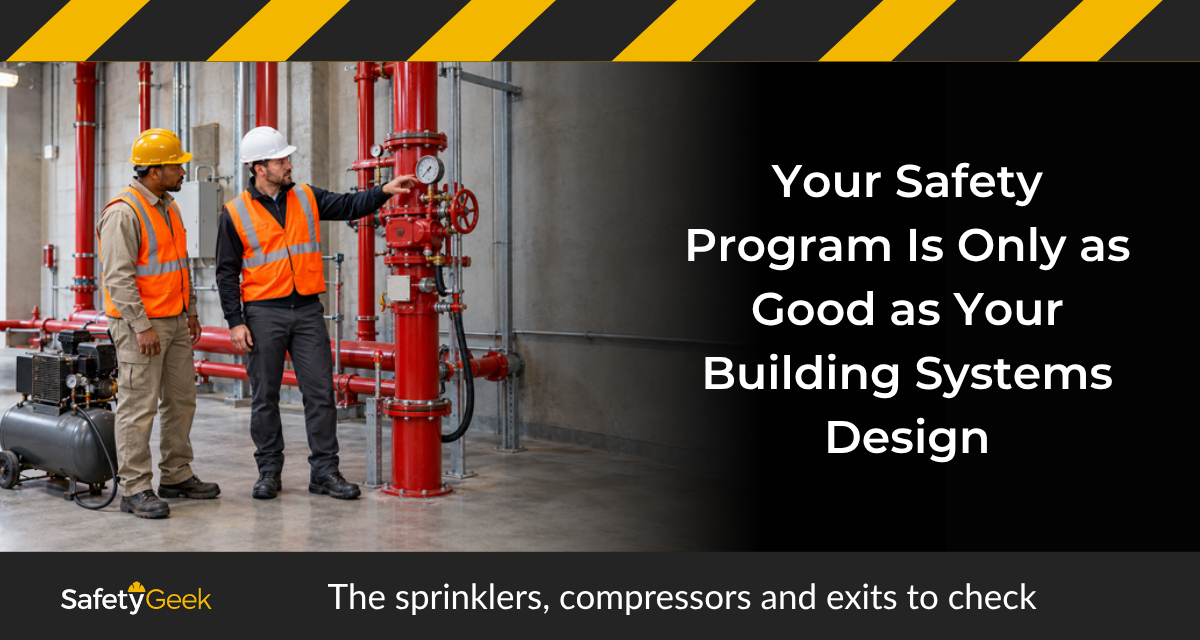
You’ve written policies, trained staff and documented procedures, yet incidents can still trace back to a building you didn’t design. Your safety program depends on its fire protection, electrical, heating, ventilation and air conditioning systems and structure. A closed sprinkler valve or blocked exit can leave your procedures unsupported when people need them most.
How Building Design Shapes Workplace Safety Outcomes
Your walk-throughs cover electrical, mechanical, heating, ventilation, plumbing, structural and fire protection systems you inherited. Commercial inspections cover sprinklers and standpipes alongside heating, ventilation and air conditioning systems.
They also assess plumbing, extinguishers, escape routes, structural integrity, documentation and accessibility. Poor design, sizing or installation can leave gaps that training alone cannot close. Your audit findings provide a starting point for discussions with facilities about these inherited gaps.
Sprinklers illustrate why those conversations deserve attention during your regular reviews. Compared with reported fires in properties without automatic extinguishing systems, properties with sprinklers had a civilian fire death rate per fire that was 90% lower and a civilian fire injury rate per fire that was 32% lower. Your audits connect that performance with actual system condition. Sound design, appropriate sizing and ongoing maintenance support that protection.
What to Inspect Regularly to Keep Systems Reliable
Systems age, building uses change and installation problems surface during maintenance. Your walk-through may reveal symptoms before facilities schedules repairs.
Dry-pipe and air-supervised pre-action systems hold air instead of water in their sprinkler piping before activation. According to General Air Products, fire-protection air compressors typically run 5,000 to 8,000 cumulative hours, compared with 500 to 1,000 for retail-grade units. Compressor flow is measured in cubic feet per minute (CFM). Knowing how to calculate the CFM your largest system needs informs sizing.
A compressor serving too many systems may run constantly. Continuous operation or early failure warrants a review of sizing and maintenance. Your regular walk-through checks can include:
- Valves and gauges: Confirm sprinkler control valves are open and that dry-system air pressure holds steady.
- Compressor records: Review run time, oil changes where applicable and intake-filter maintenance.
- Exits and clearances: Recheck escape routes and sprinkler clearance after layout or occupancy changes.
A structured routine helps prevent missed checks. A risk-based walk-through schedule might include daily checks in equipment zones, weekly warehouse checks and monthly office checks.
Frequently Asked Questions
Your audits and facilities discussions can raise these questions about sprinkler sizing, inspection schedules and design.
How do I calculate the CFM needed for my fire sprinkler system?
Knowing how to calculate the CFM needed for your fire sprinkler system comes down to volume, pressure and fill time. According to General Air Products, the National Fire Protection Association (NFPA) 13 requirement for a 30-minute fill drives compressor selection:
- Find the volume: Identify your largest system’s capacity in gallons.
- Note the pressure: Confirm the air pressure that system must hold.
- Match the rating: Choose a fire-protection compressor rated to fill that volume at that pressure within 30 minutes.
General Air Products cites a common model rated to fill a 125-gallon system to 40 psi in 30 minutes or less. That rating already converts flow, pressure and time into capacity. The company says, “Fire protection air compressor manufacturers are concerned with high flow, not horsepower.”
How often should fire sprinkler systems be inspected?
The NFPA sets the required frequencies for sprinkler inspections, testing and maintenance through NFPA 25. Intervals depend on the component and system type. Your local authority having jurisdiction may impose additional requirements. Your walkthroughs complement these requirements rather than replacing scheduled inspections, testing or maintenance.
Why does building design matter more than reactive maintenance?
Your maintenance routine can preserve operation, but repeated repairs alone cannot correct undersizing. An undersized compressor may run constantly and need recurring attention. Resolving the underlying design problem can reduce reactive repairs, leaving more of your inspection time available for identifying other hazards throughout your building.
Why Design Belongs at the Center of Your Program
Your safety program includes policies, training and the systems your emergency procedures depend on. Understanding your building’s design can help you recognize problems earlier and discuss them more clearly with facilities teams. Your building becomes part of your safety plan, and its performance deserves ongoing attention.