Estimated Reading Time: 10 minutes
TL;DR: EHS burnout in manufacturing safety usually comes from workload design, not weak willpower. When one person covers hundreds of employees across multiple lines, everything looks urgent and almost nothing gets finished.
The way out is triage. Protect the compliance items that can kill someone, hand the routine work back to the line, and report your results in dollars instead of injury counts.
EHS burnout in manufacturing safety happens when one person is carrying more risk than one person can actually cover. It’s a workload and authority problem, not a character problem. And the way out starts with deciding what you’re going to stop doing.
You know the feeling already. You walk into the production meeting, the eyes roll, everybody’s posture changes, and you leave with three new action items and zero support. Then something breaks on a line you flagged back in March, and suddenly safety is the only thing anybody wants to talk about.
Key Takeaways
- Burnout in safety is an organizational problem. NIOSH research points to staffing, workload, and support as the drivers, not individual toughness.
- Coverage math explains most of it. One safety lead responsible for hundreds of employees cannot be everywhere.
- Triage beats effort. A short list of non-negotiable compliance items protects lives and buys you back your calendar.
- The line owns compliance. Supervisors run the daily work. You coach, audit, and report.
- Dollars get you heard. Executives act on business risk long before they act on a moral argument.
- 90 days is enough to lock down the must-do items, shift ownership, and build one reporting loop that runs without you.
What EHS Burnout in Manufacturing Safety Actually Looks Like
Burnout in safety management is what happens when the demands of the role outrun the time, authority, and support available to meet them. It shows up as exhaustion, cynicism, and a slow drop in the quality of your own work.
The manufacturing version has a particular shape. You’re not burned out because the job is hard. You’re burned out because you’re accountable for outcomes you don’t control, on equipment you didn’t specify, run by people who don’t report to you.
NIOSH has been clear that psychosocial hazards at work are tied to real health effects, including burnout, sleep problems, high blood pressure, and depression. Their 2024 bulletin on workplace psychosocial hazards frames these as hazards of the work environment.
That’s the same logic we use for a guard on a press. You fix the condition, not the person standing in front of it.
The three signs that show up first
The first sign is documentation drift. Your inspections still happen, but the write-ups get shorter, and the corrective actions sit open longer.
The second sign is avoidance. You start routing around the one supervisor who fights you, which means his area quietly stops getting looked at.
The third sign is the flinch. Your phone rings after hour,s and your stomach drops before you even see who it is.
That’s not a personality flaw. That’s a nervous system that learned a ringing phone means something bad happened on your watch.
Why a plant floor hides it so well
Manufacturing rewards people who absorb pressure without complaining. Production runs, the line doesn’t stop, and everybody keeps their head down.
So the safety lead absorbs too. You cover the gaps, you write the procedure yourself because it’s faster, and you run the training because nobody else will. Every one of those choices looks responsible in the moment.
Six months later you’re the only person who knows how anything works, and the program has no legs of its own. Most people I talk to describe it the same way… organized chaos, putting out fires where needed.
The work never stopped being important. It just stopped being survivable at that volume, which is exactly the pattern that shows up in a one-person safety department.
Why the Manufacturing Safety Role Wears People Down Faster
Three forces stack up in manufacturing that don’t stack the same way elsewhere. They matter because you can’t fix a staffing problem with better time management.
The coverage math nobody runs
Do the math on your own site. Count the employees, shifts, buildings, and contractors, then divide by the number of people in your department.
Benchmarking data across manufacturing companies puts the average somewhere near 290 employees per EHS professional, with real sites ranging from 32 to well over 1,000. If you’re on the wrong end of that spread, you are not slow. You are outnumbered.
The Bureau of Labor Statistics outlook for occupational health and safety specialists projects 12% growth from 2024 to 2034 and roughly 18,300 openings a year, with a big chunk coming from people leaving the occupation.
Read that last part again. A meaningful share of the job openings in our field exist because somebody walked away.
Responsibility without the authority to match
You get held accountable for injury numbers. You don’t get to hire, fire, discipline, or shut down a line without a fight.
That gap is the single most exhausting part of the job. It’s also normal, because safety sits outside the chain of command by design. Corrections have to come from someone inside the employee’s line of power, which means your real job is influence, not enforcement.
When you try to enforce anyway, you burn energy on every single conversation. You become the safety cop, people brace when you show up, and the results still don’t hold. Shifting from doing everything yourself to coaching the people who own the work is the whole difference between a safety doer and a safety leader.
The reactive loop
Reactive work is loud. A recordable, an angry customer audit, a near miss on second shift… those things take your whole day, and they never get scheduled.
Proactive work is quiet. Nobody notices the incident that didn’t happen, so the projects that would actually reduce your workload keep sliding to next week.
That’s how a program ends up piecemealed together with bits and pieces everywhere. You’re always working, and the underlying risk never really moves. Breaking the loop means prioritizing the most important work when everything feels important, and accepting that some things are going to sit.
THE ALL-ACCESS PASS RESOURCE PAGE
Get all the FREE templates, safety management resources, PDFs, spreadsheets, and more...
The 90-Day Triage Plan for an Overloaded Safety Program
Triage is a medical term for a reason. When you can’t treat everyone at once, you treat what will kill someone first and let the rest wait.
Your safety program deserves the same discipline. Not everything on your list carries equal weight, and treating it like it does is what keeps you underwater.
| Category | Examples | Triage call |
|---|---|---|
| Life-safety compliance | Energy control procedures, machine guarding, confined space entry, hot work permits | Protect. This never slips. |
| Required training and inspections | Authorized employee LOTO training, annual periodic inspections, forklift evaluations | Protect. Put it on the calendar today. |
| Open corrective actions | Items from recordables, near misses, and internal audits | Protect. Close or escalate within 30 days. |
| Program polish | Rewriting the 40-page manual, new signage, updating the safety board | Park until day 61. |
| Discretionary programs | Poster campaigns, wellness challenges, new committee subgroups | Park. Revisit at 90 days. |
Days 1 to 30: lock down what can kill somebody
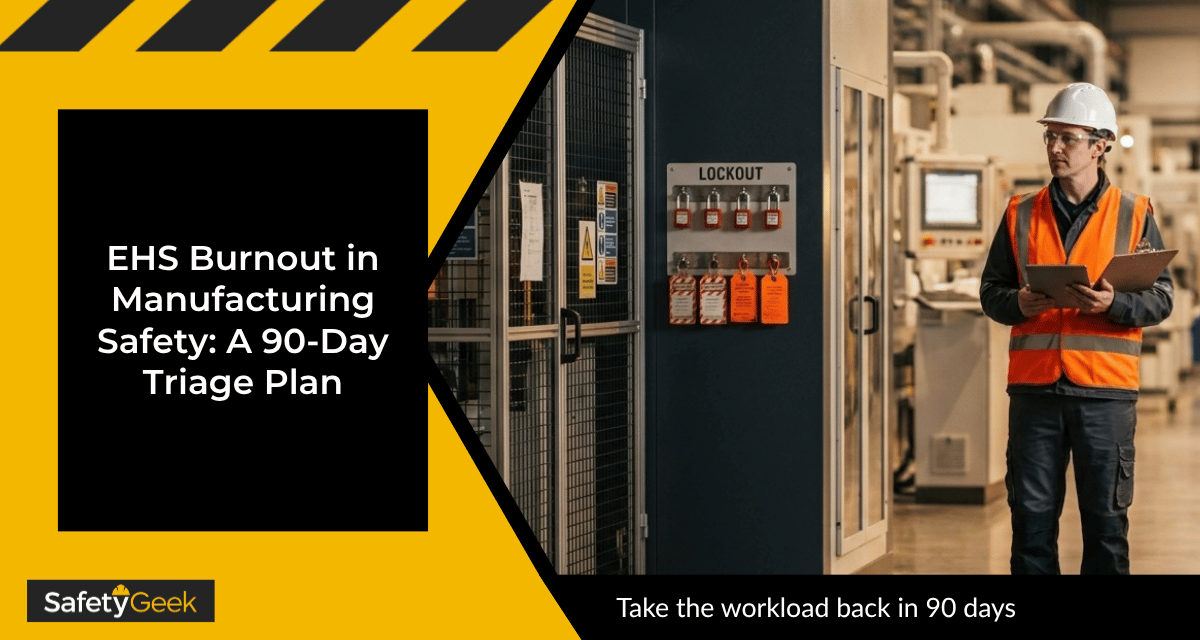
Start with hazardous energy. OSHA’s control of hazardous energy standard, 29 CFR 1910.147, requires a written energy control program, machine-specific procedures, employee training, and a periodic inspection at least annually.
Being short-staffed does not shrink that obligation. OSHA’s guidance on hazardous energy control is direct about training authorized, affected, and other employees on the purpose and use of the energy control procedures.
So in your first 30 days, verify three things and nothing else:
- Every piece of equipment that gets serviced has a written, machine-specific procedure.
- Every authorized employee has documented training on file.
- Your annual periodic inspections are current and certified, naming the machine, date, employees, and inspector.
If any of those three are shaky, that’s your month. A step-by-step lockout tagout program implementation gets you there faster than starting from a blank page, and everything else waits.
Days 31 to 60: give the daily work back to the line
Front-line supervisors should own daily safety compliance in their area. You’re the coach of the coaches, not the person doing every inspection.
Pick one process to hand over this month. Daily equipment inspections are usually the easiest place to start, because the supervisor is already walking the floor.
Build the form with them, not for them. Train them on it, watch them run it twice, then get out of the way and audit the results monthly.
You’ll get pushback, and the answer is never to take the task back… It’s to make the task easier to do correctly than to skip. When multiple people keep missing the same step, that’s a system that’s hard to follow, not a group of people who don’t care.
Days 61 to 90: build one reporting loop that runs without you
Pick one number that leadership already cares about and tie safety to it. Downtime, scrap rate, overtime, turnover… any of those work better than a recordable rate nobody understands.
Then build a single monthly report. One page, five minutes in the operations meeting, the same format every time.
Consistency is what makes it stick. After three months, the report becomes the thing people expect, and you stop having to fight for a spot on the agenda. That’s the beginning of a seat at the table, and it costs you an hour a month instead of your evenings.
How to Stop Getting Ignored in the Meetings That Matter
Getting steamrolled in the production meeting is one of the fastest routes to burnout. You bring a real hazard, you get a nod, and nothing changes.
The problem usually isn’t the hazard. It’s the frame.
Executives are not sitting there thinking they’re being immoral. They just don’t believe the risk will land on them.
Talk money, not morality
Translate the hazard into the number your leadership already tracks. An unguarded nip point isn’t a citation risk; it’s an amputation that costs you a machine operator, a line shutdown, and an experience modification rate that follows you for three years.
Bring the cost of the fix next to the cost of the event. Then stop talking and let the number do the work.
One of our students, Matt, had a CFO describe the shift as a light bulb moment. He said he wasn’t there to talk about spending money; he was there to protect the money the business brings in. Same hazard, different frame, completely different answer.
Bring options, let leadership decide
Safety shouldn’t be the decision maker. Bring the problem, bring two or three options with costs and timelines, and let the person with budget authority pick one.
This does two things. It makes it easy for you to say yes, and it puts the decision in the hands of someone who can actually fund it.
It also protects you. When leadership owns the call, you stop being the person defending every no, which is a huge part of what makes this role feel thankless.
Frequently Asked Questions About EHS Burnout in Manufacturing Safety
Is safety manager burnout actually common, or is it just me?
It’s common. NIOSH treats burnout as a hazard created by work design, staffing, and support rather than personal weakness.
Research on environmental health professionals ties burnout to poor staffing ratios, lack of resources, and weak management support. If you’re carrying a plant alone, you’re describing a workload problem.
What compliance items should never slip when I’m short-staffed?
Anything that can kill or permanently injure someone. That means energy control procedures and lockout tagout training, machine guarding, confined space entry, and hot work permits.
Add required annual inspections and open corrective actions from a recordable. Program polish, campaigns, and manual rewrites can wait 60 days without anyone getting hurt.
How do I hand work to supervisors who already say they’re too busy?
Start with one process and make it shorter than they imagine. Build the form with them so it fits how they already walk the floor.
Train it, watch them run it twice, then audit monthly instead of hovering. Busy is real, so the task has to be genuinely faster than the meeting it prevents.
Will taking a step back hurt my safety numbers?
Usually the opposite. Programs that depend on one person collapse the week that person is on vacation or out sick.
Shifting daily compliance to supervisors puts eyes on the floor every shift instead of whenever you get there. Your numbers improve because coverage improves, not because you worked more hours.
What if my management just doesn’t care about safety?
They usually care about something safety affects. Find the metric they already watch, whether that’s downtime, scrap, overtime, or turnover, and connect your work to it every month.
Caring rarely arrives through a moral argument. It arrives when safety keeps showing up in the numbers they’re already judged on.
When is it time to leave the job instead of fixing it?
When you’ve documented serious hazards, escalated in writing, offered funded options, and leadership still refuses, you’ve hit the ceiling of what influence can do. That’s a values decision, not a skills decision. Protect your license, your health, and your record, and start looking while you’re still employed.
Now It’s Your Turn
EHS burnout in manufacturing safety doesn’t get solved by working more hours. It gets solved by shrinking the list of things only you can do, and handing the rest back to the people who own the work.
Here’s what to do this week:
- Run your coverage math. Employees, shifts, buildings, and contractors divided by your headcount. Write the number down.
- Pick your non-negotiables. Five items, maximum. Energy control, guarding, confined space, required training, open corrective actions.
- Park everything else for 60 days. Put it on a list titled “after day 60” so it stops living in your head.
- Choose one process to hand to a supervisor. Build the form with them this week.
- Pick the one metric leadership already tracks and start your monthly one-page report next month.
And if the mental load is the part that’s crushing you, that’s worth naming out loud. There are real mental health resources for safety management that treat this as an occupational issue instead of a personal failing.
One of our students, Michelle, took a six-month break from safety and came back to it. Her words were that it felt new and fresh and exciting again, right alongside the question of whether she could live up to it.
She could. Within her first week back she caught a repeat trenching violation and escalated it straight to the owner.
If you want the full system for getting out of the reactive loop and building influence with leadership, I walk through it in my free training on the Safety Influencer System. It’s the same framework we teach inside the Safety Leadership Academy, and it’s what turns a department of one into a program with legs.
You got this. I got you, Safety Friend.
Hi, I'm Brye (rhymes with sky)! I am a self-proclaimed safety geek with two decades of general industry safety experience. Specializing in bringing safety programs to a world-class level and building a safety culture, I have trained and coached many safety managers, just like you, on how to effectively manage workplace safety in the real world. I would love to help you too.