Estimated Reading Time: 7 minutes
TL;DR: OSHA 1926.502(b) sets the build specs for every guardrail on a construction site. The top rail sits 42 inches above the walking surface, give or take 3 inches, and has to withstand 200 pounds of force without dropping below 39 inches. You also need a midrail, toeboards wherever materials can fall, and rails that meet a minimum strength. Miss one spec and the whole system fails inspection.
Guardrail system height and strength specs under 1926.502(b) come down to a few numbers you can check with a tape measure and a firm push. The top rail goes 42 inches above the walking surface, plus or minus 3 inches. It has to take 200 pounds of force in any outward or downward direction without failing.
If you have ever looked at a guardrail on a jobsite and wondered whether it would actually hold, you are not alone. Most safety leads inherit rails somebody else threw together, with no idea if they meet code.
The good news is the rule is short and the numbers are fixed. Once you know them, you can spot a bad rail from across the deck.
Key Takeaways
- Top rail height is 42 inches above the walking surface, plus or minus 3 inches (1926.502(b)(1)).
- The top rail must withstand 200 pounds of force without dropping below 39 inches (1926.502(b)(3)).
- A midrail is required when there is no wall or parapet at least 21 inches high, and it has to hold 150 pounds.
- Openings cannot let a 19-inch object pass through the system.
- Toeboards are required at least 3.5 inches tall wherever tools or materials could fall on someone below.
- Scrap lumber, steel banding, and rebar are not compliant top rails.
What OSHA 1926.502(b) Requires for Guardrails
A guardrail system is a barrier built along an exposed edge to keep workers from falling to a lower level. Under OSHA, it is one of the three approved ways to protect a worker from a fall of six feet or more, alongside safety nets and personal fall arrest. The build specs all live in 1926.502(b).
A guardrail is the passive option, which is why OSHA leans on it first. It protects every worker on the deck without depending on a harness, a daily inspection, or anyone remembering to clip in.
That is the whole appeal. Set it once to the right specs, and it does its job for everybody, all shift, with no behavior required.
But “to the right specs” is where teams stumble. A rail at the wrong height, or one that flexes under a lean, is not a guardrail in OSHA’s eyes. It is a citation with a handrail-shaped decoration on top.
The standard breaks down into four things you can measure: height, strength, the gap below the top rail, and the material itself. You can read the full text of 1926.502 on OSHA’s site, but the numbers that matter on a walkthrough are short enough to memorize.
[IMAGE: Diagram of a compliant construction guardrail showing the 42-inch top rail, midrail at 21 inches, and 3.5-inch toeboard with dimension callouts. Alt text: “OSHA 1926.502(b) guardrail height and strength specs diagram showing top rail, midrail, and toeboard dimensions.”]
Guardrail Height: The 42-Inch Top Rail Rule
The top rail of a guardrail has to sit 42 inches above the walking or working surface, plus or minus 3 inches. That gives you a legal range of 39 to 45 inches. Anything outside that window fails.
The plus-or-minus 3 inches is not permission to get sloppy. It exists because surfaces and materials vary, not because eyeballing is fine.
Here is the part crews forget. The 39-inch floor is also a strength requirement, not just a build target.
When a 200-pound load is applied downward on the top rail, the rail cannot deflect below 39 inches above the surface. So a rail you set at exactly 39 inches has no room to flex. The moment someone leans on it, it drops out of compliance.
That is why I tell teams to build to 42, not to the bottom of the range. You want margin for the deflection, the lean, and the tape measure that reads a little generous.
Height is measured from the walking surface up to the top edge of the rail. Not from the bottom of the post, not from the deck below. The surface the worker actually stands on is your zero.
THE ALL-ACCESS PASS RESOURCE PAGE
Get all the FREE templates, safety management resources, PDFs, spreadsheets, and more...
Guardrail Strength: The 200-Pound Force Test
A guardrail has to do more than look the part. Under 1926.502(b)(3), the top rail must withstand at least 200 pounds of force applied within 2 inches of the top edge, in any outward or downward direction, at any point along the rail.
“At any point” is the phrase inspectors live by. A rail that is rock solid next to a post but springy in the middle of a span still fails.
The test mirrors real life. Two hundred pounds is roughly a worker stumbling backward into the rail, which is exactly the moment the system has to hold.
Here is the full spec sheet you can carry in your head on a walkthrough.
| Component | Spec | OSHA Citation |
|---|---|---|
| Top rail height | 42 inches above the surface, plus or minus 3 inches (39 to 45 in) | 1926.502(b)(1) |
| Top rail strength | 200 lbs, outward or downward, within 2 in of the top edge; no deflection below 39 in | 1926.502(b)(3) |
| Midrail | Midway (about 21 in) when no parapet is at least 21 in high | 1926.502(b)(2) |
| Midrail strength | 150 lbs, outward or downward, at any point | 1926.502(b)(5) |
| Openings | No 19-inch object can pass through the system | 1926.502(b)(2) |
| Toeboard | At least 3.5 in tall, withstand 50 lbs, 1/4-in max gap at bottom | 1926.502(j) |
| Rail material | At least 1/4-in diameter, smooth, no steel or plastic banding | 1926.502(b)(6), (b)(9) |
Notice the midrail carries a lower bar at 150 pounds, while the top rail carries 200. The top rail is the part a falling worker hits first, so it gets the heavier requirement.
When guardrails are not practical, the next option is a personal fall arrest system, which trades the passive rail for a harness and anchor. Guardrails win when you can use them, because they do not depend on the worker doing anything right.
Midrails, Toeboards, and the Gaps That Fail You
A top rail alone is not a guardrail. Under 1926.502(b)(2), you need a midrail, screen, mesh, or equivalent member between the top rail and the surface whenever there is no wall or parapet at least 21 inches high.
The midrail sits roughly halfway up, around 21 inches. Its job is to close the gap a worker could slide or roll through after a stumble.
Whatever you use to fill that space has to hold 150 pounds and keep openings tight. The performance rule is simple: no opening in the system can let a 19-inch object pass through.
Toeboards are the piece teams skip most. They are required wherever tools, materials, or debris could fall onto a person or equipment below, and they have to stand at least 3.5 inches tall.
A toeboard also has to withstand 50 pounds of force and sit no more than a quarter inch off the deck. A loose two-by-four laid on edge does not count.
These are the same kinds of gaps your routine walking-working surface inspections are built to catch on the ground floor. Elevate that surface six feet, and a missing midrail stops being housekeeping and becomes a fall hazard. The six-foot trigger that makes all of this mandatory lives in 1926.501.
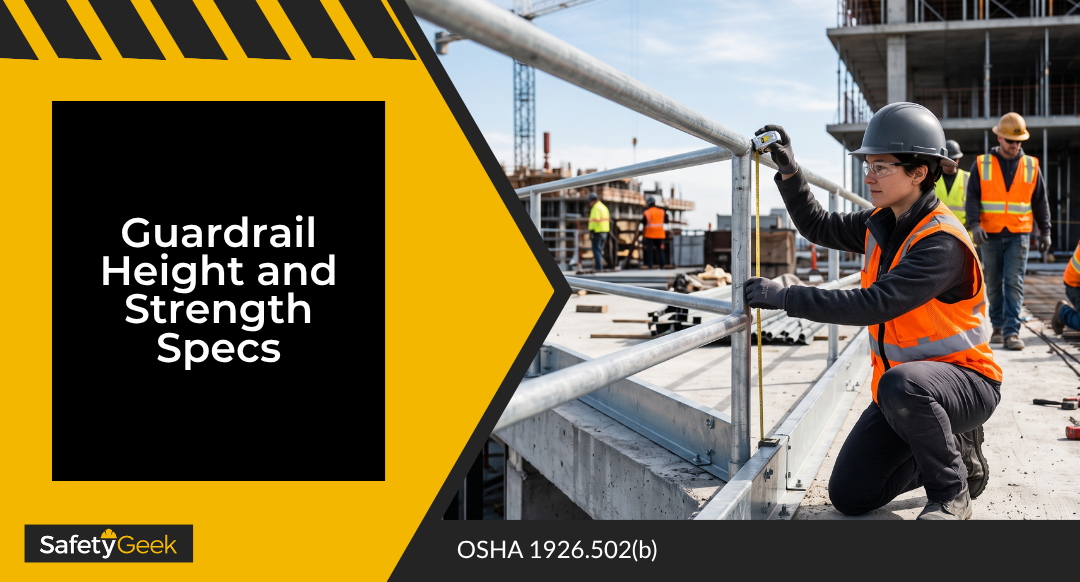
[IMAGE: Safety manager measuring the height of a guardrail top rail with a tape measure on an elevated construction deck. Alt text: “Safety professional checking guardrail height and strength specs against OSHA 1926.502(b) on a construction site.”]
Where Guardrails Fail Inspection
The citations do not come from teams that ignored the rule entirely. They come from teams that built a rail and assumed it counted. Here is the pattern I see in audit findings, year after year.
Scrap lumber as a top rail. Ungraded scrap, banding, or small-diameter stock cannot reliably take the 200-pound load, and steel or plastic banding is flat-out prohibited as a top rail or midrail. If it splinters, snaps, or whips, it fails.
Top rail set too low. A rail eyeballed at 36 inches instead of measured to 42 is one of the most common findings. The same goes for a rail at exactly 39 inches that drops lower the second someone leans on it.
No midrail. A single rail with open space underneath is not a guardrail under 1926.502. Crews assemble the top rail in a hurry and never come back for the midrail.
Missing toeboards over occupied areas. An elevated platform above a walkway with no toeboard is a falling-object citation waiting to happen. OSHA’s Fall Protection in Construction guide walks through these scenarios in plain language.
Sharp ends and rough surfaces. Rail ends that overhang the terminal posts create a projection hazard, and rough or splintered rails cause cuts and snag clothing. The standard requires smooth surfaces and no dangerous overhangs.
None of these are exotic. They are the difference between a rail somebody built and a rail somebody built to spec, and that gap is why fall protection stays OSHA’s most-cited standard. The human cost shows up in the BLS Census of Fatal Occupational Injuries, where falls to a lower level remain a leading killer in construction.
Frequently Asked Questions About Guardrail Specs
How tall does a guardrail have to be under OSHA 1926.502(b)?
The top rail must sit 42 inches above the walking or working surface, plus or minus 3 inches, giving a legal range of 39 to 45 inches. Height is measured from the surface the worker stands on to the top edge of the rail.
How much weight must a guardrail withstand?
The top rail must withstand at least 200 pounds of force applied within 2 inches of the top edge, in any outward or downward direction, at any point along the rail. It also cannot deflect below 39 inches under that load. Midrails must hold 150 pounds.
Is a midrail required on every guardrail?
A midrail or equivalent member is required whenever there is no wall or parapet at least 21 inches high between the top rail and the surface. It sits roughly midway, around 21 inches, and the system cannot have any opening that lets a 19-inch object pass through.
When are toeboards required on a guardrail?
Toeboards are required wherever tools, materials, or debris could fall onto a person or equipment below. Under 1926.502(j), a toeboard must stand at least 3.5 inches tall, withstand 50 pounds of force, and sit no more than a quarter inch above the deck.
Can I use wood for a guardrail?
Yes, wood is allowed if it meets the strength and dimension specs. The rail must be at least a quarter inch thick, smooth, and able to hold the required load. Ungraded scrap lumber, steel banding, and plastic banding do not qualify as top rails or midrails.
Now It’s Your Turn
Guardrail compliance comes down to four numbers: 42 inches of height, 200 pounds of strength, a midrail at 21 inches, and a 3.5-inch toeboard where things can fall. Know those, and you can audit any rail on your site in under a minute.
Here is what to do this week:
- Walk every active deck with a tape measure. Check each top rail against the 42-inch target, not the 39-inch floor.
- Push-test the rails. Lean into the middle of each span. If it flexes below 39 inches, flag it.
- Look for the midrail and toeboard. A top rail by itself is not compliant, and neither is a platform over a walkway with no toeboard.
- Kill the scrap lumber and banding. Anything that is not rated to hold the load comes off the rail today.
- Build it into your hazard process. Add guardrail specs to your Job Hazard Analysis so the right rail gets built before the work starts, not after the inspector shows up.
This is exactly the kind of system-level habit we build inside the Safety Leadership Academy. The Safety Management Cycle (Identify, Develop, Implement and Train, Coach and Observe, Analyze) turns a one-time fix into a rhythm, so your guardrails pass every time instead of getting rebuilt after every audit.
You got this, Safety Friend.
Hi, I'm Brye (rhymes with sky)! I am a self-proclaimed safety geek with two decades of general industry safety experience. Specializing in bringing safety programs to a world-class level and building a safety culture, I have trained and coached many safety managers, just like you, on how to effectively manage workplace safety in the real world. I would love to help you too.