Estimated Reading Time: 15 minutes
Every program in this guide uses the hierarchy as its internal decision tree. When your team identifies a chemical hazard, the first question is never “what respirator do we buy?” It’s “can we eliminate or substitute this chemical?”
If your LOTO program leaps straight to writing procedures without asking whether the equipment can be re-engineered, you’ve already lost the best protection available.
For a deeper walkthrough with real-world applications, explore our full guide to the hierarchy of controls with case studies.
TL;DR: Hazard control programs for general industry are written plans that identify workplace hazards and eliminate, engineer out, manage, or protect against them using OSHA’s hierarchy of controls. The three programs every general industry facility needs are chemical safety (HazCom 1910.1200), lockout/tagout (LOTO 1910.147), and machine guarding (1910.212). These sit at the top of OSHA’s most-cited standards year after year. This guide walks you through how to build each one, how to align them with the Safety Management Cycle, and how to turn a pile of compliance paperwork into a program that actually protects people.Hazard control programs for general industry are the written systems that tell your company how to handle the specific hazards your people face every day. They combine OSHA’s required elements with your site’s actual risks, so compliance and real-world protection happen at the same time. The three most common programs every general industry facility needs are chemical safety (HazCom), lockout/tagout (LOTO), and machine guarding. Here’s the thing… most safety programs exist as binders on a shelf. They get written once, audited once a year, and forgotten until someone gets hurt. If you’ve been handed a pile of templates and told to “make sure we’re compliant,” you already know that gap is where people get injured and where your credibility quietly disappears.
Table of Contents
- What Is a Hazard Control Program
- OSHA Standards That Drive General Industry Programs
- The Hierarchy of Controls: Your Program Backbone
- Chemical Safety and Hazard Communication
- Lockout Tagout (LOTO)
- Machine Guarding
- How to Build Any Hazard Control Program in 5 Steps
- Common Mistakes That Wreck Hazard Control Programs
- Frequently Asked Questions
- Now It’s Your Turn
Key Takeaways
- Hazard control programs are the written systems that pair OSHA’s requirements with your site’s actual hazards so paperwork and protection happen at the same time.
- Three programs every general industry facility needs: chemical safety (HazCom), lockout/tagout (LOTO), and machine guarding. All three sit in OSHA’s Top 10 most-cited standards.
- The hierarchy of controls is the backbone of every program: elimination, substitution, engineering, administrative, PPE. Start from the top, not the bottom.
- The Safety Management Cycle (Identify, Develop, Implement & Train, Coach & Observe, Analyze) turns a static program into a living one.
- Systems, not heroics. If your program depends on you being everywhere, it will fail the moment you turn your back.
- Front-line supervisors own compliance, not you. Your job is to coach the coaches, not police the floor.
What Is a Hazard Control Program
A hazard control program is a written, repeatable system that identifies a specific category of workplace hazards and controls them through elimination, engineering, administrative measures, and personal protective equipment. It combines OSHA’s regulatory requirements with your site’s actual conditions, so the program protects workers AND satisfies the compliance auditor. In general industry, most facilities need a handful of these programs running in parallel. The big three you cannot skip are chemical safety (HazCom), lockout/tagout (LOTO), and machine guarding. These address the hazards that injure and kill the most workers and attract the most OSHA citations. A real hazard control program has four elements. It names the hazard clearly and identifies exactly where it lives in your workplace. It spells out the controls that apply, starting at the top of the hierarchy of controls and working down. It also tells every person in the company exactly what they need to do, learn, verify, and document. That includes employees, supervisors, managers, and contractors. No role gets left undefined. What separates a real program from a shelf binder is whether it lives inside your Safety Management Cycle. Programs that only get written once are paper. Programs that run through Identify, Develop, Implement & Train, Coach & Observe, and Analyze every single year get better year over year and actually drive injury reduction. For a deeper look at how that cycle works, read our full guide on the Safety Management Cycle.OSHA Standards That Drive General Industry Programs
General industry hazard control programs are governed by 29 CFR Part 1910, the federal standard that applies to almost every non-construction workplace in the United States. Manufacturing, warehousing, healthcare, utilities, food processing, and most services all fall under this umbrella. According to OSHA’s FY2025 Top 10 Most Cited Standards, three of the standards that hit hardest in general industry are Hazard Communication (1910.1200) at #2, Lockout/Tagout (1910.147) at #4, and Machine Guarding (1910.212). Hazard Communication alone produced 2,888 violations in FY2024. These numbers don’t fluctuate much year to year because the same programs keep failing in the same ways. Beyond the specific standards, the General Duty Clause (Section 5(a)(1) of the OSH Act) requires every employer to provide a workplace free from recognized hazards. That applies even when a specific 1910 standard doesn’t cover the situation. That matters because it means your hazard control programs can’t stop at the regulatory minimum. Regulations are a C grade. They take roughly a decade to pass, get lobbied and watered down, and barely scrape the floor of safe practice. This is why we teach that compliance keeps you out of legal trouble… psychology, systems, and marketing are what actually keep people safe. Want the deeper HazCom playbook? Read the full HazCom implementation guide for the step-by-step.The Hierarchy of Controls: Your Program Backbone
The hierarchy of controls is the framework that turns every hazard control program from a pile of rules into a real decision-making system. Published by NIOSH and adopted by OSHA, it ranks five types of controls from most to least effective. Elimination is first. Substitution is second. Engineering controls are third. Administrative controls are fourth. PPE is last. The rule is simple: start at the top of the hierarchy and work your way down. Never lead with PPE. Here’s why this matters at the program level. When I audit hazard control programs, the most common problem I find is that safety managers jumped straight to PPE and training because those are the cheapest and fastest controls to put in writing. The hazard is still there. The work still creates the exposure. PPE is the last line of defense, and it only works if the person wears it correctly every single second they’re exposed.| Level | Control Type | Example | Effectiveness |
|---|---|---|---|
| 1 | Elimination | Remove the hazardous process entirely | Highest |
| 2 | Substitution | Swap a toxic chemical for a safer one | Very High |
| 3 | Engineering | Install machine guards, ventilation, interlocks | High |
| 4 | Administrative | Procedures, training, rotation, scheduling | Moderate |
| 5 | PPE | Respirators, gloves, safety glasses, hearing protection | Lowest |
Chemical Safety and Hazard Communication
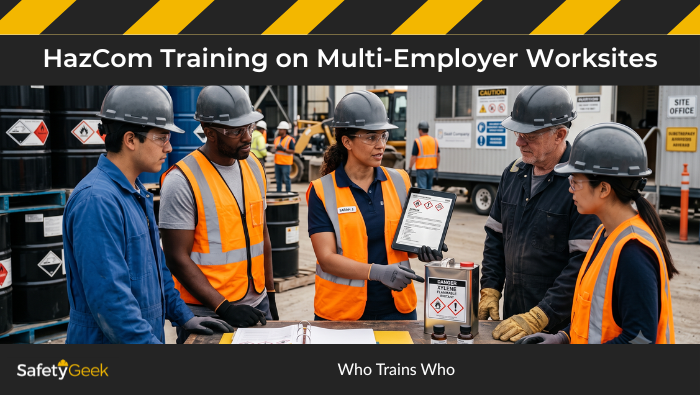
A chemical safety program protects workers from the chemicals they handle, store, and might be exposed to in the course of their work. In general industry, the regulatory anchor is OSHA’s Hazard Communication Standard at 29 CFR 1910.1200, commonly called HazCom. The standard requires a written program, a chemical inventory, safety data sheets (SDS), labels that follow the Globally Harmonized System, and employee training. Hazard Communication has been OSHA’s second-most-cited standard for multiple years running. That’s not because HazCom is hard. It’s because most programs never evolve past the template. A chemical inventory written three years ago reflects a facility that doesn’t exist anymore. Labels get missed. SDSs go stale. New hires get five minutes of HazCom training during orientation and never hear about it again. A real chemical safety program covers six things. The first is a current chemical inventory that gets reconciled at least annually. The second is a readily-accessible SDS library that every employee on every shift can reach. The third is a labeling system that catches every secondary container, not just the ones from the manufacturer. The fourth is hazard-specific training tied to the chemicals each employee actually uses. The fifth is engineering controls like ventilation, enclosures, and substitution where possible. The sixth is a written program that names who owns each piece. The common failure point is the secondary container. An employee pours degreaser out of a big drum into a squirt bottle for cleaning. That squirt bottle now needs a GHS-compliant label, and the employee using it needs to know what’s in it and how to protect themselves. This is the kind of detail that kills a HazCom audit. More importantly, it burns a worker who thought they were cleaning with something safer. For the full step-by-step build-out, read the complete guide to developing a chemical safety program.Lockout Tagout (LOTO)
Lockout/tagout is the program that controls hazardous energy during servicing and maintenance of machines and equipment. OSHA’s standard at 29 CFR 1910.147 requires a written energy control program, machine-specific energy control procedures, authorized and affected employee training, and annual inspections of each procedure by an authorized employee. LOTO moved up one spot on the FY2025 Top 10 to position #4, after a nearly 24% jump in citations between 2023 and 2024. Every LOTO citation represents a worker who was exposed to stored, residual, or live energy during maintenance. That exposure is how workers get crushed, electrocuted, or caught in unexpected startup. A strong LOTO program has five pillars. The first is a written energy control program that names the standard and applies to all forms of hazardous energy: electrical, hydraulic, pneumatic, thermal, chemical, mechanical, and gravitational. The second is machine-specific energy control procedures for every piece of equipment that gets serviced. The third is tiered training for authorized employees (who perform lockout), affected employees (who operate the equipment), and other employees (who work in the area). The fourth is documented periodic inspections at least annually. The fifth is controls for special situations like group lockout, shift change, and outside contractors. Machine-specific procedures are where most LOTO programs break down. A generic procedure that says “de-energize the equipment and verify zero energy” is useless to the maintenance tech standing in front of a specific press with three energy sources. Every machine needs its own written procedure showing every energy source, every isolating device, and the verification steps to confirm zero energy. The other failure point is the annual periodic inspection. OSHA requires an authorized employee (not the person who developed the procedure) to observe the procedure being performed and verify that it is accurate and complete. This is where you catch procedure drift, equipment modifications that never made it into the document, and training gaps. Most programs either skip this entirely or treat it as a paperwork exercise. For the full walkthrough, read our complete LOTO program implementation guide.THE ALL-ACCESS PASS RESOURCE PAGE
Get all the FREE templates, safety management resources, PDFs, spreadsheets, and more...
Machine Guarding
Machine guarding protects workers from hazards created by moving machine parts: points of operation, ingoing nip points, rotating parts, flying chips, and sparks. OSHA’s general standard at 29 CFR 1910.212 requires one or more methods of machine guarding on every machine that creates a hazard. Specific Subpart O standards add requirements for categories like saws, grinders, and power presses. Machine guarding has sat in the OSHA Top 10 for decades. Machine-related incidents are still responsible for thousands of amputations and serious lacerations every year, even as overall injury rates trend down. According to the BLS 2024 nonfatal injury and illness data, private industry reported 2.5 million recordable injuries and illnesses. “Caught in/compressed by equipment or objects” remains one of the top event categories for severe injury. A machine guarding program has six key parts. The first is a machine inventory that identifies every piece of equipment in the facility and categorizes the hazards it creates. The second is a risk-based assessment of each machine that evaluates points of operation, nip points, transmission parts, and other moving hazards. The third is specific guarding methods chosen from fixed guards, interlocked guards, adjustable guards, and self-adjusting guards, with engineering controls prioritized over administrative ones. The fourth is training for operators and maintenance personnel on the specific guards in place and the consequences of removing or bypassing them. The fifth is a documented inspection and maintenance routine so guards don’t get quietly removed over time. The sixth is a management-of-change process so new equipment and modifications get assessed before they hit the floor. The single biggest failure in machine guarding programs is guard bypass. A shortcut starts as an operator taping down an interlock because it’s “slowing production,” and before long the entire crew is running the machine with the guard defeated. This is where you have to shift your thinking from “we need more rules” to “why is the safe way harder than the unsafe way?” That question is a systems question, and it’s the right one to ask. For the full program, read the machine guarding best practices guide and the OSHA machine guarding checklist for 1910.212 compliance.How to Build Any Hazard Control Program in 5 Steps
Every hazard control program follows the same 5-step Safety Management Cycle. It doesn’t matter whether you’re writing HazCom, LOTO, machine guarding, respiratory protection, or any other program. The cycle works because it is built to repeat annually, so the program gets better every year instead of decaying on the shelf. Step 1: Identify. Map the hazard in your facility. For HazCom, build the chemical inventory. For LOTO, list every machine with a serviceable energy source. For machine guarding, walk the floor and document every moving part that creates a hazard. A Job Hazard Analysis at the task level is the foundation. If you’ve never built one, start here with our guide to performing a Job Hazard Analysis. Step 2: Develop. Write the program using the hierarchy of controls as your decision tree. Ask elimination and substitution questions before you ever ask about PPE. Build procedures that are specific to the equipment and the task, not generic templates. Include management AND employees in the development process… people who help build a program have skin in the game. Step 3: Implement and Train. Launch the program with tiered training. Authorized employees need deep technical training. Affected employees need enough awareness to recognize when the program applies to them. New hires get it at orientation, existing employees get it at rollout, and everyone gets refreshers on a published schedule. Step 4: Coach and Observe. This is where most programs die. Front-line supervisors observe the work happening and coach in real time when they see drift. The safety manager is the coach of the coaches, not the person running around writing up violations. If you’re doing all the observing yourself, you’re a bottleneck and your program is built on your presence. Step 5: Analyze. Pull the data monthly and look for patterns: training gaps, repeat findings, equipment modifications, near-misses. Feed what you learn back into Step 1 for next year’s cycle. This is how a static binder becomes a living system that drives year-over-year improvement.Common Mistakes That Wreck Hazard Control Programs
Most failed programs fail the same way. After reviewing hundreds of safety programs across manufacturing, warehousing, food processing, and service operations, the same six patterns show up again and again. Starting with PPE. If the first control in your program is a glove, respirator, or safety glasses, you skipped four higher levels of the hierarchy. Work the levels in order. Using generic templates. A template is a starting point, not a program. If the procedure does not name the actual equipment, the actual chemicals, the actual tasks, and the actual people who perform them, it is not your program. It’s someone else’s program with your logo on it. Treating training as the behavior change. Training alone does not change behavior… it only transfers knowledge. Behavior changes when training is paired with coaching, observations, and reinforcement on the floor. If your program is “we train them once a year and check the box,” you are measuring attendance, not competence. No annual refresh. Programs that live once a year on an auditor’s desk are dead programs. Equipment gets added. Processes change. People turn over. If the program isn’t running through the full 5-step cycle every year, it’s decaying. Safety owns compliance. When the safety manager is the one walking the floor with a clipboard writing people up, front-line supervisors step back and let safety own it. That is a bottleneck and a single point of failure. Supervisors have the line of power. Safety is the guide on the side, the subject matter expert, and the coach. Read about why supervisors should own compliance for the full breakdown. Compliance-first thinking. When the goal of the program is “don’t get cited,” everything above the regulatory minimum becomes optional. The standard is a floor, not a ceiling. The facilities with world-class records treat 1910 as the starting line.Frequently Asked Questions About Hazard Control Programs
What hazard control programs does OSHA require for general industry?
OSHA requires written programs for hazards specifically addressed in 29 CFR 1910, including Hazard Communication (1910.1200), Lockout/Tagout (1910.147), Respiratory Protection (1910.134), Bloodborne Pathogens (1910.1030), and Emergency Action Plans (1910.38). Machine guarding (1910.212) doesn’t mandate a written program, but you need documented procedures and training. The General Duty Clause also requires controls for any recognized hazard not named in a specific standard.How often should hazard control programs be reviewed?
Every hazard control program should be reviewed at least annually and anytime there’s a significant change. LOTO specifically requires an annual periodic inspection of each energy control procedure, performed by an authorized employee other than the one performing the procedure. Build the review into your Safety Management Cycle so it happens as part of the annual rhythm, not as a one-off project.What is the hierarchy of controls, and why does it matter?
The hierarchy of controls is NIOSH and OSHA’s ranking of hazard control methods from most to least effective: elimination, substitution, engineering, administrative, and PPE. It matters because controls higher in the hierarchy remove the hazard itself, while controls lower in the hierarchy depend on human behavior to work. A guard that physically blocks a pinch point protects the worker every time. A procedure that says “keep your hands back” only protects the worker when they remember.Who is responsible for hazard control programs in general industry?
The employer is legally responsible for every hazard control program under OSHA. Inside the company, responsibility gets distributed. Front-line supervisors own compliance on the floor because they have the line of power. The safety manager owns program development, training design, data analysis, and coaching of supervisors. Employees are responsible for following the procedures and reporting hazards.What’s the difference between a hazard control program and a hazard assessment?
A hazard assessment identifies the hazards that exist in a workplace or task. A hazard control program is the full written system for preventing, managing, and protecting workers from a category of hazards. An assessment is one input into the program. Think of the assessment as the diagnosis and the program as the treatment plan.How do hazard control programs fit into a Safety Management System?
Hazard control programs are the operational output of a Safety Management System (SMS). The SMS is the overarching framework that organizes policy, risk management, assurance, and promotion. Individual hazard control programs execute the SMS at the hazard level.How do I convince leadership to invest in hazard control programs?
Lead with business value, not the moral argument. Executives see risk differently than safety professionals do, and the moral argument rarely lands. Translate the program into dollars: workers’ comp savings, insurance premiums, OSHA penalties avoided, production downtime, turnover, and quality defects. Our guide on winning executive buy-in for safety walks through the pitch in detail.Do small general industry employers need hazard control programs?
Yes. OSHA’s 1910 standards apply regardless of company size. A 10-person machine shop still needs HazCom, LOTO if there’s any serviceable equipment, and machine guarding. Small employers get cited at the same rates as large ones, and a single serious injury can close a small company.Now It’s Your Turn
Hazard control programs are how you turn OSHA’s 1910 standards into something that actually protects your people. The three you cannot skip in general industry are chemical safety (HazCom), lockout/tagout (LOTO), and machine guarding. Build each one on the hierarchy of controls, run it through the 5-step Safety Management Cycle every year, and stop trying to be the hero who holds the whole thing together. Here are three actions you can take this week:- Pick one program tied to your highest-risk hazard and walk it through the 5 steps: Identify, Develop, Implement & Train, Coach & Observe, Analyze. Note what’s missing at each stage.
- Map the hierarchy of controls against every procedure in that program. If you’re leading with PPE or training, flag it and ask what engineering or substitution option you passed over.
- Hand compliance observations back to the front-line supervisors for that program area. Your role is coach, not cop.
Hi, I'm Brye (rhymes with sky)! I am a self-proclaimed safety geek with two decades of general industry safety experience. Specializing in bringing safety programs to a world-class level and building a safety culture, I have trained and coached many safety managers, just like you, on how to effectively manage workplace safety in the real world. I would love to help you too.