Estimated Reading Time: 8 minutes
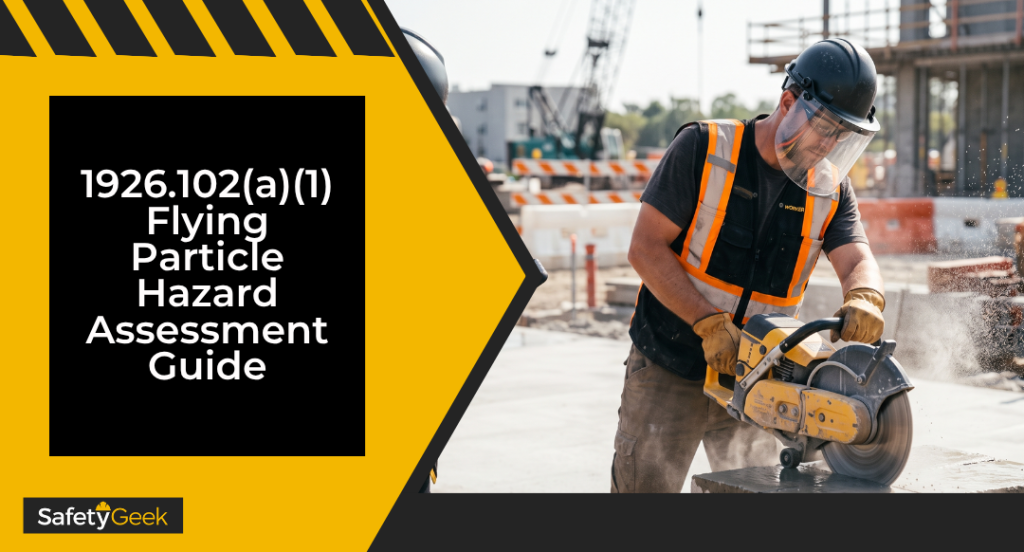
TL;DR: OSHA does not require construction employers to pay for non-specialty prescription safety glasses under 29 CFR 1910.132(h), as long as workers can wear them off the job. But employers still have to pay for specialty prescription eyewear (welding helmets, laser eyewear, respirator inserts) and must verify all eye protection meets ANSI Z87.1. Here is what 1926.102 actually requires, what the payment exemption covers, and how to build a policy that protects your workers and your company.
So your foreman just asked the same question for the third time this month. “Does the company have to pay for John’s prescription safety glasses, or does that come out of his pocket?” And every safety professional I talk to gets this one wrong at least once.
The short answer for OSHA 1926.102 employer payment for prescription safety glasses is no. You are not required to pay for non-specialty Rx safety eyewear if employees can use it off the job site. But that is only half the story.
The other half is where most companies get burned. While the payment rule has an exemption, the eye protection rule does not. You still have to make sure every worker exposed to a flying-particle, splash, or radiation hazard is wearing ANSI Z87.1 compliant protection that fits over or incorporates their prescription.
Get that wrong and you are looking at a citation, an injury, or both.
Key Takeaways
- OSHA 29 CFR 1910.132(h)(2) exempts employers from paying for non-specialty prescription safety eyewear when workers can use it off the job.
- OSHA 1926.102 still requires construction employers to provide ANSI Z87.1 compliant eye protection wherever a hazard exists.
- Specialty prescription PPE (welding helmets with integrated lenses, laser eyewear, respirator inserts) must be paid for by the employer.
- A documented hazard assessment under 1910.132(d) is required before you finalize any payment policy.
- Most mature safety programs subsidize Rx safety glasses anyway, because the cost of one preventable eye injury dwarfs the cost of a voucher program.
What 1926.102 and 1910.132(h) Actually Say About Paying for Rx Safety Glasses
OSHA 1926.102 is the construction standard for eye and face protection. It tells you when protection is required (flying particles, molten metal, chemicals, radiation) and what it must do, but it never says a word about who buys it. The payment piece lives in a separate standard, 29 CFR 1910.132(h), and OSHA applies that rule to construction work too.
The general rule in 1910.132(h)(1) is straightforward. The employer pays for all required PPE, at no cost to the employee. That covers hard hats, gloves, harnesses, high-vis, hearing protection, and standard safety glasses without question.
Then 1910.132(h)(2) carves out a handful of exceptions. The one that matters here reads: the employer is not required to pay for “non-specialty prescription safety eyewear, provided that the employer permits such items to be worn off the job-site.” That single sentence is what lets a construction company hand a new hire a list of approved frames and tell them to use their vision benefit, rather than buying every set of Rx safeties out of the safety budget.
The Non-Specialty Prescription Eyewear Exemption: What It Covers
The phrase “non-specialty” does a lot of heavy lifting in this rule. OSHA’s preamble to the 2008 PPE Employer Payment Final Rule explains the logic: these items are personal, often used outside work, and travel with the employee from job to job. So OSHA treats them more like personal vision care than like company-issued PPE.
To qualify for the exemption, three things have to be true. The eyewear must be prescription, it must be non-specialty (standard ANSI Z87.1 safety spectacles with side shields, not built into a specialized device), and the employer must allow the worker to wear them off the job site. Miss any one of those and the payment exemption disappears.
A quick frame of reference. If the glasses look like ordinary Rx safety glasses, just with Z87 stamped on the frame and lens, OSHA treats them as the worker’s own gear. If the protection is welded into a hood, integrated into a respirator face piece, or filtered for a specific laser wavelength, OSHA expects the company to pay.
What Counts as “Specialty” Prescription PPE
| PPE Type | Employer Must Pay? | Why |
|---|---|---|
| Standard Rx safety glasses with side shields, Z87.1 marked | No (exempt under 1910.132(h)(2)) | Non-specialty, usable off the job |
| Prescription welding helmet with integrated Rx lens | Yes | Specialty, job-specific design |
| Laser safety eyewear with wavelength-specific Rx filter | Yes | Specialty, cannot serve as everyday glasses |
| Respirator face piece with prescription insert | Yes | Specialty, integrated into respiratory PPE |
| Prescription goggles for chemical splash duties | Generally yes | Often job-specific, not typically worn off site |
THE ALL-ACCESS PASS RESOURCE PAGE
Get all the FREE templates, safety management resources, PDFs, spreadsheets, and more...
When the Employer Has to Pay (Even Under the Exemption)
The exemption does not mean a free pass. Three situations trigger mandatory employer payment, no matter what your policy says.
First, any specialty prescription PPE I listed above. If the lens is integrated into a welding hood, laser eyewear, or a respirator, the cost is on the company. Second, if the eyewear is required by a task and cannot reasonably be used off the job (think prescription chemical splash goggles), the exemption does not apply.
Third, and this is the one that catches people, if your policy says employees cannot take their Rx safety glasses home, you just lost the exemption. The rule explicitly conditions the carve-out on permitting off-site use. Lock those frames in a gang box overnight and you owe the worker reimbursement.
So if you want the exemption to hold, write the policy to let people wear their Rx safeties anywhere they like.
Building a Compliant Payment Policy for Rx Safety Glasses
Here is where I see most safety managers stop too early. They read the exemption, write a one-line policy that says “the company does not pay for prescription safety glasses,” and move on. Then six months later they get a complaint, a citation, or a worker walking the line without any eye protection at all because the new prescription was too expensive.
A strong policy does four things. It addresses the hazard, the standard, the payment, and the options. And it does all of that in plain language that a foreman can explain in under two minutes.
Start with the hazard assessment required by 1910.132(d). Document where eye and face hazards exist, what the hazards are (impact, splash, dust, radiation), and what level of protection each task requires. That assessment is the legal foundation for everything that follows, and an OSHA inspector will ask to see it before they ask about your payment policy.
Sample Policy Language
“[Company] will pay for all eye and face protection required by 29 CFR 1926.102 and 1910.133, including all specialty prescription PPE such as welding helmets, laser eyewear, and respirator inserts. Non-specialty prescription safety eyewear that meets ANSI Z87.1 and may be worn off the job site is the employee’s responsibility, consistent with 29 CFR 1910.132(h)(2). [Company] will [provide a voucher of $X every 24 months / fully reimburse / offer over-the-glasses goggles] as an alternative.”
That paragraph covers the standard, the payment rule, the exemption, and the company’s own choice. It tells the worker exactly what to expect and gives the supervisor something to point to when the question comes up on the job.
Voucher Programs That Work
Most mature programs do not stop at the legal minimum. A typical voucher pattern is $100 to $150 per pair, redeemed every 24 to 36 months at a network of optical providers. That money buys ANSI Z87.1 compliant frames and lenses, with the worker covering any cosmetic upgrades.
Why bother spending money you do not have to spend? Because the math is brutal in the other direction.
A single eye injury that triggers an emergency department visit, lost time, and a workers’ comp claim runs into the thousands. A voucher program at $100 per worker every two years is a rounding error against that exposure. And it pays back in PPE compliance, because workers who own well-fitting Rx safeties actually wear them.
Managing Employee-Owned Rx Safety Glasses
If you use the exemption, you still have responsibilities. Under 1910.133(a)(3), workers who wear prescription lenses must have eye protection that either incorporates the prescription or fits properly over their everyday glasses without disturbing them. You cannot just hope they figure it out.
In practice, that means giving Rx wearers a choice. Option one is over-the-glasses (OTG) safety goggles, supplied by the company, that fit over their personal prescription frames. Option two is employer-funded or employer-subsidized prescription safety eyewear through your voucher program.
Then verify. Before any employee-owned pair goes on the job, inspect for the ANSI Z87.1 marking on both frame and lens. Confirm side shields are present and intact, and check fit.
If the glasses are scratched, damaged, or missing the Z87 stamp, they do not go on the job site. Document the verification once, and you have a defensible answer the next time an inspector asks about your eye protection program.
FAQ
Are construction employers required to pay for prescription safety glasses under OSHA 1926.102?
No. OSHA’s PPE payment rule at 29 CFR 1910.132(h)(2) exempts employers from paying for non-specialty prescription safety eyewear, as long as workers are allowed to wear those glasses off the job site. The rule applies to construction work just like it does to general industry.
Does the OSHA exemption cover all prescription eyewear?
No. The exemption only covers non-specialty Rx safety glasses. Specialty PPE like prescription welding helmets, laser safety eyewear, and respirator face piece inserts must be fully employer-paid, because they are job-specific and cannot reasonably be used outside of work.
What is ANSI Z87.1 and why does it matter for Rx safety glasses?
ANSI Z87.1 is the consensus standard for occupational eye and face protection. OSHA 1926.102 requires eye protection on construction sites to meet it. Both the frame and the lens must carry the Z87 marking, and prescription safety glasses without that marking do not satisfy the standard, regardless of who paid for them.
What if an employee already owns prescription safety glasses?
Workers can use their own Rx safety glasses if the eyewear meets ANSI Z87.1, includes side shields, and is in good condition. The employer still has to verify adequacy and document that inspection. You are not required to reimburse for personal non-specialty Rx glasses, but you remain responsible for compliance.
Do I need a hazard assessment before I can rely on the payment exemption?
Yes. A written PPE hazard assessment under 29 CFR 1910.132(d) is the foundation of every eye protection program. Without it, you cannot defend the type of PPE you selected, the payment policy you wrote, or your enforcement decisions. It is the first thing an inspector asks for after an eye injury.
Can I require employees to leave their Rx safety glasses at work overnight?
Not without losing the payment exemption. The 1910.132(h)(2) carve-out only applies when the employer permits non-specialty Rx safety eyewear to be worn off the job site. If you lock the glasses up after shift, OSHA treats them as company-paid PPE and you owe the worker reimbursement.
Now It’s Your Turn
If you have been wondering how to write a clean prescription safety glasses policy that holds up to an audit and actually gets worn on the job, start with the hazard assessment and build the rest in layers. The exemption is real, but so is the responsibility that comes with it.
And if eye protection compliance is one of those areas where you keep hitting the same wall (management pushback, foremen who shrug off Z87 markings, workers who “forget” their safeties on the truck), that is exactly the kind of leadership problem we work through inside the Safety Leadership Academy. Compliance is the floor. Influence is what gets the floor walked.
Hi, I'm Brye (rhymes with sky)! I am a self-proclaimed safety geek with two decades of general industry safety experience. Specializing in bringing safety programs to a world-class level and building a safety culture, I have trained and coached many safety managers, just like you, on how to effectively manage workplace safety in the real world. I would love to help you too.