Estimated Reading Time: 8 minutes
If you can answer for all four letters on every job, you’ve got a defensible system. If even one is fuzzy, that’s where the citation (or worse) lives.
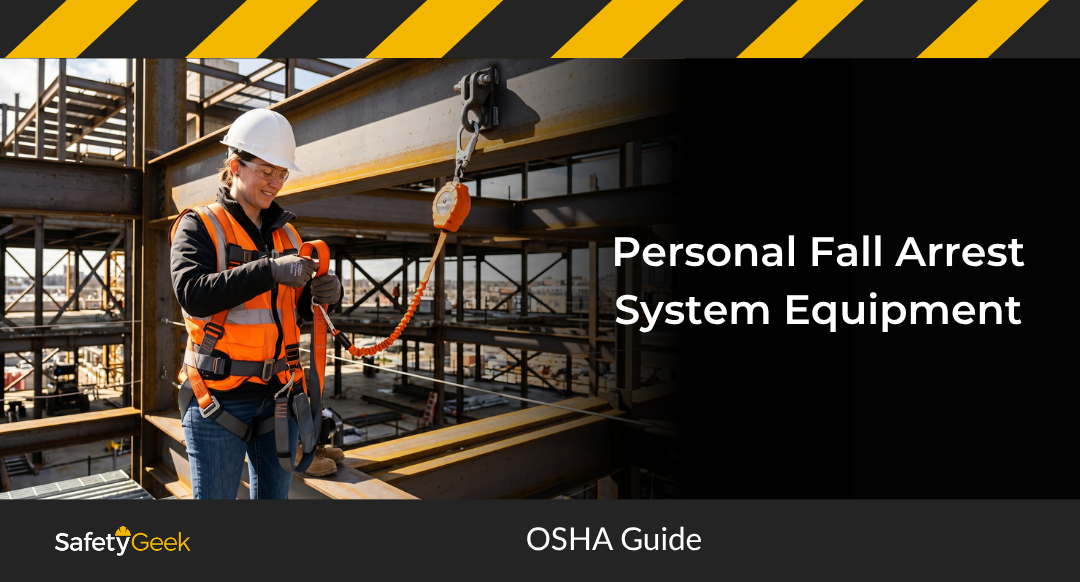
TL;DR: A personal fall arrest system (PFAS) is the gear that catches a worker when they fall… and OSHA 1926.502(d) spells out exactly what that gear has to do. Every PFAS comes down to the ABCDs: Anchorage, Body support, Connectors, and Descent or rescue. The anchorage must hold 5,000 pounds per worker (or twice the impact force when designed by a qualified person), body belts are no longer allowed for fall arrest, and connectors have to limit free fall to 6 feet and arrest forces to 1,800 pounds. If your team can’t repeat those numbers in their sleep, this is the read.If you’ve ever stood at the bottom of a roof and tried to figure out whether your crew’s harnesses, lanyards, and anchor points actually meet OSHA’s requirements… you’re not alone. Personal fall arrest system equipment criteria are buried in 29 CFR 1926.502(d), and the language can feel like it was written for engineers, not the people running the job. So let’s translate it. This guide walks through exactly what your PFAS gear has to do to keep workers alive and keep you off OSHA’s citation list.
Key Takeaways
- OSHA 1926.502(d) governs every piece of personal fall arrest system equipment used in construction.
- The “ABCDs” framework… Anchorage, Body support, Connectors, Descent and rescue… is how to mentally inventory any PFAS.
- Anchorages must hold 5,000 pounds per attached worker, or twice the impact load when designed by a qualified person.
- Body belts have been prohibited for fall arrest since 1998. Full-body harnesses are the only legal option.
- Free fall is capped at 6 feet, and the arresting force on the worker can’t exceed 1,800 pounds.
- Rescue planning is a requirement, not a nice-to-have. Suspension trauma can kill in under 30 minutes.
What Counts as a Personal Fall Arrest System
A personal fall arrest system is a setup designed to stop a worker after they’ve already fallen. It’s the last line of defense in the hierarchy of fall protection controls, used when guardrails or safety nets aren’t feasible. It’s not just a harness. A PFAS is the full chain… the anchor point at the top, the connecting device in the middle, and the harness on the worker’s body. Miss one link and the whole system fails. OSHA’s construction standard at 1926.502(d) sets the technical criteria for every component in that chain. The general industry equivalent lives at 1910.140, and the criteria are nearly identical. If you work in both worlds, the rules travel with you.When PFAS Becomes Required
In construction, fall protection kicks in at 6 feet. When guardrails and safety nets aren’t practical, a PFAS is the next option. Leading edge work, steel erection, and roofing are the most common scenarios where harnesses become the default choice. The catch is that the system only counts as “in use” if every piece meets the criteria in 1926.502(d). A worker can be fully clipped in and still be unprotected if the anchor point was rated for 300 pounds instead of 5,000.The ABCDs of Fall Arrest Equipment
Most safety pros learn the ABCDs early, and for good reason. It’s the cleanest way to mentally walk through a fall arrest setup without missing a component. Here’s the framework at a glance:| Letter | Component | What It Does | Key Criteria |
|---|---|---|---|
| A | Anchorage | The fixed point the system attaches to | 5,000 lb per worker, or 2x impact load |
| B | Body Support | The full-body harness worn by the worker | Dorsal D-ring, no body belts |
| C | Connectors | Lanyards, SRLs, and hardware linking A to B | Limit free fall to 6 ft, force to 1,800 lb |
| D | Descent & Rescue | Plan and equipment for retrieving a fallen worker | Prompt rescue required by 1926.502(d)(20) |
Anchorage Requirements Under 1926.502(d)
The anchorage is the part most safety pros underestimate. It’s the literal foundation of the system, and OSHA gives you two paths to compliance. The first is the 5,000-pound rule. Per 1926.502(d)(15), each anchorage used to attach personal fall arrest equipment must support at least 5,000 pounds per employee attached. That’s not 5,000 pounds total… it’s 5,000 per worker clipped in. The second path is the engineered system. The anchorage can be designed, installed, and used as part of a complete system that maintains a safety factor of at least two, under the supervision of a qualified person. Translation: a qualified engineer can certify a lower-rated anchor, as long as they’ve calculated the actual impact load and built in a 2x safety factor.The Anchor Mistakes That Show Up on Citations
The most common anchorage failure isn’t dramatic. It’s a worker tying off to a piece of conduit, a vent stack, or a sprinkler pipe because it was close and convenient. None of those are rated anchorages. OSHA’s construction fall protection guide is explicit that anchorages have to be independent of any anchorage used to support or suspend platforms. They also can’t be the same point used for guardrails or material hoisting. This is where the Coach & Observe step of the Safety Management Cycle earns its keep. Most workers aren’t anchoring incorrectly out of laziness… they just don’t know which steel is rated and which isn’t. That’s a training and observation gap, not a discipline problem.THE ALL-ACCESS PASS RESOURCE PAGE
Get all the FREE templates, safety management resources, PDFs, spreadsheets, and more...
Body Support: Why Body Belts Are Out
Body support means the full-body harness. Since January 1, 1998, OSHA has prohibited body belts for fall arrest use under 1926.502(d)(17). The reason is biomechanics. A body belt focuses all the arresting force into the worker’s abdomen, which can cause internal injuries or death even in a successful catch. A full-body harness distributes that force across the thighs, pelvis, chest, and shoulders, which the human body can actually tolerate. Body belts are still legal as positioning devices in specific applications, like utility work on poles. They just can’t be the thing that catches a fall.D-Ring Placement on the Harness
The attachment point for fall arrest is the dorsal D-ring, located between the shoulder blades. That placement keeps the worker upright during the arrest and away from the impact load path. Some harnesses also have sternal (chest) and side D-rings. Those are for specific applications like ladder climbing or work positioning, not general fall arrest. Using the wrong D-ring during a fall can rotate the body into a head-down position or fail to spread the load correctly.Connectors: Lanyards, SRLs, and the 6-Foot Rule
Connectors are everything between the anchorage and the harness. Shock-absorbing lanyards, self-retracting lifelines (SRLs), rope grabs, and the snap hooks on either end all fall in this bucket. 1926.502(d) lays out the performance requirements every connector has to meet:- Free fall limited to 6 feet. The worker can’t fall more than 6 feet before the system starts arresting.
- Maximum arresting force of 1,800 pounds. The force transmitted to the worker during the catch can’t exceed 1,800 lb.
- Deceleration distance of 3.5 feet or less. Once arrest starts, the worker has to stop within 3.5 feet.
- Locking snap hooks required. Non-locking snap hooks have been prohibited since 1998 because they can “roll out” of D-rings.
Fall Clearance: The Math Most Crews Skip
Total fall clearance is the distance below the working surface a worker actually needs to land safely. It’s the lanyard length, plus the deceleration distance, plus the worker’s body length below the D-ring, plus a safety margin. For a typical 6-foot shock-absorbing lanyard setup, you’re looking at roughly 18 to 19 feet of clearance below the anchor. If the lower level is 15 feet down, the system won’t fully arrest before impact… and that’s a fatality waiting to happen.Descent and Rescue: The “D” Most Sites Ignore
1926.502(d)(20) requires the employer to provide for prompt rescue of employees in the event of a fall, or assure that employees are able to rescue themselves. “Prompt” isn’t defined in the standard, but the medical reality defines it for you. Suspension trauma, also called orthostatic intolerance, can set in within minutes of hanging in a harness. Blood pools in the legs, return circulation drops, and unconsciousness or death can follow inside 30 minutes. A worker hanging successfully arrested is still a worker in active danger. A real rescue plan answers four questions: Who’s calling for rescue? Who’s executing it? What equipment is already on site? And how long will it take? “We’ll call 911” is not a rescue plan in any meaningful sense, especially on remote sites.Common PFAS Compliance Failures
The citations I see most often aren’t usually missing harnesses. They’re harnesses being worn while still being non-compliant. The pattern repeats across industries:- Damaged or expired equipment. Cut webbing, deployed shock packs, or harnesses past the manufacturer’s service life still being clipped on.
- No documented inspection. 1926.502(d)(21) requires PFAS components to be inspected before each use. Most teams do it visually but never write it down.
- Anchor confusion. Workers tying off to anything overhead because no rated anchor was identified in the pre-job plan.
- Rescue plan gaps. Equipment present but no trained rescuer on site to use it.
How PFAS Compliance Fits the Bigger Picture
Fall protection is OSHA’s #1 most cited standard, with thousands of violations issued every year per Safety+Health Magazine’s annual Top 10 list. The bulk of those citations are for missing protection, not faulty equipment. But the second wave… the citations that come after a near-miss or fatality… almost always center on the criteria in 1926.502(d). That’s because once OSHA shows up to investigate, “we had harnesses” isn’t enough. The investigation goes through every letter of the ABCDs. The anchor gets pull-tested. The harness gets inspected. The lanyard gets measured. The rescue plan gets requested. If you want to be ready for that conversation before it ever happens, the work is upstream. It’s training your crews on the ABCDs. It’s adding anchor identification to pre-job planning. And it’s running rescue drills with the same seriousness you’d run a fire drill.Frequently Asked Questions
What does PFAS stand for in fall protection?
PFAS stands for Personal Fall Arrest System. It’s the combination of anchorage, body harness, and connecting device used to stop a worker after a fall. OSHA defines and regulates it under 29 CFR 1926.502(d) for construction and 1910.140 for general industry.What is the OSHA 5,000-pound anchorage rule?
Under 1926.502(d)(15), each anchorage used for personal fall arrest must support at least 5,000 pounds per worker attached. The alternative is an engineered system designed by a qualified person with a safety factor of at least two times the maximum impact load.Can body belts be used for fall arrest?
No. OSHA prohibited body belts for fall arrest under 1926.502(d)(17), effective January 1, 1998. Body belts are still allowed as positioning devices in limited applications, but a full-body harness is the only legal option for arresting a fall.How much free fall is allowed under OSHA 1926.502(d)?
OSHA limits free fall to a maximum of 6 feet before the arresting force begins acting on the worker. The system also has to bring the worker to a complete stop within 3.5 feet of deceleration distance, and the peak force on the worker can’t exceed 1,800 pounds.Is a written rescue plan required for fall arrest?
1926.502(d)(20) requires the employer to provide for prompt rescue or assure self-rescue is possible. While the standard doesn’t explicitly say “written,” OSHA inspectors regularly request documentation, and suspension trauma can become life-threatening in under 30 minutes… making a documented, practiced plan the practical compliance standard.How often does PFAS equipment need to be inspected?
Per 1926.502(d)(21), every component of the personal fall arrest system must be inspected by the user before each use. Damaged or deteriorated components must be removed from service immediately. A documented annual or semi-annual inspection by a competent person is also industry standard practice.Now It’s Your Turn
Knowing the criteria in 1926.502(d) is one thing. Getting an entire crew to internalize the ABCDs so it’s automatic on every job is another. That’s the gap between regulatory knowledge and a real safety culture. The technical rules are public. The leadership work of making them habits is what separates safety programs that pass audits from programs that actually go home with everyone every night. If you want help closing that gap… building the systems and the influence to lead safety the way it deserves to be led… that’s exactly what we work on inside the Safety Leadership Academy. And if you’re not ready for that yet, grab the All-Access Pass below for the free templates, checklists, and resources to take with you to your next pre-job briefing.Hi, I'm Brye (rhymes with sky)! I am a self-proclaimed safety geek with two decades of general industry safety experience. Specializing in bringing safety programs to a world-class level and building a safety culture, I have trained and coached many safety managers, just like you, on how to effectively manage workplace safety in the real world. I would love to help you too.