Estimated Reading Time: 6 minutes
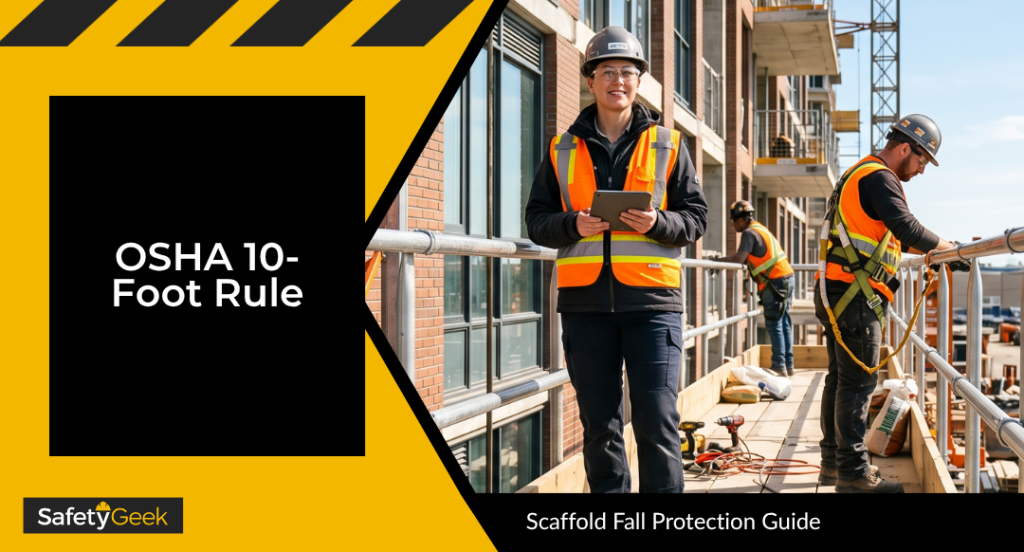
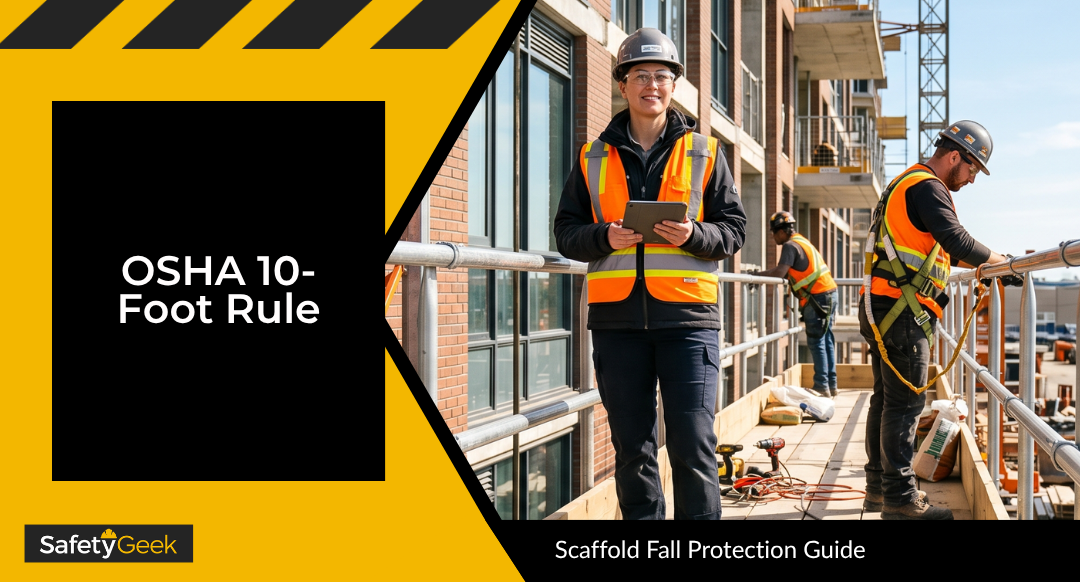
The OSHA 10-foot fall protection rule for scaffolding (29 CFR 1926.451(g)(1)) requires fall protection for any worker more than 10 feet above a lower level on a scaffold. That is different from the 6-foot trigger that covers most other construction work. Depending on the scaffold type, you protect people with guardrails, a personal fall arrest system, or both. Get the threshold or the front-edge rule wrong, and you land on OSHA’s most-cited list.
The OSHA 10-foot fall protection rule for scaffolding says workers more than 10 feet above a lower level have to be protected from falls. It lives in 29 CFR 1926.451(g)(1). That one number trips up more crews than almost any other scaffold requirement.
Here’s where it gets confusing. Everywhere else on the site, fall protection kicks in at 6 feet… but scaffolds get their own 10-foot threshold.
So your team does the right thing at one elevation and gets written up at another, and nobody can explain why. Let’s clear it up for good.
Key Takeaways
- The scaffold fall protection height is 10 feet, set by 29 CFR 1926.451(g)(1), not the 6-foot rule that covers most construction.
- Above 10 feet, you protect workers with guardrails, a personal fall arrest system, or both, depending on the scaffold type.
- Single-point and two-point adjustable suspension scaffolds require both a guardrail and a personal fall arrest system.
- Scaffold guardrails need a toprail 38 to 45 inches high plus a midrail, each able to hold 200 pounds of force.
- The platform front edge can’t sit more than 14 inches from the face of the work (18 inches for plastering) without added protection.
- Scaffolding stays on OSHA’s Top 10 most-cited standards, with roughly 1,900 violations a year.
What Is the OSHA 10-Foot Rule for Scaffolding?
The OSHA 10-foot rule for scaffolding is simple to state: any worker on a scaffold more than 10 feet above a lower level has to be protected from falling. That comes from 29 CFR 1926.451(g)(1), OSHA’s general fall protection requirement for scaffolds. You meet it with a guardrail system, a personal fall arrest system, or both, based on the type of scaffold your crew is standing on.
The number matters because it’s an exception. For most construction tasks, OSHA’s fall protection duty starts at 6 feet. Scaffolds get the higher 10-foot threshold instead.
OSHA’s own scaffolding eTool puts it plainly: guardrails, a personal fall-arrest system, or both must protect each employee more than 10 feet above a lower level. The OSHA Subpart L summary ties that threshold back to the ANSI consensus standards it was built on. So the 10-foot line isn’t arbitrary… it’s the height OSHA and industry agreed marked real fall risk for scaffold work.
10 Feet vs. 6 Feet: Why Scaffolds Are Different
Most of the site runs on the 6-foot rule. The moment a worker is 6 feet above a lower level near an unprotected edge, fall protection for unprotected sides and edges under 1926.501(b)(1) applies. Scaffolds are the carve-out, sitting at 10 feet.
Plenty of safety teams close that gap on purpose. They set one company standard, fall protection at 6 feet whether it’s a scaffold or not, so nobody has to do elevation math in their head. It’s more protective than OSHA requires, and it makes training dead simple.
| Work situation | Fall protection trigger | OSHA standard |
|---|---|---|
| Working on a scaffold | More than 10 feet above a lower level | 1926.451(g)(1) |
| Unprotected sides and edges | 6 feet or more | 1926.501(b)(1) |
| Leading edge work | 6 feet or more | 1926.501(b)(2) |
| Erecting or dismantling a scaffold | When feasible, per the competent person | 1926.451(g)(2) |
Scaffold Guardrail Requirements That Pass Inspection
A scaffold guardrail is your first line of fall protection above 10 feet, and OSHA is specific about how it has to be built. Under 1926.451(g)(4), the toprail sits 38 to 45 inches above the platform, with a midrail roughly halfway between the toprail and the deck. Both rails have to withstand at least 200 pounds of force pushed in any downward or outward direction, and every open side and end of the platform has to be guarded.
That last part is where crews lose points. A guardrail on three sides of a platform isn’t compliant if the fourth side is open above 10 feet.
If you want the full anatomy of a compliant rail, from heights to strength tests to toeboards, our breakdown of guardrail height and strength specs walks through it. Just remember scaffolds use the 38-to-45-inch toprail range, which is scaffold-specific.
The Front Edge and Face-of-Work Rule
Here’s the rule that starts the most arguments on a jobsite. The front edge of a scaffold platform, the side facing the wall or the work, can’t be more than 14 inches from the face of the work. For plastering and lathing, that jumps to 18 inches.
Go past that distance and you’ve got an open fall hazard on the work side. Now you need a guardrail along that front edge, a personal fall arrest system, or both.
Crews assume that being close to a wall cancels the guardrail on that side. It doesn’t. The distance to the work is what drives the requirement, not how solid the wall looks.
THE ALL-ACCESS PASS RESOURCE PAGE
Get all the FREE templates, safety management resources, PDFs, spreadsheets, and more...
When You Need a Personal Fall Arrest System on a Scaffold
Guardrails don’t cover every scaffold. On some types, OSHA requires a personal fall arrest system, and on a few, it requires both a harness and a guardrail at the same time. The right answer depends entirely on the scaffold your crew is using.
A personal fall arrest system, or PFAS, is the harness-and-anchor setup that catches a worker mid-fall. On suspension scaffolds especially, it’s not optional.
| Scaffold type | Required fall protection |
|---|---|
| Supported scaffolds (frame, tube and coupler, systems) | Guardrails, PFAS, or both |
| Single-point and two-point adjustable suspension | Both guardrail AND PFAS |
| Boatswain’s chair, catenary, float, needle beam, ladder jack | Personal fall arrest system |
| Self-contained adjustable (frame-supported) | Guardrail system |
| Self-contained adjustable (rope-supported) | Both guardrail AND PFAS |
Read that single-point and two-point row again, because it catches people. On those adjustable suspension scaffolds, a harness alone won’t cut it and a guardrail alone won’t either… you need both, every time. The specialty rigs like a boatswain’s chair, catenary, float, needle beam, or ladder jack all require a personal fall arrest system because guardrails aren’t practical on them.
Whoever decides which system applies needs to actually know the scaffold. That’s the job of your scaffold competent person, who inspects the setup and calls the fall protection method before anyone climbs on.
Scaffold Fall Protection Mistakes That Trigger Citations
Scaffolding lands on OSHA’s Top 10 most-cited standards year after year. Preliminary FY 2025 data reported by Safety+Health Magazine put scaffold violations around 1,900, keeping 1926.451 near the top of the list. These aren’t exotic failures… they’re the same handful of misses over and over.
The most common one is using the wrong threshold. Crews either apply the 6-foot rule to a scaffold and pull people off productive work early, or they treat 10 feet as “no protection needed below,” even during risky erection and dismantling.
The second is treating cross-bracing as a guardrail. A crossbrace only counts if its crossing point falls in the right height window, and most sit too low to serve as a real toprail. If you’re relying on the X of a brace to stop a fall, plan on a citation.
The third is the front-edge miss we already covered, with platforms sitting more than 14 inches off the work and no rail on that side. And the fourth is skipping stability basics like the scaffold 4-to-1 height ratio rule, which keeps the whole structure from tipping in the first place.
None of these are knowledge problems. They’re system problems, because nobody built the check into the daily routine. When the same miss shows up on scaffold after scaffold, the fix isn’t yelling at the crew… it’s designing the inspection so the catch happens automatically.
Frequently Asked Questions About the OSHA 10-Foot Scaffold Rule
Is scaffold fall protection required at 6 feet or 10 feet?
On scaffolds, fall protection is required at more than 10 feet above a lower level under 29 CFR 1926.451(g)(1). The 6-foot trigger applies to most other construction work, not scaffolds. Many companies still adopt a 6-foot scaffold standard voluntarily to keep their fall protection policy simple.
Do you need both a guardrail and a harness on a scaffold?
It depends on the scaffold type. Supported scaffolds let you use guardrails, a personal fall arrest system, or both. But single-point and two-point adjustable suspension scaffolds require both a guardrail and a harness at the same time, and that dual requirement is non-negotiable.
How high does a scaffold guardrail have to be?
A scaffold guardrail toprail must sit 38 to 45 inches above the platform, with a midrail roughly halfway down. Both rails have to hold at least 200 pounds of force. Every open side and end of a platform above 10 feet needs this guarding.
Does the front edge of a scaffold platform need a guardrail?
Only when it’s too far from the work. If the platform front edge is more than 14 inches from the face of the work, or 18 inches for plastering and lathing, you need a front-edge guardrail, a personal fall arrest system, or both. Closer than that, the wall itself limits the fall hazard.
What about fall protection while erecting or dismantling a scaffold?
OSHA requires fall protection during erection and dismantling when the competent person determines it’s feasible, under 1926.451(g)(2). This is one of the riskiest phases, because guardrails often aren’t in place yet. Your competent person decides the safe method before the work starts.
Now It’s Your Turn
The OSHA 10-foot rule for scaffolding comes down to one habit: know your scaffold type, then match the fall protection to it before anyone climbs. Miss the threshold, the front edge, or the suspension-scaffold double requirement, and you’re on the citation list.
Here’s what to do this week:
- Walk your active scaffolds and confirm fall protection is in place above 10 feet.
- Measure the front-edge gap on every platform and flag anything past 14 inches from the work.
- Check that your suspension scaffolds have both a guardrail and a harness in use.
- Put the fall protection check into your competent person’s daily inspection so it happens on its own.
Compliance is the floor, not the finish line. The scaffold rules keep you legal, but the safety leaders who actually change how their crews work build systems and influence on top of the regs. That’s the whole idea behind the Safety Influencer System, the free training that shows you how to stop being the safety cop and start leading.
You’ve got this, Safety Friend. Get the threshold right, build the check into your routine, and let the system do the enforcing for you.
Hi, I'm Brye (rhymes with sky)! I am a self-proclaimed safety geek with two decades of general industry safety experience. Specializing in bringing safety programs to a world-class level and building a safety culture, I have trained and coached many safety managers, just like you, on how to effectively manage workplace safety in the real world. I would love to help you too.