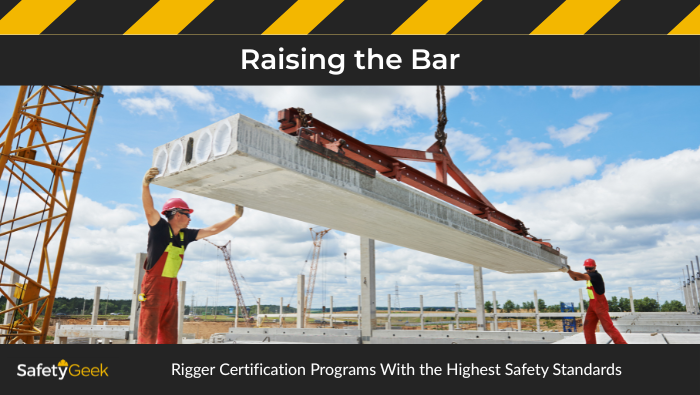
Vetting rigger training providers takes time and diligence. The top-rated rigger certification programs maintain strict adherence to the Occupational Safety and Health Administration (OSHA) guidelines, employ qualified instructors and offer a comprehensive curriculum. Discover three programs that deliver safety compliance and hands-on expertise.
- CICB Basic Rigger & Signalperson from CICB
CICB offers a top-rated rigger certification program that meets and exceeds industry benchmarks. Its structured approach combines expert instruction with flexible delivery options accessible to operations of any size in your organization. The company’s rigger training program is organized into two proficiency levels, referred to as Class A and Class B rigger courses. Other rigging training programs include CCO Rigger Levels 1 and 2 and Train-the-Trainer programs.
Key Features
- Expert instruction: Subject Matter Experts certified in adult education lead all training sessions
- Safety compliance: Training meets or exceeds the standards of OSHA, the American National Standards Institute (ANSI) and the American Society of Mechanical Engineers (ASME)
- Flexible delivery: Available at your location, training centers or virtually
- Rigger Certification from the National Center for Construction Education and Research (NCCER)
NCCER delivers comprehensive certification programs recognized across union and non-union construction sites nationwide. This certification is designed for entry-level riggers. Its focus on practical application prepares professionals for real-world jobsite demands. It has programs for entry-level professionals, experienced riggers and experts who need to be proficient in hand and verbal signals for hoisting.
Key Features
- Industry-driven curriculum: Developed with experts to meet or exceed ASME and OSHA standards
- Complete training solution: Certifications cover Crane Operators, Riggers and Signal Persons
- Easy verification: The online validation system allows quick credential confirmation
- Rigger Level I from the National Commission for the Certification of Crane Operators (NCCCO)
NCCCO’s Rigger Level I is one of the gold standards for rigger certification with national recognition and international accreditation. Construction, steel erection and utilities professionals collaborated to develop its programs. This features lessons for performing simple, repetitive tasks. The organization also offers Rigger Level II for performing complex tasks, including estimating load weights.
Key Features
- Recognized accreditation: National and international recognition ensures credentials hold value across industries
- Two-level certification path: Rigger Level I and Level II programs provide clear advancement opportunities
- Comprehensive evaluation: Certification requires passing both written and practical hands-on exams
THE ALL-ACCESS PASS RESOURCE PAGE
Get all the FREE templates, safety management resources, PDFs, spreadsheets, and more...
How to Choose From the Top-Rated Rigger Certification Programs
The following rigger certification program providers were evaluated using these four critical areas:
- Alignment with OSHA requirements and industry benchmarks such as ANSI and ASME
- Instructor expertise, including relevant certifications and field experience
- Curriculum depth, covering both foundational concepts and advanced techniques
- Training flexibility to meet the operational needs of safety managers
The Importance of Choosing the Right Rigger Program
Comprehensive rigger training protects workers and operational budgets from direct and indirect costs, such as medical bills, productivity loss, equipment damage and potential legal fees. A well-trained rigger reduces incident likelihood, directly impacting your operational budget. Programs emphasizing load assessment, equipment inspection and communication protocols create safer worksites and reduce preventable downtime.
Choosing Between Online and In-Person Training
Online rigger training offers scheduling flexibility and eliminates travel costs for geographically dispersed teams or those with tight budgets. Theory-based modules and regulatory compliance content work well in this format. A potential disadvantage is limited hands-on equipment practice and reduced instructor feedback during demonstrations.
In-person training delivers direct interaction with rigging equipment and real-time coaching from instructors. Participants practice with physical slings, hardware and load configurations that mirror jobsite conditions while receiving immediate correction. Both formats should address safety topics that help prevent violations like fall hazards, personal protective equipment issues and heavy machinery risks. Consider your team’s learning style, equipment access and timeline when selecting a delivery method.
Promote a Safer Worksite for All
Standards compliance, instructor quality and curriculum depth should guide your choice of rigger certification program. These programs meet rigorous industry requirements. Your decision determines how well your team handles rigging operations and jobsite challenges. Select training aligned with your operational needs and commit to ongoing skill development for your workforce.
Hi, I'm Brye (rhymes with sky)! I am a self-proclaimed safety geek with two decades of general industry safety experience. Specializing in bringing safety programs to a world-class level and building a safety culture, I have trained and coached many safety managers, just like you, on how to effectively manage workplace safety in the real world. I would love to help you too.