Laboratory safety extends beyond chemical handling and personal protective equipment. The way air moves through a lab can have a direct effect on both worker health and experiment integrity. Safe airflow paths are part of an engineered system intended to control contaminants, prevent cross-contamination, and maintain compliance with health and safety regulations. Poor airflow can result in hazardous particles lingering in the breathing zone, or in sensitive work areas being exposed to outside contaminants. Establishing clear, well-maintained airflow pathways is therefore a foundational part of a safe laboratory design.
The Principles of Controlled Airflow
A safe airflow system begins with directional movement. In most labs, this means that clean air should flow from areas of lower hazard potential into areas with higher hazard potential, such as fume hood zones. This directional strategy reduces the risk of hazardous substances migrating to safer spaces. Air pressure differentials are often used to control this movement, with high-hazard rooms operating under negative pressure relative to adjacent areas.
Filtration is another critical factor. High-efficiency particulate air (HEPA) filters or specialized chemical filtration systems can remove dangerous particles and vapors before air is recirculated or exhausted. Regular inspection and maintenance of these systems ensure they function correctly, as clogged or degraded filters can compromise airflow patterns.
Designing Clear Pathways for Air Movement
Safe airflow paths require thoughtful architectural and equipment placement. Obstructions such as large storage units or improperly positioned workbenches can block intended air movement, creating stagnant zones where contaminants can accumulate. Ceiling diffusers, supply vents, and exhaust points should be strategically placed to avoid turbulence and short-circuiting of airflow.
The positioning of fume hoods and biosafety cabinets plays a major role in maintaining safety. These devices must be installed in locations that allow unimpeded air movement, both into and out of their working openings. Doors should be positioned and operated in a way that minimizes disruption to airflow patterns, especially in labs with sensitive pressure controls.
Operational Practices to Maintain Air Safety
Even a well-designed airflow system can be compromised by poor operational practices. Staff should avoid placing large objects in front of vents or blocking return air grilles. Movement within the lab should be controlled during critical work to prevent turbulence that could disturb air patterns.
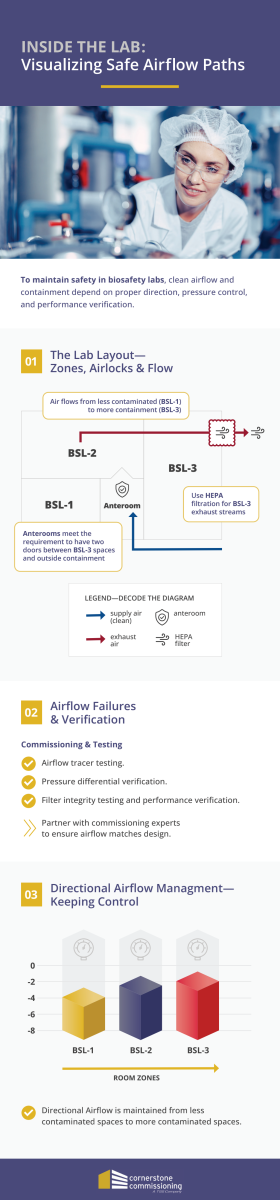
Routine airflow testing, such as smoke visualization or air velocity measurement, helps verify that systems are functioning as intended. These tests can detect subtle changes in airflow direction or velocity, allowing for prompt corrections before safety is impacted. Staff training on airflow principles can reinforce the importance of maintaining unobstructed paths and respecting the function of safety equipment.
Integrating Airflow into Broader Safety Management
Safe airflow paths should be part of an overall laboratory safety plan that includes structural design, equipment maintenance, and compliance monitoring. Organizations seeking to update or construct new laboratory spaces often benefit from professional input during the design stage. For example, companies that offer building commissioning services can evaluate ventilation systems to ensure they meet performance and safety standards from the start. This proactive approach reduces the likelihood of costly modifications later.