Estimated Reading Time: 7 minutes
TL;DR: Meaningful participation is the technique of giving employees real decision-making power inside your safety program. When workers help build the JHAs, choose the controls, and shape the investigations, they own the outcome. This guide walks through the framework, the Covert Collaboration method for guiding decisions without dictating them, and how to apply it to JHAs, SOPs, safety committees, and incident investigations.
People support what they help create. That is the entire reason meaningful participation in safety programs works for building real buy-in. When employees co-design the procedure, they treat it as theirs.
When they only get handed a finished SOP, they treat it as one more thing the safety manager dumped on them.
Here is the part nobody is talking about. Most safety programs fail at the participation step, not the technical step.
The hazards are identified. The controls are written. The training rolls out.
Then nothing changes on the floor because the people doing the work never had a hand in the decisions. OSHA’s Recommended Practices for Safety and Health Programs puts Worker Participation as one of seven core elements for a reason.
The federal guidance is telling you what the data already shows… ownership beats compliance every time.
Key Takeaways
- Meaningful participation means employees have real decision-making power, not just a seat in the meeting
- Covert Collaboration is the technique of guiding employees to a sound decision without dictating it
- The Safety Management Cycle gives you five natural entry points for participation (Identify, Develop, Implement & Train, Coach & Observe, Analyze)
- JHA development is the highest-leverage place to start – operators know the failure modes you do not
- A no-blame investigation process is the unlock for honest near-miss reporting
- NIOSH Total Worker Health calls for worker engagement throughout program design and implementation
What Meaningful Participation Actually Means
Meaningful participation is the practice of giving frontline employees a real voice in the decisions that shape their safety. Not a token spot on the committee. Not a survey nobody reads.
Real authority over a piece of the program. The line you are looking for is whether the employee’s input actually changes the outcome.
Here is how I think about it. Token participation is when you ask for feedback and then do what you were already going to do.
Meaningful participation is when the operator on Line 3 tells you the guard is in the wrong place, you move it, and the next person you train says “this came from your coworker.” That second example builds buy-in. The first one trains people to stop talking.
OSHA’s guidance explicitly calls for assigning workers the task of choosing, implementing, and evaluating hazard controls, not just following them. That is the bar.
If the workers on the floor are not picking the controls, you do not have a participation program. You have a suggestion box.
This connects directly to the Strategic Engagement pillar of the Safety Influencer System. Strategic Engagement is the discipline of building involvement into every safety process so the culture forms from the inside out.
Participation is the mechanism. The shift in beliefs is the result. You can see the same pattern at work in the benefits of employee involvement across every program element.
Covert Collaboration: Guiding Without Dictating
Covert Collaboration is the technique of structuring the conversation so employees arrive at the right answer through their own reasoning. You are not hiding information. You are not manipulating.
You are setting up the question so the answer becomes obvious to the people closest to the work.
The mechanics are simple. Bring the problem. Lay out the constraints (regulatory, operational, budget). Then ask the question.
“Given that we have to guard this point of operation and we cannot stop production for more than 15 minutes per shift, what is the cleanest way to handle this?” When you frame it that way, the team usually lands on the same solution you would have picked. The difference is they picked it.
This works because of a basic psychological truth. People defend their own ideas harder than they defend yours.
When the floor team designs the lockout procedure, they will hold each other accountable to it. When you write it alone and hand it down, they will look for ways around it.
Collaboration through experience is what changes beliefs over time.
| Approach | What It Looks Like | What You Get |
|---|---|---|
| Top-down directive | Safety writes the SOP, hands it to supervisors, expects compliance | Resistance, workarounds, eye-rolls |
| Token participation | Safety drafts the SOP, asks for “feedback” in a meeting, publishes it unchanged | Silence in future meetings |
| Covert Collaboration | Safety frames the problem and constraints, employees co-design the solution | Ownership, peer accountability, real adoption |
How to Build Participation Into the Safety Management Cycle
The Safety Management Cycle (Identify, Develop, Implement & Train, Coach & Observe, Analyze) gives you five natural entry points for meaningful participation. Each stage is a chance to hand a piece of the program to the people doing the work.
Identify. Run participatory hazard hunts where operators, maintenance, and supervisors walk the area together and document what they see.
Peer-reviewed research on participatory ergonomics consistently shows that involving workers in hazard identification produces better data and stronger implementation than safety-led inspections alone.
THE ALL-ACCESS PASS RESOURCE PAGE
Get all the FREE templates, safety management resources, PDFs, spreadsheets, and more...
Develop. Co-write the JHAs. The operators know the failure modes. The maintenance team knows the access issues.
The supervisor knows the production constraints. You are the facilitator who pulls those perspectives into a document that actually reflects the work.
Implement & Train. Have the people who built the JHA deliver part of the training. Nothing builds credibility for a new procedure like hearing a coworker explain why it changed.
Coach & Observe. Train operators to do peer-to-peer safety observations using a positive coaching framework. Bring the observation data back to the team to inform program adjustments.
Analyze. Bring frontline employees into the data review. If the recordable rate trended up last quarter, the people on the floor have a theory. Ask them.
This is the same pattern that makes boosting employee engagement in safety compound year over year instead of fading after the kickoff meeting.
Meaningful Participation in JHA Development
JHA development is the single highest-leverage place to start a meaningful participation practice. Every other safety tool flows from the JHA.
The training materials, the observation forms, the coaching topics, the SOP language. If the JHA is built without the people who do the work, every downstream tool inherits that gap.
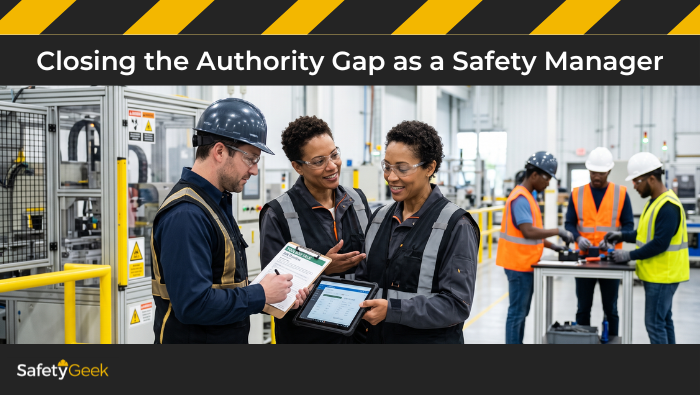
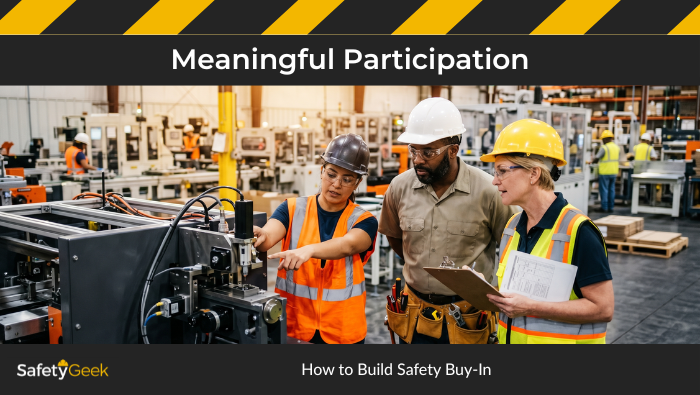
Here is what a participatory JHA workshop looks like in practice. Pull the operator who runs the task most often, the maintenance tech who services the equipment, and the supervisor who oversees the area.
Block 45 minutes. Walk through the task step by step on the floor, not in a conference room. The operator narrates what they actually do.
The supervisor flags what they think happens. The gap between those two stories is where the hazards live.
For each task step, the team identifies the hazards together. Then they discuss controls.
You are there to make sure the hierarchy of controls is honored and the regulatory baseline is met. The team picks the option that works.
Then someone from the group documents it in plain language the next operator will actually read.
Pilot test the new procedure with the same team. Revise based on what they find.
Then roll it out facility-wide. That single workshop has now given you a JHA that reflects reality, a group of internal champions who will defend the procedure to peers, and a model you can run on every other task.
Building Participation Into Investigations
A no-blame investigation process is the unlock for honest reporting. If your employees believe that reporting a near miss leads to discipline, they will stop reporting.
If they believe reporting leads to a system change, they will report more.
The core principle is to ask “what” instead of “who.” What was the task? What were the conditions?
What did the procedure say to do? What actually happened? What system or design factor made the unsafe path easier than the safe path?
The goal is to find the system failure that allowed the event, not the person to blame for it.
Bring the affected employee and their peers into the investigation as partners. They are not the subjects of an interrogation.
They are the experts on what actually happens during that task. Their input drives the corrective actions.
When the corrective action gets implemented, name the source publicly. “This guard change came from the operators who reported the near miss.”
That feedback loop is what builds a reporting culture. It is also one of the fastest ways to start building a safety culture that does not depend on you being in the room.
OSHA’s recommended practices call for a simple, non-retaliatory reporting system with an anonymous option. NIOSH Total Worker Health takes it further and frames worker engagement as foundational to program design itself.
Both point to the same conclusion. Psychological safety is the prerequisite for honest data, and honest data is the prerequisite for real prevention.
According to BLS nonfatal injury data, private industry employers reported 2.5 million nonfatal injuries and illnesses in 2024. The cases trending toward zero are the ones at facilities where reporting is honest and corrective actions follow through.
Frequently Asked Questions About Meaningful Participation in Safety
What is the difference between employee engagement and meaningful participation?
Employee engagement is the emotional state. Meaningful participation is the structural practice.
Engagement asks “do they care?” Participation asks “do they have a real role?” You build engagement by building participation. Without the structure, the engagement does not last past the next bad shift.
How do I get meaningful participation when supervisors resist it?
Start with the supervisors who are open and run a pilot. Document the results (time saved, problems caught, employee feedback).
Bring that data to the resistant supervisors with a specific ask, not a general one. Most supervisor resistance is about losing control. When they see participation produce better outcomes than top-down enforcement, the resistance fades.
Do I need management approval to start a meaningful participation practice?
Not for the smaller mechanics. Co-writing JHAs, running participatory hazard hunts, and shifting investigations to a learning model are all changes you can make inside your existing authority.
You will want executive buy-in before you formalize peer observation programs or restructure your safety committee charter. Start with what you can change today.
How does this fit with OSHA compliance?
OSHA’s Recommended Practices for Safety and Health Programs treats Worker Participation as one of seven core elements. The federal guidance explicitly directs you to involve workers in selecting controls, designing the reporting system, and evaluating program effectiveness.
Meaningful participation is not a soft addition to compliance. It is the compliance baseline.
What if employees do not want to participate?
Lack of participation is almost always a system signal, not a people signal. Ask what makes it hard for people to engage.
Common answers include meetings during their break time, no follow-through on past suggestions, and fear of being labeled the complainer. Fix those friction points before you blame disengagement on the workforce.
Now It’s Your Turn
Meaningful participation is how you move from running the safety program to influencing the safety culture. The Safety Influencer System teaches this as one of three pillars because nothing else compounds the way participation does.
Every JHA you co-write becomes the seed of a hundred conversations between coworkers that you will never hear.
Start here this week:
- Pick one upcoming JHA review or SOP update
- Invite an operator, a maintenance tech, and the supervisor for a 45-minute working session
- Frame the question with the constraints up front and let the team design the solution
- Document who contributed what
- Name the contributors when you roll the change out
If you want the full framework for building participation into every stage of your safety program, this is exactly what we teach inside the Safety Leadership Academy. The Academy walks you through the Safety Management Cycle and the Safety Influencer System step by step, with the templates, scripts, and community to help you implement them in your facility.
You can start by grabbing the Safety Management Influencer System Practical Guide and seeing how the pieces fit together.
You got this, Safety Friend.
Hi, I'm Brye (rhymes with sky)! I am a self-proclaimed safety geek with two decades of general industry safety experience. Specializing in bringing safety programs to a world-class level and building a safety culture, I have trained and coached many safety managers, just like you, on how to effectively manage workplace safety in the real world. I would love to help you too.