Estimated Reading Time: 8 minutes
TL;DR: Production pressure versus safety in manufacturing isn’t a real choice. The two only feel like opposites when you argue safety on moral grounds. The fix is strategy. Show leadership how unsafe shortcuts turn into normalized deviance, then make the business case with three numbers they already track: unplanned downtime and OEE, workers’ compensation and your EMR, and the liability cost of a severe injury. Frame every safety stop as protecting production, not blocking it.
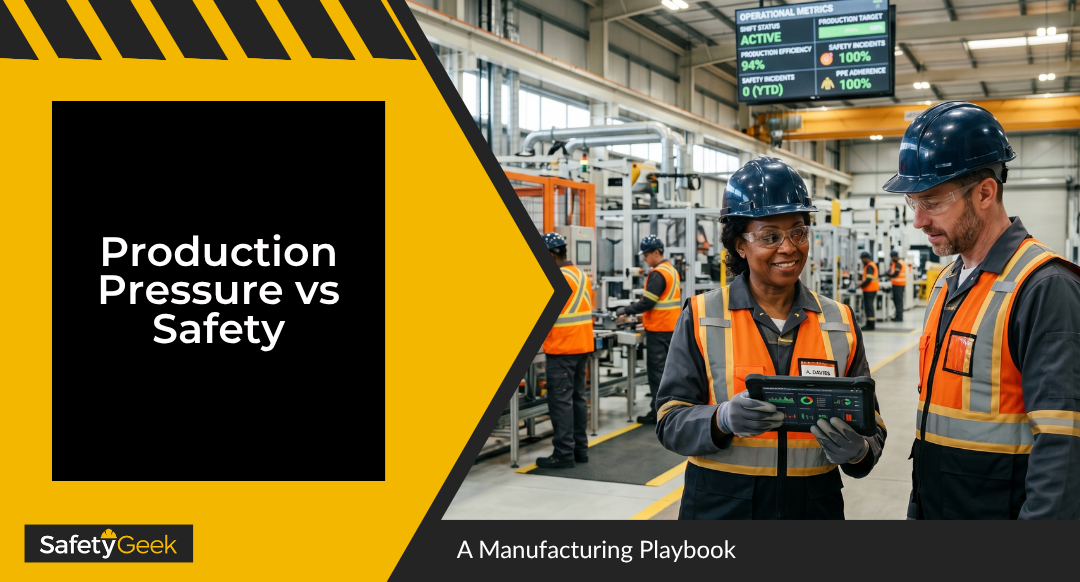
Here’s how to navigate production pressure versus safety priorities in manufacturing. Stop arguing that safety matters more than production, and start proving that safety protects it.
The plants that treat the two as a tug-of-war get more injuries, higher costs, and more downtime. The plants that weave them together run safer AND hit their numbers.
If you’re reading this, you already know the feeling. It’s go, go, go until something breaks, then stop, fix it, go again… and safety is the first thing that gets waved off when the line falls behind.
You care about getting people home safe. You’re also tired of being the one who slows everyone down.
So let me tell you what actually shifts this conversation. The moral argument doesn’t move executives, because they don’t believe the risk will land on them. You have to speak their language instead.
Key Takeaways
- Production and safety are not competing priorities. Treating them as a trade-off is exactly what drives injuries, downtime, and turnover.
- Production pressure erodes safety through normalized deviance. Small shortcuts that don’t cause harm right away become “how we do it” until someone gets hurt.
- Executives respond to three numbers, not moral appeals: unplanned downtime and OEE, workers’ compensation costs and your EMR, and the liability cost of a severe injury.
- One medically consulted injury averages about $43,000. An amputation claim averages around $120,000, which dwarfs the cost of pausing a line.
- Position every safety stop as protecting throughput, quality, and delivery, never as blocking them.
- Bring leadership the problem and two or three options, then let them decide. Safety influences, it doesn’t mandate.
Why Production and Safety Aren’t Actually Enemies
The idea that safety slows production is the most expensive myth in manufacturing. It feels true on the floor, where every guard, lockout, and inspection looks like friction against the schedule. The research says the opposite.
A safer workplace is a more productive one. When people feel safe and cared for, trust goes up, quality goes up, and turnover goes down.
When they sense leadership will trade their fingers for a delivery date, engagement drops, good operators leave, and the line gets slower and sloppier. The safe way IS the most efficient way, because it removes the variation, rework, and unplanned stops that wreck your output.
That’s the reframe you have to carry into every meeting. Safety and production are not two priorities competing for the same hour. They’re one outcome: getting the job done right, the first time, without anyone getting hurt.
The moment you let them be framed as opposites, someone has to lose. And on a busy Tuesday, safety always loses.
How Production Pressure Quietly Becomes Normalized Deviance
Normalized deviance is the slow process where a shortcut that doesn’t cause harm right away becomes accepted practice, until the unsafe way is simply how the job gets done. It almost never shows up as one big, obvious violation. It creeps in one “just this once” at a time.
Production pressure is the fuel. The Canada Energy Regulator’s safety culture research describes it as an imbalance, where leadership values output so heavily that schedules and budgets quietly outrank working safely.
You see it in the small stuff first. Someone reaches past a guard to clear a jam because locking out takes too long. The interlock gets bypassed to catch up after a changeover, and a near miss goes unreported because no one wants to stop the line.
Here’s the part that catches good teams off guard. None of these people are reckless.
According to research summarized in Safety+Health magazine on normalization of deviance, these shortcuts come from well-meaning workers trying to reconcile conflicting demands and clunky procedures. When nothing bad happens, the brain logs it as safe, and the new normal drifts a little further from the standard. Then one day the machine doesn’t forgive the shortcut.
This is why your observations and your near-miss data matter more than your injury count. If multiple people keep bypassing the same control, that’s not a discipline problem, it’s a systems problem.
The right question is never “what allows them to skip this,” it’s “what makes the safe way so hard to follow?” Strong near-miss reporting and honest safety observations are how you catch the drift before it costs someone.
THE ALL-ACCESS PASS RESOURCE PAGE
Get all the FREE templates, safety management resources, PDFs, spreadsheets, and more...
The 3 Arguments That Change the Executive Conversation
When you stop appealing to conscience and start translating risk into dollars, the room changes. Executives don’t dismiss safety because they’re heartless.
They dismiss it because they genuinely don’t think the incident will happen on their watch. So you take the guesswork off the table with three arguments they already understand.
| Executive Argument | The Number That Lands | What It Protects |
|---|---|---|
| Unplanned downtime & OEE | Preventable downtime costs many plants over $250,000 a year | Throughput and on-time delivery |
| Workers’ comp & EMR | The average claim runs about $47,000, and a higher EMR raises premiums for years | Operating budget and insurance cost |
| Severe injury liability | One amputation claim averages roughly $120,000, before investigation and OSHA scrutiny | Capacity, reputation, and legal exposure |
Argument 1: Unplanned Downtime and OEE
Speak in OEE and you’re speaking the plant manager’s native tongue. Every injury and near miss eats Availability through unplanned stops, drags Performance when operators slow the line to cope with a hazard, and dents Quality when stressed people make mistakes.
A machine that needs constant manual workarounds is both an injury waiting to happen and a steady leak in your numbers. Fix the safety problem and you usually fix the downtime problem at the same time.
Argument 2: Workers’ Compensation and Your EMR
Your Experience Modification Rate works like a credit score for safety. An EMR of 1.0 is average, lower earns you cheaper premiums, and higher punishes you for years.
A bad run of claims under production pressure doesn’t just cost you one settlement. It locks the company into elevated workers’ comp premiums that drain capital you could have spent on automation or staffing.
This is the language to use when you make the business case to executives, and it lands harder than any poster ever will.
Argument 3: The Liability Cost of a Severe Injury
This is where the National Safety Council’s injury cost data does the heavy lifting. A single medically consulted injury averages about $43,000, and a work-related death averages over $1.4 million.
By nature of injury, amputations are the costliest workers’ comp claims at roughly $120,000 each. OSHA logged more than 9,000 severe injury reports in a single year, about 25 a day, and many trace back to guards bypassed or lockout skipped under schedule pressure.
Put that next to the cost of a thirty-minute safety stop and the math makes your argument for you. Build the habit of leading with data instead of emotion, and watch how fast the pushback fades.
How to Position a Safety Stop as Protecting Production
The fastest way to lose this fight is to frame a safety stop as safety winning and production losing. The fastest way to win it is to frame the stop as protecting the very thing they care about.
A guard that’s missing isn’t a safety issue, it’s a delivery risk. A bypassed lockout isn’t a rule violation, it’s a potential three-month operational disruption with regulators in the building.
This is what a real stop-work culture does. It gives anyone permission to pause when something feels wrong, assess the hazard, and resume once it’s controlled.
The trick is to track the wins. Document the near misses you caught, the hazards you corrected, and the downtime you avoided, so leaders see stop-work as a disciplined control that protects output. And never let anyone get punished for using it, or you’ll never hear about the next one.
Your role here is the guide on the side, not the cop. You’re the coach of the coaches.
Bring leadership the problem, lay out two or three options, and let them choose. Leaders speak last, and they own the decision. That’s not weakness, it’s how influence works when you don’t have hire-and-fire authority.
This is the same shift I teach around being an influencer, not a decision maker, and it’s where the production-versus-safety compromise gets solved for good. Run it through the Safety Management Cycle… Identify the hazard, Develop the control, Implement and Train, Coach and Observe, then Analyze the result… and you build a system that holds the line even when the schedule is screaming.
Frequently Asked Questions About Production Pressure and Safety
What is production pressure in workplace safety?
Production pressure is an imbalance where leadership values output, schedules, and budgets so heavily that working safely quietly takes a back seat. It shows up as time and staffing crunches, rewards tied only to production numbers, and a slow loosening of standards whenever work falls behind. Left unchecked, it erodes your safety margins.
How does production pressure cause accidents?
Production pressure pushes people toward shortcuts that don’t cause harm right away, so the brain files them as safe. Over time those shortcuts become normalized deviance, the accepted way the job gets done. The standard drifts further from safe until a machine, a height, or a chemical stops forgiving the workaround.
What do you say when a manager wants to skip a safety step to hit a deadline?
Reframe the step as protecting the deadline, not threatening it. Show the cost of the likely incident: lost days, an OSHA visit, weeks of disruption, and a workers’ comp claim that can top $100,000. Then offer two or three options that keep both people and the schedule protected, and let leadership choose.
Does slowing down for safety actually hurt productivity?
No. Safer workplaces are consistently more productive, because controls reduce the variation, rework, and unplanned downtime that quietly drain output. A thirty-minute safety stop costs far less than an amputation that pulls an experienced operator off the line for months.
How do I get executives to take safety seriously?
Stop using the moral argument and start using their metrics. Translate risk into downtime and OEE, workers’ comp and EMR, and the liability cost of a severe injury. Bring data instead of emotion, and present the problem with options instead of demands so safety sits in the same conversation as throughput and cost.
Now It’s Your Turn
Production pressure versus safety in manufacturing was never a real choice. The plants that thrive don’t pick one… they prove that protecting people is how you protect production, and they make the case in numbers leadership can’t wave off.
Here’s where to start this week:
- Pick one shortcut your team has normalized and trace why the safe way is hard to follow.
- Pull your last twelve months of injury and downtime data and put a real dollar figure on it.
- Build just one of the three arguments… downtime, workers’ comp, or liability… for your next leadership meeting.
- Reframe your next safety stop out loud as protecting a delivery date.
If you want the full system for layering this kind of influence into the work you’re already doing, grab my free guide, The Safety Management Influencer System: A Practical Guide. It walks you through turning every hazard you identify and every observation you run into proof of your value. It’s the same foundation we build on inside the Safety Leadership Academy.
You’ve got this. I’ve got you, Safety Friend.
Hi, I'm Brye (rhymes with sky)! I am a self-proclaimed safety geek with two decades of general industry safety experience. Specializing in bringing safety programs to a world-class level and building a safety culture, I have trained and coached many safety managers, just like you, on how to effectively manage workplace safety in the real world. I would love to help you too.