Estimated Reading Time: 8 minutes
TL;DR: Qualitative fit testing (QLFT) is a pass/fail check based on whether the wearer tastes or smells a test agent. Quantitative fit testing (QNFT) uses a machine to measure leakage and give you a numeric fit factor. OSHA lets you use QLFT for half-mask respirators, but it requires QNFT for full-facepiece respirators that need a fit factor above 100. Here’s how to pick the right one for your program.
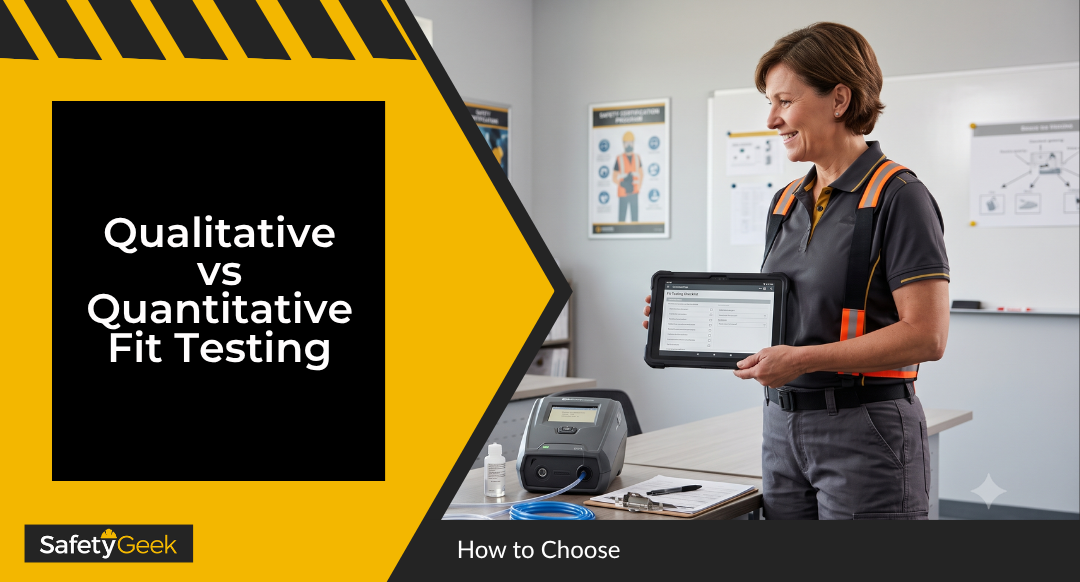
The difference between qualitative and quantitative fit testing methods comes down to one thing: pass/fail versus a number. Qualitative fit testing (QLFT) relies on the wearer’s senses. Quantitative fit testing (QNFT) relies on a machine that measures how much air leaks into the mask.
And if you’re the one who got handed the respiratory protection program with zero training, this is exactly the kind of thing that keeps you up at night. You don’t want to pick the wrong method and find out during an OSHA inspection. So let’s clear it up, once and for all.
Key Takeaways
- QLFT is a pass/fail test that depends on whether the wearer can taste, smell, or feel a test agent leaking into the mask.
- QNFT is a measured test that uses an instrument to calculate a numeric fit factor for the seal.
- OSHA decides which one you can use based on the respirator’s assigned protection factor, not your preference.
- Half-mask respirators can use either method, but full-facepiece respirators that need a fit factor of 500 require QNFT.
- Both methods are required before first use, at least once a year, and any time the fit could change.
- The device is never “OSHA-approved” by itself. OSHA approves the protocol, not the machine.
What’s the Difference Between Qualitative and Quantitative Fit Testing?
A fit test confirms that a tight-fitting respirator forms a proper seal on a specific person’s face. Qualitative and quantitative fit testing are the two ways OSHA lets you confirm that seal. The methods sound similar, but they measure the fit in completely different ways.
Qualitative fit testing is subjective. The wearer puts on a hood, and you release a test agent like a bitter or sweet mist. If they can taste or smell it, the mask fails.
If they can’t detect it through a set of standard exercises, the mask passes. There’s no number, just a yes or a no.
Quantitative fit testing is objective. An instrument samples the air inside and outside the mask while the wearer moves through the same exercises. It counts the particles leaking past the seal and calculates a fit factor.
A higher fit factor means a tighter seal, and OSHA sets the minimum number you have to hit.
| Factor | Qualitative (QLFT) | Quantitative (QNFT) |
|---|---|---|
| Result | Pass or fail | Numeric fit factor |
| Based on | Wearer’s taste, smell, or irritation | Machine measurement of leakage |
| Equipment | Hood and test solution | Calibrated instrument |
| Respirators allowed | Half-mask, APF 10 or lower | Any tight-fitting, including full-facepiece |
| Pass threshold | Detect or don’t detect the agent | Fit factor of 100 (half-mask) or 500 (full-facepiece) |
| Cost | Lower | Higher |
| Speed | Faster | Slower |
When OSHA Requires Quantitative Fit Testing
OSHA requires quantitative fit testing whenever a respirator needs a fit factor above 100. That single rule decides the whole thing. The respirator’s assigned protection factor (APF) sets the required fit factor, and the required fit factor tells you which method is legal.
Here’s how the math works in OSHA’s respiratory protection standard. The required fit factor is ten times the APF. A half-mask respirator has an APF of 10, so it needs a fit factor of 100.
A full-facepiece negative-pressure respirator has an APF of 50, so it needs a fit factor of 500.
Qualitative methods top out at a fit factor of 100. That’s the ceiling. So you can use QLFT for half-mask respirators, because 100 is exactly what they need.
But a full-facepiece respirator needs 500, and a pass/fail test can’t prove a seal that tight. That’s why full-facepiece respirators that operate in negative-pressure mode require QNFT.
The exercises, agents, and thresholds are all spelled out in Appendix A of the standard. When you build your written respiratory protection plan, this APF-to-method link is the part you cannot get wrong.
The Four QLFT Protocols and How Each One Works
OSHA accepts four qualitative fit test protocols. Each one works by giving the wearer something to detect. If the seal leaks, their senses catch it, and the test fails.
Isoamyl acetate is the banana-smell test. The wearer detects a banana-like odor, so it only works with respirators using organic vapor cartridges.
Saccharin is the sweet-taste test, and it works with particulate filters. Bitrex is the bitter-taste version, also used with particulate filters. Irritant smoke triggers an involuntary cough reflex, so it’s used more narrowly and with tighter controls.
The mechanics are the same across all four. The wearer dons the respirator, puts a hood over their head, and you introduce the agent. They run through standard exercises like normal breathing, deep breathing, turning the head, and talking.
If they never detect the agent, the respirator passes for that person.
These tests are cheaper and faster, which is why so many programs lean on them. But they only work when the wearer can actually detect the agent. That’s why a sensitivity check comes first, before the mask ever goes on.
THE ALL-ACCESS PASS RESOURCE PAGE
Get all the FREE templates, safety management resources, PDFs, spreadsheets, and more...
The Three QNFT Methods and How Each One Works
OSHA accepts three quantitative fit test methods. All three produce a fit factor, but they measure leakage in different ways. The result is a number you can record, trend, and defend.
The ambient aerosol method, often run on a PortaCount, counts the tiny particles already floating in the room. It compares the particle count inside the mask to the count outside and turns that ratio into a fit factor.
The generated aerosol method does the same comparison, but it uses a test chamber filled with a non-hazardous aerosol like corn oil or salt. The controlled negative pressure method seals off airflow for a moment and measures how much air leaks in under a controlled vacuum.
What makes quantitative testing powerful is the data. You’re not guessing whether the seal held. You get a measured fit factor for every person and every mask, which fits right into a data-driven safety program where the number does the talking.
One warning that trips up a lot of safety managers: the machine is not “OSHA-approved.” OSHA approves the protocol, not the device. So don’t assume buying a PortaCount makes you compliant.
You still have to run the accepted method, hit the required fit factor, and document it correctly. NIOSH’s respirator guidance makes the same point: a certified respirator only protects the worker when it actually seals to the face.
How to Choose the Right Method for Your Program
Start with the respirator, not the test. The respirator’s APF tells you the required fit factor, and the required fit factor tells you whether QLFT is even an option.
If every respirator in your program is a half-mask at APF 10, qualitative testing is on the table. The moment you add full-facepiece respirators, you need quantitative.
After that, weigh the trade-offs. Qualitative is cheaper, faster, and needs almost no equipment, which is why small programs start there. Quantitative costs more and takes longer, but it gives you a number, removes the subjectivity, and covers every respirator you might add later.
Plenty of mature programs buy a quantitative unit just so they never have to think about the APF ceiling again.
Then protect yourself with records. Whatever method you choose, OSHA expects you to capture the employee name, the respirator make, model, style, and size, the test date, the method used, and the result. Missing one of those fields is one of the most common respiratory protection program violations on the books.
And don’t forget the calendar. Fit testing isn’t a one-time event. Every employee gets retested before first use, at least once a year, and any time their face changes from weight loss, dental work, surgery, or a scar.
This is exactly the kind of recurring task the Safety Management Cycle is built to keep from slipping through the cracks.
Frequently Asked Questions About Fit Testing
Can I use qualitative fit testing for a full-facepiece respirator?
No. A full-facepiece negative-pressure respirator has an assigned protection factor of 50, so it requires a fit factor of 500. Qualitative methods only prove a fit factor of 100, so they can’t validate that tighter seal and you must use a quantitative method instead.
How often does OSHA require fit testing?
OSHA requires a fit test before an employee first uses a tight-fitting respirator, then at least once every 12 months after that. You also have to retest any time the fit could change. That includes a different respirator model or size, weight changes, dental work, facial surgery, or new scarring near the seal.
What is a fit factor?
A fit factor is the number a quantitative fit test calculates to show how well a respirator seals. It compares the particle concentration outside the mask to the concentration inside, so a higher number means less leakage. OSHA requires at least 100 for half-mask respirators and 500 for full-facepiece respirators.
Is the PortaCount OSHA-approved?
Not exactly. OSHA approves fit testing protocols, not specific devices, so the accepted ambient aerosol method simply runs on a PortaCount. Owning the machine doesn’t make you compliant on its own; you still have to run the method correctly, meet the required fit factor, and keep proper records.
Which method is better, QLFT or QNFT?
Neither is universally better. Qualitative is cheaper and faster, and it’s perfectly valid for half-mask respirators, while quantitative is more objective and required for full-facepiece respirators. The right choice depends on the respirators in your program and how much data you want to defend your seals.
Now It’s Your Turn
Choosing between qualitative and quantitative fit testing isn’t really a guessing game. The respirator’s protection factor makes the call for you, and your job is to match the method to the mask and document it.
Here’s what you can do this week:
- List every tight-fitting respirator in your program and note its assigned protection factor.
- Match each one to the right method. APF 10 half-masks can use QLFT. Anything needing a fit factor of 500 needs QNFT.
- Pull a few fit test records and confirm they capture the model, method, result, and date.
- Put next year’s retest on the calendar now, before it slips.
Fit testing is one piece of a much bigger system. The respirator program, the medical evaluations, the training, the recordkeeping, and the fit testing procedures all have to work together, or the whole thing turns into a pile of paperwork that collects dust.
That’s the part nobody teaches you in a regulation. If you want the full system for building a safety program that actually runs without you holding it together, watch my free training. It walks you through the exact framework I use to help safety professionals go from buried in compliance to leading the room.
You got this.
Hi, I'm Brye (rhymes with sky)! I am a self-proclaimed safety geek with two decades of general industry safety experience. Specializing in bringing safety programs to a world-class level and building a safety culture, I have trained and coached many safety managers, just like you, on how to effectively manage workplace safety in the real world. I would love to help you too.