Estimated Reading Time: 8 minutes
On a multi-employer worksite, HazCom training gets split between companies, but every employer with exposed workers still has to train its own people. The host or controlling employer covers site-specific chemical hazards, labeling, and SDS access. The staffing agency covers general awareness. And under OSHA’s multi-employer citation policy, both can be cited when the training breaks down.
HazCom training on multi-employer worksites is a shared job, not one company’s problem. Every employer whose people are exposed to hazardous chemicals has to train those workers under OSHA’s Hazard Communication Standard. The host employer usually owns the site-specific training, and the staffing agency owns the general awareness piece.
Here’s the part that keeps you up at night… you can run a spotless program and still get cited for someone else’s crew. When you’re the safety lead juggling subs, temps, and a general contractor who assumed “the other guy” handled it, the lines blur fast. And OSHA doesn’t care whose fault it feels like.
Key Takeaways
- Every employer with chemically exposed workers must train them. You can’t sign that duty away in a contract.
- The host or controlling employer owns site-specific HazCom training. The staffing agency owns general chemical-safety awareness.
- OSHA’s multi-employer citation policy lets OSHA cite more than one company for the same training gap.
- If you rely on another employer’s written program, your own plan has to say so in writing. Silent reliance is still a violation.
- HazCom ranked #2 on OSHA’s most-cited list in 2024 and 2025 with over 2,500 citations a year.
- Coordination agreements and shared SDS access are what actually keep temp and sub crews safe.
What OSHA Actually Requires on a Shared Worksite
A multi-employer worksite is any job where workers from two or more companies share the same space and can be exposed to the same hazards. Think a plant with contractors on site, or a construction project with a general contractor and a dozen subs.
Under OSHA’s Hazard Communication Standard, 1910.1200(e)(2), an employer who produces, uses, or stores hazardous chemicals in a way that could expose another company’s employees has three written duties.
You have to give the other employers access to the safety data sheets for those chemicals. You have to tell them the precautions their people need during normal work and foreseeable emergencies. And you have to explain the labeling system you use on site.
That’s the coordination layer. On top of it sits the training duty in 1910.1200(h)… and this one never transfers.
Every employer with exposed workers has to train those workers at their initial assignment and whenever a new chemical hazard shows up. The training has to cover how to detect a chemical’s presence, the physical and health hazards, and how people protect themselves.
There’s one shortcut, and it comes with a catch. You can rely on another employer’s HazCom program, but only if your own written plan spells out that reliance. If your plan is silent, OSHA treats you as if you have no program at all.
We break the written-program piece down in our guide on how to implement a HazCom plan.
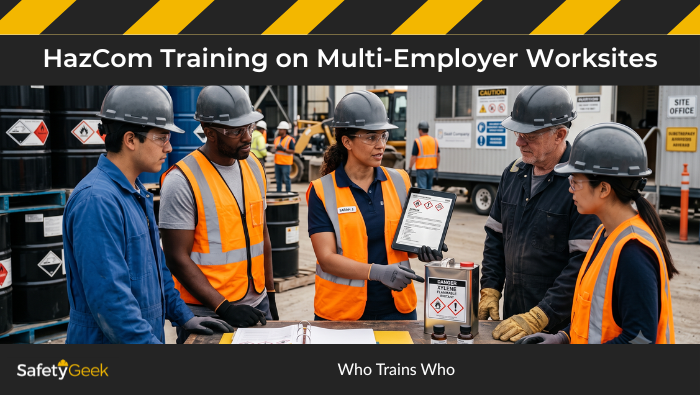
Who Trains Who: Host Employer vs. Staffing Agency
The cleanest way to think about temporary and contract workers is a split of duties. OSHA and NIOSH call the staffing agency and the host employer “joint employers,” and both share responsibility for a safe workplace.
The general rule is straightforward. The staffing agency handles general safety and hazard-awareness training before the worker ever shows up. The host employer handles the training that’s specific to your site… your chemicals, your labels, your SDS locations, your PPE.
| Training Element | Staffing Agency | Host / Controlling Employer |
|---|---|---|
| General HazCom awareness (pictograms, SDS basics, right to understand) | Owns it | Confirms it happened |
| Site-specific chemical hazards | Not equipped for it | Owns it |
| Your labeling system and secondary containers | Not equipped for it | Owns it |
| Where to find SDSs on site | Not equipped for it | Owns it |
| Verifying workers understand, not just attended | Shares | Shares |
State guidance backs this up. Illinois WorkSafe’s temporary worker guidance puts it plainly: both companies share responsibility, but the host employer bears most of the burden, and site-specific HazCom training primarily lies with the host. The reasoning is common sense… you’re the only one who knows the solvents in your parts-washer or the caustics in your CIP system.
Here’s where safety leads get burned. They assume the agency’s “we do safety orientation” line means chemical-specific training is covered. It almost never is.
A generic 20-minute video on GHS pictograms is not training on the isocyanate your crew will spray on Tuesday. Treat every temp and sub worker like they know nothing about YOUR chemicals, because for compliance purposes, they don’t.
That’s not an insult to them. It’s an honest read of what site-specific training actually requires. For the deeper build, our walkthrough of OSHA HazCom employee training covers how to make it stick.
THE ALL-ACCESS PASS RESOURCE PAGE
Get all the FREE templates, safety management resources, PDFs, spreadsheets, and more...
How a Training Gap Lands You a Dual Citation
OSHA’s multi-employer citation policy (CPL 02-00-124) is why one training gap can generate two or three citations. On any multi-employer site, OSHA sorts each company into one or more roles.
- Creating employer – the company that made the hazard.
- Exposing employer – the company whose workers are exposed to it.
- Controlling employer – usually the GC or host, with general supervisory authority over the site.
- Correcting employer – the company responsible for fixing it.
Here’s how it plays out with chemicals. Say a staffing agency’s worker is exposed to a hazardous chemical they were never trained on.
The agency is the exposing employer… citable if it knew or should have known its people would face chemical hazards. The host is the controlling employer… citable for failing to make sure training and hazard information reached everyone on site.
An exposing employer isn’t off the hook just because it lacks authority to fix the underlying problem. OSHA still expects it to ask the controlling employer to correct the hazard, warn its own workers, and take other protective steps. Do nothing, and you’re citable anyway.
The numbers make this real. OSHA’s Hazard Communication Standard drew more than 2,500 citations in both 2024 and 2025, holding the #2 spot on the most-cited list behind fall protection.
Missing or inadequate training is one of the most common reasons. If you want the specific traps, we cover the most common HazCom violations in detail.
How to Coordinate HazCom Training So Nothing Slips
Coordinating HazCom training across employers isn’t about writing a thicker binder. It’s about building a few systems that run whether you’re watching or not. Here’s what actually works on a shared site.
1. Put reliance in writing. If subs will use your written HazCom program, your plan and theirs both need a line saying so. A handshake doesn’t satisfy 1910.1200(e).
2. Run a chemical handoff before work starts. Before any new crew touches the site, walk them through the chemicals they’ll encounter, the labels, and where the SDSs live. Digital SDS access counts only if there are no barriers… no locked office, no password nobody has.
3. Verify understanding, don’t just collect signatures. A sign-in sheet proves attendance, not comprehension. Ask a worker to find an SDS and read you the pictogram – that’s the “right to understand,” and it’s where inspectors are heading.
This is exactly the kind of work that training alone can’t carry. Training tells people what a chemical does. Coaching and observation are what make it stick… that’s the whole reason the Safety Management Cycle pairs “Implement and Train” with “Coach and Observe” instead of stopping at the classroom.
4. Build a contractor advisory committee. On sites with the same subs cycling through, pull their leads into a small committee that co-owns the chemical-safety standards. When contractors help set the rules, they enforce them on their own crews… and you stop being the only cop on the property.
This is the shift from managing safety to leading it, and it’s the heart of what we teach inside the Safety Leadership Academy. You’ll never out-police a jobsite full of other companies’ workers. But you can build systems and relationships that make the safe way the default.
Frequently Asked Questions About HazCom Training on Multi-Employer Worksites
Who is responsible for HazCom training on a multi-employer worksite?
Every employer with exposed workers is responsible for training its own people. In practice, the staffing agency or sub handles general awareness, and the host or controlling employer handles site-specific chemical hazards, labeling, and SDS access. Both can be cited if training falls short.
Can I rely on the general contractor’s HazCom program instead of my own?
Yes, but only if your own written program states that you’re relying on it. OSHA’s 1910.1200(e)(3) allows shared programs when the reliance is documented and the other program meets every requirement. Silent reliance leaves you fully citable, even if the GC’s plan is solid.
Does a staffing agency’s safety orientation count as HazCom training?
Usually not on its own. Agency orientation covers general awareness like reading pictograms and SDS basics. It rarely covers the specific chemicals, labels, and SDS locations at your site, so as the host employer you still owe workers that site-specific training before they’re exposed.
What is the multi-employer citation policy?
It’s OSHA directive CPL 02-00-124, which lets OSHA cite more than one employer for the same hazard. Each company is sorted as a creating, exposing, controlling, or correcting employer. For HazCom, both the host and the staffing agency can be cited for one training gap.
How do I prove HazCom training actually happened?
Document the date, the chemicals and hazards covered, who attended, and who trained them. Go one step further and record proof of understanding, like a short skills check where workers locate an SDS and explain a pictogram. Comprehension, not just a signature, is what defends you.
Now It’s Your Turn
Here’s the bottom line… on a multi-employer worksite, HazCom training is a shared duty you can’t contract away, and both the host and the staffing agency can be cited when it slips. Your job is to build the coordination systems that catch the gaps before OSHA does.
Start here this week:
- Pull your written HazCom program and confirm it names every employer you rely on, or every employer relying on you.
- Add a chemical handoff step to your onboarding for every temp, sub, and contractor before they start work.
- Run one comprehension check – ask a worker to find an SDS and read you a pictogram. If they can’t, your training isn’t done.
If you’re still fuzzy on the fundamentals, start with what OSHA HazCom requires and build from there. And if you’re tired of being the only person on site who seems to care about chemical safety, that’s exactly the problem we solve inside the Safety Leadership Academy.
Want to map out how to lead safety across a messy multi-employer site instead of policing it? When you book a Safety Leadership Roadmap Session, you’ll walk away with a clear plan for your specific situation. You got this, Safety Friend.
Hi, I'm Brye (rhymes with sky)! I am a self-proclaimed safety geek with two decades of general industry safety experience. Specializing in bringing safety programs to a world-class level and building a safety culture, I have trained and coached many safety managers, just like you, on how to effectively manage workplace safety in the real world. I would love to help you too.