Estimated Reading Time: 7 minutes
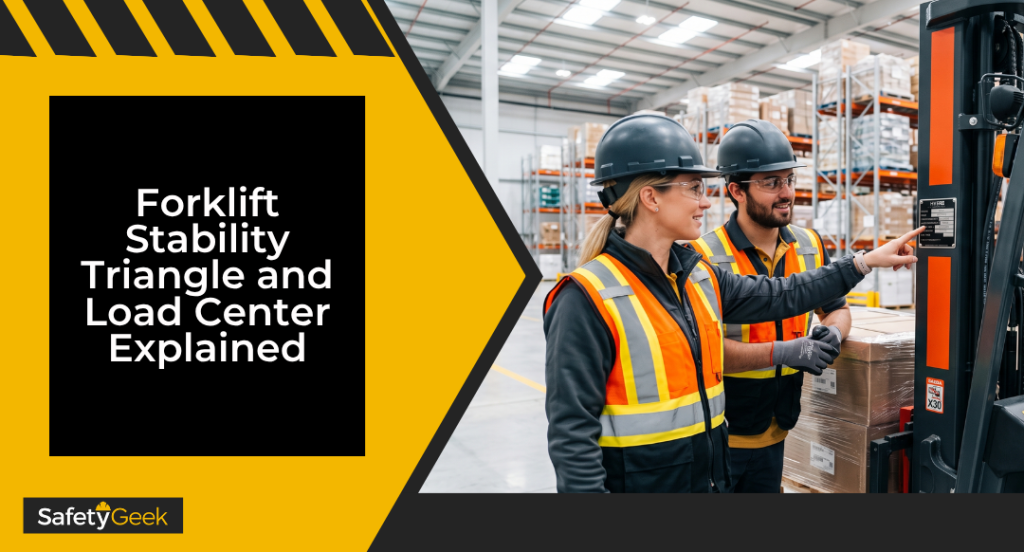
The forklift stability triangle is the imaginary triangle between a forklift’s two front wheels and the center of its rear axle. As long as the combined center of gravity of the truck and its load stays inside that triangle, the forklift stays upright. Load center is the distance from the fork face to the middle of the load, and it changes how much a truck can safely lift. Get both concepts right and you prevent the tip-overs that cause most forklift deaths.
The forklift stability triangle and load center calculation are the two physics concepts that decide whether a forklift stays upright or ends up on its side. The stability triangle is the imaginary triangle formed by a forklift’s two front wheels and the midpoint of its rear steer axle. As long as the combined center of gravity of the truck and its load stays inside that triangle, the forklift is stable.
Here’s the part they skip over in most forklift training. Operators get taught to drive, honk, and slow down at corners, but nobody teaches them why a loaded forklift tips… or how a load that’s under the rated weight can still put a truck on its side. That gap is exactly what gets people hurt.
Key Takeaways
- The stability triangle is formed by the two front wheels and the midpoint of the rear axle. A forklift tips when the combined center of gravity of the truck and load moves outside that triangle.
- A forklift is a counterbalance machine. The rear counterweight offsets the load, and the front axle acts as the fulcrum the whole truck pivots around.
- Load center is the distance from the face of the forks to the center of gravity of the load. Most forklifts are rated at a 24-inch load center.
- The data plate shows rated capacity ONLY under the exact conditions listed. Change the load center, add an attachment, or raise the load and the safe capacity drops.
- A quick field formula gives you the adjusted number: New capacity = Rated capacity x (24 / actual load center).
- Most tip-overs trace back to system and design gaps, not “careless” operators.
What Is the Forklift Stability Triangle?
The forklift stability triangle is the three-point base of support a sit-down counterbalance forklift balances on. Picture a line connecting the two front wheels, then two more lines running back to the single pivot point at the center of the rear steer axle. That triangle is the entire footprint keeping the truck upright, and OSHA’s stability guidance in Appendix A to 1910.178 explains the physics behind it.
A forklift is a counterbalance machine, not a crane. The heavy counterweight cast into the back of the truck balances the weight you put on the forks, and the front axle acts as the fulcrum… the point everything pivots around. When you add a load, tilt the mast, lift higher, turn, or drive across a slope, the combined center of gravity of the truck and load shifts.
As long as that combined center of gravity stays inside the stability triangle, the truck is stable. The moment it crosses outside the triangle, the forklift starts to tip. This is why an empty forklift can tip on a turn and a loaded one can tip going straight… it’s never just about the weight.
How Load Center Works and Why the Data Plate Matters
Load center is the horizontal distance from the front face of the forks to the center of gravity of the load. In plain terms, it’s how far out the weight of the load sits from the mast. Most forklifts are rated at a 24-inch load center, which lines up with a standard 48-inch pallet loaded evenly, so the middle of the load lands right at 24 inches.
That number matters because of leverage. The farther the load’s center of gravity sits from the fulcrum, the bigger the tipping force it creates, even if the total weight never changes. A 3,000-pound load at 24 inches behaves very differently than the same 3,000 pounds pushed out to 36 inches.
This is where the data plate (also called the capacity or nameplate) comes in. According to OSHA’s powered industrial truck guidance, the rated capacity on that plate is only valid under the exact conditions it lists… the rated load center, the mast height, and no attachments.
Add a carton clamp, a longer-than-standard load, or extra lift height and the real safe capacity is lower than the big number stamped on the plate. Reading that plate correctly is a core part of a solid OSHA forklift inspection checklist.
THE ALL-ACCESS PASS RESOURCE PAGE
Get all the FREE templates, safety management resources, PDFs, spreadsheets, and more...
How to Calculate Reduced Capacity When the Load Center Changes
When a load’s center of gravity sits beyond the rated 24 inches, you have to recalculate what the truck can safely handle. The field formula most trainers use for a forklift load center calculation is simple:
New capacity = Rated capacity x (24 / actual load center)
Say your truck is rated for 5,000 pounds at a 24-inch load center. You need to move a bulky load with a center of gravity out at 30 inches.
Run the math: 5,000 x (24 / 30) = 4,000 pounds. That truck should now be treated as a 4,000-pound machine for that load, not a 5,000-pound one.
Here’s how that plays out as the load center pushes farther from the mast:
| Rated capacity | Rated load center | Actual load center | Adjusted safe capacity |
|---|---|---|---|
| 5,000 lb | 24 in | 24 in | 5,000 lb |
| 5,000 lb | 24 in | 30 in | 4,000 lb |
| 5,000 lb | 24 in | 36 in | 3,333 lb |
| 5,000 lb | 24 in | 48 in | 2,500 lb |
One caution: this ratio is a training approximation. OSHA’s stability guidance notes that unusual loads, attachments, and nonstandard mast heights should be evaluated by the truck’s allowable load moment, not a quick ratio.
When you’re unsure, the manufacturer and the capacity plate win… never gut feeling. When the same “guess and go” habit shows up across a crew, that’s usually one of the common forklift safety violations waiting to become an incident.
What Actually Tips a Forklift Over and How to Prevent It
Tip-overs are the deadliest thing a forklift does, and the numbers back that up. NSC Injury Facts reports 67 forklift-related worker deaths in 2023 and 84 in 2024, plus more than 25,000 nonfatal forklift injuries across those two years. Those deaths sit inside the roughly 5,000 total workplace fatalities BLS counts each year, and lateral tip-overs are a leading way forklift operators die.
Most of the time, the combined center of gravity gets pushed outside the stability triangle by a handful of predictable things:
- Turning too fast or too sharply, especially with a raised load
- Traveling with the load high instead of low to the ground
- Driving or turning on ramps and slopes
- Overloading, or handling a load beyond the rated load center
- Uneven, soft, or damaged floor surfaces
Now here’s the part I care about most as a safety leader. When one operator tips a truck, it’s easy to call it a careless mistake.
But when it keeps happening across a crew, that’s a systems problem, not a people problem… the racking layout, the load sizes, the floor condition, or the training are making the safe way hard to do. The fix isn’t another write-up.
It’s designing the work so the physics stay in your favor and coaching operators on load center and the stability triangle, not just driving technique. That’s the whole point of running your program through the Safety Management Cycle instead of reacting one incident at a time, and it’s the mindset behind real powered industrial truck operator training.
Frequently Asked Questions About the Forklift Stability Triangle
What is the forklift stability triangle in simple terms?
It’s the three-point base a counterbalance forklift balances on, formed by the two front wheels and the center of the rear axle. As long as the combined weight of the truck and load stays centered inside that triangle, the forklift stays upright. Push it outside, and the truck tips.
What is a forklift’s load center?
Load center is the distance from the front face of the forks to the center of gravity of the load. Most forklifts are rated at a 24-inch load center, matching a standard 48-inch pallet loaded evenly. The farther the load sits from the mast, the more tipping force it creates.
How do you calculate forklift capacity at a different load center?
Use the formula: New capacity = Rated capacity x (24 / actual load center). For a 5,000-pound truck rated at 24 inches carrying a load at 30 inches, that’s 5,000 x (24 / 30) = 4,000 pounds. Treat it as a training estimate, and defer to the data plate and manufacturer.
Why does adding an attachment lower forklift capacity?
An attachment like a clamp or fork extension adds weight in front of the mast and pushes the load’s center of gravity farther out. Both effects shift the combined center of gravity forward and shrink your safe capacity. The data plate’s rated number no longer applies once an attachment is added.
What is the most common cause of forklift tip-overs?
Lateral tip-overs from turning too fast, turning with a raised load, or driving across a slope are among the most common and deadly. They happen when the combined center of gravity swings outside the stability triangle. Most trace back to system and design gaps, not one careless operator.
Now It’s Your Turn
The forklift stability triangle and load center calculation aren’t trivia for a written test. They’re the physics that keep an operator alive, and they belong in the way you train, coach, and design the work.
Here’s what you can do this week:
- Pull the data plate on every forklift in your building and confirm operators know how to read the rated capacity AND load center.
- Walk your busiest routes and look for the tip-over setups… tight fast turns, ramps, oversized loads, and rough floors.
- Add a five-minute load center calculation demo to your next toolbox talk using the formula above.
- When you see the same mistake more than once, fix the system… the layout, the load, the surface… before you fix the operator.
Teaching this well is exactly the kind of leadership that gets safety a real seat at the table, and it’s what we build inside the Safety Leadership Academy. If you want the full system for turning safety work into influence, watch the free training and see what’s been missing. You got this, Safety Friend.
Hi, I'm Brye (rhymes with sky)! I am a self-proclaimed safety geek with two decades of general industry safety experience. Specializing in bringing safety programs to a world-class level and building a safety culture, I have trained and coached many safety managers, just like you, on how to effectively manage workplace safety in the real world. I would love to help you too.