Estimated Reading Time: 11 minutes
TL;DR: The five-phase safety management cycle for manufacturing runs in a fixed order: Identify, Develop, Implement and Train, Coach and Observe, and Analyze. Each phase feeds the one after it, so a weak phase caps everything downstream. When a control stops working, you walk the cycle backward one phase at a time instead of chasing a brand new fix. That order is what turns scattered safety tasks into one system.
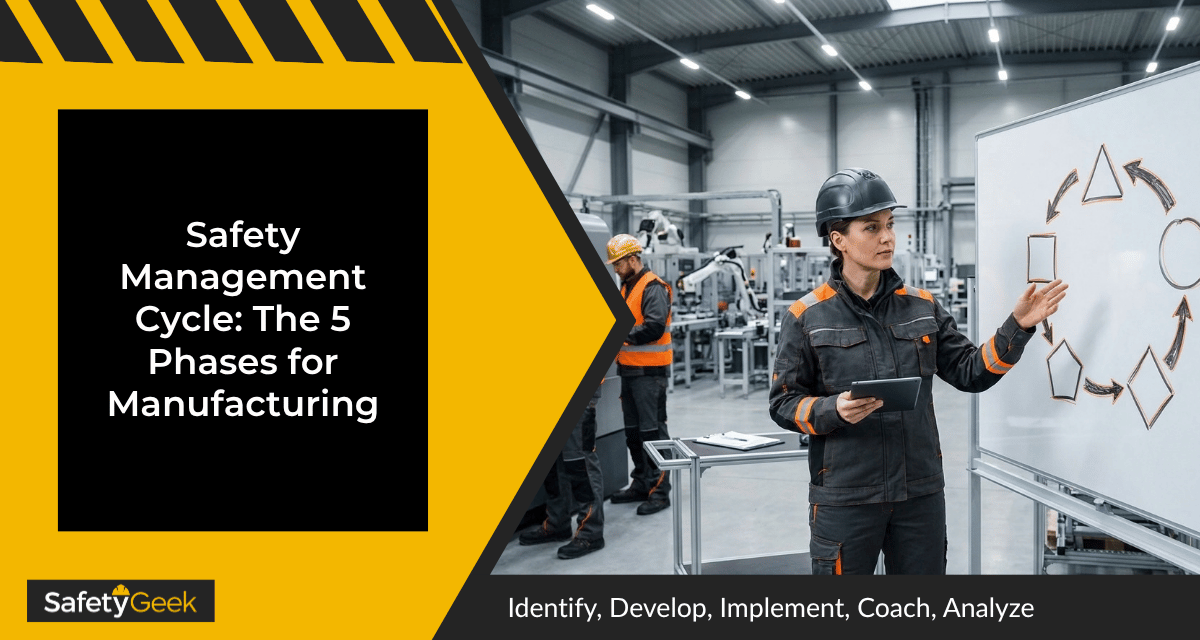
The five-phase safety management cycle for manufacturing moves every safety task through the same five stages, in the same order, every time. Identify, Develop, Implement and Train, Coach and Observe, Analyze. You never finish it, because it’s the loop your whole program runs on, for every hazard on your floor.
Does your week look like this? Organized chaos, putting out fires where needed, spinning too many plates, and never getting to the work that would stop the fires from starting.
That’s not a work ethic problem. That’s what happens when you’re doing a little bit of all five phases at once and finishing none of them.
Key Takeaways
- The safety management cycle has five phases in a fixed order: Identify, Develop, Implement and Train, Coach and Observe, Analyze.
- Rushing the Develop phase is what costs you months of enforcement later.
- Training completion is attendance, not proof. The Coach and Observe phase is your verification step.
- The Analyze phase is what turns your daily work into numbers your executive team will act on.
- When something isn’t holding, walk the cycle backward, one phase at a time.
- You can start at any phase, so start where your gap is widest today.
What Is the Safety Management Cycle?
The safety management cycle is a five-phase system for running every safety process in your plant as one connected loop instead of a list of unrelated tasks. Hazard assessments, corrective actions, training, observations, and reporting all live somewhere in that loop. It tells you which phase a piece of work is sitting in and what has to happen before it moves forward.
Safety work rarely fails at the task level. It breaks at the handoff, and it breaks in one of three predictable places:
- A hazard gets identified and never turns into a corrective action.
- A corrective action gets developed and never gets trained.
- Training happens and nobody ever watches to see if it stuck.
OSHA’s Recommended Practices for Safety and Health Programs makes the same argument in different words. Find hazards and fix them before they hurt somebody, instead of reacting after. The cycle is how that actually gets scheduled into a week.
The five phases at a glance
| Phase | What happens | Systems that live here |
|---|---|---|
| 1. Identify | You find the hazards | Inspections, job hazard analysis, self-audits, employee hazard reports, accident investigations |
| 2. Develop | You build the right correction | Safety committees, action planning, work orders, policies and SOPs, investigation teams |
| 3. Implement and Train | You put the correction in place | Action plan follow-through, recurring and new hire training, pre-shift meetings, program launches, management of change |
| 4. Coach and Observe | You verify it’s working | Employee coaching, observations, department assessments, work order validations, peer-to-peer coaching |
| 5. Analyze | You turn it into decisions | Weekly and monthly reporting, leading and lagging indicators, trending |
Why a cycle beats a checklist
A checklist tells you what to do. A cycle tells you what has to be true before the next thing will work… and that’s the piece safety leads are missing when they say they’ve got a bag of Legos with no instructions.
That’s the exact gap the Safety Management Influencer System guide was written to close, phase by phase.
You probably already know Plan-Do-Check-Act from the quality side of your plant. It’s a solid business tool. Here’s why I don’t run safety on it.
| Plan-Do-Check-Act | Safety Management Cycle | |
|---|---|---|
| Phases | 4 | 5 |
| Training | Not called out | Its own phase, tied to implementation |
| Coaching and observation | Folded into “Check” | Its own phase, where most safety hours land |
| What “Act” means in practice | A second trip back to leadership for the same problem | Implementation is complete in phase 3 |
| Failure handling | Restart the loop | Step backward one phase and diagnose |
That second trip to leadership is the practical killer. In a plant where change management is already a fight, you get ONE ask.
Phases 1 and 2: Identify the Hazard, Then Build the Fix With Your Team
Phase 1 is hazard identification, and it has more inputs than most plants use. Inspections and job hazard analyses are the obvious two. Employee hazard reports, improvement suggestions, self-audits, and accident investigations are the four that usually sit idle.
OSHA’s guidance on hazard identification and assessment puts worker reporting of injuries, close calls, and near misses at the front, then characterizing and prioritizing what you find.
That prioritization step is the one that gets skipped. Without it you end up with a list… and management will work that list from the bottom up, because the bottom is easier.
I’ve walked into organizations where everything looked like it was on fire. Damaged warehouse racking, operations with no forklift training, unknown chemical exposures, confined space violations. Most of the time it’s an operation that never had an experienced safety professional and has been surviving on luck.
Where corrective actions go wrong
Phase 2 is where you develop the correction, and it’s the phase safety leads rush hardest. It’s also where integrating your JHAs with your SOPs belongs, so the fix lands in the document people actually use.
Solving it yourself feels productive. It’s also the most expensive shortcut in the cycle.
At one of my facilities we had a lot of forklift close calls in the warehouse. The safety manager identified the gap and designed the answer himself: a pick path, one direction per aisle, no head-on conflicts.
It was a genuinely good solution. It’s safer, it’s more efficient, and it’s what works at other organizations (honestly, it’s what I would have built too).
He took it to his manager as a yes-or-no question, got a yes, built the whole thing out, and then could not get one person to follow it. He spent months and months writing people up, correcting people, coaching people, trying to force compliance with a solution he came up with alone.
What I told him was this. Instead of you deciding, why don’t you first work with your employees and supervisors, come up with one or two solutions as a team… and then as a team, pick the right one.
Design gets slower. Implementation, the part that was eating his year, gets dramatically faster, because people follow the rules they helped write.
One of my students, Gabe, ran it that way on purpose. He told his safety committee he wasn’t there to tell them what to do, then let them build and action-plan their own ideas.
They found process improvements he says he never would have found on his own… and it changed his relationship with the production team for good.
Phases 3 and 4: Implement and Train, Then Coach and Observe
Phase 3 is where the corrective action becomes real work. The action plan gets followed through, the SOP gets updated, the change gets communicated, and people get trained on what changed and why. If you’re building this from ground zero, the SMS implementation steps walk through the setup order.
The failure mode here is treating a completion date as proof. A signed roster is a tick-a-box. It doesn’t tell you whether a machine operator can do the task the new way at line speed on a Thursday afternoon.
OSHA’s education and training element points at the same gap. Training has to be tied to the specific hazards and responsibilities of the job, not delivered as a generic annual block.
Phase 4 is Coach and Observe, and it’s where most safety managers spend the majority of their time. This is the phase that runs on:
- Employee coaching
- Observations
- Department assessments
- Work order validations
- Peer-to-peer coaching, so supervisors carry it without you
What observations are actually for
Why do observations have such a bad reputation in plants? Because somewhere along the line they got turned into write-up machines, and that poisons your data.
I’m not throwing stones here. The safety person who trained me sent me out into the yard to find damage on the vehicles and track down who caused it so we could write them up. It took me 15 years to figure out that focusing on the regulations gets you mediocre results.
An effective safety observation is not a hunt. It’s your check on whether the correction you implemented survives a real shift.
Watch what makes the safe way hard. Is the guard slow to reset? Is the procedure written for a line speed that no longer exists?
When several people make the same “mistake,” you’re looking at a system that’s hard to follow, not a group of people who decided not to follow it.
Coaching is the other half. Telling someone “good job” as they walk past isn’t coaching, and it generates nothing you can use in phase 5. A real coaching moment names the specific behavior, asks why the work gets done that way, and surfaces the barrier you didn’t know about.
Getting supervisors to run those conversations without you is the part nobody hands you a process for, and it’s the phase the Safety Management Influencer System guide spends the most time on.
THE ALL-ACCESS PASS RESOURCE PAGE
Get all the FREE templates, safety management resources, PDFs, spreadsheets, and more...
Phase 5: Analyze the Data and Prove the System Works
Phase 5 is where you crunch what the first four phases collected:
- Hazards found
- Corrective actions closed
- Training completed
- Observations run
- Coaching conversations held
You trend it and build the reporting that goes to employees, management, and executives.
This is the phase that separates a safety lead who gets a seat at the table from one who doesn’t. Keith runs a two-person safety team covering 400 employees across multiple locations, and he reports to an admin officer rather than the CEO. He started communicating in the language of the business, and within a few short months he got invited to join the executive team on a site visit.
The trap is running the whole program on injury numbers. BLS put private industry at 2.3 recordable cases per 100 full-time workers in 2024, with manufacturing above that average.
Those are lagging indicators. They tell you what already happened to somebody.
Pair every lagging number with a leading one
OSHA’s guidance on leading indicators describes them as proactive measures that surface problems before an injury happens, and that’s exactly the gap injury rates leave open. A low recordable rate can mean strong controls. It can also mean a quiet quarter, or people who’ve stopped reporting.
Pick a handful of safety leading indicators you can collect from phases 1 through 4:
- Hazard reports submitted per month
- Days to close a high-risk corrective action
- Percentage of scheduled observations completed
- Supervisor coaching conversations logged
- Training verified by demonstration, not by signature
Report them together, every month, in the same format. Consistency makes a trend visible, and a visible trend gets budget approved. OSHA’s program evaluation and improvement element runs on the same logic.
Skip this phase and here’s what you’re gambling on…
…the system fails quietly, and nothing announces it. One safety lead told me she found out a year later that there had been four mishaps nobody had said a word about. The reputational hit lands on the person who never had the data to see it coming.
When a Phase Fails, Walk the Cycle Backward
The cycle always moves in order. Clockwise when things are working, counterclockwise when they’re not.
You NEVER jump across the middle to a different phase, and that rule is what makes this a diagnostic tool. Without it, you’ve just got a poster.
Say you’re in Coach and Observe and the correction isn’t holding. The instinct is to go straight back to Develop and design something new.
Don’t. Step back ONE phase, to Implement and Train, and ask whether it was implemented fully and trained in a way people actually understood.
If implementation and training were solid, then step back again to Develop. Maybe the correction was the wrong one, or the right people were never in the room when it got built.
If that phase checks out too, step back to Identify and question whether the hazard was characterized correctly in the first place.
Each backward step is cheap, and it protects you from the most expensive mistake in safety management: replacing a good solution that was simply never implemented well. Every time I’ve walked this backward with a safety manager, the answer showed up one or two phases back.
Where to start when nothing is running yet
“I don’t know where to start” is the most honest thing a safety lead says out loud. You don’t have to start at phase 1. Start where your gap is widest and let the cycle pull the rest along.
- Binders full of assessments and nothing has changed on the floor? Your gap is Develop.
- Corrections get built and never land? Your gap is Implement and Train.
- Can’t tell leadership whether anything is working? Your gap is Analyze.
Sequence matters even more when you’re a department of one. Nobody is going to catch the phase you skipped, which is how one-person safety departments stay sane.
Frequently Asked Questions About the Safety Management Cycle
How long should one turn of the safety management cycle take?
It depends on the hazard, not the calendar. A guarding fix might run all five phases in three weeks, while a plant-wide traffic pattern change takes a quarter. Run several items at different phases at once, and track which phase each sits in so nothing stalls between handoffs.
Which phase do most manufacturing safety programs fail in?
Develop, and it usually shows up as a phase 4 problem. Corrections designed without the employees and supervisors who do the work get technically correct answers that nobody adopts. The symptom looks like an enforcement problem months later, which is why so many safety leads misdiagnose it as a discipline issue.
Can I skip a phase if the hazard is simple?
No, but a phase can be short. A frayed cord still gets identified, corrected, communicated to the crew, verified on the floor, and counted in your monthly numbers. Skipping the verification and counting steps is exactly how small fixes quietly reappear six months later.
What data should I be collecting during the cycle?
Collect from every phase. Hazards found and their source, time to close corrective actions by risk level, training completion plus a verification method, observations completed and the barriers they surfaced, and coaching conversations held. That set gives you both leading and lagging numbers to report.
Do I need management approval to start running the cycle?
Not to start. Phase 1 and phase 5 are almost entirely yours, and you can begin phase 4 coaching inside whatever access you already have. A documented hazard list plus trended reporting is often what earns approval for the phase 2 and 3 work that needs budget.
Now It’s Your Turn
The safety management cycle is the same work you’re already doing, in an order where each piece actually sticks.
Identify, Develop, Implement and Train, Coach and Observe, Analyze… then around again.
Here’s what to do this week:
- Write down your three loudest current problems and label each one with the phase it’s stuck in.
- Take the worst one and step it exactly one phase BACKWARD to find out where it really broke.
- Take your next corrective action to a small group of supervisors and employees before you design it, and let them pick between two options.
- Choose two leading indicators from phases 1 through 4 that you can pull without new software.
- Put those two numbers in front of your management team next month, in the format you’ll use every month after.
Steps 1 and 2 you can do on a legal pad tonight. Steps 3 through 5 are where most safety leads stall. No degree program and no certification exam teaches you how to get people to follow something you didn’t write for them.
That’s what the Safety Management Influencer System guide walks through, phase by phase. It isn’t more reading stacked on your week… it’s the same five phases you’re already running, with a 30-day plan short enough to actually start on Monday.
You already do all five phases. Now do them in order.
You got this.
Hi, I'm Brye (rhymes with sky)! I am a self-proclaimed safety geek with two decades of general industry safety experience. Specializing in bringing safety programs to a world-class level and building a safety culture, I have trained and coached many safety managers, just like you, on how to effectively manage workplace safety in the real world. I would love to help you too.