Estimated Reading Time: 11 minutes
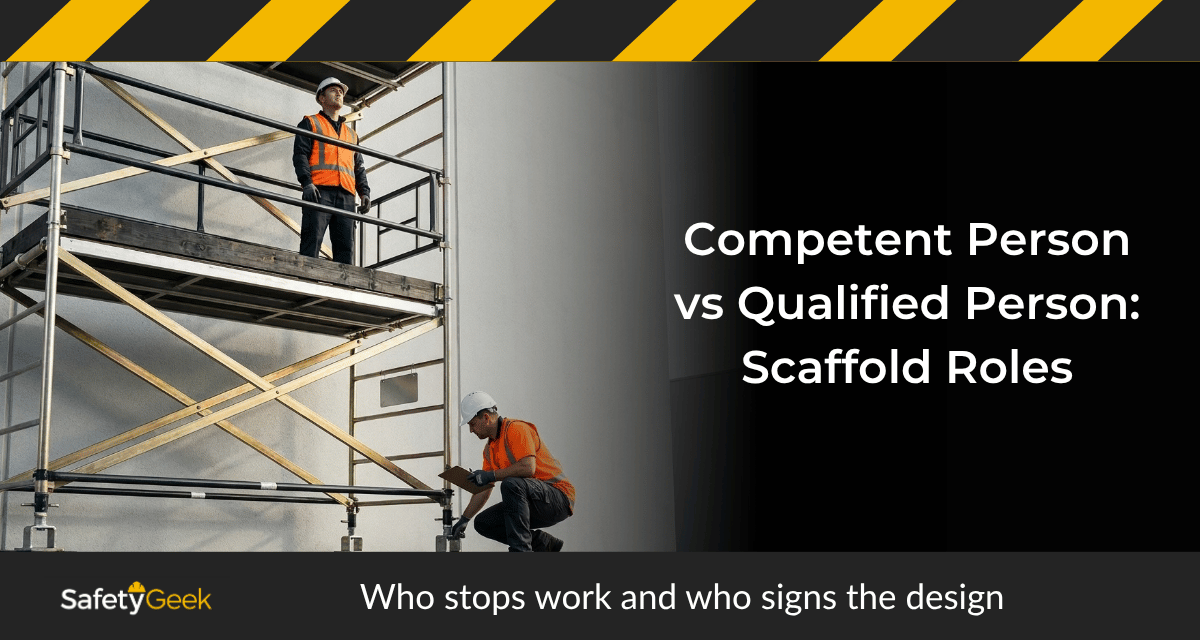
TL;DR: A competent person and a qualified person are two different OSHA roles on a scaffold. Competent person is a question of authority: they spot the hazard and hold the power to stop the work over it. Qualified person is a question of proof: a degree, certificate, or demonstrated experience behind the design.
The difference between a competent person vs. a qualified person on a scaffold comes down to two words buried in OSHA’s own definitions: authorization and demonstrated. Your competent person is authorized to stop the work and fix a hazard right now. Your qualified person has demonstrated they can solve the technical problem behind it.
So here’s the question that actually decides whether your program holds up… if your competent person pulled a scaffold out of service this morning, and the superintendent waved it off and kept the crew working, what happens next?
If the answer is “nothing,” you don’t have a competent person. You deputized somebody and handed them a card.
And that’s not a you problem. That’s the whole designation process at most places you’ve worked: one person, one class, one card in a wallet, one name typed onto a form. It’s also the first thread an inspector pulls, and scaffolding sat sixth on OSHA’s fiscal 2025 list of most frequently cited standards.
Key Takeaways
- Competent person = hazard recognition PLUS authority. Somebody who spots the hazard but can’t stop the work doesn’t meet OSHA’s definition.
- Qualified person = demonstrated ability to solve the problem and proven by a degree, certificate, professional standing, or extensive knowledge and experience.
- The competent person inspects before each work shift and after anything that could affect structural integrity.
- The qualified person designs, and the scaffold gets built and loaded to that design.
- Erection and dismantling require both roles in one body, so whoever supervises must be a competent person who’s also qualified in that specific scaffold work.
- The training rule runs the opposite direction from the job. Scaffold users are trained by a qualified person. Erectors and inspectors are trained by a competent person.
- A class certificate isn’t a designation. OSHA doesn’t issue competent person cards, and no course hands out the authority half of the definition.
What OSHA Actually Says About Each Role
Both terms are defined right there in the regulation, short enough to read out loud at a toolbox talk. Worth doing, because the whole distinction lives in the verbs.
The competent person definition has two halves.
Under OSHA’s scaffold definitions in 1926.450(b), a competent person is “one who is capable of identifying existing and predictable hazards in the surroundings or working conditions which are unsanitary, hazardous, or dangerous to employees, and who has authorization to take prompt corrective measures to eliminate them.”
That second half is the one the 8-hour competent person course can’t give you. The class covers the eyes. It has no way to hand over the power.
And prompt doesn’t mean after the superintendent gets back from lunch. If your designee has to make three phone calls before a scaffold comes out of service, they don’t have authorization, and the designation won’t hold up.
The qualified person definition is about proof, not paperwork
OSHA’s construction definition of “qualified” in 1926.32(m) reads: “one who, by possession of a recognized degree, certificate, or professional standing, or who by extensive knowledge, training, and experience, has successfully demonstrated his ability to solve or resolve problems relating to the subject matter, the work, or the project.”
Notice what is NOT in there… no license requirement, no mandatory credential, no OSHA-issued anything.
The word doing all the work is demonstrated. You’re not proving somebody attended something; you’re proving they’ve solved this kind of problem before… and you need to show how you know that.
That last clause matters too: “relating to the subject matter.” Qualified is always qualified at something. A structural engineer who’s never touched a mast climbing work platform (and plenty haven’t) isn’t automatically your qualified person for one.
Who Owns Which Scaffold Duty
| Scaffold duty | Who owns it | Where it lives |
|---|---|---|
| Design the scaffold | Qualified person | 1926.451(a)(6) |
| Build and load it to that design | Employer, per that design | 1926.451(a)(6) |
| Inspect for visible defects before each shift | Competent person | 1926.451(f)(3) |
| Inspect after any event affecting structural integrity | Competent person | 1926.451(f)(3) |
| Supervise erection, moving, dismantling, altering | Competent person also qualified in that work | 1926.451(f)(7) |
| Select who’s allowed to do that work | Competent person | 1926.451(f)(7) |
| Train employees who work on scaffolds | Qualified person | 1926.454(a) |
| Train employees who erect, move, repair, or inspect | Competent person | 1926.454(b) |
Duties that belong to the competent person
This is the daily, on-the-ground role, and the general scaffold requirements in 1926.451 put the inspection squarely on them. Scaffolds get inspected for visible defects before each work shift, and again after anything that could affect structural integrity (a struck-by, a wind event, a load nobody planned for).
That makes it a per-shift obligation, not a weekly walk, and two shifts means two inspections.
Your competent person also decides who’s allowed to erect and dismantle. Under 1926.451(f)(7), that work goes only to experienced and trained employees selected by the competent person.
Duties that belong to the qualified person
The qualified person’s job sits upstream of the jobsite. Scaffolds must be designed by a qualified person and constructed and loaded in accordance with that design.
On a standard fabricated frame scaffold, the manufacturer’s tables already do that work for you, and your qualified person’s job is confirming you’re actually inside them.
Step outside those parameters and it changes. Any of these needs somebody who can demonstrate they solve this kind of problem:
- Cantilevered platforms
- A bridged section
- An unusual tie pattern
- A load nobody tabulated for
- A soft or questionable foundation
The 4-to-1 height ratio rule is the clearest everyday example.
When one person has to be both
Here’s the one provision where OSHA fuses both roles into a single human being. 1926.451(f)(7) requires that scaffolds be erected, moved, dismantled, or altered “only under the supervision and direction of a competent person qualified in scaffold erection, moving, dismantling or alteration.”
Both words: one person, that specific scaffold type. Somebody competent for a frame scaffold isn’t automatically the person who supervises a suspended scaffold coming off a roof.
The Training Rule Most of Us Get Backward
If you take one thing off this page into your program tomorrow, take this one. The scaffold training requirements in 1926.454 assign the roles in the order most of us assume is reversed.
Employees who work on scaffolds are trained by a qualified person
Under 1926.454(a), every employee who performs work while on a scaffold gets trained by a person qualified in the subject matter. That training covers five areas:
- Electrical, fall, and falling object hazards in the work area
- Procedures for handling electrical hazards, and for erecting, maintaining, and disassembling the fall protection and falling object protection in use
- Proper use of the scaffold and proper handling of materials on it
- Maximum intended load and load-carrying capacities
- Any other pertinent requirements of the subpart
So the carpenter standing on the deck was trained by a qualified person. Not a competent person.
Employees who erect or inspect scaffolds are trained by a competent person
Under 1926.454(b), every employee involved in erecting, disassembling, moving, operating, repairing, maintaining, or inspecting a scaffold gets trained by a competent person. Four topics:
- The nature of scaffold hazards
- Procedures for erecting, disassembling, moving, operating, repairing, inspecting, and maintaining that scaffold type
- Design criteria, maximum intended load-carrying capacity, and intended use
- Any other pertinent requirements of the subpart
The people building it get the competent person. The people using it get the qualified person. Write that on the wall somewhere.
When retraining is required
1926.454(c) lists three triggers, and not one of them is calendar-based. There’s no annual scaffold refresher hiding in the standard.
- A change at the worksite presenting a hazard the employee hasn’t been trained on
- A change in scaffold, fall protection, or other equipment presenting a new hazard
- Inadequacies in an employee’s scaffold work showing they haven’t retained proficiency
That third one is sneaky-good. It makes your observation program legally part of your training program, because somebody has to notice the inadequacy before it can fire.
THE ALL-ACCESS PASS RESOURCE PAGE
Get all the FREE templates, safety management resources, PDFs, spreadsheets, and more...
Why Designating a Competent Person Falls Apart in Practice
So why does a designation that reads perfectly on paper collapse the first time somebody uses it? Here’s the part the regulation can’t fix for you, and it’s where I’ve watched good programs get cited anyway.
A card is not a designation.
There’s no OSHA competent person certification. In a letter of interpretation on competent person training for scaffold inspection, OSHA said plainly that no particular course or credential is required, and that the employer carries the burden of proving the person has the knowledge the role demands.
If the only proof you’ve got is a wallet card, you’ve documented attendance. You have NOT documented capability, and an inspector can tell the difference at a glance.
Authority has to be real, and the crew has to hear it
This is where the whole thing usually breaks… and it isn’t a paperwork problem.
I learned traditional safety from someone whose whole focus was regulations. Write-ups, documentation, safety as a hammer. I ran it that way for years.
By the time it stopped working, I was Director of Safety over 22 locations. Every hire had to be approved by my staff,f and I could fire people on the spot, which is about the easiest position a safety leader will ever be handed.
I still couldn’t move the numbers past industry standard.
So if all that authority couldn’t do it, a line on a designation form never would. The competent person role hands you a sliver of that power, exercised inside somebody else’s crew, and it only functions when their boss says so out loud.
If the superintendent can wave off your competent person and keep the crew working, that person has a title, not authorization. The same gap sits under the competent person requirements for fall protection.
Reading the standard tells you what you’re owed. Getting management to actually back it is a different skill entirely.
The fix is one conversation with the person who signs the paychecks. I know how that lands when you’ve been eating pushback for a year, and I won’t pretend it’s a comfortable ask.
Here’s the version that doesn’t work, because most of us tried it first: “Per OSHA, our designated competent person has stop-work authority on all scaffolds.” That’s an email. No crew has ever changed behavior because of an email.
Here’s the version that does: “When Miguel red-tags a scaffold, your supers need to hear from YOU that it stays down until he clears it. If it comes from me, they’ll work around it.”
Ninety seconds. That’s the whole conversation.
A scaffold citation never arrives alone, either. Once an inspector finds a missing shift inspection, the next questions are about planking, fall protection at 10 feet, access, and training records, each one its own line item at OSHA’s current maximum penalty amounts of $16,550 per serious violation.
How to Designate Both Roles So They Hold Up
Walk your site and ask three questions: who’s the competent person, what can they stop, and who do we call when the scaffold falls outside the manufacturer’s tables? If people can answer all three without going to look something up, your designation is real.
What to put in writing
Four things, in plain language:
- The person
- The scaffold systems the designation covers
- The duties assigned
- The stop-work authority, stated specifically
That last one is where these documents go soft. “Authorized to remove any scaffold from service and halt work on it immediately, without prior approval” beats “responsible for scaffold safety” every day of the week.
Then get the site’s senior operations leader to sign it, not just safety. That signature makes the authority recognized, and earning it is the influence work underneath it.
What to keep on file
- Designation records: signed competent and qualified person designations, with scaffold systems and duties spelled out
- Capability evidence: training records, work history, scaffold types previously supervised, plus the degree, certificate, or professional standing behind the qualified person
- Design records: manufacturer instructions and load tables, plus drawings and calculations for anything outside them
- Inspection records: date, shift, location, inspector name, conditions found, corrective actions, release status
- Training records: trainer name and role, date, scaffold type, hazards covered, retraining trigger applied
That same habit carries the daily scaffold competent person requirements through an audit.
Frequently Asked Questions About Competent Person vs Qualified Person Scaffold Roles
Can the same person be both the competent person and the qualified person?
Yes, and 1926.451(f)(7) actually requires it for supervising erection and dismantling. That provision calls for a competent person who’s also qualified in that specific scaffold work. The person has to meet both definitions independently for the scaffold system in front of them, not just hold one designation.
Does OSHA certify competent persons for scaffolds?
No. OSHA doesn’t issue competent person certifications or approve specific courses. The employer designates the competent person and carries the burden of showing that person can identify scaffold hazards and holds real authorization to correct them, which a vendor card supports but doesn’t create.
How often does a scaffold need to be inspected?
Before each work shift, and again after any occurrence that could affect the scaffold’s structural integrity, by a competent person, a struck-by event, a storm, or an unplanned load all trigger a fresh inspection. Two shifts on the same scaffold means two separate inspections, not one.
Who trains employees who work on scaffolds?
A person qualified in the subject matter, under 1926.454(a). Employees who erect, move, repair, or inspect scaffolds get trained by a competent person under 1926.454(b) instead. User-facing training belongs to the qualified person, and builder-facing training belongs to the competent person.
Is annual scaffold refresher training required?
No. 1926.454(c) has three retraining triggers, and none are calendar-based: a new worksite hazard the employee hasn’t been trained on, a change in scaffold or equipment type presenting a new hazard, or observed inadequacies showing the employee hasn’t retained proficiency.
What if our competent person can’t actually stop work?
Then the designation doesn’t meet the definition, because authorization to take prompt corrective measures is half of what OSHA requires. Put the stop-work authority in writing, get operations leadership to sign it, and have them announce it to the crews so the authority is recognized in their line of power.
Now It’s Your Turn
Competent person owns the authority, qualified person owns the proof. Get that split right,t and most of your scaffold program organizes itself.
Five things I’d do this week:
- Pull your competent person designation and read it out loud. If it doesn’t name specific scaffold systems and specific stop-work authority, rewrite it.
- Walk out and ask a crew member who the competent person is. If they can’t name that person in five seconds, the authority isn’t real yet.
- Check who trained your scaffold users versus your erectors, and confirm the 1926.454 split runs the right way.
- Reconstruct one scaffold’s last shift inspection from your records. If you can’t, that’s your first gap.
- Get the site’s operations leader to sign the designation. Safety’s signature alone is what got you here.
Now, if number five has you thinking, “I’ve tried several angles, and none of them work”… I believe you. Most of us have.
But those asks usually miss the mark. Wrong person, wrong language, wrong moment. All three are fixable.
That’s what changed for Keith. Nobody handed him new authority. He learned the language of the business, changed how he talked to operations, and they started backing him without being asked twice.
Then came the invitation to the executive site visit. Same building, same title, and finally a seat at the table.
So the competent person problem is really an influence problem wearing a compliance costume, which is exactly what my free training on the Safety Influencer System covers: how to get management to back what you already have the regulatory right to do. It’s free, and it runs about 39 minutes.
Watch it, then have the ninety-second conversation.
You got this, Safety Friend.
Hi, I'm Brye (rhymes with sky)! I am a self-proclaimed safety geek with two decades of general industry safety experience. Specializing in bringing safety programs to a world-class level and building a safety culture, I have trained and coached many safety managers, just like you, on how to effectively manage workplace safety in the real world. I would love to help you too.