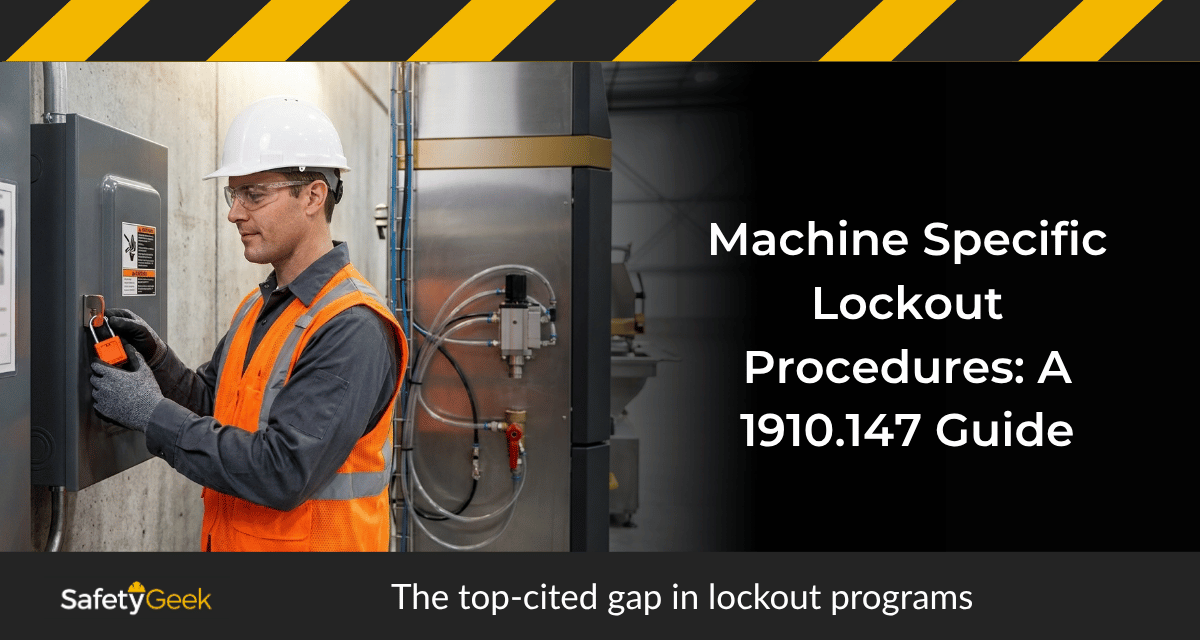
Estimated Reading Time: 11 minutes
TL;DR: Machine specific lockout procedures are written, equipment-by-equipment instructions that tell an authorized employee exactly how to shut down, isolate, verify, and restart one particular machine. OSHA’s 1910.147(c)(4) requires them for nearly every machine you service. Generic one-page LOTO policies are the single most cited piece of the lockout standard, and they are the easiest compliance gap to close.
Machine-specific lockout procedures are required by OSHA under 29 CFR 1910.147(c)(4), and a generic company-wide LOTO policy does not satisfy it. The standard wants a documented procedure for each machine, naming every energy source, the isolation point for each one, the shutdown sequence, the lock steps, and how the employee verifies zero energy.
So what happens when the compliance officer points at a machine and asks to see its procedure? You go to the LOTO binder you inherited. It has a policy in it; the policy sounds thorough; it’s been collecting dust since 2015… and there’s nothing in it about that machine.
Key Takeaways
- 1910.147(c)(4) requires a documented, machine-specific energy control procedure for servicing and maintenance work. A general policy statement doesn’t count.
- Each procedure must include four things: its intended use, the shutdown and isolation steps, the lockout device steps, and how to verify the machine is de-energized.
- Energy control procedures are the most cited part of the LOTO standard. OSHA logged 675 violations under 1910.147(c)(4) in fiscal year 2025, more than any other subsection.
- The written exception is narrow. All 8 conditions must be true at once, and a single stored-energy source knocks the machine out of compliance.
- A procedure is only compliant if it matches the machine. The fastest way to find out yours doesn’t is to walk it with the tech who does the job.
- Annual periodic inspection under 1910.147(c)(6) keeps it alive. Writing the procedure is where the work starts.
What OSHA Requires in a Machine-Specific Lockout Procedure
A machine-specific lockout procedure is a written document that walks an authorized employee through controlling every hazardous energy source on one identified piece of equipment. It names the machine, the energy, and the steps in order.
The control of hazardous energy standard at 29 CFR 1910.147(c)(4) says employers shall develop, document, and use those procedures. And that verb list matters. Documenting it isn’t enough if nobody uses it at the machine.
The Four Elements 1910.147(c)(4)(ii) Spells Out
OSHA is unusually direct about what the document must include. Every procedure has to spell out:
- The scope, purpose, and intended use of the procedure, including which machine it covers.
- Specific steps to shut down, isolate, block, and secure the machine to control hazardous energy.
- Specific steps for placing, removing, and transferring lockout or tagout devices, and who is responsible for them.
- Specific requirements for testing the machine to verify the effectiveness of the lockout devices.
The word “specific” shows up in three of those four, and that’s not an accident. A procedure that says “de-energize the equipment and apply your lock” fails all four, because it never says which disconnect, which valve, which order, or how to prove it worked.
What “Specific” Actually Means on the Floor
Specific means a person who has never serviced that machine could follow the document and reach a genuine zero-energy state. That bar is higher than most procedures clear.
It needs the machine name, asset number, and location, plus every energy source called out separately: electrical, hydraulic, pneumatic, mechanical, thermal, chemical, gravity, spring tension, and stored charge in capacitors. Each one gets its own isolation point, identified by the label that’s actually on the floor.
Then it needs the human parts… who applies locks, who removes them, what happens at shift change, what happens when a contractor is involved. Those go missing when somebody adapts a template instead of building from the machine.
The One Exception, and Why It Rarely Applies
There’s an exception in 1910.147(c)(4)(i), and safety leads lean on it far more than the language allows. All 8 of these conditions have to be true at the same time for a machine to skip the documented procedure:
- No potential for stored or residual energy, or for it to reaccumulate after shutdown.
- A single energy source that can be readily identified and isolated.
- Isolating and locking that source completely de-energizes the machine.
- The machine is isolated and locked out during the servicing.
- A single lockout device achieves the locked-out condition.
- That device stays under the exclusive control of the authorized employee doing the work.
- The servicing creates no hazard for anyone else.
- You’ve had no accidents involving unexpected startup on that machine while using the exception.
Miss ONE and you need the written procedure. A hydraulic ram that holds pressure, a flywheel that coasts, an elevated component that drops under gravity… any of those puts the machine right back in scope. Most production equipment fails on the very first condition.
Why Generic Energy Control Procedures Get Cited
Want to know the fastest way to fail a LOTO inspection? Write one company-wide policy and call it coverage for a plant full of different machines. That’s the gap inspectors find first.
The Citation Numbers Behind the Problem
Lockout/tagout ranked fourth on OSHA’s Top 10 most frequently cited standards for fiscal year 2025, with 2,177 violations of 1910.147.
According to Safety+Health Magazine’s analysis of the fiscal year 2025 data, the leading LOTO subsections were energy control procedures at 675 violations, training and communication at 422, and periodic inspection at 345. Procedures beat training. Procedures beat inspections.
And procedures sit underneath most other common lockout/tagout violations, because training and inspections both point back to a document. Here’s the test that matters: could somebody stand at the machine, read your procedure out loud, and reach zero energy? A training roster won’t answer that question. Only the document will.
The Corporate Template Trap
Here’s the pattern I run into most with safety leads who got thrown into an existing program. Corporate sends down a LOTO template, the site drops its name in the header, and it gets filed as done. You don’t know what you don’t know, so you trust it.
The template was never wrong, exactly. It just was never about your machines.
The tell is when the procedure describes a machine that doesn’t exist at your site. Two disconnects listed when the machine has four. A bleed valve referenced that was pulled out in a rebuild three years ago.
Or a step that says “lock the main breaker” when the main breaker feeds half the line.
This is a systems problem, not a people problem. When maintenance techs lock out from memory instead of using the paper you wrote, it’s usually because the paper doesn’t match what’s in front of them. Fix the document, and you remove the reason to work from memory.
And you have no authority to make anybody use it anyway. That gap between what you’re accountable for and what you can actually enforce is the real job, and it’s the whole thing we teach.
| Generic LOTO Policy | Machine-Specific Procedure | |
|---|---|---|
| Scope | Covers the whole facility | Covers one identified machine |
| Energy sources | Listed as general categories | Named individually with isolation points |
| Steps | “Shut down and apply lock” | Numbered sequence in order of operation |
| Verification | “Verify zero energy” | Named test method for each source |
| 1910.147(c)(4) status | Cited | Compliant |
| Usable by a new tech | No | Yes |
THE ALL-ACCESS PASS RESOURCE PAGE
Get all the FREE templates, safety management resources, PDFs, spreadsheets, and more...
How to Write a Procedure That Holds Up
Writing these goes faster than most safety leads expect, once you stop starting from a blank template. The work is in the walk-down. Build the energy map first, and the document writes itself.
And it fits cleanly into the Develop stage of the Safety Management Cycle. If you’re building the whole program rather than patching one gap, the broader lockout/tagout program implementation steps give you the order to work in.
Start With the Energy Map First
Go to the machine with a phone and a notepad. Photograph every disconnect, valve, breaker, bleed point, block, and restraint, plus the label on each one, so the procedure can quote the exact wording the tech will read on the floor.
Then account for what doesn’t have a switch. Gravity on elevated components, springs under tension, heat in a die or a barrel, pressure in an accumulator, residual charge in a drive capacitor.
I learned this one the hard way. A worker on an automatic meat slicer jammed, and he was trained on lockout/tagout. He unplugged the machine and reached in.
Neither he nor our procedure accounted for the air nozzle. When the jam cleared, the machine cycled and caught his hand.
He was alone in that production room, and it’s a hearing protection area, so everyone within earshot had their ears plugged. He yelled for a long while before anyone came to bleed the air and free him. He didn’t get so much as a bruise… and it opened up a boatload of corrective actions, because the gap was never his. It was ours, sitting in a procedure that listed the plug and not the air.
Those are the sources that kill people after the electrical disconnect is already locked.
Write down what makes each one safe: bleed it, block it, restrain it, or let it cool. That list is the backbone of your procedure, and it’s the part a template can never give you. Our LOTO energy control procedure templates include the walk-down worksheet to fill in while you’re out there.
Write the Sequence in the Order a Person Does It
Number the steps and keep them in the order the work actually happens. Notify affected employees, shut down using the normal stopping sequence, isolate each energy source, apply locks, release stored energy, then verify.
Verification is where most procedures go vague… so name the test. After confirming personnel are clear, attempt a normal start, then return the control to off. Check the pressure gauge reads zero, and test for voltage with a meter you first proved on a known live source.
Keep the language at the level of the person doing the job. Short sentences, plain words, one action per line. If a step needs a paragraph, it’s really two steps.
Field-Validate With the Person Who Does the Job
NEVER publish a procedure you wrote at a desk. Hand the draft to an authorized employee, stand at the machine, and have them work it top to bottom while you watch.
You’ll find the disconnect behind a locked cabinet nobody has the key for.
You’ll find the valve labeled V-7 in your document and V-12 on the pipe, which is exactly where a tech stopped on a draft of mine.
You’ll find the step that assumes two people when the shift only has one.
That walk-through is also your best engagement tool. When maintenance helps build the procedure, they own it… and you stop being the person who handed down just another piece of paperwork. That’s how a compliance task becomes the reason they start bringing you problems before they become incidents.
Keeping Procedures Alive After You Write Them
These documents have a shelf life. Equipment gets rebuilt, controls get upgraded, energy sources get added, and the procedure that was accurate in March is wrong by September.
The Annual Inspection Under 1910.147(c)(6)
The periodic inspection requirement calls for reviewing each energy control procedure at least annually. An authorized employee other than the one using the procedure being inspected must perform it, which means you cannot inspect your own work.
The certification identifies the machine, the employees included, the inspector, and the date. For lockout, it also includes a face-to-face review with each authorized employee, which overlaps directly with your authorized employee training records.
But don’t let this one turn into a tick-the-box exercise. Deviations and inadequacies must be corrected, and it’s the third most cited part of the standard precisely because it’s so easy to sign and shelve.
Triggers That Mean You Rewrite Before the Year Is Up
Annual is the minimum. Certain events should send you back to the document immediately:
- The machine was modified, rebuilt, or relocated.
- The control system or an energy source changed.
- A near miss or incident involved that equipment.
- Somebody found an energy source the procedure didn’t list.
- New guarding, disconnects, valves, or blocking equipment went in.
Build those triggers into your management of change process so the update happens automatically. And a procedure that keeps generating deviations is telling you something about the machine. That’s the Analyze stage of the Safety Management Cycle doing its job.
Making the Procedure Findable at the Machine
A procedure locked in a binder in your office is a procedure nobody uses. So laminate it and mount it at the machine, or put a QR code on the asset tag. Version-control it with a revision date and approval signature so nobody has to guess which copy is current.
Then check it the way an inspector would. Walk up to a random machine, ask the tech on duty to show you the procedure, and time it. Anything over 30 seconds means the system needs work.
Frequently Asked Questions About Machine-Specific Lockout Procedures
Our full set of LOTO frequently asked questions covers the rest.
Does every machine need its own written lockout procedure?
Nearly every one does. The exception in 1910.147(c)(4)(i) requires all 8 conditions to be true, including no stored energy and a single readily identified source. Most production equipment fails at least one, so plan on a documented procedure per machine.
Can I use one procedure for identical machines?
Yes, if they’re truly identical in energy sources, isolation points, and layout. List every asset number the procedure covers in the header. If one unit has a different disconnect location or an added component, it needs its own document.
What is the most cited part of the lockout standard?
Energy control procedures under 1910.147(c)(4). OSHA recorded 675 violations of that subsection in fiscal year 2025, ahead of training at 422 and periodic inspection at 345. Lockout/tagout as a whole ranked fourth on OSHA’s Top 10 with 2,177 total violations.
How often do machine-specific lockout procedures need to be reviewed?
At least annually under 1910.147(c)(6), by an authorized employee other than the one using it. Review sooner any time the machine is modified, an energy source changes, an incident occurs, or someone finds a source the procedure missed.
I have hundreds of machines and no time. Where do I start?
Start where the exposure is: the equipment with the most servicing activity and the most energy sources. Build three or four with the walk-down method, then use those as your house format. Run them during scheduled downtime so you’re spending hours the plant already gave up.
Now It’s Your Turn
Every machine-specific lockout procedure you finish reduces the chance that somebody gets hurt by equipment that started up when it shouldn’t have. OSHA estimates that compliance with the lockout/tagout standard prevents roughly 120 fatalities and 50,000 injuries a year. The citation exposure is real too, but it’s the smaller reason.
And let’s be honest about what the regulation is. It’s a C grade… the floor, not the goal. A procedure that satisfies 1910.147(c)(4) is the minimum a person deserves before they put their hands inside a machine.
Here’s what to do this week:
- Pull your LOTO documentation and count how many machine-specific procedures you have versus how many machines get serviced.
- Pick the machine with the most energy sources and do the walk-down. Photograph every isolation point and label.
- Draft that first procedure from the four elements in 1910.147(c)(4)(ii), then hand it to a tech and watch them run it.
- Fix what the walk-through exposes and use that corrected document as your house format.
- Put the annual inspection on a calendar with a named inspector.
Now, if you’re a department of one thinking there’s no way you get the hours to walk down 200 machines, you’re not wrong about the math. That’s a support problem, and it’s the one that keeps safety leads stuck for years. It’s also fixable without a bigger title or budget, and we walk through it in the free training on the Safety Influencer System.
Start with one machine, one hour, and the person who does the work.
You got this.
Hi, I'm Brye (rhymes with sky)! I am a self-proclaimed safety geek with two decades of general industry safety experience. Specializing in bringing safety programs to a world-class level and building a safety culture, I have trained and coached many safety managers, just like you, on how to effectively manage workplace safety in the real world. I would love to help you too.