Estimated Reading Time: 10 minutes
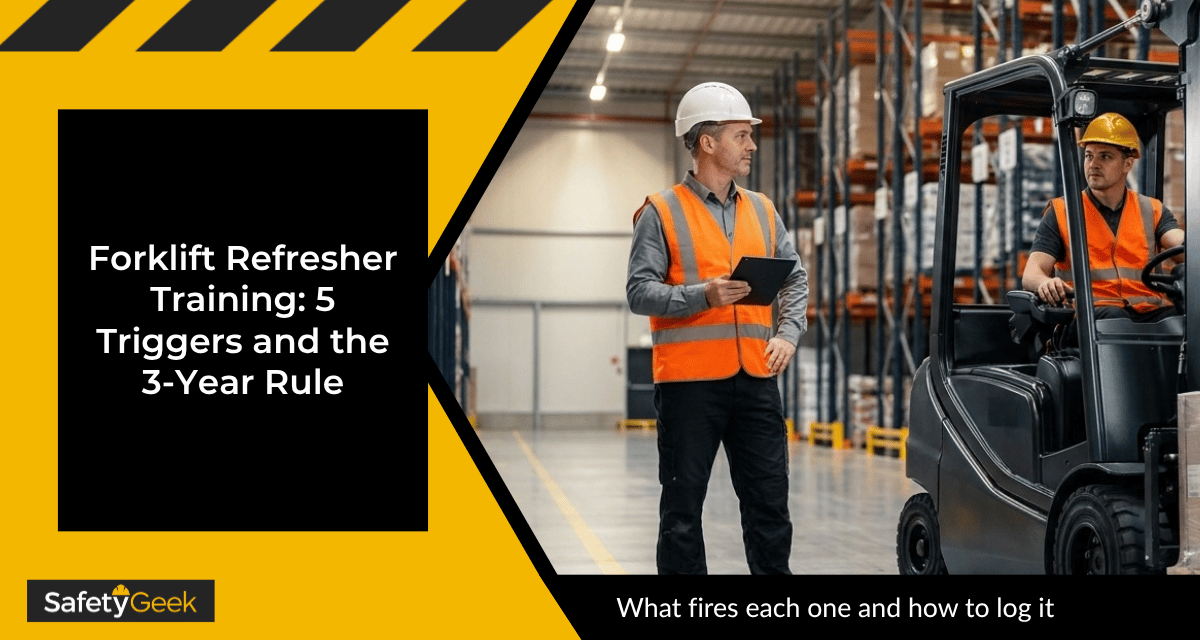
TL;DR: OSHA does not require annual forklift refresher training. Under 29 CFR 1910.178(l)(4), refresher training is event-driven and fires on five specific triggers. Separately, every operator gets a performance evaluation at least once every three years. Those are two different clocks, and most programs only track one of them.
Events, not a calendar trigger, require forklift refresher training. OSHA’s powered industrial truck standard lists five conditions that require retraining, and it separately requires a performance evaluation of every operator at least once every three years.
So what happens if your program runs on “everybody gets recertified every three years”? You’re tracking half the rule.
Somebody built you a card system and called it a program. It ticks the box… and it’s the gap I see most often when I pull a forklift file.
The dates look clean, and nobody can tell me what happened after the last near-miss in receiving.
Key Takeaways
- OSHA has no annual forklift training requirement. Nothing in the standard sets a renewal date.
- Five specific events trigger refresher training under 1910.178(l)(4)(ii), including near-misses, unsafe operation, and workplace changes.
- The three-year requirement is an evaluation of performance, not a full retraining course.
- Refresher training only has to cover the relevant topics. OSHA doesn’t require you to rerun the entire initial course.
- Powered industrial trucks were OSHA’s #8 most-cited standard in fiscal year 2025, and the training paragraph is a big part of why.
- Certification records need four data points. A class sign-in sheet gives you one of them.
What OSHA Requires for Forklift Refresher Training
Forklift refresher training is additional training given to a certified operator after a specific event shows their knowledge or skills need reinforcement. It’s paragraph (l)(4) of OSHA’s powered industrial truck standard, 29 CFR 1910.178.
The standard says refresher training “shall be conducted as required by paragraph (l)(4)(ii) to ensure that the operator has the knowledge and skills needed to operate the powered industrial truck safely.”
Now read that again and look for the deadline.
There’s no interval, no “annually,” no renewal date…
…because OSHA never put one there.
And this is where most programs go sideways. Somebody inherited a three-year certification card system, assumed it worked like a CPR card (which, to be fair, is exactly what a laminated expiration date trains you to think), and stopped there.
The two clocks you have to run
Your forklift program runs two separate timers, and they don’t sync.
Clock one is the trigger clock. It has no schedule. It starts when something happens, and it applies to one operator at a time.
Clock two is the evaluation clock. It’s the three-year performance evaluation in 1910.178(l)(4)(iii), and it applies to every operator on your list regardless of whether anything happened.
An operator can be perfectly current on the three-year evaluation and still be out of compliance, because a trigger fired six months ago and nobody retrained them.
You track both clocks separately. Neither one covers for the other.
Why this shows up in enforcement
Powered industrial trucks ranked #8 on OSHA’s top 10 most frequently cited standards for fiscal year 2025.
The training paragraph is a big part of why. The rest of OSHA 1910.178 covers the trucks themselves, but an inspector doesn’t need to watch an operator run one to write up the training piece.
They pull your certification records, compare them against your incident log, and look for the gaps between the two.
And the citation is the smaller half of that. An operator who hits racking is still running the same truck, the same way, on the same shift… and the write-up is going to have your name on it, not his.
The 5 Events That Trigger Refresher Training
Paragraph 1910.178(l)(4)(ii) lists five conditions. Refresher training in relevant topics is required when any one of them occurs.
| Trigger | Regulation | What it looks like on your floor |
|---|---|---|
| Operator observed operating unsafely | (l)(4)(ii)(A) | A supervisor sees speeding, raised forks in travel, or a blind corner taken hot. |
| Operator involved in an accident or near-miss | (l)(4)(ii)(B) | Racking hit, load dropped, pedestrian jumped out of the way |
| An evaluation reveals unsafe operation | (l)(4)(ii)(C) | Your own three-year evaluation turns up a problem |
| Operator assigned to a different type of truck | (l)(4)(ii)(D) | Sit-down counterbalance operator moved to a stand-up reach truck |
| Workplace conditions change | (l)(4)(ii)(E) | New racking layout, aisle narrowed, dock reconfigured, new product mix |
The near-miss trigger is the one that gets skipped
Read trigger B again. It says “accident or near-miss incident.”
That means a racking strike with no injury and no damage report still starts the clock. So does a pallet that came off the forks in an empty aisle.
The honest problem is usually that near-misses go into one system and training records live in another. Nobody connected them. It’s all bits and pieces, piecemealed together by whoever had the job before you.
A near-miss is also the moment retraining does the most good. The operator is still thinking about it.
I was recertifying operators one year, and they thought I was going overboard on pedestrian traffic and walkways.
So I brought in an article about a guest delivery driver who walked in front of a trailer while the operators were loading it. She got pushed into the trailer and pinned between two tall pallets.
Nobody knew she was there until the delivery was unloaded days later.
I found it in a forklift training newsletter. It changed my team’s mindset. The regulation never came close.
Try this today: open your last near-miss report. Is there a forklift in it? Then it should have a retraining date attached.
The observation trigger requires somebody to be looking
Trigger A only works if unsafe operation actually gets observed and documented. This is why forklift safety violations keep repeating in facilities that swear their training is current.
Your supervisors are the ones on the floor. If they’re not running observations, trigger A never fires, and the retraining that should have happened never happens.
Give them the words: “I saw you take the corner by shipping with the forks up. Walk me through it.” That’s an observation, and it’s the start of a forklift safety program that isn’t just paper.
The workplace-change trigger has nothing to do with the trucks
Trigger E catches the thing safety leads rarely file under “training.”
- You changed the racking.
- You added a mezzanine.
- Sales landed a new customer, and now you’re storing something twice as tall in the same aisles.
None of that touches the forklift. All of it changes how the forklift gets operated, and OSHA treats it as a retraining event.
The Three-Year Evaluation Is Not a Retraining Course
Paragraph 1910.178(l)(4)(iii) says “an evaluation of each powered industrial truck operator’s performance shall be conducted at least once every three years.”
That’s an evaluation. It doesn’t require you to rerun formal instruction, hand out the workbook again, or sit everyone through a 4-hour video every three years.
What the evaluation actually has to do
The evaluation has to confirm the operator still has the knowledge and skills to run the truck safely in your workplace. That means watching them operate on your equipment, in your aisles, doing their actual job.
A written test doesn’t do it. A vendor certificate from a class held in a parking lot two states away doesn’t do it either.
The standard is built around performance on your floor. That’s why 1910.178(l)(2)(ii) requires training to combine formal instruction, practical training, and an evaluation of how the operator actually performs there.
Where the money gets wasted
Plenty of employers run a full 8-hour recertification course every three years because they think the rule demands it. Pull 30 operators off the floor for a day. Add up the wages, the trainer, and the production you didn’t run, and you spent all of it to satisfy a paragraph that asked for an evaluation.
What the rule asks for is a documented performance evaluation. If the evaluation turns up a problem, THAT triggers refresher training under (l)(4)(ii)(C).
Evaluate first. Then train based on what the evaluation found. Powered industrial truck operator training gets a lot cheaper when you aim it.
THE ALL-ACCESS PASS RESOURCE PAGE
Get all the FREE templates, safety management resources, PDFs, spreadsheets, and more...
How Much Retraining a Trigger Actually Calls For
The regulation calls for refresher training on “relevant topics.” So how much is relevant? Less than you probably think.
OSHA covered this in an interpretation letter on moving operators between truck types. How much refresher training you owe depends on how different the two trucks actually are. Moving from one manufacturer’s sit-down counterbalance to another isn’t the same as moving from a sit-down to an order picker.
Train to the deficiency.
If an operator got flagged for speeding, your refresher covers speed, stopping distance, and load stability. Fire extinguisher placement can wait for another day.
Targeted retraining also lands better, because it’s about something the operator just did.
Paragraph 1910.178(l)(5) backs this up. If an operator was already trained on a topic and that training fits your truck and your conditions, you don’t have to retrain them. One condition: they have to be evaluated and found competent.
Who can do the training and evaluation?
Paragraph 1910.178(l)(2)(iii) requires all operator training and evaluation to be conducted by “persons who have the knowledge, training, and experience to train powered industrial truck operators and evaluate their competence.” There’s no OSHA license, no federal certification card, no required credential.
Which means it doesn’t have to be you.
I didn’t own forklift training in my organizations. I picked an employee, sent them through a train-the-trainer course, and handed them the program.
Supervisors couldn’t take it on. They had production to manage.
And honestly, the training landed harder coming from a peer who runs the same truck every day.
The ask is simple: “You’re the one everybody already comes to with forklift questions. I want to send you to train-the-trainer and have you run this.”
If you’re a department of one, this is the move. You’re building the program floor by floor instead of stacking it on your desk.
Documenting Retraining So It Holds Up
Paragraph 1910.178(l)(6) requires the employer to certify that each operator has been trained and evaluated. And it says exactly what the record has to hold.
4 things:
- The name of the operator
- The date of the training
- The date of the evaluation
- The identity of the person or persons who performed the training or the evaluation
Why the sign-in sheet fails
A class roster gives you names and one date. It doesn’t give you an evaluation date, and it usually doesn’t name the evaluator.
So two of the four elements are missing on every operator in the room. OSHA’s 1999 interpretation letter on training content, certification, and record maintenance spells out what the record must include.
Your OSHA forklift inspection checklist records already run per truck, per day. Build the training record the same way, per operator. One row, four columns, updated every time either clock ticks.
Make the trigger log the actual system
The fix is a link between two systems you already have.
Every near-miss report, every observation with a forklift finding, and every layout change lands on one trigger log, with the operator’s name and a retraining due date next to it. That log is what an inspector is really asking about.
And you don’t need to own either upstream system to do it. Copy the forklift line off the near-miss report yourself, once a week. 10 minutes.
Frequently Asked Questions About Forklift Refresher Training
Is forklift refresher training required every year?
No. OSHA has no annual forklift training requirement. Refresher training is triggered by specific events listed in 1910.178(l)(4)(ii), and a performance evaluation of each operator is required at least once every three years.
Some train annually by choice. That’s company policy, not the rule.
Does the three-year requirement mean operators get recertified every three years?
Not exactly. The three-year requirement in 1910.178(l)(4)(iii) is a performance evaluation. You watch the operator run the truck in your workplace and document it.
Formal retraining is only required if a trigger fires or the evaluation reveals a problem.
Does a near-miss really require retraining?
Yes. Paragraph 1910.178(l)(4)(ii)(B) names accidents and near-miss incidents together as a trigger. A racking strike with no injury, a dropped load in an empty aisle, or a pedestrian who had to jump clear all count.
Connect your near-miss reporting to your retraining process so these don’t slip.
Who is qualified to train and evaluate forklift operators?
Anyone with the knowledge, training, and experience to train operators and evaluate their competence, per 1910.178(l)(2)(iii). OSHA doesn’t issue or require a specific trainer credential.
Many employers send an experienced operator to a train-the-trainer course and let that person own the program.
Do we have to retrain when someone switches forklift brands?
Usually not. OSHA’s guidance ties the retraining requirement to differences in truck characteristics, not the manufacturer’s name. Switching between two similar sit-down counterbalance trucks generally doesn’t require refresher training.
Moving from a sit-down to a stand-up reach truck or order picker does.
What records prove we’re compliant?
Per operator: name, date of training, date of evaluation, and who performed each. That’s the certification required by 1910.178(l)(6).
A class sign-in sheet fails because it’s missing the evaluation date and the evaluator’s identity for every person listed.
Now It’s Your Turn
The trigger clock fires on 5 events. The evaluation clock runs at least once every three years. And the log that ties them together is the whole program.
But a citation isn’t the reason you build it. The trigger log keeps you out of trouble with OSHA… the reason you build it is so nobody’s guest driver ends up pinned between two pallets in the first place.
Three things you can do this week:
- Pull your last 12 months of near-misses and observations and check each one against your retraining records. Every unmatched forklift event is an open item, and the trigger log template in the library below gives you one row per event.
- Rebuild your certification record per operator, with all four elements from 1910.178(l)(6) in it.
- Pick your trainer. If you’re still doing forklift training yourself, find the operator everyone already goes to with questions and get them into a train-the-trainer course.
The trigger log, the per-operator certification record, and the observation forms are all free in the All-Access Resource Library. Start with the trigger log. It’s a spreadsheet, and you can have it loaded before you go home tonight.
You got this, Safety Friend.
Hi, I'm Brye (rhymes with sky)! I am a self-proclaimed safety geek with two decades of general industry safety experience. Specializing in bringing safety programs to a world-class level and building a safety culture, I have trained and coached many safety managers, just like you, on how to effectively manage workplace safety in the real world. I would love to help you too.