Estimated Reading Time: 12 minutes
TL;DR: The coach of the coaches model for safety management in manufacturing puts your front-line supervisors in the enforcer seat and you in the coach’s seat. You build the policies, resources, and training, and supervisors deliver them, coach their own people, and answer for the results. Your job is to train the supervisors, observe how they’re doing it, and report what you find to your executive advisory committee.
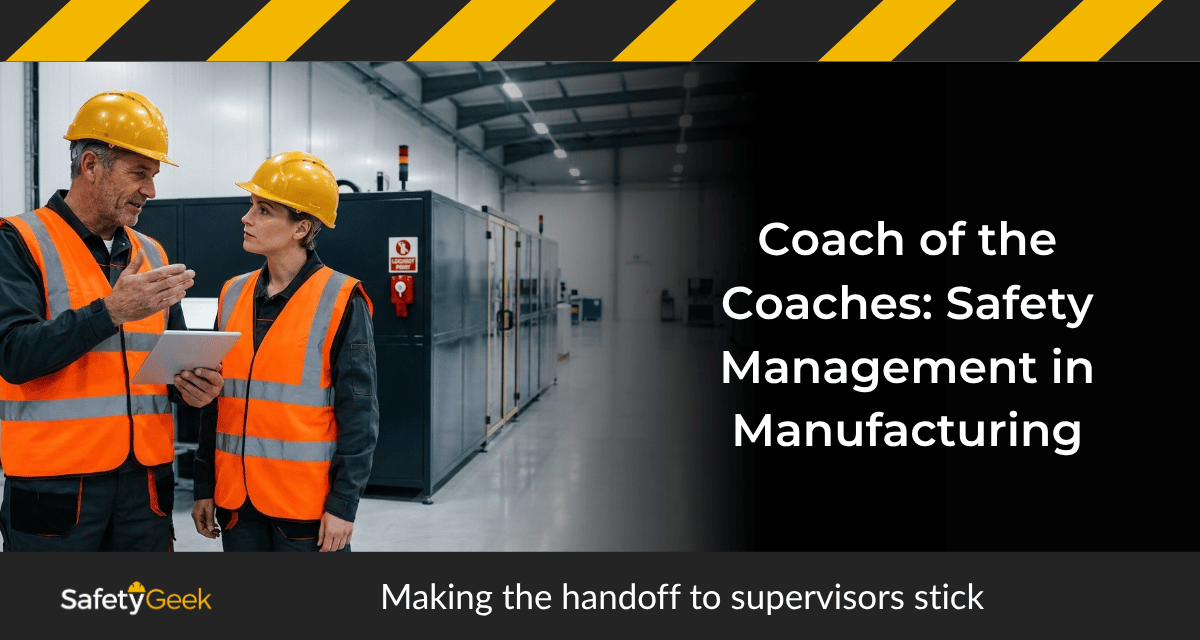
The coach-of-the-coaches model for safety management in manufacturing works like this: supervisors enforce safety, and you coach the supervisors. You stop being the person on the floor correcting operators, because you were never in their line of power to begin with.
Do you ever walk into a room and watch the eyes roll and everybody’s posture change?
You’re the one chasing the guy without hearing protection.
You’re the one whose numbers won’t budge below industry standard.
You’re the one still spinning too many plates at 6 o’clock on a Thursday.
That was me for years… before I figured out what I had backward.
## Key Takeaways
- The coach-of-the-coaches model puts supervisors in the enforcer role because they hold authority over the employee’s job, pay, and schedule. You don’t.
- Your job becomes 5 things: build the resources, train supervisors to use them, stay available to guide them, audit what’s actually happening, and report results upward.
- OSHA’s own Recommended Practices back this up. Employers should assign safety responsibilities to specific people, train supervisors in those roles, and hold them accountable.
- Training supervisors once doesn’t work. Training moves the supervisor. It doesn’t move the crew until you keep coaching and observing.
- Accountability needs all 5 pieces: commitment, training, consequences, authority, and consistency. Safety can supply 4. Only the line of power supplies authority.
- Your executive advisory committee is where supervisor performance is reported, which turns your observations into actual consequences.
What the Coach of the Coaches Model Actually Is
The coach of the coaches model is a safety management structure where front-line supervisors deliver, enforce, and coach safety with their own teams. In contrast, the safety professional builds the system, trains the supervisors, audits performance, and reports to leadership. You’re the guide on the side. You are NOT the doer.
Traditionally in safety, anything that smelled like a safety issue got handled by the safety lead. A belief floats around every manufacturing plant that safety knows everything, so safety should do everything.
That belief is how a department of one ends up with 50 hours of work stuffed into a 40-hour week.
But safety is an auxiliary position, same as HR or the controller. We sit outside the chain of command on purpose.
What changes on your calendar
The shift is easier to see when you look at where the hours go. Same job title, completely different week.
| The doer version | The coach of the coaches version |
|---|---|
| You’re putting out fires on the floor all day | Supervisors correct their own operators |
| You deliver every safety training session | You train supervisors to deliver it |
| You conduct the observations | You observe the supervisors conducting them |
| You chase down corrective actions nobody closes | You track them and report the gaps |
| You get blamed for the injury rate | The department that owns the work owns the number |
Notice that nothing on the right side is less work. It’s different work. You’re building capacity in 12 supervisors instead of trying to be in 12 places at once.
The role in 5 verbs
Here’s the whole job description, and it fits on a sticky note.
Create the resources the organization will use.
Train the people who are going to use them.
Be available to answer questions and point them the right way.
Audit what they’re actually doing against what the policy says.
Report the program’s health to executives.
Everything else you’ve been carrying belongs to somebody else, and you’ve just been volunteering for it.
Why Supervisors Have to Be the Enforcers in Manufacturing
Employees follow the person who controls their daily work life. In a manufacturing plant, that’s the supervisor who assigns their line, approves their overtime, and signs their review. It’s not you, and no amount of expertise changes that.
I learned this one in a meat processing plant. I was rolling out a hearing protection program in a semi-loud environment, and getting people to wear their plugs was a fight.
The tables were stainless, and a lot of workers had knives in their hands.
So when I walked into the production room, you’d hear this banging move across the room like a wave… workers hitting their knives on the tables to warn everybody I was coming. Like a very hostile wind chime, three tables out.
Grown adults, warning each other that I was in the building. It stung more than I let on at the time (about 2 years’ worth, if we’re being honest).
Then I got over myself and looked at what it actually told me. The training had landed, because you can’t warn each other about a rule you don’t know. What bothered me was that they never did it when the SUPERVISOR walked in.
The diagnostic hiding in that story
Whoever the room braces for is the person carrying the enforcer identity. That’s true whether or not you’re the one writing anybody up.
That’s the room telling you it sees you as the person who can CAUSE the write-up. Nobody signs up to be the department of “NO.” Most of us got there without noticing.
You’ve got your own version of this. Maybe it’s the conversation that stops when you turn the corner, or the operator who suddenly finds his safety glasses when he clocks you at the end of the aisle. Whatever your building’s tell is… it’s pointing at the same thing mine was.
And the fix is structural. The supervisor has to be the one the room adjusts for, which means the supervisor has to deliver the message in the first place.
The lockout example that makes it obvious
Say safety trains the crew on all the lockout steps. Then the supervisor tells them to skip steps 2 and 3 to get the line running.
Which one do they follow? Every single time, the supervisor.
Now flip it. Have the supervisor deliver the lockout training, and he can’t turn around 3 weeks later and tell his people to skip what he personally taught them.
The accountability lands with the person who actually has authority over those employees, and the gap between what’s taught and what’s tolerated closes on its own. That’s why supervisors must lead safety compliance.
## How to Train Supervisors to Lead Safety
Training supervisors to lead safety means teaching them the exact behaviors you want them doing. Hand a supervisor a binder and a deadline, and you’ll get a signature, nothing more. OSHA’s Recommended Practices for Safety and Health Programs is direct about this.
Employers should train managers and supervisors on their roles and responsibilities, on hazard recognition and control, and on how to respond to injury and hazard reports. OSHA also says to train them on how to avoid discouraging reporting.
Read that list again. Every single item is a behavior.
What to actually put in the training
Build supervisor training around what they’ll do on Monday:
- How to deliver a job-specific training session using the JHA you already built
- How to run an observation and give feedback on what they saw
- How to coach in a normal conversation without turning it into a meeting
- How to respond when someone reports a hazard so people keep reporting
- Where their department’s numbers come from and what moves them
Want the system behind all 5? Training supervisors to actually run safety is what the free training covers.
One class won’t hold it
A single session isn’t enough, and the evidence supports that. A CPWR study funded by NIOSH tested a front-line safety leadership training program across 20 companies.
Trained supervisors reported real, statistically significant gains in their understanding and use of leadership skills and their own safety practices. But crews reported NO significant change in safety climate over the same window.
That study ran in construction. The mechanism is identical, though, because a supervisor is a supervisor… and that’s the point.
Training moves the supervisor. Coaching and repetition are what eventually move the crew.
So I run a standing monthly supervisor meeting, and I run it the same way I run an executive advisory committee meeting. The difference is what I put on the screen. I show supervisors how their safety numbers hit their production goals, their efficiency numbers, and their bonuses.
Then I let a little competition do the rest. Nobody wants their department sitting at the bottom of the chart in front of their peers (I’m not above using peer pressure when it works this well).
You also lose the right to complain about supervisors not enforcing safety if you never properly trained them to. That’s not on you either, by the way. Nobody trained most of us how to train them.
THE ALL-ACCESS PASS RESOURCE PAGE
Get all the FREE templates, safety management resources, PDFs, spreadsheets, and more...
How to Observe and Coach Supervisor Performance
In the coach-of-the-coaches model, coaching and observations flip one level up: supervisors coach and observe employees, and you coach and observe supervisors.
Here’s why that matters more than it sounds. NIOSH researchers analyzed 2,136 pieces of supervisor feedback that 28 supervisors gave workers through a mobile app over 3 months.
Only 21.9% of it was specific to an actual hazard. About 73.5% was general supportive feedback, some version of “good job, be safe out there.”
Those supervisors weren’t slacking. Nobody had ever taught them what specific sounds like.
What good supervisor coaching sounds like
This is why “good job” is not safety coaching, and why the fix is so much smaller than people expect.
Here’s the version most supervisors give:
“Morning. Let’s be safe out there today.”
And here’s the same 10 seconds, done right:
“Hey, Warehouse Joe! Thanks for looking for pedestrians as you drove over here. There is a truck at dock door 4 I need you to unload; put the product in aisle 7. Thanks.”
See how it just fits into the conversation? You can barely spot the pedestrian safety SOP in there.
But it hits every element that builds culture: safe work method, supervisor-led, repetition, positive reinforcement: no form, no documentation, no meeting, just a conversation with a safety reminder attached.
That’s the behavior you’re coaching for. And when you sit in on a supervisor’s safety observation, you’re listening for the thing the first version never mentions…a hazard.
Assess the department, coach the supervisor
Observations are the supervisor’s tool. Assessments are yours.
Pick one job task and assess every employee doing it across a department. Now you have data on that supervisor’s team instead of a hunch. You can put a compliance percentage next to a department and the supervisor who owns it, compare across the plant, and hand the whole thing to your executive advisory committee.
And when a supervisor isn’t performing, you take it to THEIR manager. That’s the same escalation you’re asking them to run with their own people, moved up one line.
## How to Hold Supervisors Accountable Through the Executive Advisory Committee
Accountability needs 5 things in order: commitment, training, consequences, authority, and consistency. Safety can build 4 of them. Authority is the one we can’t manufacture, and it’s the one that sinks most programs.
You’ve probably watched this happen. Leadership expects safety to enforce safety, so you’re handed responsibility for consequences you have no standing to impose.
Then you get to be the bad guy about it AND get blamed when it doesn’t stick. It sucks, and it’s not a you problem.
Where the executive advisory committee comes in
Your executive safety advisory committee is where commitment gets locked down and where supervisor performance gets reported. That’s what the committee is FOR.
You bring the assessment data. You show which departments are following the SOPs and which aren’t. Then the executive team sets the expectation…
…and it flows down through the line of power to the directors, to the managers, to the supervisors.
You never have to be the one imposing a consequence. You just have to be the one holding the flashlight (which is a much better job, and nobody bangs a knife when you walk in).
Consistency is where it usually breaks
The other piece that fails is consistency, and it fails in a very specific way. An employee lifts wrong and herniates a disc; the investigation finds an SOP violation, and the company writes him up.
But that wasn’t the first time he lifted that way. It was just the first time it got expensive.
When consequences only show up after a costly outcome, you’ve told everyone the real rule: violating the SOP is fine as long as it doesn’t cost money. That’s how holding supervisors accountable for safety falls apart before it starts. Consequences have to follow the behavior, not the injury.
What happens if you don’t make the switch
Picture your calendar 6 months from today with none of this in place. You’re still walking the floor correcting operators, and your rate is still parked at industry average.
Your supervisors are still telling crews to skip lockout steps 2 and 3 a month after you trained them. And when leadership finally asks who owns the injury rate, the answer is still you.
Frequently Asked Questions About the Coach of the Coaches Model
What does “coach of the coaches” mean in safety management?
It means the safety professional coaches supervisors, and supervisors coach employees. Safety creates the resources, delivers supervisor training, audits performance against policy, and reports program health to executives. The supervisor handles day-to-day coaching, observations, and corrections with their own crew.
If I stop doing everything, won’t people think I do nothing?
This is the real fear, and it’s a fair one. The answer is your reporting. When you hand leadership assessment data, department compliance percentages, and trend lines every month, your value stops being measured by how many hours you spent on the floor and starts being measured by what you can prove.
My supervisors say they don’t have time for safety. What now?
They hear this as an extra job stacked on their real one, and some will tell you you’re just passing the problem. Try this: “I’m not adding to your day. I’m giving you the numbers behind it.” Then show them how safety hits their production, efficiency, and bonus targets.
What if I don’t have an executive advisory committee?
Then building one is your first project, because the accountability piece won’t hold without it. Start smaller than a committee. Ask for 10 minutes on an existing leadership meeting agenda, bring one department’s assessment data, and let the numbers earn you the standing meeting.
Who’s legally responsible if I hand safety tasks to supervisors?
The employer is. OSHA’s guidance covers assigning responsibilities, training people for them, and holding them accountable for performance, and none of that transfers legal duty. Delegating execution to supervisors is a recommended practice for running a program, and management still owns the outcome.
How long before this shows up in my injury numbers?
Expect supervisor behavior to change first, and crew behavior to follow later. Research on supervisor safety leadership training found leaders improved quickly while crew-reported climate lagged. Plan on a full year of consistent training, observation, and reporting before your lagging indicators move.
Now It’s Your Turn
Give the enforcement back to the people who actually have authority, and spend your week on the 5 things only you can do.
Kelly Dunn is what it looks like finished. As Director of Safety across 130 offices, she swapped directing people for influencing them, put local safety coordinators in place, and got senior leadership engaged for the first time by bringing them business numbers.
Keith shows how it starts. He runs a safety team of 2 covering 400+ employees across multiple locations, and here’s his first move: “Behind the scenes, I’ve started trying to move in that direction a little by getting supervisors more involved with toolbox talks/training and just getting them more comfortable being the ones delivering the message, even if it’s small steps right now.”
Small steps right now… that’s the entry point. He was still working through the course when he wrote it.
Do this in the next 2 weeks
- Pick ONE process to hand over. Lockout training is a good first one because the authority gap is so obvious there.
- Put a monthly supervisor meeting on the calendar. Bring their production and efficiency numbers… that’s what buys their attention.
- Run one assessment.<br />One job task, every employee doing it, one department.<br />That’s your baseline.
- Take the results to your executive team and let them set the expectation.
- Sit in on one supervisor’s observation and listen for whether they’re being specific or just saying “good job.”
Manufacturing ran a total recordable case rate of 2.7 per 100 full-time workers in 2024, according to BLS injury and illness data. You’re not going to out-walk that number by yourself, and you were never supposed to.
Does this sound like your job? Then you’ll want the rest of it. The free training walks through the Safety Influencer System… how you build management support and employee participation without fighting for either one.
You’ve been carrying a job that was never supposed to be yours alone. You got this.
Hi, I'm Brye (rhymes with sky)! I am a self-proclaimed safety geek with two decades of general industry safety experience. Specializing in bringing safety programs to a world-class level and building a safety culture, I have trained and coached many safety managers, just like you, on how to effectively manage workplace safety in the real world. I would love to help you too.