Estimated Reading Time: 8 minutes
TL;DR: The employee right to understand vs right to know in HazCom comes down to access versus use. Right to know means workers get labels, safety data sheets, and training. Right to understand means they can read that information, make sense of it, and act on it. OSHA expects training in a language and vocabulary your workers follow, and inspectors look past the paperwork to check.
The employee right to understand goes beyond the right to know. Right to know means your workers get labels, safety data sheets (SDSs), and HazCom training. Right to understand means they can read what’s in front of them, use it, and act on it.
Maybe you’ve got the binder, the roster, and a drawer full of signatures…and you still wonder if a new hire could find an SDS in a hurry.
If you’re the safety lead, that roster is also the paper you’d hand an inspector. So what happens when the inspector asks a worker to show them the SDS, and they can’t?
That question matters because Hazard Communication is the #2 most cited standard on OSHA’s FY 2025 Top 10 list. Safety+Health Magazine’s report on the list counts 3,010 violations. Later in this post, I’ll share a supervisor who knew exactly what to do and still lost his sight, and what happened when I tested an eyewash station at a new acquisition.
Key Takeaways
- Right to know gives workers labels, SDSs, a written program, and training. Right to understand means they can find the SDS, read the pictograms, and say what they’d do in a spill.
- OSHA says required training must be presented in a language and vocabulary employees can understand.
- SDSs must be readily accessible during each work shift, and electronic access can’t create barriers.
- Inspectors look beyond training records to see whether employees can understand and apply the training.
- A 5-question floor check shows you gaps a roster can’t.
What’s the Difference Between the Right to Know and the Right to Understand?
The right to know is a worker’s access to information about the hazardous chemicals in their work area. The right to understand is a worker’s ability to make sense of that information and use it to stay safe.
OSHA’s Hazard Communication page frames the revised standard this way: the standard that gave workers the right to know now gives them the right to understand. The 2012 update lined the standard up with the Globally Harmonized System. That brought standard label elements (signal words, pictograms, hazard statements, and precautionary statements) and a set order of 16 sections on every SDS.
Right to Know: What Your Employer Provides
Right to Know covers the basics that OSHA’s Hazard Communication standard, 29 CFR 1910.1200, requires. That means a written program, a list of hazardous chemicals, container labels, an SDS for each chemical, and training.
You can check off every item on that list with paper. And a worker can have all of it in front of them…and still not know what to do.
Right to Understand: What Workers Can Do
Here’s what the right to understand looks like on the floor. A worker can find the SDS for the chemical in their hand, read the pictograms on the label, and tell you what they’d do after a splash or a spill.
Could every worker on your night shift do that? You can’t verify it from a binder.
| Right to Know | Right to Understand | |
|---|---|---|
| What it means | Workers have access to hazard information | Workers can read, use, and act on that information |
| What the employer provides | Written program, labels, SDSs, training | Training in a language and vocabulary workers follow, plus SDS access with no barriers. |
| How you prove it | Records, rosters, and files | Workers show you on the floor |
| What failure looks like | A missing SDS or an unlabeled container | A signed roster and a worker who can’t find the SDS |
What Does OSHA Require for HazCom Training and SDS Access?
Training and SDS access carry most of the right to understand. Language runs through both of them.
Training Under 1910.1200(h)
Employers must give employees effective information and training on the hazardous chemicals in their work area. That happens at initial assignment and again whenever a new chemical hazard is introduced. Training can cover hazard categories, like flammability, or specific chemicals, but chemical-specific information must always be available through labels and SDSs.
Training has to cover at least these 4 things:
- How to detect the presence or release of a hazardous chemical, such as monitoring, visual appearance, or odor
- The physical and health hazards of the chemicals in the work area
- The protective measures workers can take, including work practices, emergency procedures, and PPE
- The details of your program, including how to read your labels and SDSs and how to get and use the hazard information
Deciding between category-based and chemical-specific training? The breakdown of hazard category vs chemical-specific training covers that choice.
SDS Access During Every Shift
Employers must keep an SDS in the workplace for each hazardous chemical they use. They must ensure those SDSs are readily accessible to employees during each shift, in their work area.
Electronic access is allowed when it creates no barriers to immediate access. A tablet with a password nobody knows, or a computer in a locked office, doesn’t meet that. And an SDS binder that lives in a locked office is pencil whipping with extra steps.
Language and Vocabulary
OSHA’s training standards policy statement says required training must be presented in a manner employees can understand. That means a language and vocabulary they follow. If a worker’s vocabulary is limited, the training has to account for it.
If a worker can’t read, telling them to read the training materials doesn’t meet the training duty.
Labels and SDSs stay in English under the standard, though you can add other languages. The training around them is where understanding gets built. For ideas on delivering that across languages, see Safety Training When Your Audience Doesn’t Speak the Language.
THE ALL-ACCESS PASS RESOURCE PAGE
Get all the FREE templates, safety management resources, PDFs, spreadsheets, and more...
What Do OSHA Inspectors Look for Beyond HazCom Paperwork?
Inspectors want proof the training landed. OSHA’s policy statement tells compliance officers to verify that training was provided in a format the workers could understand.
Inspectors Look Past the Training Roster
That same policy statement tells compliance officers to look beyond basic paper documentation. An employer may have training records, but employees may not have understood the training. When an officer finds a deficiency, they document barriers to understanding and any facts showing employees couldn’t apply the training in the workplace.
When a Gap in Understanding Becomes a Citation
If a reasonable person would conclude the employer didn’t convey the training in a way workers could understand, OSHA can cite the violation as serious if it falls within its guidelines.
But a clean roster doesn’t protect you. Passing an inspection is a C grade, and I didn’t get Cs in school.
How to Check the Employee Right to Understand on Your Floor
A quick floor check shows you what a roster can’t. It takes 5 questions and 3 workers across different shifts, which is a lot when you’re the only person on the floor. That’s why a supervisor comes along.
Tell the workers up front that this is a check on your training, then ask them to show you.
Ask 5 Questions at the Work Area
- “Show me where the SDS is for this chemical.”
- “What does this pictogram mean?”
- “What does the signal word on this label tell you?”
- “What would you do if this splashed on you or spilled?”
- “Who do you ask if you find a container with no label?”
Write down what each person does, not only what they say. A question that takes more than a few seconds, or gets a shrug, points to a gap in your training or your setup.
Here’s the thing…a quiz doesn’t verify understanding. I’d rather watch someone do the task. Training builds the knowledge in the Implement & Train stage of the Safety Management Cycle, and Coach & Observe is where you find out it’s stuck.
Make the Safe Step the Easy Step
On the podcast, I shared the story of a maintenance supervisor who got sprayed with ammonia while working on a roof. He knew exactly what he should do.
But the eyewash station was back inside, more than 40 seconds away, and he only had a couple of things left to do. So he finished the job before he treated himself.
He ended up with permanent lung damage and complete blindness.
Understanding the hazard only helps if the next step is within reach.
So when I walked into a new acquisition, I tested the eyewash station. It was blocked. And when I ran the water, it came out rusty.
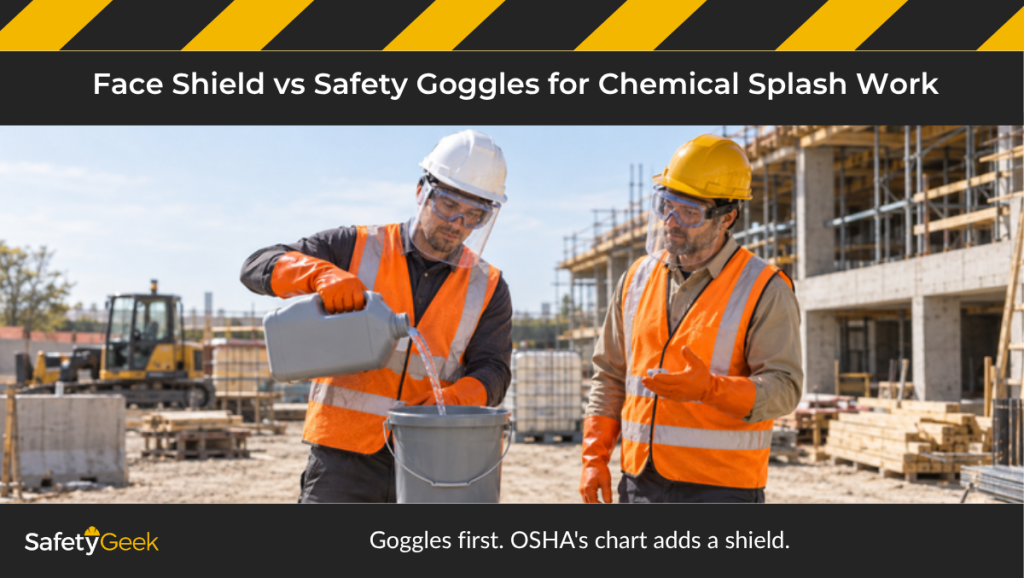
I ran chemical splash simulations where employees had to get to the eyewash quickly…and they couldn’t.
Supervisors saw it for themselves. That did more than any memo would have, and we added eyewash capability to the room sinks.
Fix the Gaps You Find
- Language gap: retrain in the language and vocabulary the worker follows, then ask them to explain it back.
- SDS access gap: remove the barrier, whether that’s a locked office, a password, or a dead terminal.
- Label gap: start with your secondary containers. The secondary container labeling guide walks through the rules, and the pictogram and label QuickCards on OSHA’s HazCom page work well posted at the point of use.
Frequently Asked Questions About the Right to Understand in HazCom
What is the right to know under HazCom?
It’s a worker’s right to information about the hazardous chemicals they work with. Employers meet it with a written program, a chemical list, container labels, an SDS for each chemical, and training. OSHA’s Hazard Communication standard, 29 CFR 1910.1200, sets those requirements.
What is the right to understand under HazCom?
OSHA uses the phrase to describe workers’ ability to find and make sense of hazard information. Standard labels with pictograms, and SDSs in a set 16-section order, make that easier. Training in a language and vocabulary workers follow completes it.
Does HazCom training have to be in my workers’ language?
OSHA’s training policy says required training must be presented in a manner employees can understand. That includes a language and vocabulary they follow. Labels and SDSs stay in English, but you can add other languages, and the training should be in the language your workers use.
Can I keep SDSs on a computer or tablet?
Yes, as long as access has no barriers. OSHA allows electronic access, but SDSs must stay readily accessible to employees in their work area during each work shift. A password workers don’t have, a locked office, or a broken terminal can turn electronic access into a violation.
Do I need to retrain for the 2024 HazCom changes?
Employers must provide additional training for newly identified hazards. The deadline to update workplace labeling, your program, and training is November 20, 2026, for substances and May 19, 2028, for mixtures. The 2024 HazCom final rule breakdown covers what changed.
Now It’s Your Turn
Pick 3 workers, ask 5 questions, and watch what they do.
Here’s where to start this week:
- Have a supervisor join you, pick 3 workers on different shifts, and ask them the 5 floor-check questions.
- Find the SDS access point in each work area and remove any barrier to it.
- Set a date to repeat the floor check, and write down what you find.
Does that sound like your week? Wouldn’t it be nice to have your supervisors running these floor checks alongside you?
My free training on the Safety Influencer System shows you how to get supervisors running the floor checks with you, so you stop being the bottleneck.
You got this, my safety friend.
Hi, I'm Brye (rhymes with sky)! I am a self-proclaimed safety geek with two decades of general industry safety experience. Specializing in bringing safety programs to a world-class level and building a safety culture, I have trained and coached many safety managers, just like you, on how to effectively manage workplace safety in the real world. I would love to help you too.