Estimated Reading Time: 10 minutes
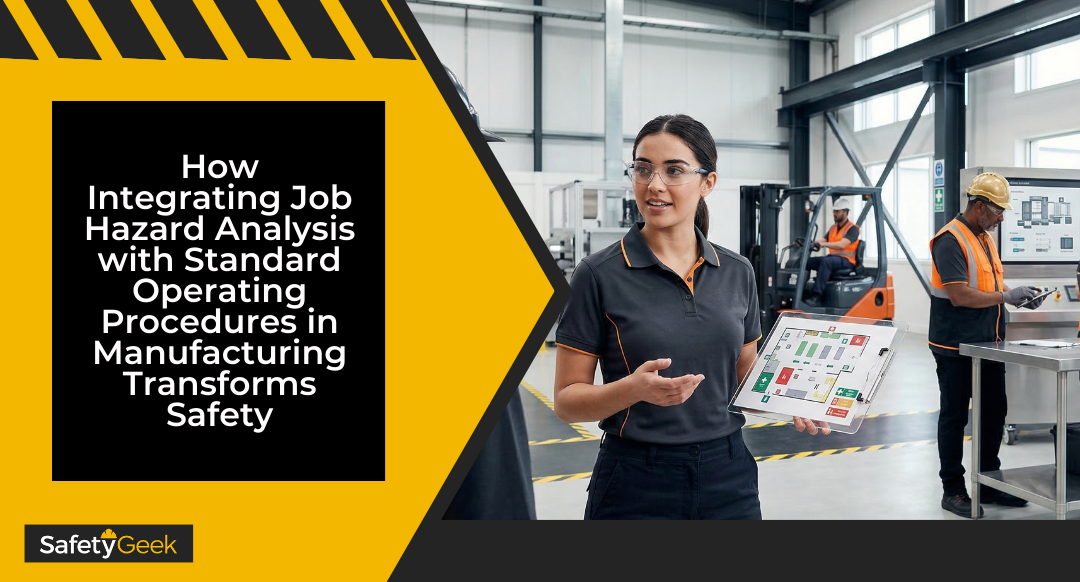
Integrating job hazard analysis with standard operating procedures in manufacturing is essential to turning your safety paperwork into actual behavior change on the production floor. When your JHA and SOP actually talk to each other, hazard controls manifest in real work environments, not just as documentation in a binder. This integration is the key difference between safety that looks good on paper and safety that truly protects people.
Many manufacturing safety professionals have experienced the frustration of investing significant time into a solid JHA, only to see it sit unused while no changes occur at the machine. Manufacturing safety pros report that JHAs and SOPs often live in completely separate silos, leaving a dangerous gap between written procedures and actual floor practices. This post outlines a step-by-step process to close that gap for good and improve your safety culture and outcomes.
By following this guide, you’ll learn why the JHA SOP combined approach is the engine behind high-performing safety programs, how to convert hazard analysis into practical SOPs, what pitfalls to avoid, and how to measure success so safety becomes a profit center, not a cost.
Key Takeaways
- The JHA SOP combined approach is critical for a high-performing manufacturing safety program.
- A six-step workflow can help you turn job hazard analyses into written procedures workers actually follow.
- Common pitfalls include isolated SOP creation, excessive hazard data in SOPs, and lack of coaching and validation.
- Measurement and feedback using the Safety Management Cycle are vital for ongoing improvement.
- Integrating JHAs and SOPs moves your safety culture from compliance to ownership and operational success.
Why Integrating Job Hazard Analysis with Standard Operating Procedures in Manufacturing Is Non-Negotiable
Almost every manufacturing site has JHAs. Most have SOPs, too. But let’s be honest… they rarely talk to each other. And that gap? It costs you more than you realize. Research from the American Institute of Chemical Engineers shows that when hazard analysis and procedures are separate, workers default to habit over protocol… and controls get skipped. That’s not a people problem. That’s a systems problem.
The JHA SOP combined approach fixes the system. When you bake your safety controls right into the SOP steps, workers don’t have to remember to be safe – the safe way is the ONLY way you describe the work. It’s how safety documentation integration transforms culture from “follow the rules or else” to “this is just how we do the job.”
But here’s the thing… this is also how you move from unnoticed to undeniable as a safety leader. When your JHAs connect to SOPs and those SOPs drive results, you bring data, stories, and credibility that gets you a REAL seat at the table. That’s not just compliance… that’s braggable results for the whole site.
This model fits right into the Safety Management Cycle. The Identify phase is for your JHA. The Develop phase is for your SOP. If those don’t connect, your cycle’s broken and safety is just talk. EHS.com job safety analysis overview backs it up – when you embed hazard controls in operations, you get better compliance and fewer incidents.
The Safety Leadership Academy has modules that show you how to build this from scratch. Think of it as your “guide on the side” – not a replacement for your judgment, but the help every “team of one” safety pro deserves.
Step-by-Step Workflow to Integrate Job Hazard Analysis with Standard Operating Procedures in Manufacturing
Ready to make change real? Here’s the workflow safety professionals use to turn JHAs into reliable SOPs. This isn’t theory. You can pick up your existing JHAs and start right now.
- Identify Hazards and Tasks
- Streamline and Prioritize Controls
- Translate Controls into SOP Language
- Engage Front-Line Supervisors Early
- Integrate Observation and Coaching Tools
- Train, Implement, and Iterate
Step One: Identify Hazards and Tasks
Grab your JHAs for jobs with the highest incidents or injury potential. Break every job into clear tasks. For each step, list the hazards: machine, chemical, ergonomic, fall risk, whatever you find. This JHA implementation guide for manufacturing is crystal clear: front-line operator input at this stage is ESSENTIAL.
Your workers know things your JHA never will. They see the shortcuts, the quirks, the steps everybody skips when they’re rushed. Get their voices in the process from Day One… because that front-line knowledge is worth its weight in gold.
Step Two: Streamline and Prioritize Controls
With your hazards in hand, run them through the hierarchy of controls: engineering first, admin next, then PPE. Use the OSHA Job Hazard Analysis Worksheet – it spells this out in language your crew understands.
Cut everything that’s not actionable. If workers can’t use a control right where the job happens, it’s not a real control. Ditch the jargon, keep only what a person at the machine can do, for real. You’ll find more on this in our hierarchy of controls case studies.
THE ALL-ACCESS PASS RESOURCE PAGE
Get all the FREE templates, safety management resources, PDFs, spreadsheets, and more...
Step Three: Translate Controls into SOP Language
Here’s where the magic of integrating job hazard analysis with standard operating procedures kicks in. Take each control and rewrite it as a simple SOP step. Swap “verify interlocking safety devices are engaged” for “check the interlock before starting the machine, every time.” Plain words get followed and fancy words don’t.
Always cross-reference each SOP step back to the JHA. Supervisors and workers need to know WHY a step is there. When you give the “why,” people own the behavior. That’s the heartbeat of real change.
Step Four: Engage Front-Line Supervisors Early
Don’t finalize your SOPs at your desk. Bring drafts to the floor. Sit with real operators and supervisors. Test every step against what really happens.
This step breaks the “team of one” curse. When supervisors help craft the SOP, they own it. When they own it, they coach it, so YOU become the coach of the coaches, not the safety police.
Step Five: Integrate Observation and Coaching Tools
An SOP without coaching tools is isolated. Attach a field observation checklist to every SOP. That way, supervisors have a clear way to coach; no more just “pencil whipping” audits. Active coaching makes safe behaviors stick.
This isn’t about pulling out the safety police hat. Instead, give your supervisors tools that make coaching natural, not confrontational. The Safety Leadership Academy is built for this. For practical guidance, read the coach of the coaches.
Step Six: Train, Implement, and Iterate
Roll out the new SOPs with formal training sessions. Then, watch real work in action: did the training stick? AIChE research says procedures must evolve every time hazards, equipment, or workflow shift.
SOPs only work if you keep them current. Set a schedule to review and tie it to incident investigations, near misses, or equipment changes. Never treat a finished SOP as fixed. Update it as you update your JHAs.
Avoiding Common Pitfalls in the JHA to SOP Workflow for Manufacturing
Even experienced pros trip on the same landmines with JHA-to-SOP integration. Here’s where things commonly go wrong:
- Building SOPs alone, without operator input.
- Packing the SOP full of hazard data until nobody reads it.
- Settling for “pencil whipping” over real coaching.
- Skipping the Analyze phase.
- Letting SOPs and JHAs drift apart.
The JHA SOP combined approach holds only when every person is accountable: safety manager, supervisor, operator. The Safety Leadership Academy’s frameworks help you build accountability that sticks without turning the process into a compliance audit. For methods to build culture and ownership, see How Workplace Safety and Accountability Shape a Positive Culture.
Measuring Success and Feeding Back into the Safety Management Cycle
Measurement makes your safety work VISIBLE. If you’re not tracking, you’re just hoping. What gets measured gets managed.
The Analyze phase of the Safety Management Cycle is where integration lives or dies. EHS.com’s compliance and hazard assessment resource confirms: track both leading and lagging indicators tied to SOPs, and you’ll have clarity and evidence to back your work.
Key KPIs for integrated safety and operations:
- Incident frequency and severity rates for those tasks
- Audit and compliance scores, before and after SOP rollouts
- Supervisor coaching and observation touchpoints per month
- Near-miss reporting rates (higher is better at first, shows growing safety awareness)
- Operational improvement metrics tied to safer, standardized work
These are the wins that get you a seat at the table. If you can show a 30% incident drop on lines with integrated SOPs, you’re talking operational results – REAL business language. That’s how you get traction with leadership.
The Safety Leadership Academy offers analytics and reporting training that equips you to share your story and data – the RIGHT way – with leaders and executives. That’s how you keep building on your safety wins.
Frequently Asked Questions About Integrating Job Hazard Analysis with Standard Operating Procedures in Manufacturing
What is the difference between a JHA and an SOP in manufacturing?
A Job Hazard Analysis (JHA) breaks a job into steps, marks the hazards at every step, and explains how to control them. A Standard Operating Procedure (SOP) shows exactly how to do the task safely and correctly. The JHA spots the risk; the SOP tells the safe steps, so the control is built into the job. When JHA and SOP are linked, hazard management is automatic.
Check How to Know Which is Best: JHA vs. SOP vs. Policies & Procedures for the full breakdown.
How do you start converting a job hazard analysis to standard procedures?
Start with your riskiest or most incident-prone task. Pull its JHA, grab every hazard control, and rewrite them in plain, action-based language that fits the actual workflow. Validate every draft with an operator and a supervisor before you finish.
Why do JHAs and SOPs fail to work together in manufacturing?
Typical reasons: Safety writes the JHA, operations writes the SOP. Two teams, no talk. SOP gets overloaded with hazard info, becomes useless. Finally, nobody coaches or observes after training, so the SOP gets ignored. You fix it by following an integrated workflow and coaching system that’s tied – step by step – to the procedure.
How often should integrated JHAs and SOPs be updated?
Review them at least once a year. Trigger a review anytime there’s a work process change, new equipment, a near-miss, a recordable, or a rule update. Hazards evolve, so your documentation must stay live. Tie every update to the Analyze phase in your Safety Management Cycle to keep it effective.
How does integrating JHAs with SOPs support OSHA compliance?
OSHA expects that hazards you identify get fixed with procedures that workers can follow. When your JHA controls are inside your SOPs, you show a documented process for both hazard ID and control. That makes audits easier and cuts the risk of hazard-based citations.
Take Action
You don’t need perfection to start. You just need your current JHAs, a word processor, and a connection with your front-line supervisors.
- Pull JHAs for your top three incident-heavy or high-severity tasks. Flag every hazard and control.
- Draft plain-language SOP steps with those controls, one action per step. Add the “why” as a JHA reference.
- Share the draft with operators and a supervisor this week. Ask for missing steps, unclear pieces, or easier ways. Make edits live.
You got this. I got you. Safety is the Golden Opportunity. When you integrate job hazard analysis with standard operating procedures in manufacturing, you create real and measurable results; results that leadership can’t ignore.
Now It’s Your Turn
What’s your biggest barrier to turning JHAs into SOPs your people will actually use? Are you struggling to get operator buy-in… leadership support… or just not sure where start? Drop your thoughts in the comments, Safety Friend. Let’s solve it together.
If this guide gave you a fresh approach, share it with a safety pro who needs a boost. Let’s keep building this community where safety results actually HAPPEN and nobody is stuck figuring it out alone.
Hi, I'm Brye (rhymes with sky)! I am a self-proclaimed safety geek with two decades of general industry safety experience. Specializing in bringing safety programs to a world-class level and building a safety culture, I have trained and coached many safety managers, just like you, on how to effectively manage workplace safety in the real world. I would love to help you too.