Estimated Reading Time: 8 minutes
TL;DR: To build a safety program that runs without the safety manager, you have to stop being the system and start building it. That means three things… supervisors own daily compliance, leading indicators get tracked by the people doing the work, and every task lives in a written SOP. Your job shifts from doing safety to coaching the people who do it.
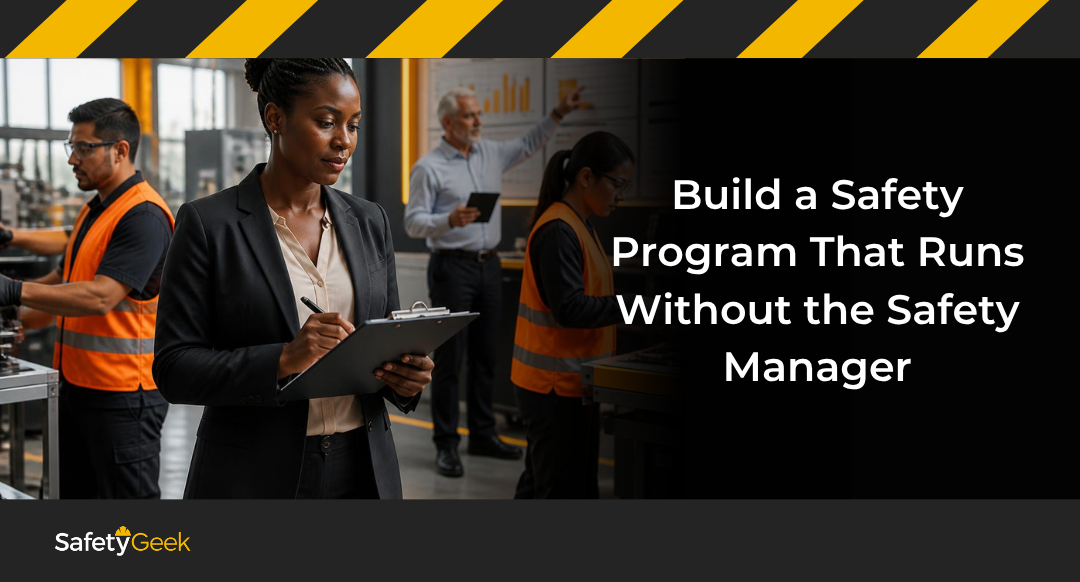
You build a safety program that runs without the safety manager by handing daily ownership to the people who already control the work. Supervisors own compliance on their floor. You own the system that makes that possible.
Most safety leads I talk to feel like the only thing holding safety together. Take a week off and the inspections stop, the toolbox talks stop, and the corrective actions sit until you get back. That’s not proof you’re doing a great job… it’s proof you built a program that depends on a person instead of a process.
Key Takeaways
- Your job is to build the system, not be the system. A program that needs you in the room every day has a single point of failure, and that point is you.
- Supervisors own daily compliance. Corrections have to come from someone inside the employee’s line of power, and that has never been the safety department.
- Leading indicators make the handoff visible. When supervisors own the numbers, you can prove the program is working without standing there watching it happen.
- Written SOPs carry the knowledge. If the right way to do a task only lives in your head, the program walks out the door when you do.
- Independence is measurable. You can score how much of your program runs without you, then track that score quarter over quarter.
- This is a career move, not a workload dodge. Safety leads who build systems get promoted. Safety leads who are the system stay stuck doing the same job forever.
What It Takes to Build a Safety Program That Runs Without the Safety Manager
A self-sustaining safety program is one where the daily safety work is owned, performed, and documented by line management and employees, while the safety professional designs the system, trains the people running it, and audits how well it holds up.
Here’s what that looks like on a real floor. The production supervisor does the daily walkthrough because she’s already walking her area. The maintenance lead closes the corrective action because he owns the equipment. The team lead runs the five-minute pre-shift talk because his crew already gathers at shift change.
None of those tasks land on your calendar. What lands on your calendar is designing the walkthrough form, training the supervisor on what to look for, checking the completion data, and coaching the people who missed something.
That split isn’t you getting lazy. OSHA’s Recommended Practices for Safety and Health Programs assign safety responsibilities to managers, supervisors, and workers, not to one specialist holding the whole thing up. When you build it this way, the program survives vacations, turnover, and the three weeks you spend buried in an incident investigation.
The difference between a person-built program and a system-built program
| Daily Work | Built Around a Person | Built Around a System |
|---|---|---|
| Floor inspections | Safety manager walks every area, every day | Supervisors inspect their own area on a standard form |
| Corrective actions | Safety manager chases every open item | Area owner closes the item; safety tracks closure rate |
| Training delivery | Safety manager delivers every session | Supervisors deliver; safety builds the content and coaches |
| Metrics | Injury rate only, reported monthly | Leading indicators owned by each department |
| When safety is out | Everything pauses | Nothing changes |
| Career effect | You stay indispensable in the same seat | You get room to do strategic work and move up |
Look at that right-hand column honestly. Every single item is something a supervisor can do better than you can, because they’re already there and their people already answer to them.
Pillar 1: Give Supervisors Real Ownership of Daily Compliance
Supervisor ownership means the front-line supervisor is accountable for safety compliance in their area the same way they’re accountable for quality and output. Not helping with safety. Owning it.
This is the pillar most programs skip, and it’s the one that decides whether anything else sticks. You can write the best inspection form in the building… if the person completing it thinks it’s your form, for your program, it gets pencil-whipped by week three.
Why the correction has to come from their boss
You don’t have authority. You have influence. Unless you can hire and fire someone, a correction from you is a suggestion with a stern face.
When a supervisor corrects an employee, it carries weight because it comes from inside that employee’s line of power. When you correct the same employee, it goes in one ear and stays exactly as long as you’re standing there. That’s not a people problem; that’s an org chart problem.
OSHA’s management leadership element puts it plainly… managers and supervisors are expected to hold themselves and the people they supervise accountable for safety responsibilities. That’s the mechanism. Your job is to make it easy for them to use it, which is exactly the work of holding supervisors accountable when you have no direct authority.
How to hand over the work without losing the standard
Handing off doesn’t mean dumping. It means transferring a task with the training, the tool, and the follow-up attached.
- Pick one task, not ten. Start with the daily area walkthrough. It’s visible, it’s short, and supervisors are already in the area.
- Build the tool for them. A one-page form with five things to look for beats a 40-line audit checklist every time.
- Train them on the why, then the how. Adults do the thing when they understand what it prevents, not when they’re told it’s required.
- Put it in the operational routine. Attach it to something they already do, like the shift-change handoff, so it never becomes an extra errand.
- Coach, don’t take it back. When a supervisor misses a hazard, walk it with them and ask what they saw. The second you fix it yourself, you own it again.
Keith, one of our Academy students on a two-person safety team supporting 400-plus employees, started exactly here. He started having supervisors deliver the toolbox talks instead of doing them himself, and described it as small steps… getting them comfortable delivering the message. A few months later he was invited to join the executive team on a site visit.
That’s the pattern. Hand off the floor work, and you free up the calendar space that makes strategic work possible. This is the coach-of-the-coaches model, and it’s the whole reason the role exists.
THE ALL-ACCESS PASS RESOURCE PAGE
Get all the FREE templates, safety management resources, PDFs, spreadsheets, and more...
Pillar 2: Track Leading Indicators the Floor Actually Owns
A leading indicatormeasuresf safety activity before an injury, like inspections completed, hazards reported, or coaching conversations held. A lagging indicator measures what already went wrong.
Here’s the part most programs get bbackward They hand supervisors a lagging number, the injury rate, and expect ownership to follow. But nobody can control a number that only moves after someone gets hurt.
Give a supervisor a leading number, and everything changes. “Complete four area walks this month” is something they can do today, this shift, without anyone’s permission. That’s what makes the ownership real instead of ceremonial.
Which numbers belong to which people
| Indicator | Type | Who Owns It |
|---|---|---|
| OSHA recordable rate | Lagging | Safety reports it; nobody controls it directly |
| Workers’ comp cost | Lagging | Safety and finance report it |
| Area walks completed | Leading | Production supervisor |
| Hazards reported per employee | Leading | Department team leads |
| Corrective actions closed on time | Leading | Maintenance and area managers |
| Pre-shift talks delivered | Leading | Shift supervisors |
| Employee participation percentage | Leading | Plant manager |
Campbell Institute research on high-performing organizations points in the same direction… world-class programs measure supervisor engagement, inspection completion, and corrective action closure as primary indicators of program health, not just recordable rates. Line management owns those activities, which means line management owns the score.
Put those numbers on the operations scorecard next to production and quality. Not in a monthly safety report that goes in a drawer. If you want a deeper walkthrough of choosing the right ones, start with safety leading indicators and how to shift your team’s focus toward them.
Pillar 3: Put Every Task in a Written SOP
A standard operating procedure is a short written document that describes how a specific job gets done correctly, combining the operational steps, the quality requirements, and the safety controls in one place.
Notice what that definition does NOT say. It doesn’t say “safe work practice.” The moment you write a separate safety document for a job that already has a work instruction, you’ve told everyone that safety is the optional add-on version of the task.
Why documentation is what makes independence possible
Think about how much of your safety program lives only in your head right now. The reason that guard has to stay on. The two steps everyone skips on changeover. Which chemical can’t go near which other chemical.
All of that is real institutional knowledge, and none of it is transferable while it’s stored in one person. Written SOPs are how you move the knowledge out of you and into the operation.
Build them from the task level up. A job hazard analysis breaks one task into steps, hazards, and controls, and those JHAs combine into the SOP for the job title. That’s the practical mechanics of integrating job hazard analyses into your SOPs.
Keep them short. Bulleted lines, under eight words each, written for the person doing the job and not for a lawyer reading it later.
This is also where consensus standards back you up. ANSI/ASSP Z10.0 and ISO 45001 both treat safety as a management system with defined roles, documented processes, and measurable objectives. Both assume the program is bigger than any one professional running it.
How to Measure Whether Your Program Can Run Without You
You can’t manage what you don’t measure, and “does my program need me” is measurable. Run this readiness check twice a year and watch the score move.
Score one point for every statement that’s true today. Be honest… the version of this where you grade generously helps nobody.
- Supervisors complete their own area inspections without a reminder from me.
- Corrective actions are assigned to the area owner, not to the safety department.
- At least three leading indicators appear on the operations scorecard.
- Front-line supervisors deliver safety training and pre-shift talks.
- Every high-risk task has a written SOP that an employee could follow today.
- New hire orientation runs correctly when I’m not in the building.
- Employees report hazards to their supervisor first, not to me.
- The safety committee runs its own agenda without me driving the meeting.
- Incident investigations are led by the area manager with me as an advisor.
- I spent more hours last month on analysis and strategy than on floor errands.
8 to 10 points: Your program is a system. Your next move is business value work… ROI reporting, executive influence, and the seat at the table.
5 to 7 points: You’re partway there. Pick the two lowest-scoring items and rebuild those handoffs this quarter.
0 to 4 points: You ARE the program. Start with one task, one form, one supervisor. This is the same starting point as running a one-person safety department and it works the same way.
Then close the loop. OSHA’s program evaluation and improvement element calls for regularly reviewing whether the program is working and adjusting it, which is exactly what re-scoring this checklist gives you.
And run the real test… take a full week off and see what happened when you get back. That week tells you more than any audit.
Frequently Asked Questions About Building a Self-Sustaining Safety Program
Won’t I make myself unnecessary if the program runs without me?
The opposite happens. Companies don’t promote the person who does inspections… they promote the person who built a system that produces results across every department. Being indispensable in a task keeps you in that task. Being the architect of the system is what gets you a bigger seat.
How do I get supervisors to take safety ownership when they’re already slammed?
Attach the work to something they already do and make the tool short. A five-item walkthrough form during a shift-change handoff costs about four minutes. When it prevents one line stoppage or one injury investigation, they get that time back several times over.
What if my management team won’t back the handoff?
Start without permission. Nothing about training a supervisor, building a one-page form, or tracking completion requires budget or a policy change. Bring the first quarter of results to management as evidence, because the numbers persuade in a way the moral argument never will.
How long does it take to build a program that runs without the safety manager?
Plan on 12 to 24 months for a full transfer, but you’ll feel the first shift inside 90 days. One task, handed to one group of supervisors, with training and follow-up attached. Momentum comes from stacking small handoffs, not from one big rollout.
Doesn’t OSHA require a safety manager to be in charge of the program?
No. OSHA’s recommended practices assign safety responsibilities across managers, supervisors, and workers, and emphasize worker participation throughout. A distributed program with clear roles and documented accountability lines up with what regulators and consensus standards expect.
What’s the first thing I should hand off?
The daily area walkthrough. It’s short, it’s visible to employees, it produces data immediately, and it puts supervisors in the habit of looking at their area with safety eyes. Everything else gets easier after supervisors own that one.
Now It’s Your Turn
A safety program that runs without the safety manager isn’t a program you abandoned. It’s a program you built well enough that it holds on its own… supervisors owning daily compliance, leading indicators owned by the floor, and every task written down where anyone can follow it.
You’ve been carrying this thing on your back. Let’s start setting it down in a way that doesn’t drop it.
Take Action This Week
- Score the readiness checklist above and write the number down. That’s your baseline.
- Pick your two lowest items and choose ONE to fix this quarter.
- Build a one-page tool for the task you’re handing off. Five items, no more.
- Train one supervisor on the why before the how, and walk the first one with them.
- Put the completion number on the operations scorecard so it lives next to production and quality.
If you want the full framework for this, the Safety Management Influencer System practical guide walks through the five-phase Safety Management Cycle and the influence layer that gets supervisors and management to carry it with you. It’s the same structure we build with students inside the Safety Leadership Academy, and there’s a 30-day action plan in the back so you know exactly where to start.
You’re closer to this than you think. Build the system, stop being the system… you got this, Safety Friend.
Hi, I'm Brye (rhymes with sky)! I am a self-proclaimed safety geek with two decades of general industry safety experience. Specializing in bringing safety programs to a world-class level and building a safety culture, I have trained and coached many safety managers, just like you, on how to effectively manage workplace safety in the real world. I would love to help you too.