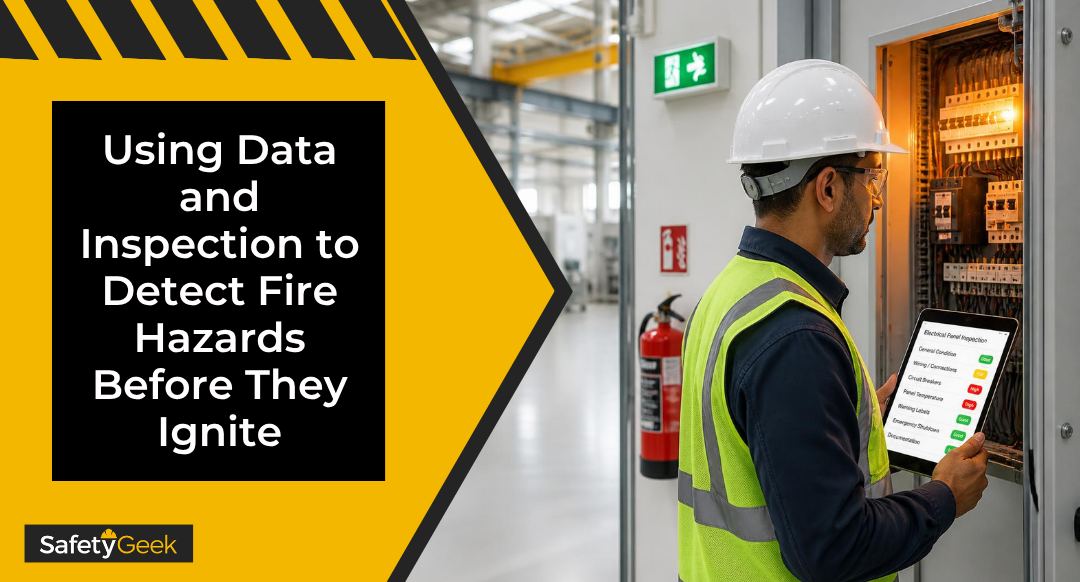
Transitioning from reactive responses to proactive prevention can protect your employees and infrastructure from fire hazards. Explore how to identify safety risks, document equipment conditions, track facility trends and prioritize fixes.
The Importance of Avoiding Fire Hazards in Your Workplace
Workplace fires pose severe risks to workers. In 2024, 119,500 nonresidential structure fires resulted in an estimated 170 civilian deaths and 1,020 civilian injuries. As the safety manager, it is your responsibility to protect the staff’s physical and psychological safety.
A fire can also have significant financial and operational impacts on a business, including costs for physical damage and injuries. Nonresidential structures faced $3.6 billion in direct property damage in 2024. Your team could avoid these costs with proper risk detection and mitigation.
How to Detect Workplace Fire Hazards
Data analysis and physical inspections can help you detect fire hazards.
Ensure Basic Safety Mechanisms Are Present
Look for and correct visible hazards during routine visual inspections. This may include unlocking exit doors when the building is occupied, keeping storage items out of stairwells and replacing faulty extension cords. It may be helpful to use a color-coded inspection log and mark “open,” “in progress” and “corrected” for each identified hazard.
You must also verify that emergency equipment is highly visible and accessible to employees, visitors and safety personnel. Anyone inside the building should be able to immediately spot safety signage, exit routes, fire extinguisher locations and first aid information. Each staff member should be trained on the use of these essential safety tools.
Uncover Hidden Electrical and Equipment Risks
Aging heating sources, damaged electrical wiring and other hidden hazards are often less visible and may lead to workplace fires if left unaddressed. For example, heat sources ignite about 52,000 fires annually, so identifying equipment with damaged or exposed electrical wiring is crucial.
Check for warm outlets, flickering lights, damaged cord insulation or frequently tripping breakers throughout the facility. Logging any recurring electrical problems by department, machine or room can make it easier to spot ongoing risks and identify patterns.
Adopt Data-Driven Risk Scoring
Create a simple risk-scoring system with factors such as severity, likelihood, equipment criticality and time since last inspection. This practice can help you give higher priority to machines with repeated overheating, leaks, abnormal fluid results or missed maintenance. For instance, contaminated or low-additive machinery coolant may overheat and pose a fire risk, so proactive coolant analysis can reveal issues for your team to interpret and solve.
Municipal frameworks, such as Firebird in Atlanta, compute fire risk scores based on historical data to identify commercial properties that most need inspection. You can apply this practice to your facility by recording and examining equipment data to determine maintenance, repair or replacement needs based on severity.
Automate Compliance Monitoring
Artificial intelligence (AI) can support continuous compliance monitoring, allowing your organization to proactively target risks. These tools review digital data and automatically flag repeated issues, such as blocked exits, missing extinguisher inspections or recurring storage near electrical panels. AI can also compare inspection results across departments or locations to identify which areas repeatedly fail fire-safety checks.
AI-assisted monitoring and alerts should complement, not replace, human judgment. You should pair them with human review, so your team can verify the hazard, properly document it and take the most appropriate action.
Tips to Mitigate Fire Hazards
Once risks are detected, your organization must understand how to handle them most effectively. Start by assigning each fire hazard an owner, deadline and severity level to establish accountability. Higher-risk hazards will require immediate action, while lower-risk hazards may fall under routine maintenance tasks.
Documentation is critical. You must note the correction date, the responsible party and the reinspection result. Once a hazard has been addressed, you should reinspect the area or equipment to confirm that the solution worked.
Ongoing mitigation strategies can also help prevent incidents. Update training, maintenance schedules or housekeeping procedures based on recurrent risks. Regularly review the top fire risks with operations, maintenance and leadership staff to keep everyone up to date with the organization’s fire safety needs.
Safeguard Your People and Property
Fire hazard detection and prevention have moved from baseline visual checks to more comprehensive, data-backed inspection programs. By auditing your facility’s current workflows and equipment, you can implement better data tracking today to prevent fires tomorrow.