Estimated Reading Time: 9 minutes
Each of these connects to a deeper subtopic. Selection ties directly to your hazard data and NIOSH guidance. Medical evaluation is a gatekeeper – nobody wears a tight-fitting respirator until a physician or licensed health care professional clears them. And fit testing has its own detailed methodology you’ll want to get right; the mechanics of qualitative versus quantitative testing are worth understanding before you write that section, which is why we broke down respirator fit testing procedures in their own deep dive.
The point isn’t to write nine paragraphs and call it done. Each element has to describe what your people actually do, with your equipment, against your hazards.
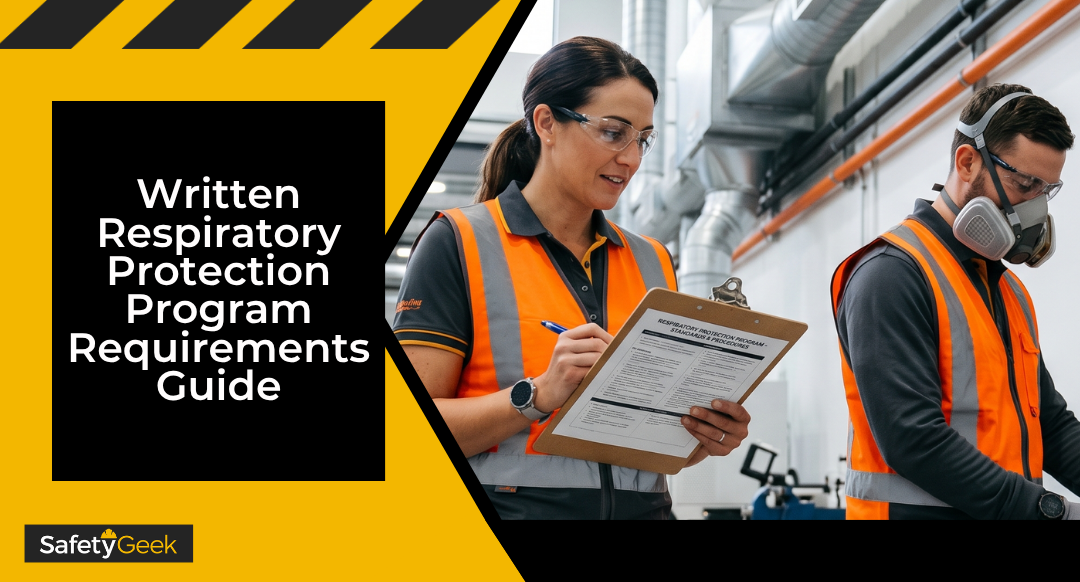
TL;DR: Written respiratory protection program requirements come from OSHA 29 CFR 1910.134(c)(1). Any employer who requires respirators – or whose hazard assessment shows they’re needed – must create a written, worksite-specific program run by a qualified program administrator. It has to cover nine areas: respirator selection, medical evaluations, fit testing, use, maintenance and storage, breathing air quality, training, program evaluation, and recordkeeping. Respiratory Protection was the fourth most-cited OSHA standard in fiscal year 2024, so a missing or generic program is a fast track to a citation.Written respiratory protection program requirements are set by OSHA 29 CFR 1910.134(c)(1), and they apply the moment respirators become necessary at your worksite. If your hazard assessment shows respirators are needed to protect employee health, or you require them for any reason, you need a written program with worksite-specific procedures and a qualified administrator. There’s no “we’ll wing it” option here. And here’s the thing that trips up so many safety professionals… a binder you downloaded off the internet with your company name pasted on the cover is not a program. I’ve reviewed dozens of these over the years, and the gap between “we have a document” and “we have a program OSHA will accept” is exactly where the citations live.
Key Takeaways
- A written program is mandatory whenever respirators are required by you or by a hazard assessment – it is not optional or “best practice.”
- The program must be worksite-specific, not a generic template with your logo on it.
- Nine elements are required under 1910.134(c)(1), from respirator selection through recordkeeping.
- A qualified program administrator must run and evaluate the program.
- Voluntary respirator use still triggers written requirements under 1910.134(c)(2).
- Respiratory Protection ranked fourth on OSHA’s most-cited list for fiscal year 2024 – this standard is heavily enforced.
What a Written Respiratory Protection Program Actually Is
A written respiratory protection program is a documented, worksite-specific set of procedures that controls how respirators are selected, used, and maintained so they actually protect your people. It is the operational blueprint OSHA expects whenever respirator use is required. The key word is worksite-specific – it has to reflect your hazards, your contaminants, your tasks, and your workforce. OSHA’s respiratory protection standard exists because respirators are the last line of defense, not the first. When engineering and administrative controls can’t get airborne exposure low enough, the respirator is what stands between a worker and occupational lung disease. That’s a heavy job for a piece of equipment, which is why the standard wraps so many systems around it – medical clearance, fit, training, and maintenance all have to work together. The program has to be administered by a qualified person. OSHA doesn’t hand you a certification path for this; the administrator just has to have the training or experience to run and evaluate the program competently. In practice that’s usually you, the safety lead, and your name being on it means the quality of the document is on you too. This is exactly the kind of system the Safety Management Cycle is built for – you Identify the hazard, Develop the written procedures, Implement and Train, Coach and Observe usage, then Analyze whether it’s working. A respiratory program isn’t a one-time document. It’s a loop.When OSHA 1910.134 Triggers a Written Program
The written program requirement kicks in two ways. First, any time you as the employer require employees to wear respirators. Second, any time respirators are necessary to protect employee health – meaning your hazard assessment shows exposures that engineering and administrative controls can’t bring under the permissible limit. That second trigger is the one people miss. You don’t get to skip the program just because OSHA didn’t explicitly name your chemical. If your own exposure data says a respirator is needed, the obligation is on you to build the written program around it. The program also has to stay current. Process changes, new materials, different ventilation, or a switch to a new respirator model all mean the document needs an update. A program written in 2019 that nobody has touched since is a finding waiting to happen. Voluntary use has its own rule under 1910.134(c)(2). If employees choose to wear tight-fitting respirators when they aren’t required, you still need written elements ensuring the respirator itself doesn’t create a hazard – medical ability to wear it, plus cleaning and storage. Filtering facepiece dust masks worn voluntarily are the one carve-out, but you still owe those employees the information in Appendix D of the standard.The 9 Required Elements of a Written Respiratory Protection Program
Paragraph 1910.134(c)(1) doesn’t just say “have a written program.” It spells out nine procedure areas, codified in subparagraphs (i) through (ix), that the program has to cover to the extent they apply to your workplace. Skipping one because it felt irrelevant is how generic templates fail an inspection. Here’s what each element has to address, in plain language:| Element | What Your Program Must Cover |
|---|---|
| 1. Respirator selection | How NIOSH-certified respirators are chosen based on the hazard, exposure level, and assigned protection factor |
| 2. Medical evaluations | How employees are medically cleared before fit testing or use, and when they’re re-evaluated |
| 3. Fit testing | Procedures for qualitative or quantitative fit testing of tight-fitting respirators, before use and annually |
| 4. Use procedures | Routine and emergency use, including IDLH entry and rescue requirements |
| 5. Maintenance and storage | Cleaning, disinfecting, inspection, repair, and proper storage of respirators |
| 6. Breathing air quality | For atmosphere-supplying respirators: Grade D air and adequate quantity |
| 7. Training | Training on respiratory hazards and correct respirator use, before use and annually |
| 8. Program evaluation | How you check the program is working and being followed in the field |
| 9. Recordkeeping | Records of medical evaluations, fit tests, and the program itself |
THE ALL-ACCESS PASS RESOURCE PAGE
Get all the FREE templates, safety management resources, PDFs, spreadsheets, and more...
Why “Worksite-Specific” Is the Part That Gets You Cited
Here’s where I see the most failures. Someone grabs a model program – the Army’s, SMACNA’s, a vendor’s – swaps in the company name, and files it. On paper every element is “covered.” In reality it describes hazards the company doesn’t have and skips the ones it does. OSHA’s own Small Entity Compliance Guide is blunt about this. The model programs are starting structures, not finished programs. You’re expected to tailor every element to your operations, your contaminants, and your workforce. A template tells you a section should exist. It can’t tell an inspector that your welders use half-mask APRs against manganese fume while your tank cleaners use supplied air for IDLH entry. Only a worksite-specific program does that, and that specificity is exactly what a compliance officer is checking against what they see on the floor. This is the CYA documentation trap in action. A program written to cover yourself reads generic and protects no one. A program written for purpose – to actually guide selection, fit, and use – reads specific and happens to also satisfy OSHA. Build it for the work, not for the file cabinet. If you want the full breakdown of turning requirements into an actual usable document, we walk through how to build a respiratory protection plan for 1910.134 step by step.What Non-Compliance Actually Costs
Respiratory Protection isn’t a sleepy standard. It ranked fourth on OSHA’s Top 10 most-cited standards for fiscal year 2024, with roughly 2,470 violations. Inspectors look for this, and the written program is one of the first things they ask to see. The penalty math is not small. Under OSHA’s current penalty structure, a serious or other-than-serious violation runs up to $16,550, and willful or repeated violations reach up to $165,514. A missing program element across multiple employees adds up fast. The bigger cost is the one that doesn’t show up on the citation. The reason this standard exists is occupational lung disease, and that damage is permanent. The encouraging news from the Bureau of Labor Statistics injury and illness data is that reported respiratory illness cases dropped sharply in 2024 – from about 100,200 to 54,000 – alongside more attention to respiratory protection. Programs that actually work move that number. Common respiratory protection program violations follow predictable patterns, and most are preventable with a real program. We catalog the common respiratory protection program violations so you can pressure-test your own document before an inspector does.How to Build a Program That Holds Up
Start with the hazard assessment, always. Your written program is only as good as the exposure data underneath it. If you don’t know what your people are breathing and at what concentration, you can’t select the right respirator or defend the program. Then build each of the nine elements around what people actually do. Walk the floor. Watch the welder, the painter, the tank cleaner. Write procedures that match reality, then use NIOSH respirator selection guidance to confirm the device matches the hazard. Don’t write it alone in your office, either. The program sticks when supervisors and employees help shape the use procedures, because people follow systems they helped build. Training alone doesn’t change behavior – you train, coach, observe, and reinforce, or the respirator stays in the locker. Finally, treat program evaluation as a real step, not a checkbox. Get into the field and watch whether the program is actually being followed, then update the document when conditions change. A program that never gets evaluated isn’t a program – it’s a CYA artifact with a dust layer.Frequently Asked Questions About Written Respiratory Protection Program Requirements
Is a written respiratory protection program legally required?
Yes. OSHA 29 CFR 1910.134(c)(1) requires a written, worksite-specific program whenever respirators are required by the employer or are necessary to protect employee health based on a hazard assessment. It is a mandate, not a recommendation, and it must be administered by a qualified program administrator.What are the required elements of the program?
The program must cover nine areas under 1910.134(c)(1): respirator selection, medical evaluations, fit testing, use procedures, maintenance and storage, breathing air quality for supplied-air respirators, training, program evaluation, and recordkeeping. Each element has to be tailored to your specific workplace, hazards, and respirator types.Do I need a written program for voluntary respirator use?
Usually yes. Under 1910.134(c)(2), voluntary use of tight-fitting respirators still requires written elements ensuring the respirator doesn’t create a hazard, including medical ability and proper cleaning and storage. Voluntary filtering facepiece dust masks are exempt from the written program, but you still must provide Appendix D information.Can I use a template for my respiratory protection program?
A template is a starting structure, not a finished program. OSHA expects the program to be worksite-specific, reflecting your actual contaminants, tasks, and workforce. A generic template with your company name added is one of the most common reasons programs fail an inspection. A respiratory protection program template helps you organize, but you still have to customize every element.Who can be the respiratory protection program administrator?
OSHA requires a suitably trained or experienced program administrator, but does not mandate a specific certification. The person must be qualified to administer and evaluate the program competently. In most organizations this is the safety manager, and the quality of the program reflects directly on them.How often does the program need to be updated?
The program must be kept current and updated whenever workplace conditions change respirator use – new processes, new materials, altered ventilation, or different respirator models. There’s no fixed calendar requirement, but program evaluation should happen regularly enough to catch changes before an inspector or an exposure does.Now It’s Your Turn
The written respiratory protection program requirements come down to one idea: a real, worksite-specific program built around your actual hazards and run as a living system – not a template gathering dust. Get the hazard data right, build all nine elements around what people actually do, and evaluate it like it matters. Here’s what to do this week:- Pull your current program and check it against the nine elements in 1910.134(c)(1). Flag any that are generic or missing.
- Verify the hazard assessment underneath it. No exposure data means no defensible program.
- Walk the floor and compare what’s written to what’s actually happening with respirators.
- Name your program administrator and make sure they’re genuinely qualified to run it.
- Schedule a real program evaluation – not a desk review, a field check.
Hi, I'm Brye (rhymes with sky)! I am a self-proclaimed safety geek with two decades of general industry safety experience. Specializing in bringing safety programs to a world-class level and building a safety culture, I have trained and coached many safety managers, just like you, on how to effectively manage workplace safety in the real world. I would love to help you too.