Estimated Reading Time: 17 minutes
The mature programs use both. Qualitative for the daily flow. Quantitative for the big swings.
If you want a deeper walk-through with examples, the qualitative vs. quantitative risk assessment guide covers when to switch from one to the other and how to defend the choice.
You do not need to pick one for the entire program. Mature programs use JHA as the daily workhorse and pull HAZOP, FMEA, or Bowtie out for higher-stakes assessments where the simple methods are not enough.
TL;DR: Risk assessment tools and methodologies give safety professionals a structured way to identify hazards, score them by severity and likelihood, and decide where to put time, money, and attention. The right approach combines a foundational method (qualitative or quantitative), a scoring tool (the risk matrix), a step-by-step process, supporting software or templates, and a clear way to communicate results to leadership and employees. This guide walks through the full landscape so you can build a defensible, repeatable risk assessment program inside your Safety Management Cycle.The fastest way to lose credibility as a safety leader is to walk into a leadership meeting with a hazard list and no way to rank it. Risk assessment tools and methodologies fix that. They turn “I think this is a problem” into “here is the data, here is the score, here is what we do next.” If you have ever been told your safety program is “just paperwork” or watched leadership ignore a hazard you flagged six months ago, this is usually the missing piece. Risk assessment is the bridge between the work you already do and the business decisions you want leadership to make.
Table of Contents
- What Is Risk Assessment in Workplace Safety?
- Why Risk Assessment Matters More Than Compliance
- Qualitative vs. Quantitative Risk Assessment
- The Risk Matrix: Scoring and Prioritizing Hazards
- The Risk Assessment Process Step by Step
- Common Risk Assessment Methodologies (HAZOP, FMEA, JHA, Bowtie)
- Risk Assessment Software and Templates
- Communicating Risk to Leadership and Teams
- Integrating Risk Assessment Into the Safety Management Cycle
- Common Mistakes That Sink Risk Assessment Programs
- Frequently Asked Questions
Key Takeaways
- A complete risk assessment program needs five things: a method, a scoring tool, a process, supporting software, and a communication plan.
- Qualitative methods are faster and use descriptive ratings. Quantitative methods use real numbers and are better for high-consequence work.
- The risk matrix is the workhorse tool that turns severity and likelihood into a priority score everyone on the team can read.
- Methodologies like HAZOP, FMEA, JHA, and Bowtie each solve a different problem. The skill is knowing which one to pull out and when.
- Risk assessment is not a one-time event. It is a recurring loop that lives inside the Identify and Analyze stages of the Safety Management Cycle.
- The way you communicate the result to leadership is what determines whether anything gets fixed.
What Is Risk Assessment in Workplace Safety?
A risk assessment is a structured process for identifying workplace hazards, analyzing how serious and how likely they are, and deciding what to do about them. The output is a prioritized list of actions, not a binder that sits on a shelf. Most safety professionals have done a risk assessment without calling it that. Walking a production line and noting what could hurt someone is a risk assessment. Reviewing an injury and asking what changed is a risk assessment. The difference between an informal one and a real one is whether the result can be defended with data and acted on with priorities. A complete risk assessment answers four questions in order. What can go wrong here, and how bad would it be if it did. How likely is it to happen, and what are we going to do about it. The answers feed every other safety decision you make. Training topics, inspection focus, capital budget requests, and corrective action priorities all start with risk. When risk assessment is missing or weak, every decision downstream becomes opinion-based. When it is strong, every decision has a why behind it. This is also the place where the safety profession lives by the standards. ANSI/ASSP Z690 (the U.S. adoption of ISO 31000) and ISO 45001 both make documented risk assessment a core requirement of any safety management system. Your assessment becomes the evidence that your decisions were rational, not reactive.Why Risk Assessment Matters More Than Compliance
Regulations are a C grade. They take years to pass, get watered down by lobbying, and by the time they are law they are barely the minimum. A risk assessment program is how you climb past the C and get to the A. Here is the business case in numbers. The Bureau of Labor Statistics reported 5,070 fatal work injuries in 2024 and 2.5 million nonfatal injury and illness cases in private industry. Workers age 65 and older die on the job at 2.5 times the rate of younger workers. Every one of those numbers is a risk that was either not assessed, not scored honestly, or not acted on. Compliance asks “is this allowed.” Risk assessment asks “is this acceptable.” Those are different questions and they get different answers. A guard rail might meet OSHA’s six-foot trigger and still leave you with unacceptable risk for the people working under it. The standard is the floor. Risk tells you the ceiling. When you bring a prioritized risk list to a leadership meeting, the conversation changes. Instead of “safety wants more money,” it becomes “here are the top five risks ranked by potential cost, here is what each one would cost to control, here is the ROI.” Leadership can argue with opinions. They cannot argue with a defensible score. This is also how the safety role moves from cost center to profit center. Every dollar saved in workers’ comp, lost time, insurance premiums, legal fees, and turnover starts as a risk you scored and controlled before it became an incident.Qualitative vs. Quantitative Risk Assessment
Every risk assessment falls into one of two camps. Qualitative methods use descriptive ratings like Low, Medium, and High. Quantitative methods use real numbers, probabilities, dollar values, and statistical models. Both are valid. Picking the wrong one for the job is where teams waste months. Qualitative is the right call for most general industry work. It is fast, it does not require a statistician, and the output is something a frontline supervisor can read and act on. A team of three people can score 20 hazards in an afternoon and walk out with a real plan. Quantitative is the right call when the consequences are catastrophic and the cost of being wrong is high. Process safety, chemical handling, structural engineering, and major capital decisions all benefit from numbers instead of adjectives. The trade-off is time, expertise, and data quality. A bad quantitative model is worse than an honest qualitative one.| Factor | Qualitative | Quantitative |
|---|---|---|
| Output type | Descriptive (Low / Med / High) | Numeric (probabilities, dollars, frequency) |
| Time required | Hours to days | Days to weeks |
| Expertise needed | Trained safety team | Specialists, often engineers |
| Best for | Daily operations, JHAs, inspections | Process safety, capital decisions, catastrophic risk |
| Defensibility | Strong with documented criteria | Strongest, when data is good |
| Common pitfall | Subjective ratings without anchors | Garbage in, garbage out |
The Risk Matrix: Scoring and Prioritizing Hazards
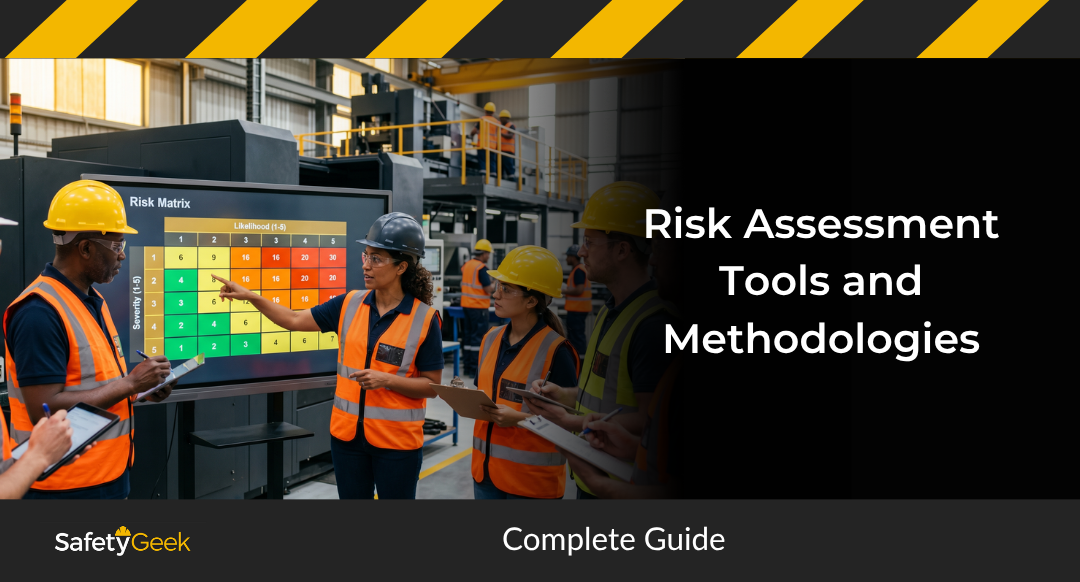
The risk matrix is a grid that scores a hazard based on two things. How severe the outcome would be if it happened, and how likely it is to happen. Multiply the two and you get a priority score. Most teams use a 5×5 matrix because it gives enough resolution without overwhelming people. A 3×3 is fine for low-complexity environments. A 4×4 is the awkward middle that I rarely recommend. High-hazard industries like oil and gas almost always use 5×5 because the consequence range is wide. The trick is the anchors. A risk matrix is only as honest as the definitions behind each score. “Severity 5” needs to mean something specific, like “fatality or permanent disability.” “Likelihood 1” needs to mean something specific, like “less than once in 10 years across the industry.” Without anchors, the matrix becomes a popularity contest. Once the matrix is built, the color zones do the heavy lifting. Green means accept and monitor. Yellow means action plan within a defined window. Red means stop work or implement controls immediately. Leadership can see the heat map and instantly understand what is urgent without reading a single sentence of analysis. The matrix also forces an honest conversation. Two people staring at the same hazard and disagreeing on severity is a sign your team needs to talk about what severity actually means in your operation. That conversation is where culture is built. The full breakdown lives in the risk matrix explained for safety walk-through, including how to set anchors and avoid the most common scoring traps.The Risk Assessment Process Step by Step
Every effective risk assessment follows the same shape. The names change between standards, but the bones are identical. Here is the version that works in general industry without needing a process safety background.- Define the scope. Pick the task, the area, the equipment, or the process you are assessing. Vague scope kills assessments before they start.
- Assemble the team. Pull in the people who actually do the work. A risk assessment without frontline input is fiction. Add a supervisor, an engineer if relevant, and the safety lead.
- Identify the hazards. Walk it. Watch it. Talk through every step. List everything that could cause harm, even the ones that feel obvious.
- Analyze the risk. Score each hazard for severity and likelihood using your matrix. Document the reasoning, not just the score.
- Evaluate and prioritize. Sort by score. Use the color zones to flag what needs immediate action versus what can be scheduled.
- Control the risk. Apply the hierarchy of controls. Eliminate first, then substitute, then engineering, administrative, and PPE last. Document the chosen controls.
- Review and reassess. Schedule a re-look. Anytime a control is added, equipment changes, or an incident happens, the assessment gets revisited.
Common Risk Assessment Methodologies (HAZOP, FMEA, JHA, Bowtie)
The risk matrix is the scoring tool. The methodology is how you generate the hazards in the first place. There are dozens of named methods. These four cover almost everything a safety professional in general industry will need. Job Hazard Analysis (JHA). A task-by-task breakdown of a job, listing each step, the hazards in that step, and the controls. JHAs are the foundation tool because everything else is built from them. Observation forms, training topics, SOPs, and coaching sessions all trace back to a JHA. If your JHA library is weak, the rest of your program is built on sand. The deeper walkthrough lives in the job hazard analysis guide. HAZOP (Hazard and Operability Study). A team-based method for process industries. The team walks each part of a process and asks “what if” questions using guide words like “more,” “less,” “no,” and “reverse.” HAZOP is the gold standard for chemical and continuous-process plants. It is overkill for a warehouse and underkill for nothing. FMEA (Failure Mode and Effects Analysis). A structured look at how each component of a system can fail and what happens if it does. FMEA shines for equipment reliability and machine safety. If you are doing a machine guarding risk assessment, FMEA is often the right backbone. Bowtie Analysis. A visual method that puts the hazard in the middle, causes on the left, consequences on the right, and barriers (preventive and mitigating) between them. Bowtie is the easiest method to communicate to leadership because the picture tells the story. It is becoming the standard for major-hazard industries because everyone in the room can read it without a degree.| Method | Best For | Format | Communication Strength |
|---|---|---|---|
| JHA | Task-level hazards in any industry | Step / Hazard / Control table | Strong with frontline workers |
| HAZOP | Process industries (chemical, oil, gas) | Team workshop with guide words | Moderate with non-engineers |
| FMEA | Equipment, machinery, system reliability | Failure mode rating table | Strong with engineering |
| Bowtie | Major-hazard scenarios across any industry | Visual diagram with barriers | Strongest with leadership |
THE ALL-ACCESS PASS RESOURCE PAGE
Get all the FREE templates, safety management resources, PDFs, spreadsheets, and more...
Risk Assessment Software and Templates
The tools you use to capture and store assessments matter almost as much as the methodology. A perfect assessment that lives in a single Word document on someone’s desktop is a perfect assessment nobody will find next year. For small to mid-size programs, a well-built spreadsheet is often plenty. Columns for hazard, severity, likelihood, score, control, owner, and review date. Conditional formatting to color-code the risk level. A pivot table to see your top risks at a glance. The All Access Resources library has spreadsheet templates set up exactly this way so you do not have to build from scratch. For larger programs or multi-site operations, dedicated EHS software starts to earn its keep. The benefits are real time aggregation across locations, mobile capture in the field, automated review reminders, and a single source of truth for audits and inspections. The trap is buying a platform with twice the features you need and watching adoption die in the first six months. When you evaluate software, look for four things. Mobile-first capture, because the field is where assessments actually happen. Dashboard reporting that leadership can read in 30 seconds. Integration with your incident system so risk and incident data live together. And a permission model that lets supervisors capture without giving the keys to the kingdom. Templates and software are tools, not the program. A team that uses spreadsheets with discipline will outperform a team that bought a $50K platform and uses 10% of it. The full breakdown of templates and software options is in the risk assessment software and templates guide.Communicating Risk to Leadership and Teams
A risk assessment that does not get communicated is a risk assessment that does not exist. The audience changes everything about how you present the same data. Same risk, three different conversations. For executives, lead with dollars and risk to the business. The top three risks ranked by potential cost. The cost to control each one. The net impact on workers’ comp, downtime, and insurance. Five slides max. They do not need the methodology, they need the decision. For middle managers, lead with operational impact. Which risks affect their area, which are owned by them, what the deadline looks like, and what support they will get. The conversation is about ownership, not analysis. Hand them the action items and the timeline. For frontline employees, lead with what changes for them. Which hazards were identified in their work, what new controls are coming, when training is happening, and who they tell if they spot something new. Skip the matrix. Show them the controls and the reporting path. The mistake most safety professionals make is using the same deck for all three audiences. The executive deck bores frontline workers. The frontline conversation insults executives. Build three versions of every risk story and you will see action accelerate in all three groups. The full playbook on tailoring messages, building the deck, and handling pushback is in the communicating risk effectively in the workplace guide. This is also where the Safety Influencer System earns its keep. Risk assessment communication is where Hidden Triggers and Strategic Engagement land in the real world. The data is the credibility. The tailoring is the influence.Integrating Risk Assessment Into the Safety Management Cycle
Risk assessment is not a standalone project. It is a thread that runs through the Safety Management Cycle, the recurring 5-stage system that runs your program. The five stages are Identify, Develop, Implement and Train, Coach and Observe, and Analyze. Risk assessment lives in two of those stages and influences the other three. It belongs to Identify at the top of the cycle, because every risk assessment starts with naming the hazard. It belongs to Analyze at the end, because the assessment is what gets reviewed when injury data, observation data, and audit data come back in. What changes between cycles is what you learn from the data. A risk you scored as Medium last year that produced three near-misses is not Medium anymore. The Analyze stage feeds the next Identify cycle, and the assessment evolves with the program. This is also why the cycle beats Plan-Do-Check-Act for safety. PDCA treats risk as a one-time input. The Safety Management Cycle treats risk as a moving picture. Every loop sharpens the next one. Every assessment gets more honest as the data piles up. When risk assessment is integrated this way, your program stops feeling like a list of unrelated projects. Inspections feed assessments. Assessments feed training topics. Training feeds observations. Observations feed assessments again. The whole thing becomes a system instead of a stack of binders. This is exactly what we build inside the Academy, and it is the single biggest difference between programs that drift and programs that compound.Common Mistakes That Sink Risk Assessment Programs
Most failed risk assessment programs fail for the same handful of reasons. None of them are about the methodology. All of them are about how it is run. Doing the assessment alone. A safety manager scoring risks in a conference room without the people who do the work is producing fiction. The hazards you cannot see from the office are the ones that hurt people. Always pull the team that does the job into the assessment. Treating it as a one-time event. A risk assessment with no review schedule is dead the day it is signed. Build a recurring review into your calendar, tied to the Analyze stage of the Safety Management Cycle. Quarterly is good for high-risk operations. Annual is the floor. Using the matrix without anchors. When “Severity 4” does not have a written definition, every scorer invents their own. Two assessments of the same hazard come back with three different scores. Anchors fix this in 30 minutes of upfront work. Skipping the hierarchy of controls. A risk assessment that lands on PPE for every hazard is a risk assessment that did not really try. Eliminate first, then substitute, then engineering, then administrative. PPE is the last line of defense. The hierarchy of controls case studies post breaks down what good looks like at each level. Communicating in the wrong language. A 40-page risk assessment report sent to executives gets skimmed and filed. A 3-slide summary with dollar figures gets acted on. The same assessment can succeed or fail based on the deck you build around it. When multiple supervisors push back on the same assessment, that is a system signal, not a people problem. The assessment is making it hard to follow, the controls are not realistic, or the priorities do not match what they see on the floor. Reopen the assessment and find out what the system is telling you.Frequently Asked Questions About Risk Assessment Tools and Methodologies
What is the difference between a risk assessment and a hazard assessment?
A hazard assessment identifies what could cause harm. A risk assessment goes one step further and analyzes how serious and how likely that harm is, then prioritizes action. Hazard assessment is the input. Risk assessment is the decision-making layer that tells you which hazards to control first and which can wait.How often should a workplace risk assessment be reviewed?
At minimum once per year, plus anytime a process changes, a new piece of equipment is added, a control is implemented, or an incident occurs. High-hazard operations like chemical processing or heavy equipment work usually review quarterly. The schedule should be written into your Safety Management Cycle so it never relies on memory.Do small businesses need formal risk assessments?
Yes. The format can be simpler, but the discipline cannot. A two-person crew using a one-page risk assessment template is following the same logic as a multinational using EHS software. OSHA, ANSI/ASSP Z690, and ISO 45001 expect documented risk evaluation regardless of company size. Skipping it because you are small is the fastest way to find yourself reactive after an incident.What is the best risk assessment methodology for general industry?
Job Hazard Analysis is the right starting point for almost every general industry operation. It is task-based, easy to teach, and produces output that drives training, observation, and SOPs. Add FMEA for machinery, HAZOP for any chemical processes, and Bowtie for the highest-consequence scenarios. JHA is the daily workhorse, the others are pulled out when the stakes go up.Who should be involved in a workplace risk assessment?
The people who do the work, a supervisor from that area, the safety lead, and an engineer or specialist if the process is technical. Risk assessments done without frontline input are missing the most important data source you have. The team approach is also what builds buy-in for the controls that come out of the assessment.What software is best for risk assessment?
The best software is the one your team will actually use. For small to mid-size programs, a well-built spreadsheet often beats a half-adopted platform. For multi-site operations, dedicated EHS platforms with mobile capture, dashboard reporting, and incident integration earn their cost. Adoption beats features every time.How do I present risk assessment results to leadership?
Lead with the top three to five risks ranked by potential business impact. Show the cost of control next to the cost of inaction. Use the risk matrix as a heat map, not a wall of numbers. Keep the deck under five slides and finish with a clear ask. Save the methodology details for the appendix in case anyone asks.What is the relationship between risk assessment and the hierarchy of controls?
The risk assessment tells you which hazards to act on. The hierarchy of controls tells you how. Once a risk is scored and prioritized, you walk down the hierarchy starting with elimination, then substitution, engineering controls, administrative controls, and PPE last. A complete risk assessment always names the chosen control level and why it was selected over the higher-tier options.Now It’s Your Turn
Risk assessment tools and methodologies are not the hard part of safety leadership. The hard part is building the discipline to run them, refresh them, and communicate them in a way that makes leadership act. The five elements are simple. The execution is where careers are made. Here are the steps you can take this week:- Pick one process or area in your operation and run a JHA on it. Use the people who actually do the work.
- Build or pull a 5×5 risk matrix and write anchor definitions for each severity and likelihood level.
- Score the hazards from your JHA on the matrix and rank them.
- Pick the top three and walk them down the hierarchy of controls. Document why you chose the level you chose.
- Build a 3-slide summary of the result and put it on the next leadership meeting agenda.
Hi, I'm Brye (rhymes with sky)! I am a self-proclaimed safety geek with two decades of general industry safety experience. Specializing in bringing safety programs to a world-class level and building a safety culture, I have trained and coached many safety managers, just like you, on how to effectively manage workplace safety in the real world. I would love to help you too.