Estimated Reading Time: 7 minutes
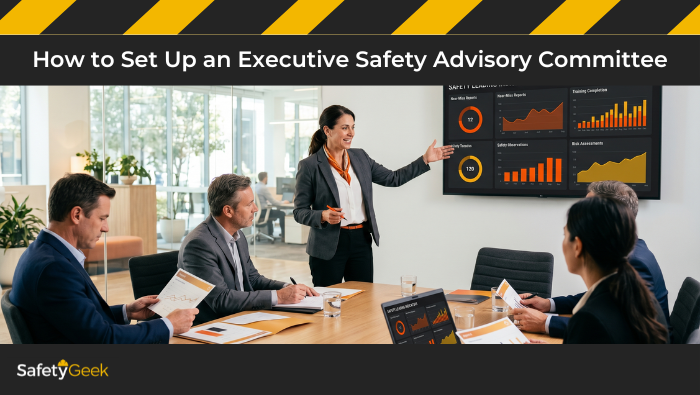
An executive safety advisory committee is a small group of senior leaders who meet on a set schedule to govern safety strategy, review leading indicators, and decide where resources go. To set one up: write a clear charter, invite the CEO plus your operations, finance, HR, and EHS leaders, meet monthly or quarterly, and run a data-driven agenda built around prevention, not just last month’s injuries.
Here’s how to set up an executive advisory committee for workplace safety. You build a small governance group of senior leaders, give it a written charter, and run it on a predictable schedule with an agenda built around leading indicators. That’s the short version, and this committee becomes the formal room where safety strategy gets decided and funded.
Most safety professionals never get that room. You’re stuck fighting management every step of the way, sitting in meetings where safety is “a priority until it comes to money.” An executive safety committee changes that, because it gives leadership a structured reason to own safety instead of leaving it as your cross to bear.
Key Takeaways
- An executive safety advisory committee is a senior-leadership governance group, not another employee safety committee.
- It works because culture is created from the top. When leaders own safety in a formal room, it shifts downward.
- The right members are the CEO or COO, plus your EHS, operations, finance, and HR leaders.
- Meet monthly or quarterly on a calendar set 12 months out, so safety becomes a standing business priority.
- Build the agenda around leading indicators, not just injury counts.
- A written charter defines the purpose, the authority, and how decisions get tracked.
- This committee is Strategic Engagement from the Safety Influencer System, applied at the executive level.
What Is an Executive Safety Advisory Committee?
An executive safety advisory committee is a small group of senior leaders who meet on a set schedule to govern safety strategy, review performance, and decide where resources go. It sits above your day-to-day safety committee and your site-level teams. Think of it as the boardroom for safety.
This is not the committee where you debate whether to buy new gloves. It’s the room where leadership sets the direction, approves the budget, and holds the organization accountable for safety the same way it does for sales or quality.
I’ve watched safety programs stay stuck for years because there was no room like this. The safety manager carried everything alone, and every win depended on cornering a busy executive in a hallway. A formal committee ends that, because it gives safety a standing place at the table instead of a favor you have to beg for.
How It Differs From an Employee Safety Committee
Your employee safety committee spots hazards, runs inspections, and gathers frontline input. That work matters, and it’s where getting the right people on a safety committee pays off. But it isn’t governance.
An executive committee operates one level up. It doesn’t find the hazard. It decides whether the company will fund the fix, change the policy, and measure whether prevention is actually working.
| Executive Safety Committee | Employee Safety Committee |
|---|---|
| Senior leaders and the CEO | Frontline workers and supervisors |
| Governs strategy and budget | Spots hazards and gathers input |
| Reviews leading indicators and trends | Reviews inspections and near misses |
| Meets monthly or quarterly | Meets monthly or more often |
| Owns accountability and resources | Owns awareness and participation |
Both matter. The executive committee is what gives the employee committee the backing to actually change things. This is the structure that standards like the ANSI/ASSP Z10 standard call management review, and it’s where real authority lives.
Who to Invite to Your Executive Safety Committee
The members you choose decide whether this committee has teeth or becomes another meeting nobody respects. You want the people who control direction, money, and operations in the room. Keep it small, usually six to eight people.
Here’s who belongs on an executive safety advisory committee:
- Chair: The CEO or COO. Their presence signals that safety is owned at the top.
- Top safety leader: Your VP of EHS or Chief Safety Officer, who frames the data and the strategy.
- Finance leader: The CFO or a finance director, because resource and investment decisions happen here.
- Operations leaders: The VPs who run the work where the risk actually lives.
- HR leader: For training, culture, and accountability.
- Risk or legal: For claims, compliance, and liability trends.
Why the CEO Has to Be in the Room
Culture is created from the top. It flows downward through hiring and through the line of power, which is why a safety committee without a senior leader rarely changes anything.
When the CEO sits in the room, asks questions, and reviews the metrics, every other leader treats safety as real. NIOSH’s leadership work in Total Worker Health ties this visible leadership directly to a stronger safety climate. And OSHA’s Recommended Practices for Safety and Health Programs names management leadership as a core element of any program that works.
This is the part that’s hard to hear. If you can’t get a senior leader to show up, you don’t have a governance problem… you have a buy-in problem. That’s worth solving first, and it usually starts with showing leadership what real management commitment to safety looks like.
THE ALL-ACCESS PASS RESOURCE PAGE
Get all the FREE templates, safety management resources, PDFs, spreadsheets, and more...
How Often to Meet and What Goes on the Agenda
Meet quarterly at a minimum. For high-risk or fast-moving operations, go monthly, with one deeper review each year. Set the full 12-month calendar in advance so safety becomes a standing commitment, not a meeting that gets bumped the first time things get busy.
The agenda is where most committees fall apart. They spend the whole meeting reviewing last month’s injuries and never look forward. Your job is to keep the room focused on prevention and decisions, which is the same discipline behind running the types of safety meetings worth running.
A Sample Executive Safety Committee Agenda
| Agenda Item | Time | Purpose |
|---|---|---|
| Leadership message | 5 min | Chair reinforces safety as a core value |
| Serious incident review | 10 min | Review high-potential events and corrective actions |
| Dashboard review | 15 min | Leading and lagging indicators against targets |
| Risk deep dive | 15 min | One high-risk area examined in depth |
| Resource and policy decisions | 10 min | Approve staffing, budget, and policy changes |
| Open actions and owners | 5 min | Assign decisions, owners, and deadlines |
Notice how little time goes to past injuries. One block, and then the room moves to what’s coming and what to do about it. End every meeting by recording decisions, owners, and deadlines, then open the next one by reviewing whether those actions closed.
The Metrics That Earn Safety a Seat at the Table
What gets measured gets managed. If your committee only tracks injury counts, you’ll always be reacting to bad news. Leading indicators let you manage safety before someone gets hurt, and they’re what make executives lean in.
The standards back this up. Both ISO 45001’s leadership clause and ANSI Z10 require leaders to review the performance of the safety system, not just the injury numbers at the end of it.
Leading vs. Lagging Indicators
A lagging indicator measures harm that already happened. A leading indicator measures the activity that prevents harm. Your executive dashboard needs both, weighted toward the leading side.
| Leading Indicators (proactive) | Lagging Indicators (reactive) |
|---|---|
| Executive safety walks completed | Recordable injury rate (TRIR) |
| Critical controls verified effective | Lost-time injuries |
| Near-miss and hazard reports per 100 employees | Workers’ comp claim cost |
| Corrective actions closed on time | Days away, restricted, transferred (DART) |
| Safety training completed on schedule | Regulatory citations |
When you walk into that room with leading indicators, you stop being the person who reports body counts. You become the leader showing how the organization is getting ahead of risk. That’s also how you make the business case for safety in language the C-suite respects.
Tracking the right metrics is one of the three pillars of the Safety Influencer System. Operational Expertise gets you the data, and Strategic Engagement gets it in front of the people who can act on it.
Frequently Asked Questions About Executive Safety Committees
What is an executive safety advisory committee?
It’s a small group of senior leaders who govern safety strategy, review performance, and decide where resources go. It sits above your employee safety committee and focuses on direction, budget, and accountability rather than spotting individual hazards. Think of it as the boardroom for your safety program.
Who should chair the executive safety committee?
The CEO or COO should chair it. Their presence signals that safety is owned at the top, and it gives every decision real weight. When the most senior leader runs the room, the rest of the organization treats safety as a genuine business priority instead of a side project.
How often should an executive safety committee meet?
Quarterly at a minimum, and monthly for high-risk operations. Set the full year of meetings on the calendar in advance so they don’t get bumped. Consistency is what turns the committee into a standing business priority rather than a meeting that only happens when something goes wrong.
What’s the difference between an executive and an employee safety committee?
An employee safety committee spots hazards, runs inspections, and gathers frontline input. An executive committee operates one level up, governing strategy, approving budgets, and holding leadership accountable. The employee committee finds the problem, and the executive committee decides whether the company will fund the fix.
How do I get leadership to agree to a safety committee?
Start small by asking for one short quarterly review instead of a standing monthly commitment, then let the value sell the rest. Bring leading indicators and a clear business case to that first meeting. Once leaders see safety framed in resources and risk, expanding the cadence becomes an easy yes.
Now It’s Your Turn
An executive safety advisory committee is how you stop carrying safety alone and start sharing the weight with the people who control direction and money. It’s the room where safety finally earns its seat at the table.
Here’s where to start this week:
- Write a one-page charter naming the committee’s purpose, members, and meeting cadence.
- List the six to eight leaders who need to be in the room, starting with your CEO or COO.
- Pick five leading indicators you can put on a simple dashboard.
- Ask for one 45-minute quarterly meeting to start, not a standing monthly commitment.
- Draft the first agenda using the sample above.
If you want the full system for turning everyday safety work into executive influence, that’s exactly what we teach inside the Safety Management Influencer System guide. It walks you through layering influence into your Safety Management Cycle so every task you already do builds your credibility with leadership.
You don’t need a title or authority to start building this room. You just need a plan and the confidence to ask. You got this.
Hi, I'm Brye (rhymes with sky)! I am a self-proclaimed safety geek with two decades of general industry safety experience. Specializing in bringing safety programs to a world-class level and building a safety culture, I have trained and coached many safety managers, just like you, on how to effectively manage workplace safety in the real world. I would love to help you too.